
AI Agents & Automation
Browsing page 108 of AI Frameworks & Infra in AI Agents & Automation. Sorted by confidence score — our independent quality rating.

ControlLLM
ControlLLM is a framework designed to augment large language models (LLMs) with multi-modal tool utilization capabilities. This allows LLMs to tackle complex real-world problems by leveraging various tools and searching on graphs. The framework aims to enhance the automation and content generation potential of LLMs, enabling them to perform tasks that require more than just text-based understanding. While the live website currently indicates a maintenance message due to network issues, the underlying technology focuses on expanding the functional reach of LLMs through advanced tool integration.
pytorch-image-classification
pytorch-image-classification offers a comprehensive set of tutorials for implementing various image classification architectures using PyTorch and TorchVision. The repository guides users through building models from a basic multilayer perceptron (MLP) to more advanced convolutional neural networks (CNNs) such as LeNet, AlexNet, VGG, and ResNet. Each tutorial details specific aspects like data loading, augmentation, model definition, training, visualization, and parameter initialization. It also covers advanced techniques like transfer learning, discriminative fine-tuning, adaptive pooling, batch normalization, and learning rate schedulers, including the one-cycle policy. The tutorials are designed for Python 3.8 and utilize PyTorch 1.7, torchvision 0.8, matplotlib 3.3, and scikit-learn 0.24.
Danbooru Tags Transformer V2 with WD Tagger & Florence 2 Flux Captioner
Danbooru Tags Transformer V2 with WD Tagger & Florence 2 Flux Captioner is an AI tool designed to assist users in creating detailed prompts for AI art generation. By uploading an image, users can leverage the power of WD Tagger and Florence 2 Flux Captioner models to automatically generate relevant tags and captions. The tool offers customization options for these generated prompts, allowing users to fine-tune them to their specific needs. Once satisfied, the prompts can be easily copied to the clipboard for use in various AI art generation platforms. This tool is hosted on Hugging Face Spaces, making it accessible for those looking to enhance their AI art creation workflow.
Dimple 7B
Dimple 7B is a discrete diffusion multimodal large language model designed for image-text-to-text tasks. This application enables users to upload images and type questions or prompts, receiving informative answers and detailed responses. Built upon Dream-org/Dream-v0-Instruct-7B, Dimple 7B has been trained on extensive datasets such as LLaVA-CC3M-Pretrain-595K and Lmms-lab/LLaVA-NeXT-Data, ensuring robust performance in multimodal understanding and generation. It provides a platform for advanced AI interactions, bridging the gap between visual and textual information to deliver comprehensive outputs.
Djrango Qwen2vl Flux
Djrango Qwen2vl Flux is a Hugging Face Space designed for text-to-image generation. Users can enter a text description, and the application will generate a corresponding image. This tool is ideal for visualizing creative ideas, prototyping designs, or simply generating unique art pieces from textual prompts. It leverages the Qwen2vl model and is built with Gradio, providing an interactive interface for experimentation. The platform is hosted on Hugging Face, making it accessible for testing and exploring the capabilities of AI-driven image generation.
ReAct
ReAct is an open-source tool designed to provide GPT-3 prompting code, enabling the synergy of reasoning and acting in language models. Based on the ICLR 2023 paper, this tool is instrumental for developers looking to implement ReAct agents. While ReAct offers core functionalities for agent development, LangChain's zero-shot ReAct Agent is recommended for broader task applications, suggesting a complementary relationship between the two. It serves as a foundational framework for building intelligent agents that can reason and perform actions effectively within various AI applications.
emteq labs
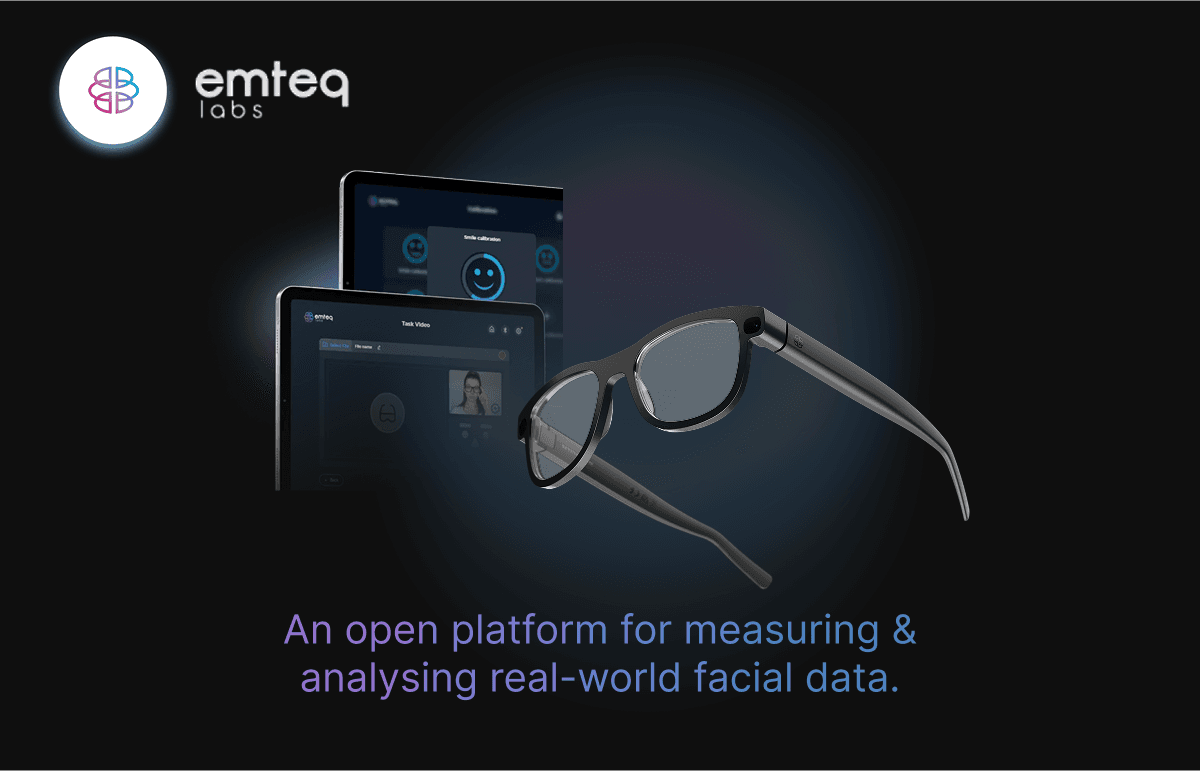
emteq labs provides innovative eyewear equipped with wireless non-contact sensors and a machine learning platform, enabling real-time emotion sensing and analytics. This technology allows for effortless collection and analysis of facial data and activities, offering unparalleled behavioral insights. The proprietary OCO™ Optomyography (OMG) sensors track facial muscle activation, providing precise three-dimensional facial movement mapping. The system includes a 9-axis inertial measurement unit (IMU), an altimeter for behavioral understanding, and an outward-facing camera to synchronize context with responses. Data can be streamed in real-time to a mobile app, allowing for monitoring, annotation, and analysis of various metrics like eating behavior, attention, engagement, and facial expressivity. Applications span research, healthcare, content creation, gaming, corporate training, and human-computer interaction.
Emu2
Emu2 is a generative multimodal model developed by BAAI, designed for in-context learning and capable of processing both image and text inputs. This application, hosted on Hugging Face Spaces, enables users to generate various forms of content and engage in interactive chat experiences. By providing a combination of text and images, users can receive generated responses or participate in conversations, making it a versatile tool for multimodal AI research and experimentation. The model aims to push the boundaries of AI's ability to understand and create content across different modalities.
JustAHuman
JustAHuman offers a unique gamified platform for 3D asset evaluation and labeling, allowing users to earn rewards while contributing to data annotation. Players accumulate points by completing challenges, which can then be converted into game credits, GenAI service provider credits, or crypto. This innovative approach aims to improve the efficiency and accuracy of AI model training by engaging users in a fun and rewarding way. The platform is designed to connect game creators with a community that can help process and label their 3D assets, making it a valuable resource for both players and developers.
HF LLM API
HF LLM API provides a straightforward interface for exploring and interacting with the HuggingFace Large Language Model API. Users can easily input text prompts and receive generated text responses, facilitating the testing and utilization of various large language models. This application is designed to simplify the process of working with LLMs, offering a practical way to experiment with different models and their outputs. It is hosted on Hugging Face Spaces, indicating its accessibility and potential for community-driven development and sharing. The tool's focus on direct interaction with the API makes it valuable for developers and researchers looking to integrate or test LLM capabilities.
chainer
Chainer is a Python-based deep learning framework known for its flexibility and define-by-run approach to automatic differentiation, also referred to as dynamic computational graphs. It offers object-oriented high-level APIs for constructing and training neural networks, making it suitable for researchers and developers. The framework leverages CuPy for CUDA/cuDNN support, enabling high-performance training and inference. While Chainer is currently in a maintenance phase, focusing primarily on bug fixes, it remains a valuable tool for those working with deep learning models. It provides extensive documentation, tutorials, and community support through forums and Slack.
Pipeshift (YC S24)
Pipeshift delivers the production infrastructure, tooling, and expertise needed to take AI products and agents to market quickly. It focuses on optimizing model runtimes to meet inference performance SLAs, with orchestration to scale real-time production workloads across various clouds and regions. The platform offers low latency, high throughput, fast cold-starts, and 99.99% uptime. Pipeshift allows users to serve open-source, custom, and fine-tuned AI models on infrastructure purpose-built for high-performance inference at massive scale. Key features include a Model API Sandbox, infrastructure observability, custom SLA-based auto-scaling, and increased GPU utilization through scheduling and bin-packing pipelines. Their proprietary framework, Modular Architecture for GPU Inference Clusters (MAGIC), adapts the inference stack in real-time for unique GenAI application needs.
Gemma-3-R1984-27B ChatBot
Gemma-3-R1984-27B ChatBot is an AI-powered application designed to provide answers by analyzing various document types, including text, PDF, CSV, and TXT files. Users can upload their documents and then ask questions, receiving detailed responses derived directly from the content. This tool is built for reasoning and deep research, leveraging the Gemma-3 family of models. It is hosted on Hugging Face Spaces and benefits from the processing power of NVIDIA H100 GPUs, indicating a focus on robust performance for complex analytical tasks. The application aims to streamline information extraction and question-answering from diverse data sources.
Intuition Machines
Intuition Machines transforms AI/ML research into privacy-preserving platforms and services, serving hundreds of millions of people globally. Their offerings include the IM Perception Platform, which automates the full train-deploy-improve cycle for machine learning models with a focus on active learning and robust APIs. A key product is the hCaptcha Security Suite, a leading privacy-first Security AI platform used by enterprises to protect users from fraud and abuse. They also provide Risk Insights, a novel approach to signal enrichment that helps ML models stay compliant with global privacy laws while benefiting from unique detection and risk analysis. Intuition Machines emphasizes solving hard problems in new ways, particularly through private learning in security ML, and is recognized for its research contributions.
truss
Truss is a command-line interface (CLI) tool designed to streamline the deployment and serving of AI/ML models on Baseten. It allows developers to package their model's serving logic in Python, manage dependencies, and configure GPUs with ease. Truss handles containerization automatically, eliminating the need for manual Docker and Kubernetes setup. It supports a wide range of open-source frameworks, including vLLM, SGLang, TensorRT-LLM, transformers, diffusers, PyTorch, and TensorFlow. Key features include a fast developer loop with live reload, production-ready capabilities like built-in GPU support, secrets management, caching, and autoscaling, whether deployed to Baseten or custom infrastructure. Truss also provides a JSON schema for `config.yaml` to enable autocompletion and validation in popular IDEs.
vminds.ai
vminds.ai is an AI toolkit designed to enhance everyday efficiency by integrating various AI models to streamline workflows. The platform offers access to leading AI models from providers like OpenAI and Google, aiming to boost both productivity and creativity for its users. While specific features are not detailed on the homepage, the overarching goal is to provide a comprehensive AI solution that simplifies complex tasks and automates routine processes. This makes vminds.ai suitable for individuals and businesses looking to leverage advanced AI capabilities without needing deep technical expertise in model deployment or management.
SpikeGPT
SpikeGPT is an implementation of a generative pre-trained language model that utilizes pure binary, event-driven spiking neural networks. This lightweight model is inspired by RWKV-LM and allows for experimentation with spiking neural networks in language modeling tasks. It supports training on datasets like Enwik8 and pre-training on large corpora such as The Pile. Users can fine-tune the model on datasets like WikiText-103 and perform inference with custom prompts or a pre-trained model. The repository also includes resources for fine-tuning with Natural Language Understanding (NLU) tasks, making it a valuable tool for researchers and developers exploring alternative neural network architectures.
SuperGlue-pytorch
SuperGlue-pytorch offers a PyTorch implementation of the SuperGlue matching network, designed for learning feature matching with Graph Neural Networks. This repository specifically includes code for training the SuperGlue network using SIFT keypoints and descriptors. It is intended for applications leveraging the Physarum Dynamics LP solver, which can potentially replace the original Sinkhorn Algorithm in SuperGlue. The architecture involves an Attentional Graph Neural Network and an Optimal Matching Layer, facilitating the identification of correspondences between image features, even in cases of occlusion or detector failure. The tool provides scripts for training the model and loading data, including generating keypoints, descriptors, and ground truth matches.
symbolic_deep_learning
symbolic_deep_learning is an open-source project providing the official implementation for the research paper "Discovering Symbolic Models from Deep Learning with Inductive Biases." This tool enables researchers and developers to explore the integration of symbolic reasoning with deep learning techniques. It supports the development of models that combine neural networks with symbolic structures, offering a novel approach to understanding and interpreting complex deep learning models. The repository includes code for training example models, generating data, and analyzing results, making it a valuable resource for academic research in AI and machine learning.
Wisent
Wisent is at the forefront of AI innovation, leveraging representation engineering to offer unparalleled control over AI models. This technology allows for precise modification of AI behavior, significantly reducing hallucinations and enhancing capabilities like coding. By understanding how AI processes information, Wisent transforms rigid AI tools into flexible, adaptable systems tailored to specific needs. It integrates seamlessly with existing AI models via a simple API and SDK, offering flexible deployment options including cloud API or on-premise solutions. Wisent enables users to fine-tune open-source models in minutes, bypassing lengthy training processes and making advanced AI capabilities accessible to everyone.
Poetry3D
Poetry3D is an innovative artistic visualization project that transforms user-entered poems into unique 3D semantic trees. This tool serves as a practical demonstration of core AI concepts, including tokenization, vector embeddings, vector databases, and cosine similarity. By representing each word as a point in a multi-dimensional space, where words with similar meanings are positioned closely, Poetry3D visually explains how AI processes and understands language. Connections between words form branches, and parallel branches indicate similar phrases, revealing hidden patterns and semantic structures within the poem. The project flattens AI's 1,536-dimensional word space into a 3D visualization, offering a 'shadow of meaning' that is unique to each poem.
TeaCache
TeaCache, or Timestep Embedding Aware Cache, is an innovative, training-free caching approach designed to significantly accelerate the inference process for various diffusion models. It achieves this by estimating and leveraging the fluctuating differences among model outputs across timesteps. While primarily focused on Video Diffusion Models, TeaCache also demonstrates effectiveness with Image Diffusion Models and Audio Diffusion Models. The project is open-source and available on GitHub, offering support for a wide range of models including Open-Sora, Latte, CogVideoX, and many others. It has been recognized as a highlight in CVPR 2025, underscoring its significance in the field. TeaCache also encourages community contributions and provides instructions for supporting new models, making it a versatile and evolving tool for researchers and developers.

Viam
Viam is a comprehensive software platform designed for the entire robotics lifecycle, from prototyping to global fleet management. It offers multi-language SDKs (Python, Go, TypeScript, C++) and abstracts complex hardware into simple, well-defined APIs, allowing engineers to focus on application logic rather than plumbing. The platform includes features for fleet management, AI and data processing, control and motion, and security. Viam supports remote access and control, OTA updates for software and ML models, and cloud-managed monitoring. It also provides specialized solutions like Robotic Surface Finishing for manufacturing, which uses AI to adapt and learn processes over time, enhancing efficiency and consistency.
Guardian Forge - Autonomous MCP Server
Guardian Forge functions as an autonomous MCP server, leveraging AI to generate and manage tools specifically designed for code security and auditing. Users interact with the system by providing their code and necessary API keys, which are crucial for secure execution and real-time approval of the generated tools. This platform aims to streamline the process of developing and deploying AI-powered solutions for code analysis and protection, offering a robust environment for developers and security professionals to enhance their software development lifecycle with advanced AI capabilities.