
AI Agents & Automation
Browsing page 26 of AI Frameworks & Infra in AI Agents & Automation. Sorted by confidence score — our independent quality rating.

cognita
Cognita is an open-source RAG (Retrieval Augmented Generation) framework designed to streamline the development and deployment of modular, scalable, and extensible AI applications. While leveraging Langchain/LlamaIndex, Cognita addresses the challenges of moving RAG systems from experimentation to production by offering an organized codebase where each RAG component is API-driven. It supports various features like multiple document retrievers, incremental indexing, and integration with open-source LLMs and embedding models. Cognita also includes a no-code UI for easier configuration and experimentation, making it suitable for both local development and production environments, with optional support for Truefoundry components for enhanced scalability.
Accretional
Accretional offers a comprehensive platform designed to take ideas from concept to deployed application with cutting-edge tools and zero-friction integration. Key features include Hosted Version Control with Git, providing managed repositories and deep IDE integrations. The Brilliant Agentic IDE enables AI coding directly in your browser within secure, remote, cloud-based Linux development environments. Additionally, the Statue Static Site Generator allows for quick setup and customization of modern websites. Accretional aims to be an open, modular ecosystem for software development, catering to hackers, professionals, and builders alike, facilitating the creation and management of AI-driven software.
ctransformers
ctransformers is a Python library designed to provide efficient bindings for Transformer models, leveraging C/C++ implementations and the GGML library. This allows for optimized local execution of various large language models, including GPT-2, LLaMA, Falcon, and more. The library offers a unified interface for model loading and generation, supporting both local files and Hugging Face Hub repositories. It integrates seamlessly with popular AI frameworks like Hugging Face Transformers and LangChain, making it versatile for different development workflows. ctransformers also provides GPU acceleration for compatible models, with support for CUDA, Metal, and ROCm, and includes experimental GPTQ quantization support for LLaMA models, enhancing performance and reducing memory footprint.
datapizza-ai
Datapizza-ai is a Python-based framework designed to streamline the development and deployment of reliable Generative AI solutions. It emphasizes speed and efficiency, aiming to reduce overhead and accelerate the transition of AI agents from development to production environments. The framework offers an API-first design, multi-provider support for LLMs like OpenAI, Google Gemini, and Anthropic, and robust tool integration including web search and document processing. Key features include composable and reusable blocks, smart chunking for document processing, and built-in reranking. Datapizza-ai also provides comprehensive observability with OpenTelemetry tracing, allowing developers to monitor performance and debug execution flow effectively. Its vendor-agnostic approach ensures flexibility, enabling users to swap models and providers without extensive code changes, making it a migration-friendly option for various AI projects.

Unframe
Unframe is a managed AI delivery platform specializing in tailored enterprise AI solutions. It goes beyond generic tools by offering secure, governed, and production-ready AI systems designed to deliver measurable ROI quickly. The platform emphasizes rapid deployment, often within days, without requiring upfront costs or full-time developers. Unframe's core consists of feature-rich building blocks for search, reasoning, automation, and agents, configured by blueprints to orchestrate solutions for specific use cases. It integrates with existing tech stacks, supports various LLMs and infrastructure choices (on-prem, private cloud), and ensures data security by allowing solutions to be hosted within the client's perimeter. Unframe aims to provide compounding value, where each new use case builds on the last, leading to faster deployments and higher accuracy.
core
Cheshire Cat AI, also known as core, is an open-source framework designed for building custom AI agents as a microservice. It adopts an API-first philosophy, making it easy to integrate conversational layers into existing applications. Key features include chat via WebSocket, a customizable REST API for agent management, and built-in Retrieval Augmented Generation (RAG) using Qdrant. The framework is highly extensible through plugins, supports event callbacks, function calling (tools), and conversational forms. It also provides an easy-to-use admin panel, supports any language model via Langchain, and offers multi-user capabilities with granular permissions. The entire system is 100% dockerized, ensuring easy deployment and scalability. It also boasts an active Discord community and comprehensive documentation.

XFactr.AI
XFactr.AI is a comprehensive AI solutions and IT consulting company dedicated to helping businesses unlock their full potential through advanced technology. The platform offers three core hubs: AI X for building and scaling production-ready ML, GenAI, and agentic AI solutions; Edge Foundry for deploying connected devices and edge intelligence; and Digital Arena for full-stack platforms, enterprise integrations, and automation. XFactr.AI specializes in custom ML/DL models, computer vision, predictive maintenance, multimodal AI, RAG-based solutions, and data engineering. They also provide services in DevOps, MLOps, LLMOps, and industry-specific AI applications, catering to sectors like energy, industrial automation, construction, PropTech, and retail.
Tribe AI
Tribe AI serves as an AI delivery layer for large enterprises, bridging the gap between cutting-edge AI models and practical, real-world applications. The platform is dedicated to helping the world's largest companies rewire their operations, compete more effectively, and create significant value through AI. Tribe AI offers deep partnerships with frontier AI providers like OpenAI and Anthropic, aiming to transform large enterprises into AI-native organizations. Their expertise lies in end-to-end AI product development, ensuring rapid deployment and proven value creation, tackling high-stakes projects with potential for $100M+ enterprise value. They focus on specialization, speed, quality of delivery, and tangible impact.

The International Conference on Machine Intelligence and Smart Innovation (ICMISI)
The International Conference on Machine Intelligence and Smart Innovation (ICMISI) serves as a crucial platform for researchers and practitioners dedicated to advancing the fields of artificial intelligence, machine learning, and related innovative technologies. This conference is designed to facilitate the exchange of cutting-edge developments, encompassing both theoretical frameworks and practical applications. ICMISI aims to foster robust collaboration between academic institutions and industry leaders, promoting a synergistic environment for innovation. The conference broadly covers key areas such as electronics, intelligent systems, and automation, providing a comprehensive overview of the latest trends and breakthroughs in these domains. It is an essential event for those looking to stay informed and contribute to the future of smart innovation.
Agumbe
Agumbe.AI is a comprehensive platform designed to simplify machine learning operations for developers and enterprises. It offers a unified gateway for managing LLM access, including authentication, guardrails, routing, and usage visibility. The platform allows users to build and deploy full AI applications, agents, and policies, abstracting away infrastructure complexities. Agumbe supports hybrid cloud deployments on Kubernetes across AWS, GCP, and Azure, and provides a fully-managed developer API. Key features include a reactive core for low-latency performance, ephemeral environments for testing, and robust data platform capabilities for data preparation, feature stores, and experimentation, ensuring secure and scalable AI application development.
BaseAI
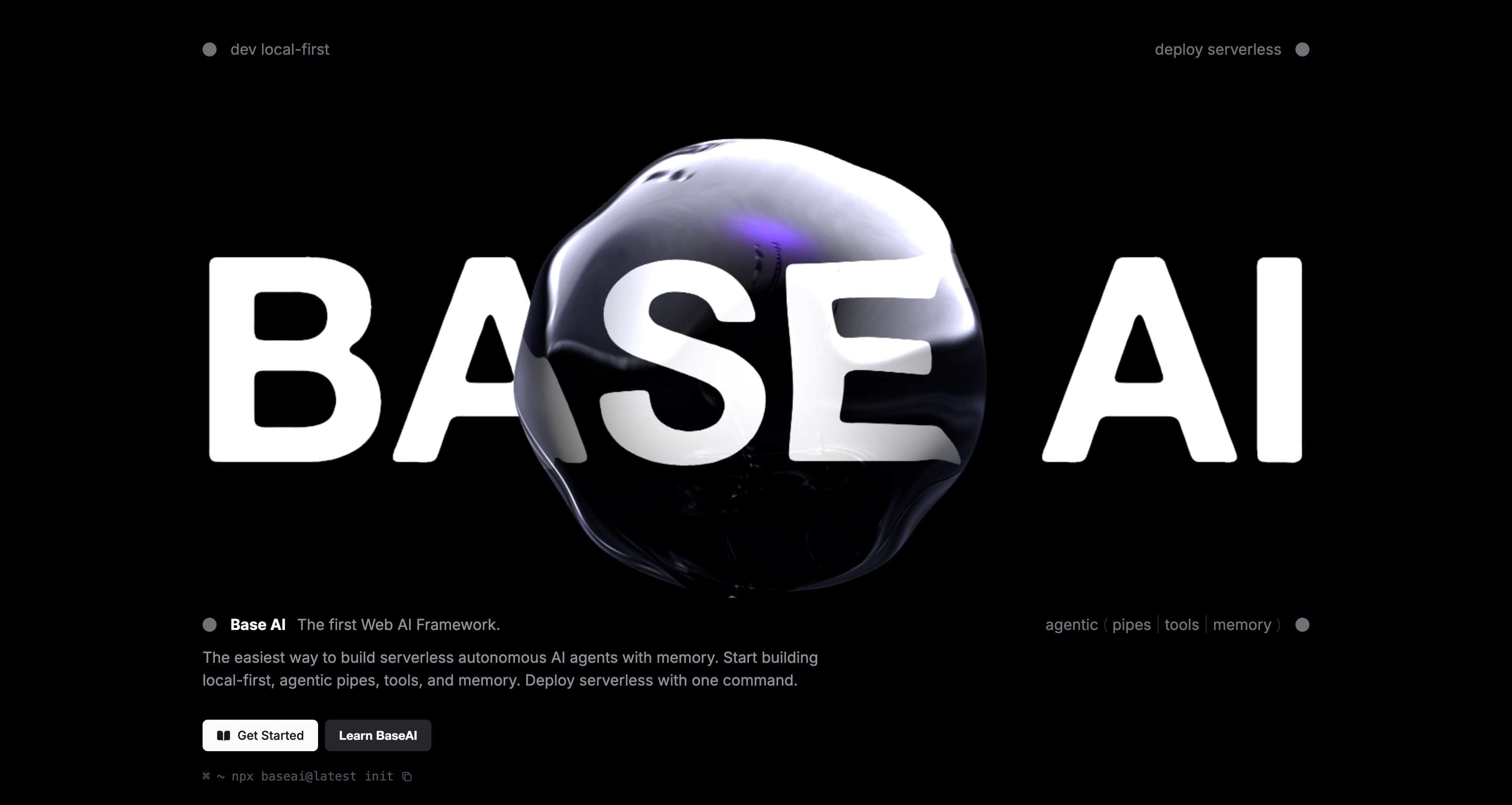
BaseAI is the first web AI framework designed for building and deploying serverless autonomous AI agents with memory. It emphasizes simplicity and composability, allowing developers to start building local-first with agentic pipes, tools, and memory. The framework integrates seamlessly with Langbase, a composable serverless AI cloud, enabling one-command deployment. BaseAI provides a straightforward API for creating and deploying various AI agents and features, supporting RAG (Retrieval Augmented Generation) for memory. It's an ideal solution for developers looking to streamline the creation and deployment of intelligent AI applications.
InsForge
InsForge is an open-source backend development platform specifically designed for AI coding agents and AI code editors. It simplifies full-stack application development by exposing backend primitives such as databases, authentication, storage, and functions through a semantic layer. This layer allows AI agents to understand, reason about, and operate these backend systems end-to-end. Key features include fetching backend context, configuring primitives directly, and inspecting backend state and logs via structured schemas. InsForge supports core products like user management, Postgres relational databases, S3 compatible file storage, an OpenAI compatible API across multiple LLM providers, serverless edge functions, and site deployment. It can be run locally via Docker Compose or deployed with one-click solutions like Railway, Zeabur, and Sealos.
tidi.studio
mx.works is an independent AI product studio dedicated to designing, building, and shipping AI-native software products. Founded in 2024 by Andrés Max, the studio emphasizes a small team, fast iteration, and building products they would personally use. They specialize in AI-native tools, productivity apps, and automation systems, focusing on problems where AI can make a meaningful difference. The studio prides itself on creating simple, craft-focused applications without feature bloat or subscription traps, ensuring tools do one thing well. They utilize OpenAI, Anthropic, and Gemini models for AI, React and Rails for applications, n8n and custom pipelines for automation, and Figma for design, selecting technology based on the problem at hand.

DKube
DKube helps enterprises design, deploy, and scale secure, private AI systems across on-premise, private cloud, and hybrid environments. It ensures full control, compliance, and ownership of AI initiatives. The platform offers solutions like DKubeX for Generative AI and ML, and DKube for MLOps, enabling AI/ML and data engineering teams to build, train, and deploy complex models. DKube also provides AI Blueprints such as QueriLynx for data exploration, Virtual Teaching Assistant for education, and DocMind for document processing, all designed for real-world impact and rapid deployment within weeks.
korvus
Korvus is an all-in-one, open-source RAG (Retrieval-Augmented Generation) pipeline built specifically for Postgres. It integrates LLMs, vector memory, embedding generation, reranking, summarization, and custom models into a single SQL query, significantly boosting performance and simplifying search architecture. By leveraging Postgres's robust capabilities, Korvus eliminates the need for external services and API calls, reducing latency and complexity. It provides SDK support for Python, JavaScript, Rust, and C, allowing seamless integration into existing tech stacks. This approach offers a simplified architecture, high performance, and scalability, making it ideal for developers looking to build efficient RAG applications directly within their database.
Beyond Imagination, Inc.
Beyond Imagination, Inc. is actively developing an advanced AI brain with the ambitious goal of learning and executing complex physical labor tasks. This innovative AI is engineered to progressively master individual tasks and eventually entire professions, mimicking human learning capabilities. The technology is intended to power humanoid robots and various other robotic systems, enabling them to perform a wide range of physical activities. The core concept revolves around an AI that learns and adapts much like a human brain, allowing for versatile and evolving robotic applications in diverse industries.
lemonade
Lemonade is an open-source local AI server designed to help users discover and run AI applications directly on their own hardware. It optimizes and serves large language models (LLMs), image generation models, and speech models using the user's GPUs and NPUs, offering capabilities similar to cloud APIs but with 100% privacy and no cost. Lemonade comes in two forms: a server that connects to apps via standard OpenAI, Anthropic, and Ollama APIs, and an embeddable binary for developers to integrate multi-modal local AI into their own applications. It supports a wide range of models including GGUF, FLM, ONNX, Whisper, and Stable Diffusion across various platforms like Windows, Linux, and macOS, with specific optimizations by AMD engineers for Ryzen AI, Radeon, and Strix Halo PCs.
llm-python
llm-python is a comprehensive repository offering instructional materials and code samples for working with Large Language Models (LLMs) in Python. It integrates popular frameworks and tools such as LangChain, OpenAI's Agent SDK, LlamaIndex, Chroma (Chromadb), and Pinecone. The resource is designed to help developers build sophisticated LLM applications and agents, with code examples that are self-contained and focused on specific usage patterns. It includes tutorials on building Q&A systems, querying databases, using HuggingFace's Inference API, understanding embeddings, and creating multi-agent systems. The repository also provides code references for public courses on building search engines and generative AI for various sectors.
langchain4j
LangChain4j is an idiomatic, open-source Java library designed to streamline the integration of Large Language Models (LLMs) into Java applications running on the JVM. It offers a unified API that abstracts away the complexities of various LLM providers (like OpenAI, Google Vertex AI) and embedding stores (such as Pinecone, Milvus), allowing developers to easily switch between them without extensive code changes. The library provides a comprehensive toolbox for common LLM patterns and techniques, including low-level prompt templating, chat memory management, function calling, and high-level patterns like Agents and Retrieval Augmented Generation (RAG). LangChain4j is built with Java conventions in mind, emphasizing type safety, POJOs, annotations, and seamless integration with enterprise Java frameworks like Quarkus and Spring Boot. It aims to provide a robust and developer-friendly solution for creating sophisticated LLM-powered applications in Java.
markdown-site
Markdown-site is an open-source publishing framework designed for AI agents and developers to create and publish websites, documentation, or blogs. It allows users to write content in markdown and sync it directly from the terminal, making it instantly available to browsers, Large Language Models (LLMs), and other AI agents. Built on Convex and Netlify, it offers real-time data synchronization, ensuring that all connected browsers update automatically without requiring a rebuild or redeploy. Key features include four theme options, full-text search, an analytics dashboard, an MCP server for AI tools, newsletter integration, and comprehensive SEO optimization with RSS feeds, sitemaps, and structured data. The framework also provides extensive documentation optimized for AI coding assistants, including specific instructions for Claude Code CLI and general AI agent guidelines.
mcphost
mcphost is an open-source command-line interface (CLI) host application designed to enable Large Language Models (LLMs) to interact with external tools via the Model Context Protocol (MCP). It supports a range of popular LLMs, including Anthropic Claude, OpenAI, Google Gemini, and Ollama-compatible models. The tool acts as a host in the MCP client-server architecture, managing connections and interactions, allowing LLMs to access external tools and data sources, maintain consistent context, and execute commands securely. Key features include interactive and non-interactive modes, script mode for YAML-based automation, support for multiple concurrent MCP servers, dynamic tool discovery, and configurable message history. It also offers a Go SDK for programmatic access, ensuring identical behavior to the CLI for developers building custom applications.
miyagi
Miyagi is a comprehensive sample project designed to help developers envision and build intelligent applications using Microsoft's Copilot stack. It offers an experiential approach to developing AI-infused product experiences, covering both generative and traditional machine learning use cases. The project introduces traditional software engineers to emerging design patterns in prompt engineering, such as chain-of-thought and retrieval-augmentation, alongside techniques like vectorization for long-term memory, fine-tuning of open-source models, agent-like orchestration, and plugins for augmenting and grounding LLMs. It includes examples utilizing Semantic Kernel, Promptflow, LlamaIndex, LangChain, and various vector stores, making it ideal for modernizing applications with AI.
Milvus
Milvus is a high-performance, cloud-native vector database designed for scalable Approximate Nearest Neighbor (ANN) search. Written in Go and C++, it leverages hardware acceleration for CPU/GPU to achieve best-in-class vector search performance. Its fully-distributed and K8s-native architecture allows horizontal scaling to handle tens of thousands of search queries on billions of vectors, with real-time streaming updates. Milvus supports various vector index types, including HNSW, IVF, FLAT, SCANN, and DiskANN, and offers advanced features like metadata filtering and range search. It also supports sparse vectors for full-text search and hybrid search, combining semantic and full-text capabilities. Milvus ensures data security through user authentication, TLS encryption, and Role-Based Access Control (RBAC), making it suitable for enterprise applications.
mindnlp
MindNLP bridges the gap between HuggingFace's extensive model ecosystem and MindSpore's hardware acceleration capabilities. By simply importing `mindnlp`, users can run over 200,000 HuggingFace models, including Transformers and Diffusers, on Ascend NPU, NVIDIA GPU, or CPU without requiring any code modifications. The tool offers full HuggingFace compatibility, supporting various model architectures and advanced features like mixed precision (FP16/BF16), quantization (INT8/INT4), distributed training, and PEFT/LoRA for parameter-efficient fine-tuning. MindNLP also provides a PyTorch-compatible API via mindtorch, safetensors support, and model hub mirrors for faster downloads, making it an efficient solution for AI developers and researchers.