
AI Agents & Automation
Browsing page 87 of AI Frameworks & Infra in AI Agents & Automation. Sorted by confidence score — our independent quality rating.

small-text
small-text is a Python library designed for active learning in text classification, enabling efficient labeling of training data for supervised learning, especially when labeled data is scarce. It provides unified interfaces for active learning, allowing users to easily combine various query strategies with classifiers from popular libraries like sklearn, PyTorch, and transformers. The tool supports GPU-based PyTorch models and integrates with transformers for state-of-the-art text classification. It includes multiple scientifically evaluated components such as query strategies, initialization strategies, and stopping criteria, which can be mixed and matched for building active learning experiments or applications. The library is open-source and requires Python 3.9 or newer.
skrl
skrl is an open-source, modular Reinforcement Learning (RL) library implemented in Python, supporting PyTorch, JAX, and NVIDIA Warp. It is designed with a focus on modularity, readability, simplicity, and transparency of algorithm implementation, making it suitable for both research and development. The library supports a wide range of environment interfaces, including OpenAI Gym, Farama Gymnasium, PettingZoo, and ManiSkill. Additionally, it allows for loading and configuring NVIDIA Isaac Lab and MuJoCo Playground environments, enabling simultaneous training of agents by scopes within the same run. skrl is under active continuous development, with the latest updates available on its develop branch.
Plexe
Plexe functions as an AI Data Scientist, enabling users to build and deploy custom machine learning models directly from natural language prompts. The platform simplifies the process of turning raw data into engineered AI solutions, offering features like instant data insights, custom model creation, and transparent performance metrics. Users can connect their data, and Plexe will check quality, identify patterns, and build production-ready models for specific business challenges such as fraud detection, churn prediction, or product recommendations. It provides full transparency with clear performance metrics, training details, and explanations for model predictions. Plexe supports various industries including Finance & Banking, E-commerce, Logistics, and Cybersecurity, offering tailored ML solutions.
torchtitan
Torchtitan is a PyTorch-native platform designed for rapid experimentation and large-scale training of generative AI models. It serves as a minimal clean-room implementation of PyTorch native scaling techniques, providing a flexible foundation for developers to build upon. The platform emphasizes ease of understanding, use, and extension for different training purposes, with a bias towards a clean, minimal codebase. Key features include multi-dimensional composable parallelisms like FSDP2, Tensor Parallel, and Pipeline Parallel, along with support for activation checkpointing, distributed checkpointing, and interoperable checkpoints. Torchtitan also integrates with `torch.compile`, supports Float8 and MXFP8 training, and offers Supervised Fine-Tuning (SFT) with chat-formatted datasets. It provides debugging tools, flexible learning rate schedulers, and helper scripts for tokenizer downloads and checkpoint conversions, making it a comprehensive solution for advanced generative AI model development.
Text2Video-Zero
Text2Video-Zero is an innovative tool that leverages text-to-image diffusion models to perform zero-shot video generation. This means users can create dynamic video content directly from textual descriptions without the need for extensive training or fine-tuning of the model. It's particularly useful for AI research, allowing for rapid prototyping and experimentation with video synthesis from text. Beyond research, it serves as a powerful asset for video content creation, enabling users to quickly visualize concepts and generate initial video drafts based on simple text inputs, significantly streamlining the production workflow.
Q-CTRL
Q-CTRL offers infrastructure software designed to make quantum technology useful, focusing on quantum computing and quantum sensing. The platform leverages AI to bridge the gap between the quantum and classical worlds, delivering performance enhancements in quantum computing and enabling new quantum sensing capabilities. Key products include Fire Opal for optimizing quantum algorithms and hardware performance, Boulder Opal for designing and scaling quantum hardware, and Black Opal for interactive quantum education. Q-CTRL has achieved significant milestones, including world records in quantum computing performance and a 94x quantum advantage in navigation, making it a leader in practical quantum applications. The tool serves a diverse audience from quantum learners and educators to defense and aerospace industries, providing solutions for GPS-free navigation, quantum computer calibration, and algorithm development.
tensorspace
TensorSpace is a neural network 3D visualization framework built using TensorFlow.js, Three.js, and Tween.js. It offers Keras-like APIs for constructing deep learning layers, loading pre-trained models, and generating interactive 3D visualizations directly in the browser. This framework makes it intuitive to understand model structures, internal feature abstractions, intermediate data manipulations, and final inference generations. TensorSpace supports visualizing pre-trained models from TensorFlow, Keras, and TensorFlow.js after a preprocessing step, which can be done using the TensorSpace Converter. It aims to involve front-end developers in the deep learning ecosystem by providing an accessible visualization tool.
tools
tools is an open-source project designed to empower AI agents with a comprehensive suite of capabilities. It adopts a model-driven approach, enabling developers to build sophisticated AI agents with just a few lines of code. The platform offers a wide array of ready-to-use tools, including file operations for reading, writing, and editing, secure shell integration for executing commands, and HTTP client for API requests. It also features advanced functionalities like memory management with Mem0 and Amazon Bedrock Knowledge Bases, web infrastructure tools for searching and crawling, and Python execution with state persistence. Furthermore, tools supports image and video processing, audio output, environment management, journaling, task scheduling, and advanced reasoning. Its unique offerings include swarm intelligence for parallel problem-solving, agent-as-tool for nested agent instances, and a multi-agent graph for deterministic pipelines, making it a versatile solution for complex AI agent development.
vearch
Vearch is a cloud-native distributed vector database designed for efficient similarity search of embedding vectors in AI applications. It provides key features such as hybrid search, which combines vector search with scalar filtering, and high performance for fast vector retrieval, searching millions of objects in milliseconds. The database is built for scalability and reliability, offering replication and elastic scaling out. Vearch integrates with popular AI frameworks like Langchain, LlamaIndex, Langchaingo, and LangChain4j, allowing it to be used as a memory backend for various AI applications. It supports multiple deployment methods including Kubernetes, Docker Compose, and source compilation, and offers SDKs for Python, Go, Java, and Rust.
torchdistill
torchdistill is a modular, configuration-driven, and coding-free framework built on PyTorch, designed to facilitate reproducible deep learning studies. It integrates various state-of-the-art knowledge distillation methods, allowing users to design and conduct experiments by simply editing declarative YAML configuration files, rather than writing Python code. The framework also supports general deep learning experiments without teachers. It provides tools like ForwardHookManager for extracting intermediate representations from models without modifying their interfaces. torchdistill has officially joined the PyTorch Ecosystem and offers trained models, training logs, and configurations to ensure reproducibility and benchmarking. It supports importing models from PyTorch Hub and Hugging Face Model Hub, making it versatile for various research and development tasks.
Appified.ai
Appified.ai is a no-code platform designed to transform OpenAI Assistants into fully functional web applications. This enables users to easily embed their AI assistants directly onto their websites, share them with others, or even commercialize them as products. The platform supports advanced features such as function calling and API integration, allowing for dynamic and interactive AI applications. A key differentiator is its focus on security, ensuring that OpenAI API keys remain private and secure. Appified.ai simplifies the deployment of AI agents, making sophisticated AI accessible to a broader audience without requiring extensive coding knowledge.
XNNPACK
XNNPACK is an open-source library developed by Google, offering highly optimized floating-point neural network inference operators. It is designed to accelerate machine learning frameworks such as TensorFlow Lite, TensorFlow.js, PyTorch, ONNX Runtime, ExecuTorch, and MediaPipe across a wide range of platforms including ARM, x86, WebAssembly, and RISC-V. While not intended for direct use by deep learning practitioners, it serves as a foundational component for developers building high-performance AI applications. XNNPACK supports a comprehensive set of neural network operators, including various convolutions, pooling types, and element-wise operations, with optimizations for different architectures and channel dimensions. It provides significant performance improvements for mobile and embedded devices, as demonstrated by benchmarks on MobileNet models across different Pixel phones and Raspberry Pi boards.
voice-assistant
voice-assistant is a simple Python script designed to function as a local voice assistant. It leverages OpenAI's Whisper model for accurate voice recognition, enabling users to interact with the system through spoken commands. For generating textual responses, it integrates with large language models, specifically mentioning the Yi model from 01.AI. This setup allows for a complete voice-based dialogue experience, where user input is recognized and processed, and intelligent responses are generated locally. The project is structured for ease of use, with a single main script and dedicated folders for models, prompts, and recordings. It's ideal for developers and AI enthusiasts looking to experiment with local AI voice capabilities.
LoRA
LoRA (Low-Rank Adaptation of Large Language Models) is an open-source Python package that provides an implementation of the LoRA technique for fine-tuning large language models. It significantly reduces the number of trainable parameters by learning pairs of rank-decomposition matrices while freezing the original weights. This approach vastly decreases storage requirements for models adapted to specific tasks and allows for efficient task-switching during deployment without adding inference latency. LoRA supports PyTorch models, including those from Hugging Face, and has demonstrated performance comparable to or superior to full fine-tuning on benchmarks like GLUE using models such as RoBERTa and DeBERTa. It also compares favorably to other efficient tuning methods like adapter and prefix-tuning on GPT-2.

Gambit AI
Gambit AI offers a software-first, platform-agnostic intelligence stack designed to unlock the full potential of autonomous systems. It moves beyond simple automation to provide adaptive intelligence that allows machines to learn, collaborate, and adapt as a single unified system. Key features include a Behavior Builder for creating and training autonomous behaviors, adaptive intelligence at the edge for real-time operation, and an intuitive interface for monitoring and controlling missions. Gambit AI emphasizes coordination and orchestration over mere control, enabling multi-robot systems to operate across various platforms (air, land, sea) and translate human intent into collective action. The technology has been validated in defense industries and is designed for scalability across diverse applications.
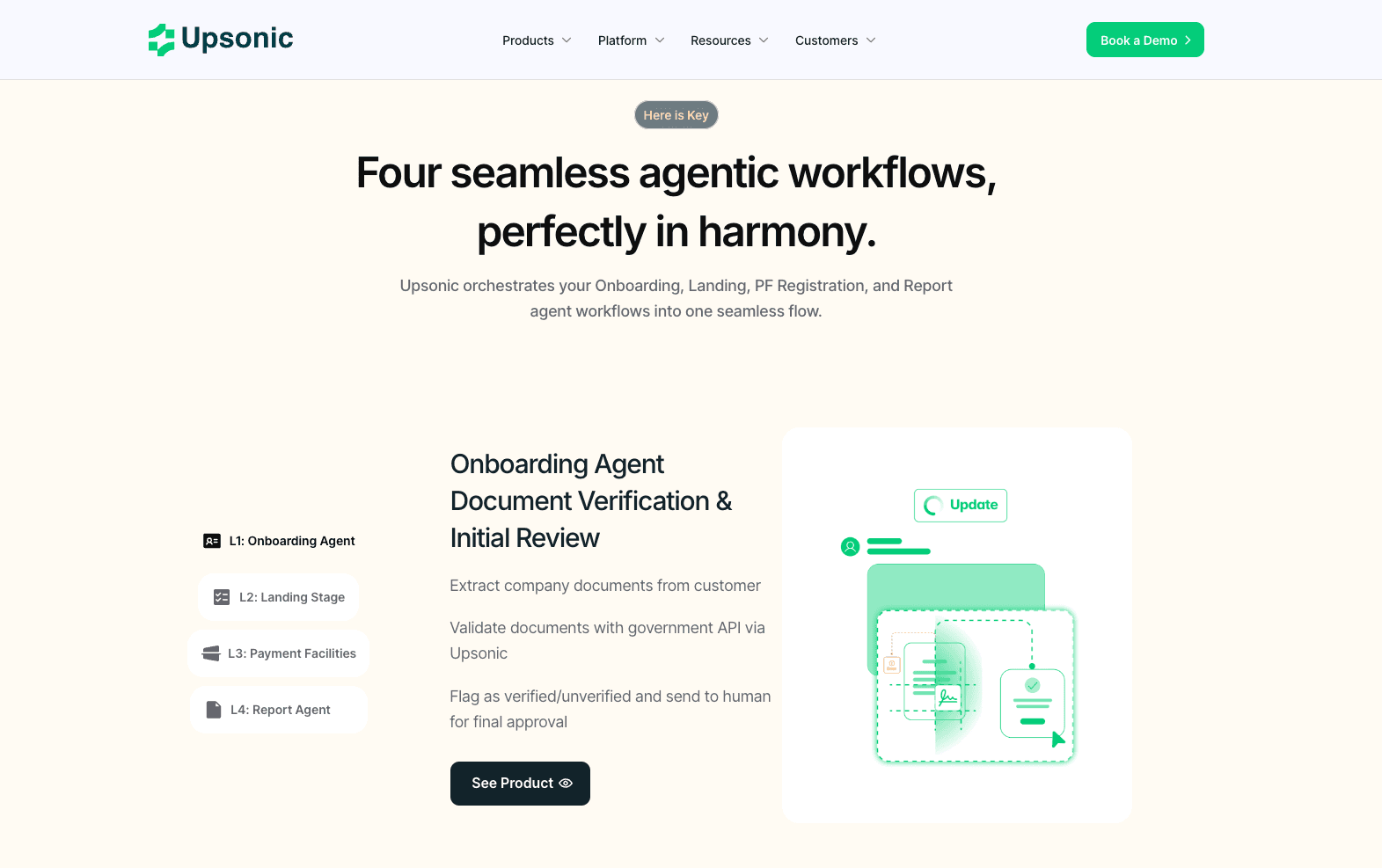
Upsonic
Upsonic is an AI agent framework specifically designed to automate complex FinTech operations, including merchant onboarding, AML list management, and risk assessment. The platform provides end-to-end agentic workflows for tasks such as document verification, regulatory compliance, post-onboarding streamlining, and multi-bank payment automation. Upsonic's AgentOS v2.0 allows users to build, deploy, monitor, and iterate production-ready agents, offering features like multi-Git provider support for seamless workflow management. It emphasizes human-in-the-loop control, ensuring reliability and compliance. The platform can be deployed in various environments, including self-hosted, VPC, or on-prem, with robust security features like data encryption, role-based access, and audit logs.

NeuralPit
NeuralPit, branded as CVChecker.co, offers an AI-powered resume and CV checker designed to help job seekers optimize their applications. The platform allows users to upload their resume and a job description to receive an in-depth analysis of how well their skills and experience align with the role. It provides role-specific improvement suggestions to address skill gaps and enhance the resume's effectiveness. Additionally, CVChecker.co can generate custom cover letters tailored to each job application, helping candidates stand out to hiring managers. The tool also includes interview preparation features, offering role-specific questions and tailored advice to help users ace their interviews. It aims to increase hiring chances by providing comprehensive resume analysis and application support.
xtuner
xtuner is a next-generation LLM training engine specifically designed for ultra-large-scale MoE models. Unlike traditional 3D parallel training architectures, XTuner V1 is optimized for mainstream MoE training scenarios, enabling scalable training of 200B-scale MoE models without expert parallelism and 600B models with only intra-node expert parallelism. It features memory-efficient design for long sequence support, allowing 200B MoE models to train on 64k sequence lengths. The engine boasts superior efficiency, supporting MoE training up to 1T parameters and achieving breakthrough FSDP training throughput. It also integrates with leading inference frameworks like LMDeploy, vLLM, and SGLang.
Johnny Days Estúdios
Johnny Days Estúdios is a machine learning studio operating out of Brazil, with a stated focus on developing AI-driven solutions. While their website is currently under construction, the studio aims to provide innovative services by leveraging machine learning technologies for both creative and business applications. The limited information available suggests an upcoming platform or service that will likely cater to users seeking advanced AI capabilities. Further details regarding specific features, pricing, and target audience are expected upon the full launch of their website.
lablab.ai
LabLab.ai is a leading ecosystem for AI builders, empowering innovation through a community-driven approach. The platform hosts world-class AI hackathons, providing a space for developers and founders to collaborate, build, and ship AI products. Participants can join events for free, either solo or in teams, and gain access to resources like tutorials, workshops, and expert mentorship. LabLab.ai focuses on fostering an AI-native future by encouraging the creation of real-world AI systems and applications, often in partnership with leading AI labs and tech organizations. It also features articles and news to keep the community informed about the latest advancements in AI.
zhusuan
ZhuSuan is a Python probabilistic programming library designed for Bayesian deep learning, combining the strengths of Bayesian methods and deep learning. Built upon TensorFlow, it offers a unique approach compared to traditional deep learning libraries that primarily focus on deterministic neural networks and supervised tasks. ZhuSuan provides a suite of deep learning-style primitives and algorithms specifically tailored for constructing probabilistic models and performing Bayesian inference. It supports various inference algorithms including Variational Inference (VI) with programmable posteriors and advanced gradient estimators, Importance Sampling (IS) for model learning and evaluation, Hamiltonian Monte Carlo (HMC) with parallel chains, and Stochastic Gradient Markov Chain Monte Carlo (SGMCMC) methods like SGLD, PSGLD, SGHMC, and SGNHT. The library is still under active development, with installation typically involving cloning the repository and using pip.
Oraczen
Oraczen offers enterprise-ready Agentic Systems, modular AI products built on their Zen Platform, designed to power real-world decisions across various industries. The platform helps enterprises navigate the complexities of AI adoption by providing solutions like Auron for capturing and transforming sales and customer conversations into organizational memory, and Scorpio for eliminating fog in spend, contract, category, and supplier information to unlock procurement savings. The Zen Platform also includes Observezen, which offers deep visibility into agent execution, conversations, and pipeline steps, enabling faster troubleshooting and optimized AI flows for dependable and predictable agent behavior. Oraczen aims to rewire enterprises with agentic systems, making the AI journey from complexity to clarity achievable.
tambo-ai
Tambo is an open-source toolkit designed for React developers to integrate AI agents directly into their applications. It enables agents to "speak" the UI by rendering existing React components based on user messages, handling complex tasks like streaming UI updates, managing state, and supporting the Model Context Protocol (MCP) for external system integration. Tambo allows developers to register their components, which the AI agent then uses to generate dynamic and interactive user interfaces. It supports both generative components (rendered once) and interactable components (persisting and updating across conversations), making it suitable for a wide range of AI-powered features without rebuilding existing UI logic. The toolkit includes a React SDK, a built-in agent, and solutions for error states, cancellation, and message threads.
aci
ACI.dev is an open-source tool-calling platform designed to integrate over 600 tools with any agentic IDE or custom AI agent. It provides intent-aware access to these tools, supporting both direct function calling and a unified Model-Context-Protocol (MCP) server. The platform simplifies authentication and API client management for various services like Google Calendar and Slack, offering multi-tenant authentication, granular permissions, and dynamic tool discovery. ACI.dev is framework and model agnostic, ensuring compatibility with any LLM framework and agent architecture. It aims to improve tool-calling reliability and accountability, offering features like authentication at scale, discovery without overwhelming LLM context, natural language permissions, and tool-use logging. The platform is 100% open source under the Apache 2.0 license.