
AI Agents & Automation
Browsing page 93 of AI Frameworks & Infra in AI Agents & Automation. Sorted by confidence score — our independent quality rating.

torchquantum
torchquantum is a comprehensive PyTorch-based framework designed for quantum-classical simulation, quantum machine learning, and quantum neural networks. It enables researchers and developers to simulate quantum computations on classical hardware, supporting both statevector and pulse simulation on GPUs, and can scale to over 30 qubits with multiple GPUs. Key features include dynamic computation graphs, automatic gradient computation, fast GPU support, and batch model tensorized processing. It facilitates easy deployment on real quantum devices like IBMQ and supports hybrid classical-quantum model construction. The framework is ideal for researchers in quantum algorithm design, parameterized quantum circuit training, quantum optimal control, and quantum machine learning.
SpatialVLA
SpatialVLA is a cutting-edge, spatial-enhanced vision-language-action model designed for robotics research and development. Trained on an extensive dataset of 1.1 Million real robot episodes, it aims to advance robot learning and performance in complex visual-language-action tasks. The model is built on a purely HuggingFace-based, concise code structure, ensuring efficient performance and easy deployment. It supports both pre-training from scratch using large datasets like OXE and RH20T, and fine-tuning with LoRA for real-world experiments with smaller datasets. SpatialVLA also provides evaluation code for benchmarks like SimplerEnv and offers a Model Zoo with various pre-trained and fine-tuned models.

StackAI
StackAI is an enterprise AI transformation platform designed for IT and Enterprise Architecture teams, enabling them to orchestrate AI agents with enterprise-grade security. The platform allows users to build secure, compliant AI applications rapidly using an intuitive drag-and-drop no-code interface. Key features include agentic workflows, multi-tenant deployment options (VPC, on-premise), robust security and governance with feature controls and audit logs, and human-in-the-loop capabilities for precise process oversight. StackAI is LLM agnostic, allowing deployment of the best-performing model for each task, and supports an Agentic Development Life Cycle (ADLC). It boasts over 100 enterprise integrations, enabling AI agents to interact with existing systems. The platform is certified for HIPAA, GDPR, SOC 2 Type II, and ISO 27001, ensuring secure handling of sensitive data across various industries like finance, healthcare, and government.
NLTK
NLTK (Natural Language Toolkit) is a leading open-source platform designed for building Python programs to work with human language data. It offers a comprehensive suite of text processing libraries for tasks such as classification, tokenization, stemming, tagging, parsing, and semantic reasoning. NLTK also provides easy-to-use interfaces to over 50 corpora and lexical resources, including WordNet, and includes wrappers for industrial-strength NLP libraries. The toolkit is accompanied by a hands-on guide that introduces programming fundamentals alongside computational linguistics topics, making it suitable for linguists, engineers, students, educators, researchers, and industry users. NLTK is available for Windows, macOS, and Linux, and is supported by an active discussion forum and a community-driven project.
Chi SquareX
Chi SquareX provides comprehensive data analytics and statistical solutions, helping businesses and researchers transform raw data into actionable insights. The platform specializes in cutting-edge statistical analysis, machine learning solutions, and data visualization to uncover patterns and drive strategic decision-making. With a focus on delivering competitive advantages, Chi SquareX offers expert analytics services tailored to various needs. The tool aims to simplify complex data challenges, making advanced analytical techniques accessible for deeper understanding and informed strategies. It supports both individual researchers and corporations in their data-driven endeavors.
Stammer.ai
Stammer.ai provides a white-label platform for agencies to create and manage AI chat and voice agents for their clients. These agents can handle customer support, qualify leads, and book appointments across various channels, including websites, phone calls, Instagram DM, Facebook Messenger, and WhatsApp. The platform offers full white-label branding, allowing agencies to deploy agents under their own domain and logo. It includes features like automated lead collection, AI scheduling, and seamless human hand-off. Stammer.ai also provides client dashboards for agencies to showcase ROI, a rebrandable API for custom integrations, and flexible pricing control, enabling agencies to set their own profit margins and scale their AI services.
Nexus
Nexus is an enterprise AI agent platform designed to help organizations deploy AI agents rapidly and effectively. Unlike traditional approaches, Nexus offers a comprehensive solution that includes not just technology, but also embedded engineers and change management to ensure successful adoption and ROI. The platform enables businesses to build and deploy autonomous AI agents across various departments like sales, support, marketing, and HR, connecting with over 4,000 systems and multiple AI models. It emphasizes a results-driven approach, starting with a 3-month POC tied to measurable outcomes, and focuses on continuous optimization to ensure agents learn and impact compounds over time. Nexus aims to bridge the gap between AI technology and organizational change, ensuring that AI solutions deliver tangible business value.
Dedalus Labs
Dedalus Labs offers Dedalus Machines, which are full Linux Virtual Machines designed for AI agents, boasting a boot time of just 50ms. These machines provide persistent sandboxes with VM-level isolation, ensuring a secure and robust environment for AI agent deployment. The platform supports long-running, stateful agents that never sleep, with a unique per-second billing model where sleep is free. Users can run anything on Linux, including systemd, root access, any package manager, and any runtime, with GPU support for ML workloads. Dedalus Machines differentiate themselves by offering both fast startup and a full unrestricted Linux environment, unlike many providers that force a trade-off. It's an ideal solution for building, deploying, and monetizing production-grade AI agents.
ai00_server
AI00 RWKV Server is an inference API server for the RWKV language model, built upon the web-rwkv inference engine. It offers high performance and accuracy, supporting Vulkan inference acceleration which allows GPU acceleration without the need for CUDA, making it compatible with AMD cards, integrated graphics, and any GPU that supports Vulkan. The server is compact and ready to use out of the box, eliminating the need for bulky PyTorch or CUDA runtime environments. It is fully compatible with OpenAI's ChatGPT API interface, 100% open source, and commercially usable under the MIT license. This makes it an excellent choice for various tasks including chatbots, text generation, translation, and Q&A, providing a fast, efficient, and easy-to-use LLM API server.
new-api
new-api is a next-generation LLM gateway and AI asset management system designed for aggregation and distribution of AI models. It offers robust support for cross-converting various Large Language Models (LLMs) into OpenAI-compatible, Claude-compatible, or Gemini-compatible formats, making it a versatile tool for developers and enterprises. The platform provides a centralized gateway for personal and enterprise model management, featuring a modern UI, multi-language support, and full compatibility with the original One API database. Key functionalities include token grouping, model restrictions, user management, and flexible billing policies with online recharge options. It also supports advanced features like intelligent routing, automatic retry on failure, and user-level model rate limiting, ensuring efficient and reliable AI model deployment.
SmythOS
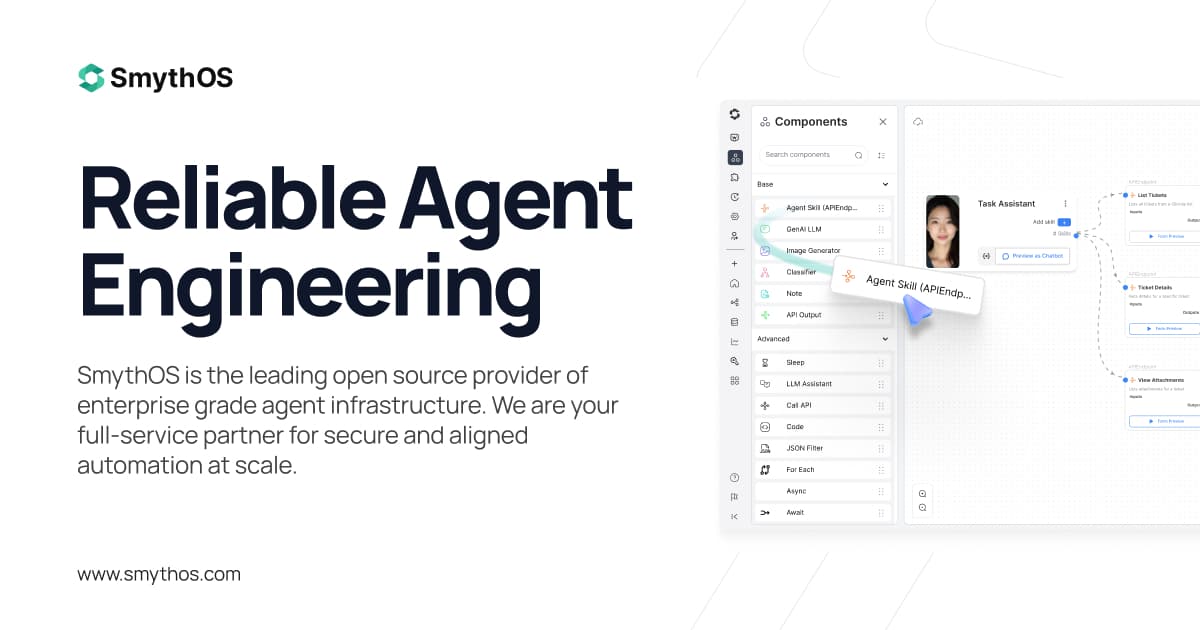
SmythOS is the leading open-source provider of enterprise-grade AI agent infrastructure, designed to empower global engineering teams. It offers a unified ecosystem for the entire AI lifecycle, from visual prototyping to secure, edge-to-cloud deployments. Key components include an Agent Runtime for secure execution with strict sandboxing, an Agent SDK for rapid development, and an Agent Visual Studio with drag-and-drop capabilities and Agent Weaver for intuitive workflow creation. SmythOS supports multi-agent orchestration, enterprise-grade security, and seamless integration with APIs and AI models, making it a full-service partner for secure and aligned automation at scale. It can be deployed on-prem, in the cloud, or as a hosted SaaS.

MbarQ
MbarQ empowers businesses with AI-driven solutions designed to enhance automation, facilitate business translation, and refine strategic planning. The company's core mission is to make AI accessible for widespread adoption, ensuring it becomes an integral part of business growth and efficiency. MbarQ operates on principles of tangibility, feasibility, and scalability, delivering tangible business value by demystifying AI and leveraging standardized, pre-built generative AI solutions. Their services include Smart Automation, AI Business Translation, and AI Strategy, aiming to streamline operations and drive innovative, replicable success for organizations.
OpenClaw Directory
OpenClaw Directory is your go-to resource for everything related to OpenClaw, offering a comprehensive collection of essential tools to enhance project experiences. It meticulously curates listings of top-notch tools, including robust deployers, innovative skills, and versatile plugins, complete with direct links to GitHub repositories and customizable code. Each entry provides the information needed to make informed decisions about tools for OpenClaw projects. Users can explore skills to transform applications or discover plugins that simplify and elevate workflows, ultimately helping to maximize OpenClaw potential and elevate development experiences.

Arpia
Arpia is an Enterprise AI governance and orchestration platform designed to close the gap between an organization's data platforms and AI agents. It provides a governed infrastructure that connects, coordinates, and activates AI decisions directly into operational systems. The platform features a Data Reflection Layer for AI-optimized data mirroring with built-in provenance and governance, and a Knowledge Ontology that acts as a living knowledge graph for contextual AI reasoning. Arpia emphasizes compliance with ISO 42001 and SOC 2, ensuring every agent decision is auditable. It aims for rapid deployment, promising the first use case in 30-90 days, and offers a handover model where the platform is built and then owned by the client's team for continuous scaling.

LG AI Research
LG AI Research is dedicated to advancing artificial intelligence for a better life, focusing on its potential to transform industries, drive economic growth, and address global challenges. The organization explores various AI domains, including Superintelligence, EXAONE Language, Physical Intelligence, Bio Intelligence, Data Intelligence, and Materials Intelligence. Through its research, LG AI Research aims to empower individuals and organizations to leverage AI's capabilities. The initiative also features the EXAONE Showroom, highlighting practical applications and solutions derived from their cutting-edge research.

Arrikto
Arrikto offers an Enterprise Kubeflow distribution, functioning as a comprehensive MLOps platform designed to streamline the delivery of scalable machine learning models. It significantly reduces operational costs and accelerates the transition of models from development environments to production. The platform addresses the critical need for robust storage and data management in AI workloads, which often face bottlenecks with traditional storage solutions. Arrikto's storage is built from the ground up for AI, optimized for Kubernetes, and designed for hybrid and multi-cloud environments. It leverages new kernel APIs and a novel storage architecture combining NVMe and object storage with P2P federation for efficient data syncing. This approach results in storage that is up to 8x faster and 3.5x cheaper than comparable cloud block storage offerings, all while being software-only and requiring no changes to existing infrastructure.

Metis
Metis is an applied-research and product lab focused on creating proprietary intelligence for enterprise AI agents. It provides a crucial post-training and continual-learning layer, addressing the limitations of current information stacks built for static software and generic models. The Mantis platform allows agents to learn continuously from first-party data, tools, and environments, making agentic computing dependable at scale. Metis's first product, Insight, transforms a company's data into a continuously learning agent stack. It improves agents through practice using offline/online reinforcement learning and validates them against real tasks before production, ensuring reliability and throughput for complex, multi-step workflows. Metis aims for pragmatic progress, fostering a data flywheel where agents learn from every interaction while remaining observable, auditable, and safe.

PixelPlex
PixelPlex is a software development and IT consulting company that has been turning ideas into successful solutions since 2007. They specialize in blockchain and AI development services, building powerful applications for various industries including fintech, retail, healthcare, real estate, and cybersecurity. Their offerings span blockchain development (dApps, NFT marketplaces, smart contracts), custom software development (web, UI/UX, DevSecOps), AI development (consulting, ML, computer vision, predictive analytics), and data analytics & visualization (business intelligence, big data engineering). PixelPlex works with startups, small businesses, and enterprises, providing tailored guidance and implementing growth strategies.
End-to-End Driving at Scale 2024
End-to-End Driving at Scale 2024 is a platform designed for participants in autonomous driving competitions. Users can access comprehensive details about the competition, including rules, datasets, and specific requirements. The tool facilitates the submission process for participants' models and provides real-time updates on leaderboards, allowing for performance tracking and comparison. Hosted on Hugging Face Spaces, it serves as a central hub for researchers and developers focused on advancing end-to-end driving systems, offering a streamlined experience for competition engagement and progress monitoring.

Blumind
Blumind is a Canadian deep-tech startup specializing in all-analog AI neural network architecture. Their disruptive AMPL™ technology delivers industry-standard inferencing performance with significantly lower power consumption (up to x1000 less) and ultra-low latency compared to traditional digital approaches. Blumind's solutions are built using standard cost-effective CMOS process technology, making AI accessible for a wide range of applications. They offer ultra-low power devices, AMPL™ IP/chiplets, and software solutions, all designed for easy deployment using industry-standard software tools for always-on applications. Their products aim to enable sustainable AI with net-negative emissions by minimizing total system power.
Kmeans
Kmeans is designed to provide advanced machine learning solutions directly within a web browser, leveraging WebGPU support for enhanced efficiency in handling complex computational tasks. This approach allows users to perform sophisticated data analysis and pattern recognition without the need for extensive local setup. The tool also offers the option to clone its repository for faster local execution, catering to users who prefer or require on-premise processing. Additionally, Kmeans provides special downloadable models, enabling tailored data analysis and more precise pattern recognition for specific use cases. This combination of browser-based accessibility and local execution options makes it a versatile platform for machine learning development.
Gradio 🤝 TGI
Gradio 🤝 TGI integrates Gradio and Text Generation Inference (TGI) within a unified environment, simplifying the process of deploying and testing AI models. This setup is particularly useful for developers and researchers who need to quickly create interactive web interfaces for their text generation models. By packaging both Gradio, a popular library for building UI components for machine learning models, and TGI, an optimized solution for serving large language models, this tool aims to streamline AI development workflows. It allows for efficient experimentation and demonstration of AI capabilities without the complexity of managing separate infrastructures for UI and model serving.
Onyxium
Onyxium is a comprehensive platform designed to centralize access to a diverse range of AI tools, simplifying the process of discovering and utilizing artificial intelligence for various tasks. Users can find tools for generating text, creating images, and performing advanced functions like image recognition, text analysis, and speech recognition. The platform emphasizes ease of use and affordability, allowing users to sign up, explore models, customize parameters, and quickly get results. Onyxium aims to streamline workflows and elevate projects by providing a technology-first approach to AI, making advanced AI capabilities accessible to a broad audience.
Gradio OpenAI CLIP Grad-CAM
Gradio OpenAI CLIP Grad-CAM is a tool designed for visualizing the decision-making process of artificial intelligence models, specifically focusing on image-based predictions. It integrates Gradio for the user interface, OpenAI CLIP for understanding image-text relationships, and Grad-CAM for generating visual explanations of model predictions. This combination allows users to gain insights into which specific regions or features within an image are most influential in a model's output. The tool is particularly valuable for educational purposes, helping students and practitioners understand complex AI behaviors, and for researchers who need to analyze and debug model performance by observing its internal reasoning.