
AI Agents & Automation
Browsing page 23 of AI tools for General-Purpose Agents in AI Agents & Automation. Sorted by confidence score — our independent quality rating.

BraveGPT
BraveGPT enhances Brave Search by integrating AI chat and search summaries directly into the user experience. Powered by the latest large language models (LLMs) like GPT-4o, this tool allows users to engage with an AI bot and receive concise summaries alongside their search results. It functions as a userscript, requiring installation via managers like Tampermonkey or ScriptCat, and supports a wide range of browsers including Chrome, Firefox, Edge, and Safari. BraveGPT offers a Proxy API Mode for text responses without a ChatGPT.com account, making it accessible even if OpenAI API is unreliable. It is an open-source project, welcoming contributions and providing support through its GitHub community.
BrowserAI
BrowserAI is an open-source platform designed to run production-ready Large Language Models (LLMs) directly within your web browser. It prioritizes privacy, with all processing occurring locally, and offers WebGPU acceleration for near-native performance. This eliminates server costs and allows for offline functionality after the initial model download. BrowserAI provides a simple SDK supporting multiple engines (MLC, Transformers, Flare, Demucs) and pre-optimized popular models. Key features include text generation, structured output with JSON schemas, speech recognition, text-to-speech, and audio source separation. It's ideal for web developers, companies needing privacy-conscious AI, researchers, hobbyists, and no-code platform builders.
ComfyUI-Copilot
ComfyUI-Copilot is an AI-powered custom node designed to significantly enhance workflow automation and provide intelligent assistance within the ComfyUI environment. It acts as an AIGC intelligent assistant, offering comprehensive support for tedious workflow building, answering ComfyUI-related questions, and optimizing parameters. The tool streamlines the debugging and deployment of AI algorithms, making creative workflows more efficient. Key features include one-click debugging, workflow rewriting based on user descriptions, and enhanced workflow generation that accurately understands requirements. It also offers node and model recommendations, a node query system, and parameter tuning tools for batch execution and visual comparison of results.
ComfyUI_UltimateSDUpscale
ComfyUI_UltimateSDUpscale offers a set of ComfyUI nodes designed for advanced image-to-image diffusion, specifically tailored for upscaling large images in a tiled manner. This innovative approach significantly improves the detail quality commonly found in upscaled images, addressing a key challenge in AI image generation. By processing images in tiles, the tool efficiently reduces hardware requirements, making high-quality upscaling accessible to a broader range of users. Furthermore, it ensures that the image size remains consistent with what the diffusion model is trained on, which is crucial for maintaining optimal image quality and preventing artifacts. The tool is open-source and integrates seamlessly into the ComfyUI environment, providing flexible installation options including Git, ComfyUI Manager, comfy-cli, or manual download.
InternLM
InternLM is an open-source large language model series developed by Shanghai AI Laboratory, featuring models like InternLM3-8B-Instruct, InternLM2.5, and InternLM2. This series is designed for general-purpose usage and advanced reasoning, offering enhanced performance at reduced training costs compared to other LLMs of similar scale. It supports deep thinking for complex reasoning tasks and normal response modes for fluent user interactions. The models are available for commercial application and provide API access, with deployment options via Transformers, LMDeploy, and SGLang. InternLM also includes reward models for fine-tuning chat models and offers strong capabilities in long-context processing, reasoning, and coding.
Guidance
Guidance is an efficient programming paradigm designed for steering large language models, offering precise control over their output. It enables users to structure LLM outputs, constrain generation using regular expressions or context-free grammars (CFGs), and seamlessly interleave control flow (conditionals, loops, tool use) with generation. This approach helps achieve high-quality results while potentially reducing latency and cost compared to conventional prompting or fine-tuning. Guidance provides a Pythonic interface, supporting various backends like Transformers, llama.cpp, and OpenAI. It also allows for offline grammar debugging and the creation of custom Guidance functions for complex tasks like generating JSON based on schemas.
LMOps
LMOps is an open-source research initiative by Microsoft dedicated to advancing the fundamental technology for building AI products using foundation models, particularly Large Language Models (LLMs) and Multimodal Large Language Models (MLLMs). The project focuses on key areas such as better prompt engineering through automatic prompt optimization and extensible prompts, enabling longer context windows via structured prompting, and improving LLM alignment. It also explores LLM acceleration for faster inference and customization techniques. LMOps provides a platform for researchers and developers to explore and implement cutting-edge techniques in generative AI.
Swiftsell AI
Swiftsell AI offers an agentic AI-powered platform designed to automate patient communication for healthcare practices. It leverages AI voice agents and WhatsApp automation to manage inbound and outbound patient interactions around the clock. Key functionalities include automated appointment booking, reminders, follow-ups, and handling patient queries. The platform supports natural conversations, integrates with existing knowledge bases for instant answers, and allows for patient segmentation for targeted communication. It also features a smart campaign engine for automated health campaigns and seamless human handoff when complex cases arise. Swiftsell AI aims to reduce patient no-show rates, free up staff time from repetitive tasks, and ensure no patient communication is missed, even after hours.
RankGPT
RankGPT is an open-source project dedicated to exploring the capabilities of large language models (LLMs), such as ChatGPT and GPT-4, as re-ranking agents within information retrieval systems. The project provides code and resources for researchers to investigate how these generative LLMs can improve relevance ranking. It features instructional permutation generation for re-ranking passages, including a sliding window strategy to handle token limits. RankGPT also supports the distillation of LLMs into smaller, specialized models for efficiency and offers evaluation benchmarks for various datasets like TREC, BEIR, and Mr. TyDi. The project recently won the Outstanding Paper Award at EMNLP 2023.
AgentPilot
AgentPilot is a versatile workflow automation platform designed for creating, organizing, and executing AI workflows. It provides a seamless experience for interacting with a single LLM or managing complex multi-member workflows. The platform features an intuitive interface for designing AI workflows and chatting with them in real-time, including support for branching chats for flexible interactions and iterative refinement. Users can create and manage agents, tools, and modules, and organize them into folders. AgentPilot also offers customizable UI, scheduled and recurring workflows based on natural language expressions, and integration with Open Interpreter for code execution in multiple languages. It supports various LLM providers through LiteLLM and allows for structured outputs.
Awesome-Papers-Autonomous-Agent
Awesome-Papers-Autonomous-Agent is an Open Source collection of recent academic papers dedicated to autonomous agents. This repository specifically categorizes papers into two main areas: Reinforcement Learning (RL)-based agents and Large Language Model (LLM)-based agents. It serves as a valuable resource for researchers and developers interested in the latest advancements in intelligent agent design, learning, and knowledge acquisition. The collection is actively maintained, with regular updates including papers from major conferences like NeurIPS, ICML, and ICLR, and offers classifications based on research topics such as instruction following, world models, generalization, and multi-agent systems.
Unfetch
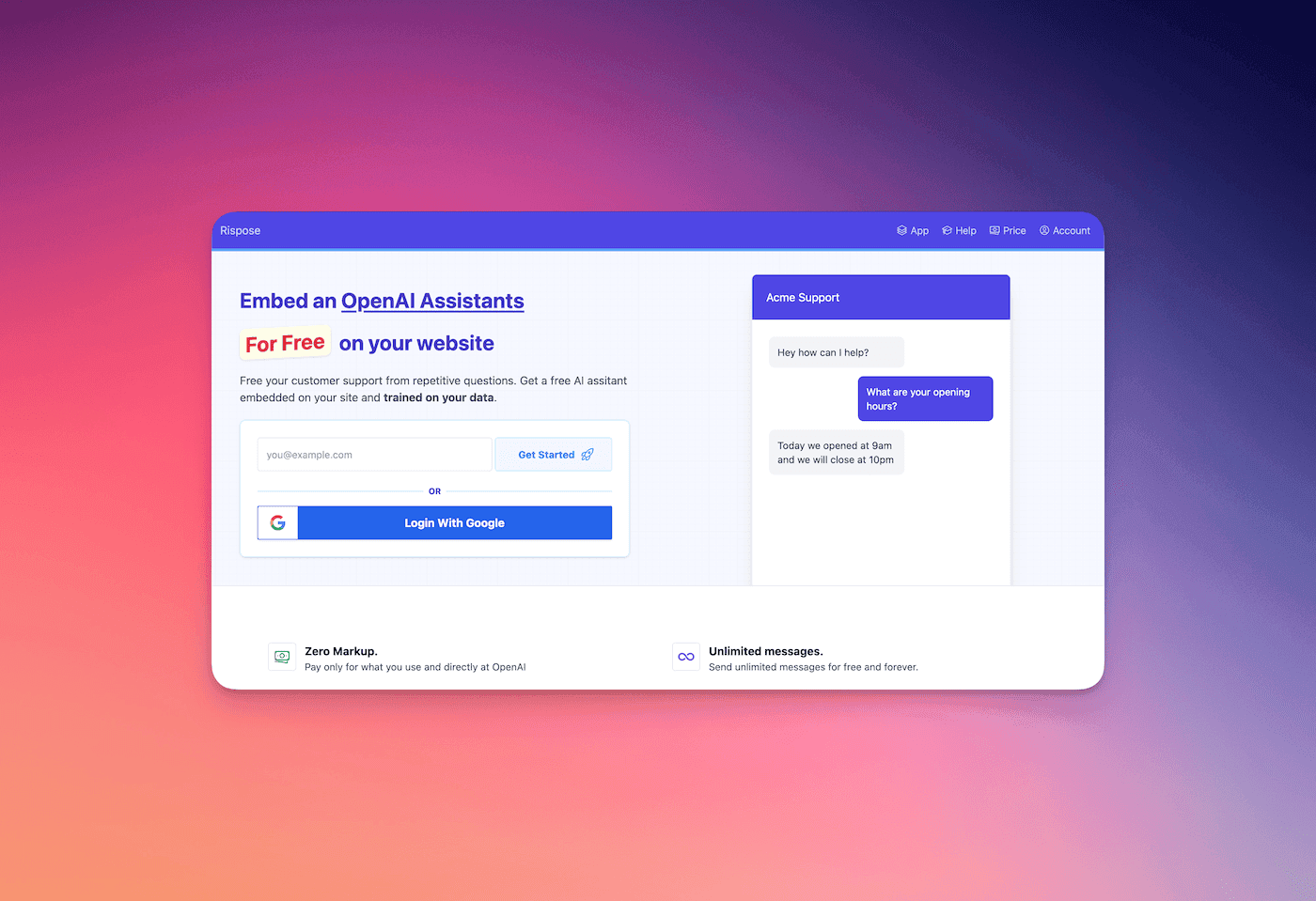
Rispose, formerly Unfetch, is an AI Agents & Automation tool designed to help businesses build and embed custom AI agents directly onto their websites or platforms. It enables automation of support, sales, and customer engagement through AI-powered assistants. Users can train their agents with up to 1,000 files, including PDFs, documents, and text files, and customize their behavior with specific instructions to match brand voice. The platform integrates with popular services like Shopify, WordPress, Notion, Wix, and Webflow. Rispose offers detailed history and metrics to track agent performance, understand user interactions, and facilitate continuous improvement. It provides a seamless and budget-friendly solution for integrating LLMs into existing web applications.
docs-mcp-server
Grounded Docs MCP Server is an open-source solution designed to prevent AI hallucinations and outdated knowledge by offering a personal, always-current documentation index for AI coding assistants. It can fetch official documentation from websites, GitHub, npm, PyPI, and local files, ensuring your AI queries the exact version you are using. This tool supports a wide range of file formats including HTML, Markdown, PDF, Office documents, and over 90 source code languages. It runs entirely on your machine, keeping your code private and secure. Compatible with any MCP-compatible client like Claude, Cline, and Gemini CLI, it offers both a command-line interface for agents and scripts, and a long-running server with a web UI for easy management.
dolly
Dolly is an instruction-following large language model developed by Databricks, trained on the Databricks Machine Learning Platform. It is based on EleutherAI’s Pythia-12b and fine-tuned on a ~15K record instruction corpus generated by Databricks employees. Dolly is licensed for commercial use and excels in capability domains such as brainstorming, classification, closed QA, generation, information extraction, open QA, and summarization. While not a state-of-the-art model, it demonstrates surprisingly high-quality instruction following. The model is available on Hugging Face as databricks/dolly-v2-12b and can be deployed and trained on various GPU instances, including A100, A10, and V100, with specific configurations for optimal performance.
DiffiT
DiffiT (Diffusion Vision Transformers) is a generative AI model that merges the strengths of diffusion models with Vision Transformers (ViTs). This innovative approach introduces Time-dependent Multihead Self Attention (TMSA), enabling precise control over the denoising process at each timestep. DiffiT has demonstrated state-of-the-art performance in class-conditional ImageNet generation across various resolutions, notably achieving an FID score of 1.73 on ImageNet-256. The official PyTorch implementation is available, along with pretrained model checkpoints and scripts for sampling images and computing FID scores, allowing users to reproduce the reported results.
Factory Process Monitoring Agent
The Factory Process Monitoring Agent is a sophisticated AI tool designed to control industrial automation systems through the application of large language models (LLMs). This repository offers comprehensive details and video demonstrations accompanying research on this innovative approach. It showcases a refined system design with extensive testing and model fine-tuning, including supervised fine-tuning (SFT) of open-source models like Llama-3 and Qwen2, as well as OpenAI's GPT-4o. The tool evaluates LLM performance in both routine processes following standard operating procedures (SOPs) and autonomous responses to unexpected events, highlighting the potential for customizing general LLMs for specialized automation equipment control. This research builds upon previous work in autonomous systems and flexible modular production enhanced with LLM agents.
genai-processors
GenAI Processors is a lightweight Python library designed for building modular, asynchronous, and composable AI pipelines, specifically for generative AI applications. It addresses the fragmentation of LLM APIs by providing a unified content model, simple composable Python classes called Processors, and built-in asynchronous streaming capabilities. The library allows developers to create custom processors, chain them together, or parallelize them to build sophisticated data flows and agentic behaviors. Key features include rich content handling with `ProcessorPart` for various content types, integration with GenAI API for model calls, and utilities for stream management. It's built on Python's `asyncio` framework to orchestrate concurrent tasks, making it ideal for real-time applications.
G-Retriever
G-Retriever is an open-source framework designed for retrieval-augmented generation (RAG) in the context of textual graph understanding and question answering. It is the official implementation of a NeurIPS 2024 paper and combines the strengths of Graph Neural Networks (GNNs), Large Language Models (LLMs), and RAG. The tool is applicable to multiple real-world scenarios, including scene graph understanding, common sense reasoning, and knowledge graph reasoning. G-Retriever can be fine-tuned to enhance graph understanding through soft prompting, offering flexibility for researchers and developers working with complex textual data structures.
gpt-2-Pytorch
gpt-2-Pytorch is an open-source implementation of OpenAI's GPT-2 for text generation, built using the PyTorch framework. This repository offers a straightforward way to generate text, making it accessible for researchers and developers interested in natural language processing. It includes features like specifying the initial text, controlling the number of samples, setting sentence length, and adjusting generation parameters such as temperature and top_k. The project emphasizes responsible disclosure by providing a smaller model for experimentation, aligning with OpenAI's initial release strategy. It also provides quick start instructions for setting up the environment and running the text generator, including options for Google Colab.
Dydas
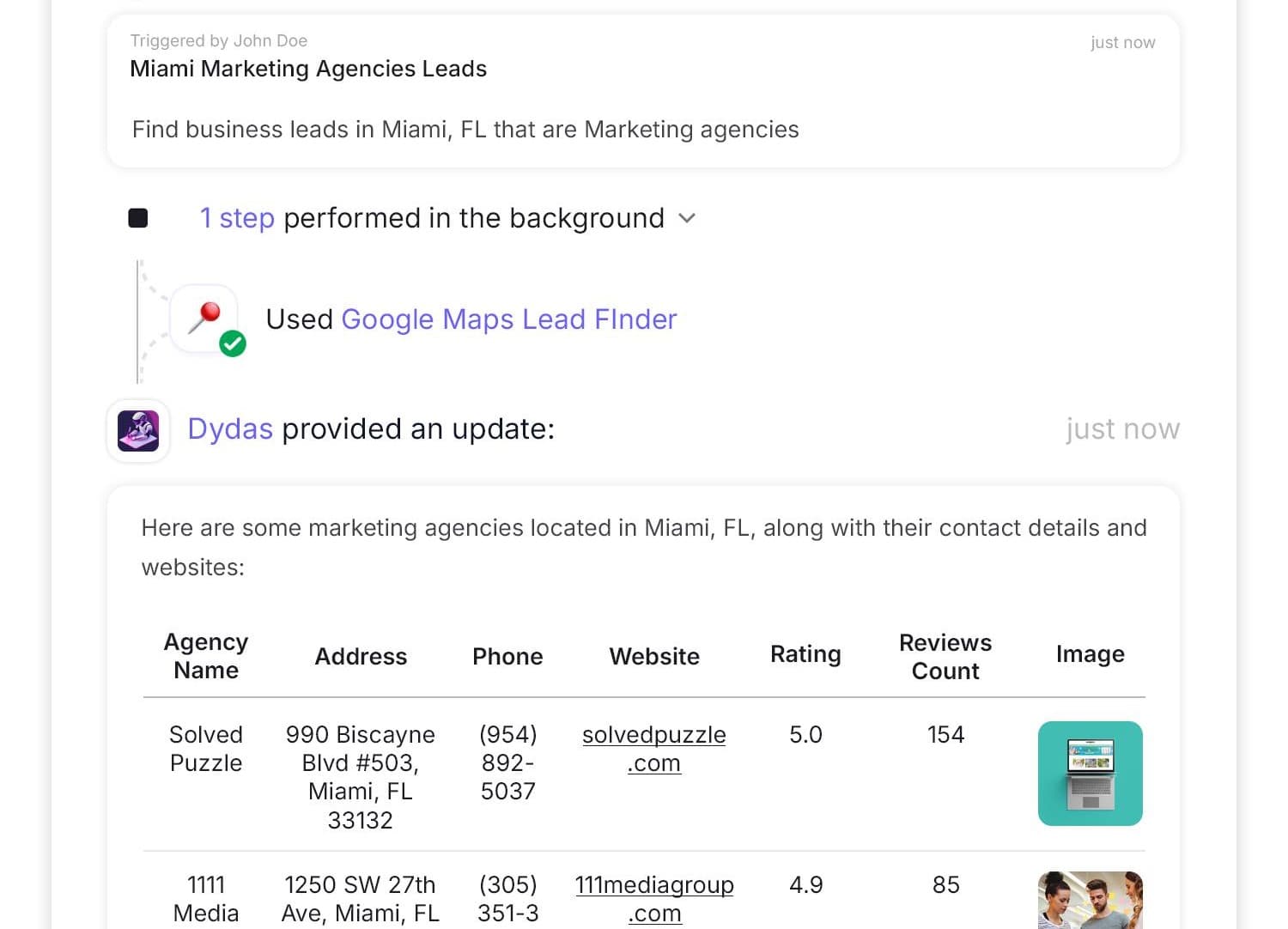
Dydas is an AI agent team designed to provide a competitive edge in lead generation and modern content marketing. Unlike traditional language models, Dydas leverages AI agents to perform tasks such as web scraping, lead qualification, trend analysis, and SEO article generation. Users can interact with the platform using natural language, eliminating the need for technical expertise. The service offers unlimited marketing tools and lead generation capabilities for a monthly fee, with a risk-free trial. Dydas aims to boost marketing efforts and business operations through its powerful AI agent solutions, extending capabilities through app connections for agencies.
EroPlay.ai
EroPlay.ai is an advanced platform designed for AI roleplay, allowing users to unleash their fantasies with virtual characters. It goes beyond typical AI chat by offering interactive erotic scenes where characters have unique personalities, traits, and goals. The platform provides engaging text responses alongside periodic images that vividly depict unfolding scenarios. Users can choose from pre-made scenarios and characters or create their own from scratch, with their words and actions shaping the story. EroPlay.ai focuses on realism, immersion, emotion, and freedom, offering AI girlfriends, AI boyfriends, and custom AI characters that adapt to user preferences and remember past conversations. It supports various themes, including romantic, fantasy, and NSFW AI roleplay, ensuring a personalized and dynamic experience.
KwaiAgents
KwaiAgents is an open-source project from KwaiKEG at Kuaishou Technology, offering a generalized information-seeking agent system built with Large Language Models (LLMs). The project includes KAgentSys-Lite, a simplified agent system with core functionalities, and KAgentLMs, a series of LLMs specifically tuned for agent capabilities such as planning, reflection, and tool-use. It also provides KAgentInstruct, a large dataset of agent-related instructions for fine-tuning, and KAgentBench, a comprehensive benchmark for evaluating agent performance across various dimensions. KwaiAgents supports both local and cloud-based LLM usage, making it a versatile platform for researchers and developers in the AI agent space.
Convogenie AI
Convogenie AI offers an all-in-one platform for businesses to deploy and manage AI agents across various functions including sales, marketing, support, and operations. The tool is designed to automate lead capture, campaign management, and operational tasks, ensuring 24/7 autopilot functionality. It provides a unified workspace to manage conversations, knowledge, tasks, skills, and AI agents, catering to modern customer teams. Convogenie AI aims to transform customer engagement through intelligent AI conversations across multiple channels, enabling quick deployment of AI agents to drive meaningful interactions and streamline communication.

QX
QX innovates through rapid iteration and open-source solutions, focusing on deep-tech challenges in AI and blockchain. The platform aims to accelerate the refinement and accessibility of advanced technologies, making them adaptable and beneficial for everyday human and business needs. QX is actively constructing a human-centric software ecosystem designed to cater to enterprise needs, weaving together cutting-edge technology and open-source flexibility. Their offerings include a Blockchain-based Self-Sovereign Identity (SSI) system, a Web3 Custodial Wallet for loyalty programs, a digital QR menu for restaurants, and a customer experience dApp for shopping centers and retailers. They are also developing a utility token for Web3 loyalty programs and a Small Language Model (SLM) for friend chats.