
AI Agents & Automation
Browsing page 365 of AI Agents & Automation. Sorted by confidence score — our independent quality rating.

stable-diffusion-webui-forge
Stable Diffusion WebUI Forge is an open-source platform that enhances the capabilities of Stable Diffusion WebUI, focusing on improving development workflows, optimizing resource management, and accelerating inference speeds. Inspired by 'Minecraft Forge,' it aims to become the definitive 'Forge' for SD WebUI. The platform is currently based on SD-WebUI 1.10.1 and synchronizes with the original WebUI periodically. It offers features like GPU memory management, support for various LoRAs, preprocessors, ControlNets, and IP-Adapters. Forge also integrates Gradio 4 UIs and provides one-click installation packages for different CUDA/Pytorch versions, making it accessible for users to quickly set up and run the environment.
WhiStress Demo
WhiStress Demo is an AI-powered tool available on Hugging Face that provides audio transcription with a unique feature: it highlights emphasized words. Users can easily interact with the tool by either uploading an audio file or recording their voice directly within the interface. The platform is designed to offer clear transcriptions, with a recommendation to speak clearly for optimal results. This tool is particularly useful for analyzing speech patterns and identifying key stress points in spoken language, making it valuable for various applications from linguistic analysis to speech therapy demonstrations.
Write a Book with Flows
Write a Book with Flows is a powerful AI tool designed to streamline the book writing process by orchestrating multiple AI agents. Built on the CrewAI framework, this tool automates various stages of book creation, from generating a comprehensive outline to writing individual chapters and finally compiling them into a complete markdown file. It utilizes an OutlineCrew to research and define the book's structure and main topics, and then creates a dedicated WriteBookChapterCrew for each chapter to ensure detailed and coherent content. This modular approach allows for efficient and scalable book production, maximizing the collective intelligence and capabilities of AI agents. The tool is highly customizable, allowing users to modify agents, tasks, and the overall flow to suit specific writing needs.
FinGLM
FinGLM is an open-source project dedicated to building a robust and sustainable financial large language model. Its primary goal is to foster the integration of AI with finance through open collaboration and shared resources. The project offers a comprehensive framework for deep analysis of listed company annual reports, transforming complex financial texts into expert-level insights using AI. It addresses the significant challenges in real financial interactive scenarios by providing data preparation workflows, model fine-tuning processes, and a question-answering system. FinGLM also includes extensive datasets, such as 70GB of annual reports and 10,000 manually annotated evaluation data points, along with learning tutorials for data preprocessing, database usage, GLM, prompt writing, and model fine-tuning.
Everlyn AI
Everlyn AI is a platform designed to facilitate the creation of personalized AI tutors. Users can define specific learning objectives to generate AI tutors tailored to individual student needs. This makes it a valuable resource for teachers, parents, and tutors looking to enhance educational experiences. The platform supports automated assessment and feedback mechanisms, which can significantly streamline the grading process. Additionally, Everlyn AI promotes interactive learning through features like quizzes and tests, aiming to boost student engagement and comprehension. Its focus on customization and automated support makes it a versatile tool for various educational settings.
Tidepool
Tidepool is an AI tool designed to assist product teams in making informed decisions by analyzing user text interactions. It leverages artificial intelligence to uncover patterns in how users engage with software through text-based interfaces. The tool automatically identifies topics, languages, and actions taken by users, providing valuable insights into user behavior. Tidepool also measures and categorizes new user interactions, allowing teams to track trends over time and understand evolving user needs. This capability helps product managers and data analysts to quickly identify areas for improvement and optimize their software offerings based on real user feedback.
Dynasor
Dynasor is an AI Agents & Automation tool hosted on Hugging Face Spaces, providing a seamless way to interact with Gradio applications directly within a web browser. Users can provide necessary inputs to the embedded app and receive results instantly, eliminating the need to navigate away from the current page. This integration simplifies the user experience for those working with Gradio-based AI tools, making it easier to test and utilize AI models. Dynasor is licensed under MIT, promoting open access and collaboration for its development and use. Its design focuses on task automation and content generation, making it a versatile tool for various AI-driven workflows.
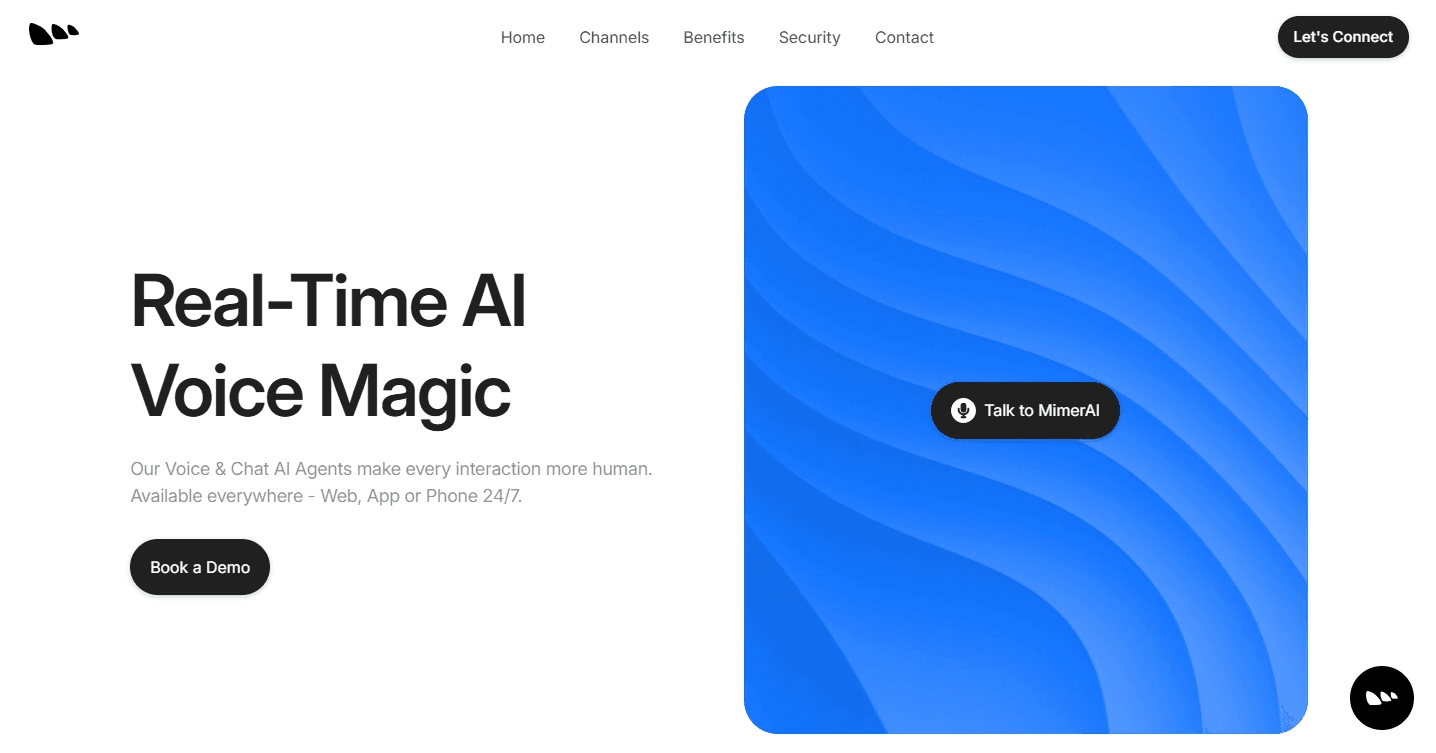
MimerAI
MimerAI offers real-time voice and chat AI agents designed to make any website or web application voice-interactive and humanize digital interactions. These AI agents can answer questions, book meetings, place orders, drive engagement, and handle phone calls without missing any. They are available 24/7 across all channels, including web, app, and phone, with widgets ready for deployment on any website. Powered by cutting-edge, proprietary voice AI technology, MimerAI ensures ultra-low latency, 99.99% uptime, and guaranteed security through self-hosted, end-to-end engineering, eliminating the need for third-parties. The platform supports all major languages and allows users to easily configure and deploy agents through its Studio.
Focal Systems
Focal Systems leverages AI and computer vision to revolutionize retail operations, offering real-time shelf intelligence and automation. The platform deploys AI-powered cameras to provide continuous visibility into product availability, enabling retailers to reduce out-of-stocks, minimize waste, and streamline inventory management. Key features include Computer Vision for comprehensive store monitoring, Shelf AI for optimizing availability and sales, and an Action Tool to translate insights into actionable tasks for staff. Focal also offers an Impact dashboard for measuring operational improvements, helping retailers enhance productivity, ensure compliance, and boost customer satisfaction. It's designed for grocery, convenience, pharmacy, and health and beauty stores.
Elook.AI
Elook.AI is an AI-powered platform designed for social mention monitoring and lead generation. It enables users to discover relevant discussions on Reddit, score potential leads based on engagement, and generate AI-powered response drafts to streamline communication. The tool aims to help businesses identify new opportunities, engage with their target audience effectively, and automate parts of their sales and marketing outreach. By focusing on social listening and AI-assisted lead nurturing, Elook.AI provides a comprehensive solution for enhancing customer engagement and driving growth.
wego
GitHub is a leading platform for software development, offering robust tools for version control, collaboration, and project management. It enables developers to host public and private repositories, automate CI/CD pipelines with GitHub Actions, and secure their code with features like Dependabot and Advanced Security. The platform supports various team sizes, from individual developers to large enterprises, providing features like code review, issue tracking, and instant dev environments with Codespaces. GitHub also offers AI-powered tools like Copilot for code creation and GitHub Models for integrating AI into workflows, making it a versatile solution for modern software development.

Brilliant Labs
Brilliant Labs is dedicated to fostering an open-source ecosystem, providing resources and tools for developers and creatives to innovate and shape the future. Their flagship product, Halo, is an open-source glasses platform designed for curious and creative individuals. Halo features a color microOLED display, bone conduction speakers, and an ultra low-power Alif B1 processor with a NPU for on-device AI. It includes an optical sensor for AI inference, microphones with audio activity detection, and a 6-axis IMU. Running on ZephyrOS with a Lua interface, Halo offers cross-platform mobile app connectivity and a cloud-based AI agent named Noa, which handles real-time, multimodal conversations and remembers past interactions to personalize experiences.
browser-agent
browser-agent is an open-source, vision-first browser agent developed by magnitudedev, designed to automate web tasks using natural language. It leverages vision AI to understand and interact with web interfaces, allowing users to control their browser with high-level commands. Key capabilities include navigating web pages, executing precise actions with mouse and keyboard, and intelligently extracting structured data based on DOM content and Zod schemas. The tool also features a built-in test runner with powerful visual assertions, making it suitable for web app testing and integration into CI/CD pipelines. Magnitude emphasizes a vision-first architecture to overcome the limitations of traditional browser agents that rely on numbered boxes, ensuring better generalization across complex modern sites and future-proofing for desktop applications.
BitBLAS
BitBLAS is an open-source library designed to facilitate efficient mixed-precision DNN model deployment on GPUs. It specializes in mixed-precision BLAS operations, particularly for $W_{wdtype}A_{adtype}$ quantization in large language models (LLMs). Key features include high-performance matrix multiplication for both GEMV and GEMM, supporting various mixed-precision types like FP16xFP8/FP4/INT4/2/1 and INT8xINT4/2/1. BitBLAS also offers auto-tensorization for TensorCore-like hardware instructions and provides integrations with popular frameworks such as PyTorch, GPTQModel, AutoGPTQ, vLLM, and BitNet-b1.58. Based on techniques from the "Ladder" paper, it allows for customizing mixed-precision DNN operations via a flexible DSL (TIR Script).
bitsandbytes
bitsandbytes is a powerful library designed to make large language models (LLMs) more accessible through k-bit quantization for PyTorch. It significantly reduces memory consumption during both inference and training, allowing for more efficient use of computational resources. The library provides three core features: 8-bit optimizers that use block-wise quantization to maintain 32-bit performance with reduced memory, LLM.int8() for 8-bit quantization enabling large language model inference with half the memory and no performance degradation, and QLoRA for 4-bit quantization, which facilitates LLM training with memory-saving techniques without compromising performance. It includes quantization primitives for 8-bit and 4-bit operations, along with 8-bit optimizers, making it an essential tool for developers working with large-scale AI models.
blitz-bayesian-deep-learning
BLiTZ is an Open Source Python library designed to facilitate the creation of Bayesian Neural Network layers within PyTorch. It enables users to introduce uncertainty into their models and quantify the complexity cost, adhering to principles from the "Weight Uncertainty in Neural Networks" paper. The library provides core weight sampler classes, allowing for extensibility and integration with various PyTorch layers. BLiTZ aims to simplify the process of implementing Bayesian Deep Learning, making it accessible for tasks like regression with confidence interval estimation, which can be crucial for more reliable decision-making in various applications.
Biomni
Biomni is a general-purpose biomedical AI agent designed to autonomously execute a wide range of research tasks across diverse biomedical subfields. It integrates cutting-edge large language model (LLM) reasoning with retrieval-augmented planning and code-based execution, enabling scientists to dramatically enhance research productivity and generate testable hypotheses. Biomni supports various LLM providers like Anthropic, OpenAI, Azure OpenAI, Gemini, and Groq, and can be configured via environment variables or a .env file. It features a data lake for biomedical information, a Gradio interface for interactive use, and configuration management for consistent settings. Additionally, Biomni can generate PDF reports of execution traces, supports Model Context Protocol (MCP) for external tool integration, and includes a Know-How Library of best practices. It also offers Biomni-R0, a specialized reasoning model for biology, and Biomni-Eval1, a comprehensive evaluation benchmark.
visualkeras
Visualkeras is a Python package designed to help visualize Keras and TensorFlow neural network architectures. It offers several rendering styles, such as classic layered CNN diagrams, general node-based visualizations, and LeNet-style feature map stack diagrams. The tool is highly customizable, allowing users to tailor visualizations to their specific needs. It supports both standalone Keras and TensorFlow-included Keras workflows, making it a versatile option for data scientists and machine learning engineers. Visualkeras simplifies the process of understanding complex model structures through clear and intuitive graphical representations.
bert-extractive-summarizer
bert-extractive-summarizer is an open-source Python library designed for extractive text summarization, building upon the HuggingFace Pytorch transformers library. The tool operates by first embedding sentences from the input text and then employing a clustering algorithm to identify and extract sentences closest to the cluster centroids, forming a concise summary. It also incorporates coreference resolution techniques, utilizing the neuralcoref library, to enhance the coherence and context of the generated summaries. Users can customize various parameters, including the number of sentences or ratio for the summary, and integrate custom models or Sentence-BERT for diverse summarization needs. The library supports GPU acceleration via CUDA by default if available, and offers a Flask service with Docker support for easy deployment.
BERT-NER
BERT-NER is an open-source tool leveraging Google's BERT model for named entity recognition (NER), specifically fine-tuned on the CoNLL-2003 dataset. This updated version addresses shortcomings of the original by providing clearer annotations and improved data preprocessing and layer design, making it easier for developers to implement and modify. Users can experiment with different layer designs, such as CRF or Softmax, to optimize performance. The repository includes all necessary files, such as BERT model components, data directories, and evaluation scripts, along with detailed instructions for usage. It offers strong performance metrics on the CoNLL-2003 test set, including high accuracy, precision, recall, and F1 scores for various entity types like LOC, MISC, ORG, and PER.
☆Stern Tech
Stern Tech develops scientifically validated behavioral AI solutions designed exclusively for human decision-support across various industries. Their technology analyzes behavior, not identity, and is fully owned, developed, and governed in France, ensuring compliance with GDPR and the EU Artificial Intelligence Act. The platform operates with human oversight, processes data privacy-preservingly and energy-efficiently, primarily on user devices, and makes no automated or autonomous decisions. Key products include Alex for securing hiring processes, Pegasus for rapid market insights, Shield for health center care, and WiseDriver for smarter driving. Stern Tech emphasizes trusted, ethical, and sovereign AI.
Google Gemini Pro 2 Latest 2025
Google Gemini Pro 2 Latest 2025 is presented as an AI chatbot hosted on Hugging Face Spaces. The application is designed to execute Python scripts provided as text via an environment variable named 'MY_SCRIPT_CONTENT'. Users are required to set this variable with their script's content for the application to function. However, the current status indicates that this Space is paused, meaning it is not actively running or available for use. To utilize this tool, users would need to request the author(s) to restart the Space through the community tab on Hugging Face.
cagent
cagent, developed by Docker Engineering, is an AI Agent Builder and Runtime designed for creating, running, and sharing intelligent AI agents. It leverages a declarative YAML configuration, eliminating the need for extensive coding. The platform supports a multi-agent architecture, enabling teams of specialized agents to collaborate and delegate tasks automatically. With a rich tool ecosystem, including built-in tools and integration with any MCP server, cagent offers flexibility. It is also AI provider agnostic, supporting major models like OpenAI, Anthropic, Gemini, AWS Bedrock, and Mistral. Key features include advanced reasoning capabilities with built-in think, todo, and memory tools, as well as pluggable RAG for retrieval. Agents can be packaged and shared via any OCI registry, making deployment and collaboration seamless.
Baichuan-7B
Baichuan-7B is a large-scale 7B parameter pre-training language model developed by BaiChuan-Inc. Based on the Transformer structure, it was trained on approximately 1.2 trillion tokens and supports both Chinese and English languages. The model features a context window length of 4096 and has demonstrated strong performance on standard Chinese and English benchmarks like C-Eval and MMLU. It includes optimizations for training stability and throughput, such as efficient operators, operator splitting, mixed precision, and communication optimizations, achieving high GPU peak compute utilization. The model also features an optimized tokenizer for Chinese language compression and improved mathematical capabilities.