
AI Agents & Automation
Browsing page 470 of AI Agents & Automation. Sorted by confidence score — our independent quality rating.
Opencord AI
Opencord AI is an AI-powered platform designed to automate and optimize social media lead generation. It continuously identifies target customers and personalizes interactions to significantly improve conversion rates. The tool focuses on providing 24/7 targeted social engagement, ensuring that businesses can maintain a constant presence and outreach without manual effort. By leveraging AI, Opencord AI aims to streamline the process of finding and engaging with potential customers, making it an efficient solution for sales teams and marketing managers looking to scale their outreach and drive growth.

agent-scan
Agent Scan is a robust security scanner designed for AI agents, Model Context Protocol (MCP) servers, and agent skills. It automatically discovers and inventories installed agent components, including harnesses, MCP servers, and skills, then scans them for common threats such as prompt injections, sensitive data handling, and malware payloads hidden in natural language. The tool supports a wide range of agents like Claude, Cursor, Windsurf, Gemini CLI, and Amazon Q, detecting over 15 distinct security risks. Agent Scan operates in both a CLI scan mode, generating detailed reports, and a background mode for continuous monitoring by security teams. It offers capabilities to scan specific MCP configurations or individual agent skill files, ensuring comprehensive coverage for AI agent security.
alluxio
Alluxio Open Source is a Distributed Caching Platform designed for large-scale data, specifically for analytics workloads. It acts as a data orchestration layer, allowing computation applications to connect to various storage systems through a common interface. Originating from UC Berkeley's AMPLab, Alluxio accelerates structured data analytics and is widely adopted with engines like Presto, Spark, and Trino. While the open-source edition is suitable for testing and small-scale production, the Enterprise Edition offers a decentralized metadata service for AI/ML workloads, supporting billions of files and providing FUSE-based POSIX integration for frameworks like PyTorch and TensorFlow.
chat-with-mlx
chat-with-mlx provides an all-in-one chat playground for Large Language Models (LLMs) specifically designed for Apple Silicon Macs, utilizing the MLX Framework. It prioritizes privacy by allowing users to chat with their favorite models and data securely on their local device. The tool offers easy integration with HuggingFace and MLX Compatible Open-Source Models, including popular options like Llama-3, Phi-3, Yi, Qwen, Mistral, Codestral, Mixtral, and StableLM. Installation is straightforward via pip or Conda, making it accessible for developers and enthusiasts. It features a unified memory model and dynamic graph construction, characteristic of the MLX framework, ensuring efficient performance without data transfers between CPU and GPU.
conformer
Conformer is an unofficial PyTorch implementation of the "Conformer: Convolution-augmented Transformer for Speech Recognition" model, originally presented at INTERSPEECH 2020. This tool is designed to leverage both Convolutional Neural Networks (CNNs) for local feature extraction and Transformers for capturing global interactions within audio sequences. By combining these architectures, Conformer achieves state-of-the-art accuracies in speech recognition tasks while maintaining parameter efficiency. The repository provides the core model code, allowing developers and researchers to integrate and train Conformer within their own speech processing pipelines. It requires Python 3.7 or higher, along with Numpy and PyTorch, and can be installed from the source code.
chatgpt-conversation
chatgpt-conversation is an open-source tool designed to facilitate voice-based conversations with ChatGPT. It allows users to speak their queries and receive spoken replies from the AI model, offering a more natural and accessible interaction method. The tool requires local installation of dependencies like espeak, ffmpeg, portaudio19-dev, and python3-pyaudio, primarily on Ubuntu. Users need to configure it with a session token and install Python requirements. Once set up, it supports continuous conversation, allowing users to respond to ChatGPT without interruption. Future plans include features like interrupting ChatGPT mid-speech, silencing PyAudio errors, and developing a web-app version for improved text-to-speech and broader accessibility.

Totoy
Totoy specializes in integrating state-of-the-art AI solutions into existing business processes, focusing on measurable profitability and employee satisfaction. They offer a comprehensive approach starting with a free AI workshop, followed by an in-depth potential analysis where specialists spend a day on-site. The process culminates in AI evaluation and implementation, delivering systems that save time and money. Totoy's solutions are developed and hosted in the EU, ensuring compliance with GDPR and AI Act regulations. They address various use cases including document management, customer support, administration, controlling, quality control, and knowledge management, providing tailored AI agents and systems.
diamond
DIAMOND (DIffusion As a Model Of eNvironment Dreams) is a cutting-edge reinforcement learning agent that operates entirely within a diffusion world model. This innovative approach allows the agent to learn and play in an autoregressive imagination of environments like Atari and Counter-Strike: Global Offensive. Recognized as a NeurIPS 2024 Spotlight, DIAMOND offers researchers and developers a powerful tool for exploring diffusion-based world models in reinforcement learning. It provides quick installation for pretrained models, options for launching training runs, and extensive configuration management via Hydra. Users can visualize policy play, human interaction, and dataset replays, making it a versatile platform for advanced AI research.
dictionariez
Dictionariez is a highly customizable, open-source browser extension designed to significantly enhance language learning. It allows users to double-click on any word on a webpage to instantly access its definition, translation, and pronunciation. Supporting over 20 languages, including English, Chinese, Japanese, Korean, German, Spanish, French, Italian, Portuguese, and Swedish, it integrates with more than 1000 dictionaries. Beyond quick lookups, Dictionariez provides text-to-speech functionality, translation services, and seamless integration with Anki for vocabulary retention. The extension also features auto-completion, word history, and keyboard shortcuts, making it a comprehensive tool for students and language enthusiasts alike. It is available on Chrome, Firefox, and Edge, with specialized versions like Ordböcker for Swedish learners and SidePal for a lighter side-panel experience.

Venta AI (YC S23)
Venta AI is an AI sales employee designed for sales teams in Europe, specializing in highly targeted and GDPR-compliant cold outreach. The platform identifies qualified leads from over 70 million companies based on individual criteria, moving beyond traditional job titles to find ideal buying personas. It automates extensive company data research, integrates with CRMs like HubSpot, Salesforce, and Pipedrive, and crafts AI-personalized messages for various channels. Venta AI ensures optimized email deliverability, LinkedIn automation, and even offers physical letter campaigns. It also monitors sales signals such as job postings, website visits, and news articles to identify opportune outreach moments, all while adhering strictly to EU data protection laws.
DREAMPlace
DREAMPlace is an open-source, deep learning toolkit-enabled VLSI placement tool designed for flexibility and efficiency in very large-scale integration (VLSI) design. It supports both CPU and GPU execution, achieving over 30X speedup in global placement and legalization compared to CPU implementations like RePlAce on ISPD 2005 benchmarks with a Nvidia Tesla V100 GPU. The tool integrates ABCDPlace, a GPU-accelerated detailed placer, which provides around 16X speedup on million-size benchmarks over NTUPlace3. Key features include multi-threaded CPU and optional GPU acceleration, net weighting, incremental placement, LEF/DEF support, and Python binding. It also supports timing optimization in global placement, fence regions, and deterministic modes.
gemma.cpp
gemma.cpp is a lightweight, standalone C++ inference engine specifically designed for Google's Gemma foundation models. It provides a minimalist implementation for Gemma 2-3 and PaliGemma 2 models, prioritizing simplicity and directness over full generality, making it suitable for experimentation and research. The engine supports CPU-only inference, offering features like sampling with TopK and temperature, and a backward pass (VJP) with Adam optimizer for Gemma research. It includes optimizations such as mixed-precision GEMM (fp8, bf16, fp32, fp64 bit), automatic runtime autotuning, and integrated weight compression. The project leverages the Google Highway Library for portable SIMD, ensuring efficient CPU inference. It offers C++ APIs with streaming for single and batched inference, a basic interactive command-line app, and Python bindings. gemma.cpp is designed to be easily embeddable in other projects with minimal dependencies and is highly modifiable, featuring a small core implementation.
Fregata
Fregata is a lightweight, super-fast, and large-scale machine learning library designed for Apache Spark. It offers high-level APIs in Scala, enabling developers and data scientists to build and deploy intelligent applications efficiently. A key differentiator is its ability to achieve higher accuracy and significantly faster convergence compared to MLLib, often training Generalized Linear Models in minutes for massive datasets. Fregata utilizes GSA SGD optimization, making it parameter-free by dynamically calculating appropriate learning rates. It supports Spark 1.x and 2.x with Scala 2.10 and 2.11, and includes algorithms like Trillion LR, Trillion SoftMax, and Logistic Regression. Its architecture is designed for seamless integration into existing Spark data processing workflows.
DeepBrain Chain
DeepBrain Chain is positioned as the world's first public artificial intelligence chain, aiming to create a decentralized AI infrastructure. The platform leverages blockchain technology to address the computational demands of AI by utilizing idle computing resources globally. This approach is designed to offer a more cost-effective solution for AI development while simultaneously enhancing data privacy through the implementation of smart contracts. By decentralizing AI computing, DeepBrain Chain seeks to provide a robust and secure environment for developers and organizations working on AI projects, ensuring both efficiency and data protection.
BemiDB
BemiDB is an open-source alternative to Snowflake and Fivetran, designed to centralize data without complex pipelines. It seamlessly connects to different data sources, syncing data in a compressed columnar format to S3. Its Postgres-compatible analytical query engine allows users to run complex queries up to 2000x faster than regular Postgres, making it ideal for high-speed analytical workloads. BemiDB integrates with existing Postgres tools and services, enabling querying data with BI tools, notebooks, and ORMs. It's packaged in a single Docker image with stateless processes for easy deployment and supports continuous data archiving from databases.
vlmrun-hub
vlmrun-hub is a comprehensive, open-source repository offering pre-defined Pydantic schemas specifically designed for extracting structured data from unstructured visual domains like images, videos, and documents. It is built for Vision Language Models (VLMs) and optimized for real-world use cases, simplifying the integration of visual ETL into various workflows. The hub addresses the common challenge of VLMs lacking strongly-typed, validated outputs for automation by providing schemas that ensure data conforms to expected types and structures, eliminating complex parsing and validation. Key benefits include ease of use, automatic data validation, type-safety, model-agnostic compatibility, and optimization for visual ETL across industries such as healthcare, finance, and retail.
csghub-server
csghub-server is the open-source backend server for CSGHub, a platform designed for managing large model assets. It facilitates the management of models, datasets, and other LLM assets through a robust REST API. Key features include the creation and management of users and organizations, automatic tagging of models and datasets, and comprehensive search functionalities. Users can also preview dataset files online, download individual files including LFS files, and track activity data like downloads and likes. The server supports extensible and customizable architectures, allowing integration with various Git servers and flexible configuration of LFS storage systems. It also enables on-demand content moderation and has a roadmap for supporting more Git servers, Git LFS, dataset online viewers, and model/dataset auto-tagging.
TurboDiffusion
TurboDiffusion is an open-source video generation acceleration framework designed to drastically reduce the time required for end-to-end diffusion generation. It boasts an impressive 100-200x acceleration on a single RTX 5090 GPU, all while preserving video quality. The framework achieves this efficiency through key technologies like SageAttention and SLA (Sparse-Linear Attention) for attention acceleration, combined with rCM for timestep distillation. It supports both text-to-video (T2V) and image-to-video (I2V) models, offering various checkpoints optimized for different resolutions and GPU memory configurations. Users can install it via pip or compile from source, with detailed instructions provided for both quantized and unquantized model inference.
Klu
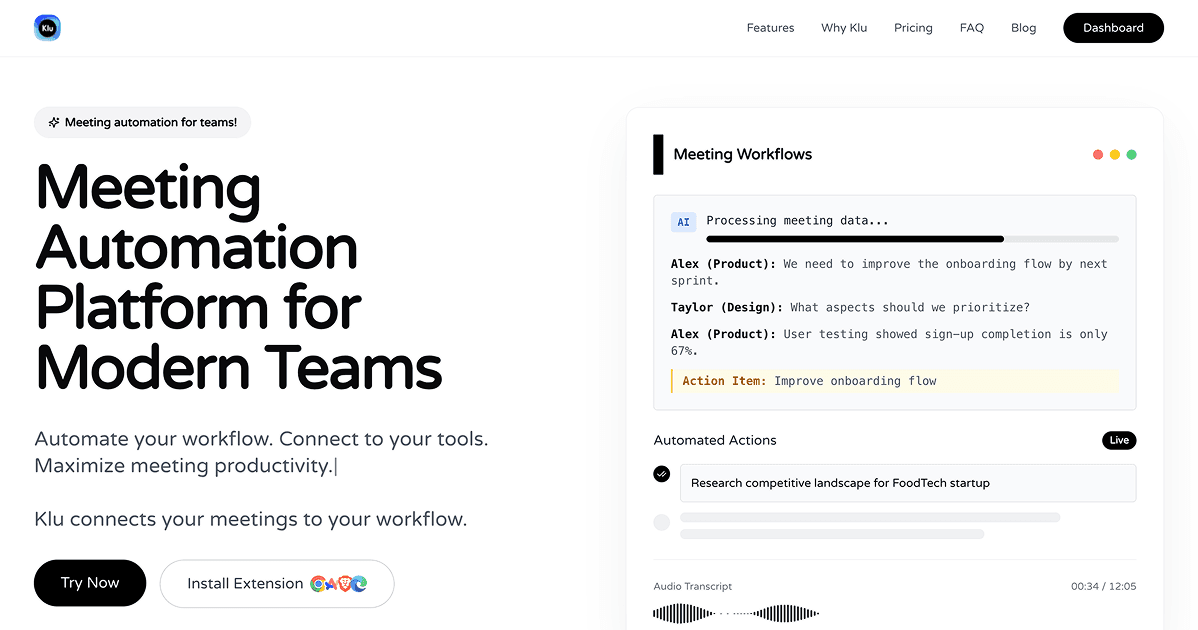
Klu is a meeting automation platform designed to enhance productivity for modern teams. It focuses on automating workflows and integrating with existing tools to streamline meeting management. The platform aims to help users take meeting notes with no effort, suggesting a focus on efficiency and ease of use. By connecting to various tools, Klu seeks to centralize meeting-related tasks and information, ultimately leading to more productive team interactions. Its core offering appears to be around simplifying the often-tedious aspects of meetings, allowing teams to concentrate on core discussions and decisions.
vulcan-sql
VulcanSQL is an open-source Analytical Data API Framework designed to simplify the creation of RESTful APIs from various data sources like databases, data warehouses, and data lakes. It addresses common pain points in traditional API development, such as time-consuming custom coding, integration complexity, security concerns, and scalability issues. By allowing users to insert variables into templated SQL, VulcanSQL generates SQL statements on the fly, making data accessible for AI agents and data applications. It utilizes DuckDB as a caching layer to boost query speed and reduce API response times. The framework supports flexible deployment options, including Docker, and offers features like OpenAPI document generation for standardization, ensuring easier integration and maintenance.
Ai Angels
AI Angels offers a platform for users to chat with over 70 AI angel girlfriends, providing romantic, supportive, and 24/7 NSFW AI companion experiences. Key features include persistent memory across conversations, uncensored chat, unlimited messaging, and real-time voice chat. Users can customize their AI girlfriend's personality, interests, appearance, and style. The platform also supports AI girlfriend image generation on demand and roleplay scenarios, aiming for realistic companions with emotional support capabilities. AI Angels differentiates itself with free unlimited messages and no content filters, unlike some alternatives.
ComfyUI-QwenVL
ComfyUI-QwenVL is a custom node designed to seamlessly integrate the powerful Qwen-VL series of vision-language models (LVLMs) from Alibaba Cloud into ComfyUI workflows. This includes support for the latest Qwen3-VL and Qwen2.5-VL models, as well as GGUF backends and text-only Qwen3 support. The tool provides advanced multimodal AI capabilities, facilitating efficient text generation, comprehensive image understanding, and detailed video analysis. Key features include automatic model downloading from Hugging Face, on-the-fly quantization (4-bit, 8-bit, FP16), and a flexible preset and custom prompt system. It offers both standard and advanced nodes for varying levels of user control, along with hardware-aware safeguards for FP8 model compatibility and SageAttention support for GPU-optimized performance.
Spaces To Github
Spaces To Github is a Hugging Face Space designed to help users convert their Hugging Face Spaces into GitHub repositories. This tool is particularly useful for developers and AI enthusiasts who want to manage their AI projects, models, and applications developed on Hugging Face within a GitHub environment. While the live website indicates a runtime error, the intention of the tool is to bridge the gap between the Hugging Face ecosystem and GitHub, allowing for better version control, collaboration, and deployment workflows for AI-driven applications. It aims to streamline the process of moving projects between these two popular platforms.
logfire
Logfire is an AI observability platform designed for production LLM and agent systems, built by the team behind Pydantic Validation. It offers a simple and powerful dashboard that provides Python-centric insights, including rich display of Python objects, event-loop telemetry, and profiling of Python code and database queries. Users can query their data using standard SQL, leveraging existing BI tools. Logfire is an opinionated wrapper around OpenTelemetry, supporting all OpenTelemetry signals (traces, metrics, and logs) and enabling integration with existing tooling and infrastructure. It also features deep Pydantic integration to understand data flow through models and provides built-in validation analytics. The platform's SDKs are open source, while the server application and UI are closed source, with an enterprise license available for self-hosting.