
AI Agents & Automation
Browsing page 482 of AI Agents & Automation. Sorted by confidence score — our independent quality rating.
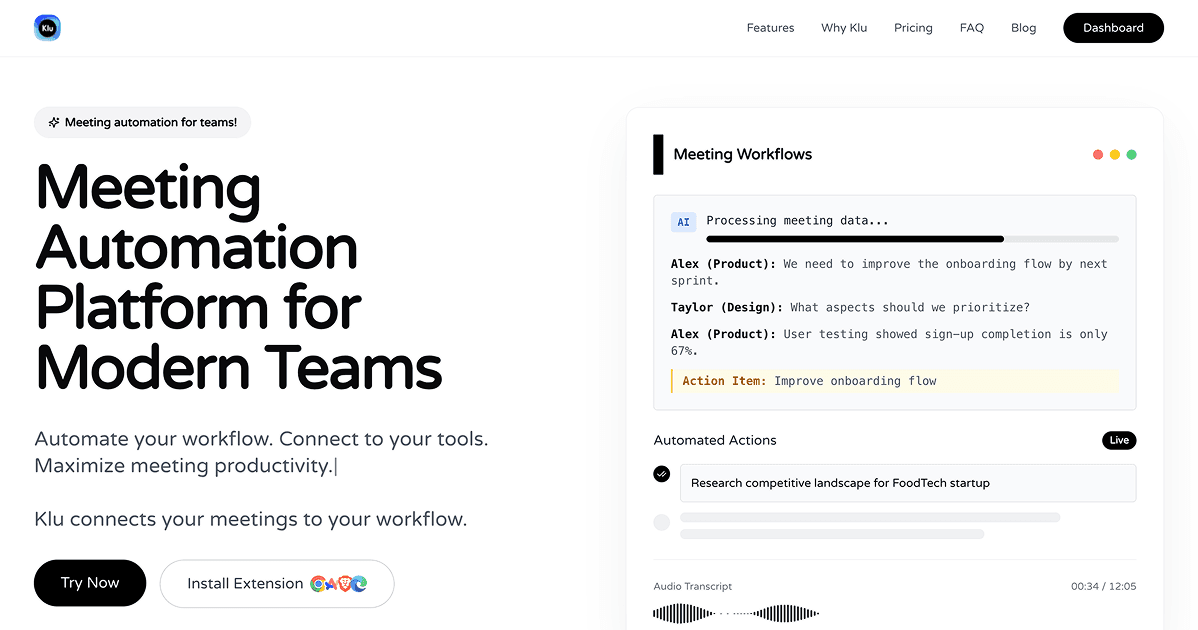
Klu
Klu is a meeting automation platform designed to enhance productivity for modern teams. It focuses on automating workflows and integrating with existing tools to streamline meeting management. The platform aims to help users take meeting notes with no effort, suggesting a focus on efficiency and ease of use. By connecting to various tools, Klu seeks to centralize meeting-related tasks and information, ultimately leading to more productive team interactions. Its core offering appears to be around simplifying the often-tedious aspects of meetings, allowing teams to concentrate on core discussions and decisions.

tiny-dnn
tiny-dnn is a C++14 implementation of deep learning, designed for environments with limited computational resources, such as embedded systems and IoT devices. It stands out as a header-only and dependency-free framework, meaning there's nothing to install beyond a C++14 compiler. This makes it highly portable and easy to integrate into existing applications. The framework supports a variety of network layers, activation functions, loss functions, and optimization algorithms, allowing for the construction of diverse deep learning models. It offers reasonable speed without a GPU, leveraging TBB threading and SSE/AVX vectorization. Additionally, tiny-dnn can import models from Caffe and provides a simple, exception-free operational model, making it a good choice for learning neural networks.
kornia
Kornia is a differentiable computer vision library built on PyTorch, designed for spatial AI applications. It offers a comprehensive suite of differentiable image processing and geometric vision algorithms, allowing users to leverage powerful batch transformations, auto-differentiation, and GPU acceleration. Key features include a wide range of image processing operators like filters, transformations, and enhancements, as well as advanced augmentation pipelines for training AI models. Kornia also provides access to pre-trained AI models for tasks such as face detection, feature matching, segmentation, and classification. The library is expanding its focus towards end-to-end vision models, with a particular emphasis on integrating state-of-the-art Vision Language Models (VLM) and Vision Language Agents (VLA). It supports multi-framework usage, including TensorFlow, JAX, and NumPy, making it a versatile tool for developers and researchers in the AI and computer vision fields.
kokoro-tts
kokoro-tts is an open-source command-line interface (CLI) text-to-speech tool built on the Kokoro model, designed to convert text into natural-sounding speech. It offers extensive language and voice support, including the ability to blend multiple voices with customizable weights for unique audio outputs. The tool can process various input formats such as TXT, EPUB books, and PDF documents, automatically extracting chapters for organized output. Users can stream audio directly, adjust speech speed, and save output in WAV or MP3 formats. It also supports GPU acceleration for faster processing and provides detailed debug output for troubleshooting, making it a versatile solution for generating audio content from diverse text sources.

Chat AI Assistant - Watch chat
Amazing eLearning provides an innovative online platform focused on AI and cryptocurrency education. Their free ChatGPT Bootcamp for beginners covers ChatGPT fundamentals, prompting skills, and how to effectively use AI tools. The platform aims to empower individuals to elevate their skills and unlock the potential of AI and crypto. Courses are designed for various skill levels, with some requiring basic tech knowledge and others suitable for complete beginners. The bootcamp is 100% free with no subscription required, offering practical skills and hands-on exercises, though it does not currently provide a certificate. Course durations vary, from a few hours to several weeks, depending on the topic's complexity.
pyttsx3
pyttsx3 is a text-to-speech (TTS) conversion library specifically designed for Python, offering the unique advantage of offline operation. Unlike many other TTS solutions that require an internet connection, pyttsx3 enables developers to integrate speech synthesis directly into their Python applications, making it ideal for environments with limited or no connectivity. The library supports a variety of voices and languages, providing flexibility for different project requirements. Its offline capability makes it a robust choice for applications where real-time, independent speech generation is crucial, such as embedded systems, local desktop applications, or projects requiring enhanced privacy.
DirectedDiffusion
DirectedDiffusion is presented as a Hugging Face Space application, indicating it's a web-based AI tool. While the specific functionalities are not detailed on the live page, the context of Hugging Face Spaces suggests it likely involves machine learning models, potentially for tasks like content generation or automation, as hinted by its previous description. The tool is built using Gradio, a popular Python library for creating user interfaces for machine learning models, making it accessible via a web browser. It operates under an MIT license, which typically allows for broad use, modification, and distribution.
kedro
Kedro is an open-source Python framework designed for building production-ready data engineering and data science pipelines. It emphasizes software engineering best practices to ensure pipelines are reproducible, maintainable, and modular. Key features include a project template based on Cookiecutter Data Science, a Data Catalog for connecting to various data sources and versioning, and pipeline abstraction for automatic dependency resolution and visualization with Kedro-Viz. Kedro also supports coding standards like test-driven development with pytest and flexible deployment strategies, including integration with Argo, Prefect, Kubeflow, AWS Batch, and Databricks. It aims to address the shortcomings of one-off scripts and Jupyter notebooks by promoting team collaboration and efficiency through modular, reusable analytics code.
TrueLark
TrueLark is an AI-powered virtual receptionist solution designed to help businesses, particularly those in the healthcare sector, manage patient interactions around the clock. It automatically engages with patients through web chat and real-time text responses to missed calls, ensuring no revenue opportunities are lost. The platform allows patients to book appointments via text or website at any time, filling schedules even after hours. TrueLark integrates with existing systems to add bookings directly to calendars and can handle emergency calls with speed and effectiveness. By automating routine tasks like answering FAQs and scheduling, TrueLark reduces staff burnout and allows teams to focus on direct patient care, improving overall patient experience and practice efficiency.
Keras-Project-Template
Keras-Project-Template is an open-source project template designed to streamline the development and training of deep learning models with Keras. It offers a clear, structured architecture, including predefined folders for models, trainers, data loaders, and configurations, simplifying project organization. The template supports checkpointing and TensorBoard visualization for monitoring training progress. A key feature is its integration with Comet.ml, enabling comprehensive experiment tracking, including hyper-parameters, metrics, and graphs, with real-time updates. This allows developers to easily manage and compare different model iterations and configurations, enhancing the efficiency of deep learning research and development.
Trinity-RFT
Trinity-RFT is a comprehensive, open-source framework designed for the reinforcement fine-tuning (RFT) of large language models (LLM). It offers a general-purpose, flexible, and scalable solution by decoupling the RFT process into three core components: Explorer for generating experience data, Trainer for updating model weights, and Buffer for managing data pipelines. This architecture supports various RFT modes, including synchronous/asynchronous, on-policy/off-policy, and online/offline RL, allowing for independent scaling of rollout and training. Trinity-RFT also provides robust support for agentic RL workflows, full-lifecycle data pipelines with active data management, and a user-friendly design with plug-and-play modules and graphical interfaces. It supports a wide array of algorithms like PPO, GRPO, DPO, and CHORD.

Simposcan Scanner App PDF OCR
Simposcan Scanner App PDF OCR is a mobile application designed to turn your smartphone into a powerful scanning device. It enables users to easily scan and organize various types of documents, including receipts and pictures, directly from their mobile device. The app supports conversion of scanned items into multiple formats such as PDF, JPG, CSV, and FAX, offering flexibility for different needs. Users can also conveniently share their digitized files through popular messaging applications or other sharing methods. This tool aims to simplify document management and sharing for individuals and small businesses.
Insect Identifier: Bug Finder
HeritCoin is an AI-powered mobile application designed for coin collectors, numismatists, and enthusiasts to identify and learn about coins. The app boasts a high recognition accuracy of 99.9% and covers over 195 nations. Users can upload or take pictures of coins for identification. Beyond AI recognition, HeritCoin provides an expert appraisal service with authoritative numismatic experts for more precise evaluations and condition assessments, especially for rare or unconventional currency. It also allows users to create a 3D collection and wishlist to showcase their coins. The app supports multiple languages and offers a user-friendly experience without mandatory sign-up, binding accounts to Apple ID or Google accounts for security.
Bender
Bender is an open-source abstraction layer built over MetalPerformanceShaders, designed to simplify the development and execution of neural networks on iOS devices. It addresses the growing need to run AI models directly on mobile devices, even if the training was done elsewhere. Bender provides an intuitive way to define and run neural networks using common layers like Convolution, Pooling, and FullyConnected. A key feature is its ability to load models trained in other frameworks, such as TensorFlow, by translating them into Bender layers. This eliminates the need to include TensorFlow's static library or rely solely on CPU execution, enabling GPU-accelerated inference on iOS. It aims to make on-device AI more accessible and performant for developers.
matgl
MatGL (Materials Graph Library) is an open-source graph deep learning library specifically designed for materials science. It leverages mathematical graphs to represent atomic collections, allowing for the development of surrogate models that consistently deliver exceptional performance in predicting material properties. The library aims to be an extensible platform for creating and sharing materials graph deep learning models. MatGL includes implementations of various architectures such as M3GNet, MEGNet, CHGNet, QET, and TensorNet, with a transition towards PyTorch Geometric (PyG) as the default backend. It offers pre-trained models, a command-line interface for quick relaxations and predictions, and integration with Hugging Face Hub for model sharing and loading. MatGL is a collaborative effort between Materialyze.AI and Intel Labs, forming part of the broader MatML ecosystem.
eli5
eli5 is a Python package designed to help debug and inspect machine learning classifiers, providing explanations for their predictions. It supports a wide range of machine learning frameworks, including scikit-learn, Keras (for Grad-CAM visualizations), xgboost, LightGBM, CatBoost, and lightning. The library can explain weights and predictions of linear classifiers, print decision trees, show feature importances, and debug scikit-learn pipelines. Additionally, eli5 implements algorithms for inspecting black-box models, such as TextExplainer for LIME-based explanations and permutation importance for feature importances. Explanations can be formatted for console display, HTML embedding, pandas DataFrames, or JSON for custom rendering.
Gradio Discord Bot Server
The Gradio Discord Bot Server provides a seamless way to integrate Hugging Face Spaces into Discord, transforming how users interact with AI models. By simply typing the space's name, users can load various AI applications directly into their Discord server. The bot facilitates making predictions by enclosing inputs in quotes and offers the ability to view statistics related to the interactions. This tool is ideal for developers and community managers looking to bring AI capabilities and interactive experiences directly into their Discord communities without extensive coding, fostering engagement and making AI more accessible.
T-MAC
T-MAC is an open-source AI Frameworks & Infra tool specifically designed for efficient low-bit Large Language Model (LLM) inference on CPU/NPU architectures. It utilizes a lookup table approach to accelerate the execution of LLMs, making it suitable for deployment on resource-constrained devices. The tool supports models like BitNet and offers a significant advantage over traditional dequantization-based methods by providing faster inference speeds. T-MAC aims to optimize the performance of AI models in environments where computational resources are limited, making advanced AI capabilities more accessible and practical for a wider range of applications.
Trainon
Trainon is a free AI-powered running coach designed to help runners of all levels achieve their personal best. It provides personalized adaptive training plans tailored to individual goals, fitness levels, and target races. The platform offers instant AI run analysis, giving users feedback on their performance and adjusting future workouts accordingly. Trainon seamlessly syncs with Strava, automatically importing running, trail running, and hiking activities for comprehensive tracking and analysis. Key features include accurate race predictions, progress tracking, and analytics, all aimed at structuring workouts, monitoring progress, and maintaining motivation. The platform is accessible via web and behaves like an app when added to a phone's homescreen.
All-in-One Chrome Extension
HelixScribe is an AI-powered content creation software designed to help small businesses and marketers generate high-quality, on-brand content efficiently. It offers both a self-service platform for hands-on marketers to create blogs, social media posts, and emails, and done-for-you content creation and marketing services for time-strapped businesses. The platform incorporates AI behavior research to ensure consistent and predictable output, focusing on SEO-optimized content with built-in keyword strategies. HelixScribe aims to provide marketing-ready content without constant editing, integrating audience insights and practical marketing experience to drive engagement and performance.
sumo-rl
sumo-rl is an open-source tool designed to simplify the creation and management of Reinforcement Learning (RL) environments for Traffic Signal Control using SUMO. It offers a straightforward interface, ensuring compatibility with widely used RL libraries and frameworks such as Gymnasium, PettingZoo, stable-baselines3, and RLlib. The tool supports both single-agent and multi-agent RL scenarios, allowing for flexible experimentation. Users can easily customize observation spaces and reward functions to suit their specific research or application needs. sumo-rl is particularly useful for developers and researchers focused on advancing AI agents for traffic management and optimization, providing a robust platform for simulating and evaluating different control strategies.

AI Cartoon Avatar: Cartoonly
AI Cartoon Avatar: Cartoonly is an intuitive iOS mobile application designed to effortlessly transform your photos into captivating cartoon, anime, or sketch-style artwork. This all-in-one AI cartoon maker allows users to convert selfies, portraits, or any image into a personalized digital avatar with just a single tap. Whether you want to become a hand-drawn fantasy character or embody your favorite comic hero, Cartoonly provides a fun and easy way to personalize your digital presence. The app focuses on speed and simplicity, making the process of creating unique and vibrant cartoon avatars accessible to everyone, without requiring any artistic skills.
SwanLab
SwanLab is an open-source, modern-design AI training tracking and visualization tool built for AI model training teams. It provides comprehensive features for experiment analysis, metric observation, and collaboration. Researchers can track key metrics, record hyperparameters, and visualize training processes through an intuitive UI, helping to identify issues and accelerate model iteration. SwanLab supports a wide range of data types including scalar metrics, images, audio, text, video, 3D point clouds, and biochemical molecules, along with various chart types like line, media, bar, and custom ECharts. It offers both cloud and self-hosted deployment options and integrates with over 50 mainstream frameworks, including PyTorch, Transformers, and Keras. Key functionalities include experiment comparison, multi-person collaboration, hardware monitoring, and an open API for extended capabilities.
Myiq Ai
Myiq Ai is an AI-powered invoice automation solution designed to streamline and enhance the efficiency of invoice processing. This tool focuses on automating various aspects of accounts payable and bookkeeping tasks, aiming to reduce manual effort and improve accuracy. By leveraging artificial intelligence, Myiq Ai helps businesses manage their invoices more effectively, from receipt to payment. It is built to address common challenges in financial operations, such as data entry errors and slow processing times, ultimately contributing to more organized and efficient financial management.