
AI Agents & Automation
Browsing page 595 of AI Agents & Automation. Sorted by confidence score — our independent quality rating.

GPTDrive
RecordAi is an innovative AI tool designed to act as a personal memory assistant, accessible directly through WhatsApp. It allows users to chat with the AI to record and organize information, ensuring that important details, ideas, or tasks are not forgotten. This integration with WhatsApp makes it incredibly convenient and fast for users to interact with the AI, leveraging a platform they already use daily. The tool aims to simplify organization and information recall, providing a seamless experience for managing daily notes and reminders without needing to switch between multiple applications. It's ideal for anyone looking for an effortless way to keep track of their thoughts and conversations.
ChatGPT File Uploader
Audo specializes in building custom software solutions for enterprise clients, providing a senior engineering team based in California. Their services encompass application engineering for native and web applications (iOS, Android, Next.js), interface design including UI and design systems, and data & analytics for dashboards and BI tools. Additionally, Audo develops custom internal tools like CRMs and platforms, and offers comprehensive security services such as application security audits and penetration testing. They emphasize building tailored solutions that are never off-the-shelf, ensuring applications are architected for scale and observability.
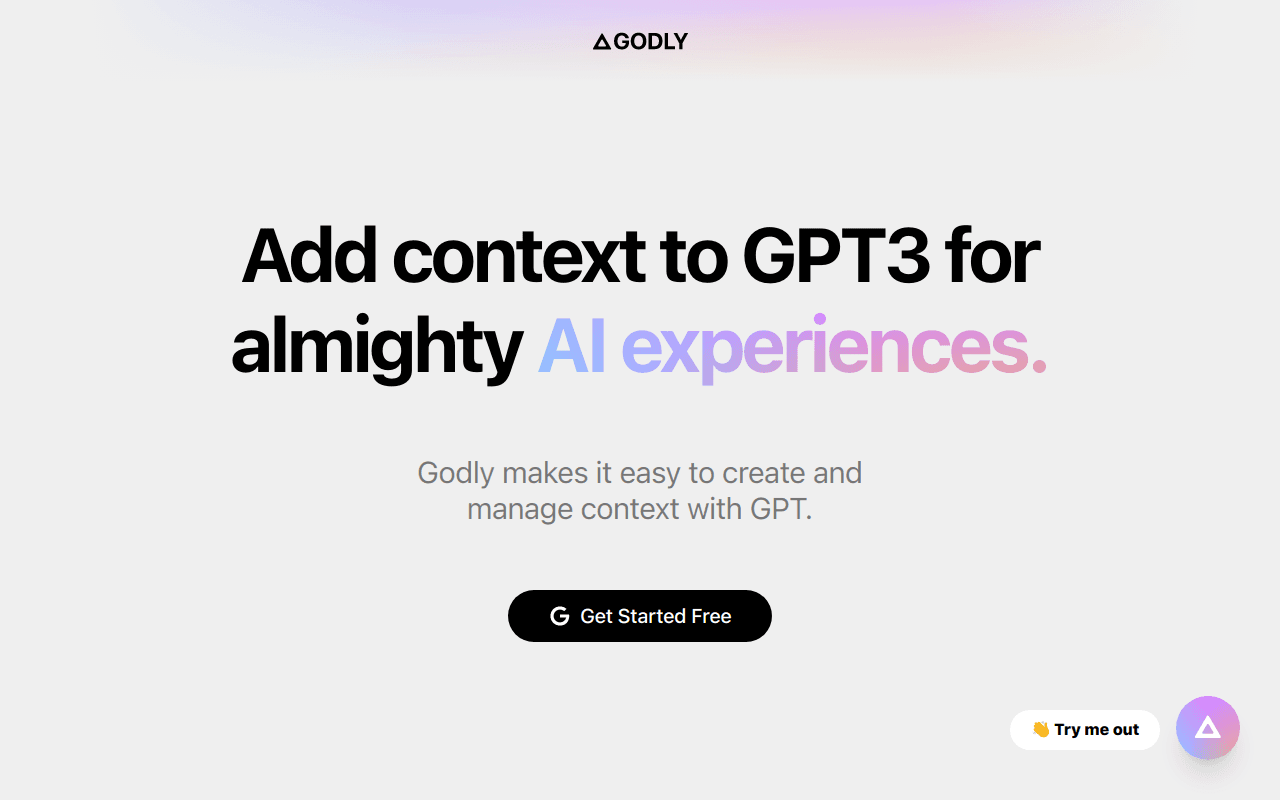
Godly
Godly was an AI tool that aimed to enhance the performance of GPT models by providing instant context to user prompts. Its core functionality was to magically append relevant information, thereby moving beyond generic AI responses to more personalized and accurate completions. The tool leveraged OpenAI's embedding model to achieve this contextual integration. However, as of 2023, Godly has been sunset, and its service is no longer operational. All functionality has been discontinued, and the website explicitly states that the service is no longer running.
WavLM Speaker Verification
WavLM Speaker Verification is an AI tool developed by Microsoft that leverages the WavLM model for speaker identity verification. This technology is designed to enhance security systems and facilitate the development of robust voice authentication applications. While the live website currently displays a runtime error, the underlying purpose of the tool is to provide a reliable method for distinguishing between different speakers based on their voice characteristics. This capability is crucial for applications requiring secure access control or personalized user experiences through voice recognition.
SEED-Bench Leaderboard
SEED-Bench Leaderboard is a platform designed for evaluating and comparing the performance of various AI models. Users can submit their model evaluation results in JSON format, providing details such as the model name, type, size, and the evaluation method used. The platform then analyzes and displays the model's performance on a public leaderboard. This tool serves as a centralized hub for researchers and developers to track advancements and benchmark their models against others in the AI field. While the current live website indicates a build error, the intended functionality is to facilitate transparent and comparable evaluation of AI models.
docker-airflow
docker-airflow is an open-source tool that offers a Docker image for Apache Airflow, a robust platform designed for programmatically authoring, scheduling, and monitoring complex workflows. This tool significantly streamlines the setup process for Airflow, allowing users to easily deploy and manage their data pipelines within consistent Dockerized environments. It supports various executors like SequentialExecutor, LocalExecutor, and CeleryExecutor, and provides options for integrating custom Airflow plugins and Python dependencies. Users can configure Airflow settings and connections via environment variables, making it highly adaptable for different operational needs.
geckoview
GeckoView is an open-source project by Mozilla, offering a robust set of components for embedding the Gecko browser engine into Android applications. This allows developers to seamlessly integrate web content rendering capabilities directly within their native Android apps, providing a consistent and powerful browsing experience. The project emphasizes customizability, enabling developers to tailor the web view to their specific application needs. It is a foundational technology for applications like Firefox for Android, providing a secure and performant way to display web content. The GitHub repository serves as the documentation hub, guiding contributors and users on how to get started and utilize its features.
wespeaker
wespeaker is a comprehensive, open-source toolkit primarily focused on speaker embedding learning, with applications in speaker verification, recognition, and diarization. It supports both online feature extraction and the loading of pre-extracted features in Kaldi format. The toolkit offers command-line and Python programming interfaces for tasks like embedding extraction, similarity computation, and diarization. It boasts continuous development with recent updates including support for various models like w2v-bert2, Xi-vector, SimAM_ResNet, and Whisper-PMFA, as well as advanced features like quality-aware score calibration and MNN inference engine integration. wespeaker also provides detailed recipes for popular datasets like VoxCeleb, CnCeleb, and NIST SRE16, making it a robust solution for researchers and developers in the speech technology domain.
YOLOv11-RGBT
YOLOv11-RGBT offers a comprehensive single-stage multispectral object detection framework, extending the capabilities of YOLO models (from YOLOv3 to YOLOv13) and RTDETR to handle RGBT (Red, Green, Blue, Thermal) data. This project simplifies the configuration of visible and infrared datasets for multimodal object detection tasks, providing three distinct configuration methods. It supports multi-spectral object detection, keypoint detection, and instance segmentation. The framework is adaptable to various pixel-aligned images, including depth maps and SAR images, not just multispectral. Key features include support for TIFF images, 16-bit multi-spectral datasets with arbitrary channels, and various image formats like Gray, BGR, RGBT, and Multispectral with flexible channel configurations.
Timmy App
Timmy App is a domain name currently listed for sale on HugeDomains.com. The website content indicates that the domain is available for a one-time purchase of $4,295 or through a 24-month payment plan at $178.96 per month. HugeDomains.com offers a 30-day money-back guarantee and secure shopping with SSL encryption. They also provide quick delivery of the domain, typically within one to two hours of purchase, and offer zero percent financing for payment plans. The purchase includes only the domain name, with email packages and hosting services needing to be acquired separately.
ner-annotator
ner-annotator is a specialized Named Entity Recognition (NER) annotation tool designed to create training data for custom NER models with SpaCy. It provides an intuitive user interface for labelling entities in text, supporting both word-level and character-level annotation. Users can define custom labels with color-coding for enhanced clarity. The tool generates training data in a generic JSON format, making it readily usable for various tagging formats like IO, IOB, or IOBES. While no longer actively maintained, the web application and desktop versions (Linux and Windows) remain fully functional, offering features like keyboard shortcuts and the ability to import existing annotations for review. It also includes light and dark themes for user preference.
Intrascope
Intrascope offers a secure and collaborative AI workspace designed for teams, centralizing the management of AI models, API keys, and project manifests. It allows multiple users to interact with advanced AI models like OpenAI, DeepSeek, Gemini, Anthropic, and xAI within a shared environment. Each team member has their own login and chat history, while working within a unified team context. The platform features structured projects, contextual prompts called manifests, user-level control, project-based histories, and token usage monitoring. Administrators can invite and manage users, create manifests, monitor token usage, and control API providers, ensuring full visibility and cost control over team AI usage.
Trading-Gym
Trading-Gym is an open-source project designed for the development and testing of reinforcement learning algorithms within the context of financial trading. It offers a flexible environment, currently featuring a SpreadTrading environment, which allows users to trade spreads based on bid and ask price time series for multiple products. A key feature is its generic data feeding mechanism, enabling users to create custom DataGenerators to input diverse price data. The environment's state includes prices, entry price, and position (long, short, or flat). Trading-Gym's API is inspired by OpenAI Gym, aiming for full compatibility to integrate as an additional OpenAI environment, making it accessible for researchers and developers familiar with the OpenAI Gym framework.
TextGrocery
TextGrocery is an efficient short-text classification tool built upon the LibLinear library. It is designed to categorize text quickly and accurately, making it suitable for tasks like classifying news titles or other brief content. A key feature is its integration with Jieba, providing robust support for Chinese tokenization, which is crucial for processing Chinese language texts. The tool demonstrates superior performance compared to scikit-learn's SVM and Naive Bayes classifiers in terms of both accuracy and processing time, as shown in benchmarks with news title datasets. TextGrocery offers a straightforward API for training models from lists or files, saving and loading models, and performing predictions and tests, making it accessible for developers and data scientists working with text classification.
SEAM
SEAM (Self-supervised Equivariant Attention Mechanism) is an open-source implementation designed for weakly supervised semantic segmentation. This tool addresses the challenge of generating accurate object masks from image-level supervision, a common limitation in advanced class activation map (CAM) solutions. SEAM introduces a self-supervised approach by enforcing consistency regularization on predicted CAMs across various transformed images, effectively narrowing the gap between full and weak supervisions. Additionally, it incorporates a pixel correlation module (PCM) to refine predictions by leveraging context appearance information and similar neighbors. Extensive experiments on the PASCAL VOC 2012 dataset demonstrate SEAM's superior performance compared to state-of-the-art methods using the same level of supervision, making it a valuable resource for AI researchers and computer vision engineers.
StreamPETR
StreamPETR is an official implementation of a research paper accepted by ICCV 2023, focusing on exploring object-centric temporal modeling for efficient multi-view 3D object detection. This open-source tool provides a robust framework for researchers and developers working in the field of computer vision and autonomous driving. Key features include support for StreamPETR, PETR, and Focal-PETR codebases, flash attention, deformable attention (RepDETR3D), and checkpoints. It also offers functionalities like sliding window training, efficient training in streaming video, TensorRT inference, and 3D object tracking. The repository provides detailed documentation for environment setup, data preparation, and training/inference procedures, along with model zoo results on NuScenes validation and test sets.
nitrain
Nitrain (formerly torchsample) is a framework-agnostic Python library designed for medical image analysis, enabling efficient training of AI models. It provides robust functionalities for sampling and augmenting medical images, supporting various frameworks like PyTorch, TensorFlow, and Keras. The library simplifies model training by offering reasonable defaults and a high level of abstraction. Users can visualize results within a medical imaging context, making it a comprehensive tool for medical imaging AI development. Full examples for segmentation, classification, and registration tasks are available, and it integrates with the ANTsPy package for advanced medical image processing.
PyGCL
PyGCL is a PyTorch-based open-source library specifically designed for Graph Contrastive Learning (GCL). It provides a comprehensive framework for researchers and developers to implement and experiment with various GCL algorithms. The library features modularized GCL components, including graph augmentation techniques like Edge Adding, Feature Masking, and Node Dropping, as well as different contrasting architectures and modes (single-branch, dual-branch, bootstrapped, within-embedding). PyGCL also implements a variety of contrastive objectives such as InfoNCE, JSD, and Barlow Twins, alongside negative sampling strategies. It supports standardized evaluation with evaluators like Logistic Regression and SVM, and offers utilities for managing experiments, making it a valuable tool for advancing graph representation learning.
pytorch-pose
pytorch-pose is an open-source PyTorch toolkit designed for 2D single human pose estimation. It offers a comprehensive pipeline for training, inference, and evaluation, making it a valuable resource for researchers and developers in computer vision. The toolkit includes a robust dataloader with various data augmentation options, compatible with popular human pose databases such as MPII, LSP, and FLIC. Key features include multi-thread data loading, multi-GPU training support, a logger for tracking progress, and visualization of training and testing results. It is compatible with PyTorch 0.4.1/1.0 and provides detailed instructions for installation, data preparation, and usage, including testing with pre-trained models and evaluating PCKh@0.5 scores.
python-docx2txt
python-docx2txt is a pure Python-based utility designed for extracting text and images from DOCX files. This open-source tool is adapted from python-docx but extends its capabilities to include content from headers, footers, and hyperlinks, offering a more comprehensive extraction solution. It can be run both from the command line for quick processing or integrated into Python scripts for automated document handling. Users can specify a directory to save extracted images, making it useful for tasks requiring both textual and visual data from DOCX documents. Its straightforward installation via pip and simple usage make it accessible for developers and data scientists working with document processing.
Online-3D-BPP-PCT
Online-3D-BPP-PCT is an open-source tool that implements a method for efficient online 3D bin packing. It leverages deep reinforcement learning (DRL) on a hierarchical packing configuration tree to enhance the practical applicability of the online 3D Bin Packing Problem (BPP). This approach makes the DRL model adept at dealing with practical constraints and performing well even in continuous solution spaces. Key features include arbitrary container and item sizes, support for continuous online 3D-BPP, algorithms for approximating stability, and improved performance with complex constraints. It also offers more adequate heuristic baselines for domain development and stable training.
Online-3D-BPP-DRL
Online-3D-BPP-DRL is an open-source project that provides the implementation of the paper "Online 3D Bin Packing with Constrained Deep Reinforcement Learning." This tool is designed for researchers and developers interested in optimizing 3D bin packing problems using AI. It allows users to train new models on randomly generated sequences or test existing models with various data sets. The repository includes code for user-study applications, multi-bin algorithms, and MCTS for comparison, offering a comprehensive environment for experimentation and development in this domain. Users can adjust network architectures and parameters to suit their specific needs, making it a flexible platform for advanced AI research in logistics and optimization.
Hunyuan3D Part
Hunyuan3D Part is an AI tool developed by Tencent, available through Hugging Face Spaces, designed for advanced 3D model analysis. Users can upload 3D models in common formats such as GLB, PLY, or OBJ. The tool's primary function is to segment these models into their constituent parts, providing a detailed breakdown of the object's composition. Beyond simple segmentation, it generates comprehensive part compositions and offers both segmented and exploded views of the model, which can be invaluable for design, engineering, or educational purposes. The platform currently appears to be experiencing a runtime error, preventing its full functionality from being accessed.
uTox
uTox is a lightweight and secure Tox client, providing peer-to-peer, end-to-end encrypted instant messaging. It supports a range of features including text chat, audio and video calls (with webcam or desktop sharing), file transfers with inline image support, and group chats. The client is cross-platform, with primary support for Windows 7+ and Linux, and secondary support for OpenBSD, FreeBSD, NetBSD, and DragonFlyBSD. While macOS support is currently unmaintained, uTox offers multi-lingual support with complete translations for several languages. It also includes themes, avatars, and chat history. As alpha software, users may encounter bugs, and contributions are encouraged.