
AI Agents & Automation
Browsing page 81 of AI tools for Workflow Agents in AI Agents & Automation. Sorted by confidence score — our independent quality rating.

OmAgent
OmAgent is a Python library designed to simplify the development of multimodal language agents. It abstracts away complex engineering challenges such as worker orchestration, task queues, and node optimization, providing a straightforward interface for defining agents. The library supports various multimodal interactions, including native integration with VLM models, real-time APIs, computer vision models, and mobile device connections. This enables developers and researchers to build agents that can process and reason over diverse inputs like text, images, video, and audio. OmAgent also offers a flexible agent architecture with a graph-based workflow orchestration engine and multiple memory types for contextual reasoning. It includes state-of-the-art unimodal and multimodal agent algorithms like ReAct, CoT, and SC-CoT, and supports local model deployment via Ollama or LocalAI, alongside a fully distributed architecture with custom scaling options.

Wobby
Wobby equips teams with AI Analysts that deliver business-ready insights directly from data warehouses. It translates natural language queries into trusted SQL, allowing business users to ask questions and receive answers, charts, and summaries instantly in platforms like Slack and Teams. The tool integrates with existing data catalogs for semantic understanding and provides full control for data teams to set rules, sign off query templates, and track usage. Wobby emphasizes a zero-copy, enterprise architecture, ensuring data remains secure in its original location. It also features continuous improvement through memory and feedback, refining approved queries into smarter templates over time. Governance features include built-in validation, version control, and role-based access.
Self Learning Solutions | SLS
Self Learning Solutions (SLS) is an advanced AI platform designed to automate complex business processes. It leverages intelligent AI agents and real-time data processing capabilities to enhance operational efficiency and reduce costs. The platform offers a user-friendly low-code/no-code interface, enabling business teams to build and customize workflows without extensive coding knowledge. SLS supports a wide range of applications, including risk and anti-fraud systems, debt collection, loan underwriting, and sales and onboarding processes. Its self-learning capabilities ensure continuous improvement and adaptation, making it suitable for industries like FinTech, manufacturing, and e-commerce.
Strawberry
Strawberry is a browser with integrated AI designed to automate repetitive tasks across research, prospecting, and data work. It helps users, including sales teams, talent teams, founders, operators, marketing teams, and researchers, to streamline their daily browser-based activities. The tool can automate lead sourcing, CRM updates, personalized outreach, candidate finding, data logging, report generation, competitor tracking, and data extraction from websites without coding. Strawberry aims to reduce the time spent on administrative and repetitive tasks, allowing users to focus on strategic work. It is available for macOS and Windows and offers a free plan with additional paid tiers.

Luru
Luru's AI SDR acts as an automated sales development representative, designed to streamline and scale sales outreach efforts across inbound, outbound, and unbound channels. It leverages AI to identify ideal customer profiles, enrich prospect information with intent data, and craft hyper-personalized, human-quality messages. The platform supports multi-channel outreach via email, LinkedIn, and phone calls, ensuring messages reach prospects where they are most likely to respond. Luru also features AI calling agents that qualify leads and book meetings, and a self-learning model that continuously optimizes campaigns based on performance and human feedback. It integrates seamlessly with existing CRMs to manage leads effectively.
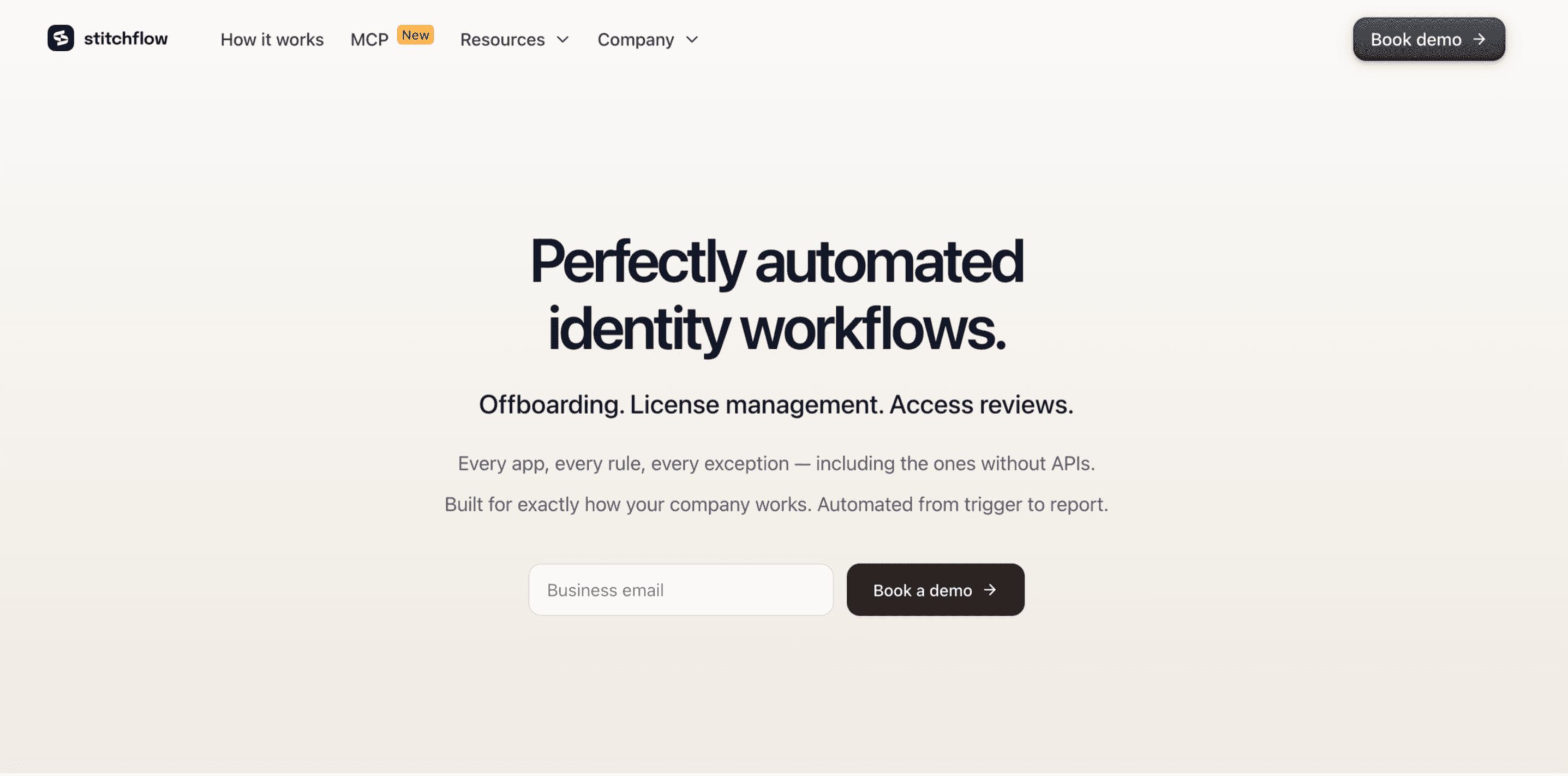
Stitchflow
Stitchflow is a managed IT automation service designed to streamline complex IT operations like offboarding, license cleanup, access reviews, and SaaS spend management. It integrates with over 60 apps via API and utilizes a local browser agent for applications without management APIs, ensuring 100% coverage of your app stack. Stitchflow learns your specific workflows, including rules and edge cases, and builds them using AI for rapid deployment, typically under a week. The workflows then run on deterministic logic, ensuring consistent execution without AI hallucinations. The service also provides spend intelligence by mapping users and apps with financial data to identify shadow IT and optimize SaaS spend. Stitchflow handles all maintenance, monitoring, and updates for integrations, allowing IT teams to focus on strategic tasks.

Nicolab
Nicolab accelerates stroke care with its AI-powered workflow and emergency platform, designed to give clinicians critical insights when seconds matter. The platform seamlessly links acute care teams across hospitals and regions, enabling real-time sharing of imaging, timelines, and decisions within a secure, cloud-based environment. Its intuitive mobile app, available for both Android and iPhone, offers clear patient timelines, instant access to clinical images, and secure messaging. StrokeViewer AI speeds up triage with accurate and fast decision-making, trusted by physicians and having assisted over 170,000 patients. Nicolab's solution is vendor-agnostic, integrating with CT scans from any manufacturer, and stores patient information securely in Google Cloud warehouses for a maximum of 30 days. The company provides 24/7 support via email, phone, and in-app channels.

Wokelo
Wokelo is an agentic AI platform specifically designed for investment research and due diligence. It automates critical processes such as deal sourcing, due diligence, deal research, and strategy development. The platform utilizes proprietary AI agents trained on investment methodologies and provides access to an extensive database of over 20 million companies. Trusted by major firms like KPMG and SoftBank, Wokelo aims to enhance efficiency and accuracy for professionals in investment banking, private equity, venture capital, and management consulting by providing advanced tools for market analysis and strategic decision-making.
Aisera
Aisera is an AI agent platform designed to deliver transformative work experiences, boost employee productivity, and reduce operational costs for enterprises. It features a unified AI agent platform that goes beyond simple assistance to provide autonomous execution, automate tasks, deliver answers, and transform workflows. Key components include Agent Composer for creating custom AI agents, Aisera Unify for integrating best-of-breed agents and tools, and Aisera Assistant and Agent Assist for executing complex, cross-domain actions. The platform also offers TRAPS (Trusted, Responsible, Auditable, Private, Security) for reliability and observability, and analytics for continuous learning and improvement. Aisera supports various domains and departments, including IT, HR, finance, sales, customer service, and procurement, across numerous industries.

BondAI
BondAI is an open-source Python framework specifically designed for the development of AI agents. It empowers users to construct, evaluate, and deploy intelligent agents that can effectively interact with their surroundings. The framework emphasizes extensibility, allowing for seamless integration with existing tools and workflows. Developers can leverage BondAI to create agents that observe their environment, perform actions, and learn from experiences, fostering a robust platform for advanced AI applications. Its open-source nature promotes community contributions and flexible customization for various use cases.

Familiar
Familiar is an open-source macOS and iOS application designed to run a local AI agent directly on your machine, prioritizing user privacy and control. It processes tasks locally, eliminating the need to send sensitive data to external servers. The app features hardware detection on first launch to recommend the optimal model for your system, ensuring efficient performance without overheating. It includes out-of-the-box file management tools, allowing users to create, rename, move, and delete files offline. A unique "Night Shift" mode is in progress, enabling the agent to switch to a more capable model for intensive tasks while the machine is idle, leveraging local hardware without cloud costs. Familiar aims to make local AI usable as an agent, not just a chat toy, by focusing on practical, offline capabilities.
Twin
Twin is an AI company builder that empowers users to create autonomous AI agents using natural language, eliminating the need for coding. These agents can connect to any API, automate browser actions like a human, and run on a schedule or trigger from webhooks, emails, or messages. The platform allows users to brainstorm and refine ideas into working agents, creating integrations in real-time. It's designed for individuals and businesses looking to automate workflows, find clients, manage jobs, and streamline various operational tasks, offering a no-code solution for agent deployment and community sharing.
SmsForwarder
SmsForwarder is an open-source Android application designed to monitor and forward SMS messages, incoming calls, and app notifications based on user-defined rules. It supports forwarding to a wide array of destinations, including DingTalk, WeChat, Telegram bots, email, Bark, webhooks, Server酱, PushPlus, and even other mobile phones. Beyond simple forwarding, SmsForwarder offers advanced remote control capabilities, allowing users to remotely send SMS, check SMS history, monitor call logs, access phone book contacts, and even check battery levels. The project is primarily for learning and personal use, with a strong emphasis on user privacy, explicitly stating that it collects no personal data.
Newelle
Newelle is an open-source AI virtual assistant designed for advanced customization and flexible AI model integration. Users can tailor the application with a wide range of settings and choose from multiple AI models and providers, including the ability to download and run local models using Llama.cpp or Ollama. It supports extensions for added functionality, skills from platforms like Claude and Codex, and tools via MCP servers. Key features include voice support with wakeword detection, a call mode for real-time AI interaction, long-term memory for conversations, and the ability to chat with documents and perform web searches. Newelle also offers terminal command execution, dynamic context management, file permissions, scheduled tasks, a profile manager, and a built-in file manager with AI assistance. It supports rich formatting (Markdown and LaTeX), multichat, chat branching, and chat editing, allowing for a highly personalized and efficient virtual assistant experience.

v-Lawyer
v-Lawyer is an AI-powered legal assistance platform designed to help individuals confidently navigate everyday legal problems. The tool offers AI-powered workflows, professional templates, and step-by-step guidance across various common legal areas. Users can get assistance with disputes, refunds, contracts, employment issues, and family matters. The platform aims to simplify complex legal processes, making legal support more accessible. It provides a user-friendly interface to manage legal concerns, offering initial free messages to explore its capabilities before requiring sign-in for unlimited access.
Talus Network
Talus Network is a decentralized AI automation protocol designed to power the autonomous AI economy. It provides the foundational infrastructure for developing, deploying, and managing autonomous AI Agents and multi-agent systems. Unlike centralized competitors, Talus leverages blockchain technology for enhanced verifiability and resiliency, while outsourcing execution to service providers for optimal performance and cost-efficiency. The platform offers Talus Vision, a user-friendly drag-and-drop interface for creating and deploying agent workflows, similar to n8n or Zapier. Built on Sui using Move and Rust, Talus supports high-throughput architecture, enabling AI agents to execute complex, multi-step workflows with sub-second finality and predictable costs for both developers and users.
supabase-mcp
The supabase-mcp tool facilitates seamless integration between Supabase projects and AI assistants by implementing the Model Context Protocol (MCP). This protocol standardizes how Large Language Models (LLMs) communicate with Supabase, enabling AI assistants to directly interact with and perform tasks within Supabase projects. This capability is crucial for developers looking to build intelligent applications that leverage the robust backend services of Supabase with the advanced reasoning and data processing of AI. By providing a structured communication layer, supabase-mcp simplifies the development of AI-powered features, allowing for more efficient data handling, task automation, and dynamic application responses based on real-time data from Supabase.
Anything V3.0
Anything V3.0 is an AI application hosted on Hugging Face Spaces by akhaliq. The tool is currently non-functional, displaying a runtime error related to an unexpected keyword argument in its `DPMSolverMultistepScheduler` initialization. This indicates a potential issue with its underlying code or dependencies. As a result, its intended capabilities, such as content generation or educational assistance, are not accessible at this time. The project is open source, allowing community members to inspect and potentially contribute to its resolution.
bnb-my-repo
bnb-my-repo is a Hugging Face Space designed to simplify the process of quantizing AI models. Users can select a model from Hugging Face, apply desired quantization settings, and then upload the reduced-size model directly to their personal Hugging Face account. This tool is particularly useful for developers and researchers looking to optimize model performance and reduce storage requirements without extensive manual configuration. It provides a straightforward interface for managing and deploying quantized models within the Hugging Face ecosystem.
Catch Me If You Can
Catch Me If You Can is an AI tool hosted on Hugging Face Spaces, designed for real-time text generation. Users can input sentences, and the application will continue the text, providing completions in real-time. This tool is ideal for those looking to experiment with AI-driven text generation and explore the capabilities of language models in a straightforward manner. Its simple interface allows for quick interaction, making it accessible for various text-based tasks, from creative writing prompts to basic content generation.
Data Copilot
Data Copilot is an AI agent tool developed by zwq2018 and hosted on Hugging Face Spaces. The tool is licensed under the MIT license, indicating it is open-source and can be freely used and modified. However, the current status of the application shows a "Runtime error" with an unknown exit code, suggesting it is not currently operational. The platform also indicates a failure to retrieve error logs, further hindering troubleshooting. While the original intent of Data Copilot was likely for task automation and potentially educational assistance, its current state prevents any functional use.
DirectedDiffusion
DirectedDiffusion is presented as a Hugging Face Space application, indicating it's a web-based AI tool. While the specific functionalities are not detailed on the live page, the context of Hugging Face Spaces suggests it likely involves machine learning models, potentially for tasks like content generation or automation, as hinted by its previous description. The tool is built using Gradio, a popular Python library for creating user interfaces for machine learning models, making it accessible via a web browser. It operates under an MIT license, which typically allows for broad use, modification, and distribution.
Disco
Disco is presented as a Hugging Face Space, indicating it's an AI application hosted on the platform. The tool is built using Gradio, a popular Python library for creating customizable UI components for machine learning models. It operates under the OpenRAIL license, suggesting an open and responsible AI development approach. While the exact functionality is not fully detailed due to a runtime error on the live page, the context of Hugging Face Spaces implies it's designed for showcasing or experimenting with AI models. The tool's current status shows a runtime error, preventing full access to its features.
Fibo Edit
Fibo Edit is an AI tool hosted on Hugging Face Spaces by briaai. The application is currently in a paused state, meaning it is not actively running or available for use. To utilize Fibo Edit, interested users are directed to the community tab on its Hugging Face page to request the author, BRIA AI, to restart the space. Further details regarding its specific functionalities, features, or intended use cases are not available from the current live website content due to its paused status.