
Data & Analytics
Browsing page 12 of AI tools for Data Visualization in Data & Analytics. Sorted by confidence score — our independent quality rating.
OVA AI Data Analyst
OVA AI Data Analyst is an intuitive AI-powered platform designed to transform raw spreadsheet data into actionable insights. Users can easily upload CSV files and interact with their data by asking questions in natural English, eliminating the need for complex coding or advanced data science skills. The tool then generates instant visualizations and summaries, making data exploration accessible to a broad audience. It empowers business professionals, researchers, and students to quickly understand trends, identify patterns, and make data-driven decisions without extensive training. OVA AI Data Analyst streamlines the analytical process, saving time and resources while democratizing access to powerful data analysis capabilities for both beginners and seasoned data experts.

nn_vis
nn_vis is an open-source project designed for processing and rendering neural networks to visualize their architecture and parameters. Developed as part of a master's thesis, it introduces a novel 3D visualization technique that declutters complex models. The tool estimates attributes for trained neural networks using established optimization methods like batch normalization, fine-tuning, and feature extraction to determine the importance of different network parts. It combines these importance values with techniques such as edge bundling, ray tracing, 3D impostors, and special transparency to create a comprehensive 3D model. nn_vis supports both 2D and VR visualization, allowing users to gain insights into model behavior, especially regarding generalization based on edge proximity. It also provides a GUI for controlling shader parameters and processing settings, enabling customization of the visualization.
PlotNeuralNet
PlotNeuralNet is an open-source library that provides Latex code for generating neural network diagrams. This tool is designed to help researchers, students, and professionals create high-quality visualizations of deep neural network architectures for academic papers, presentations, and reports. It supports various network representations, including FCN-8, FCN-32, and Holistically-Nested Edge Detection, with examples provided for easy understanding. Users can install necessary packages on Ubuntu or Windows (via MikTeX and Git Bash/Cygwin) and utilize either Latex or Python interfaces to define and generate their network diagrams. The project encourages community contributions for improvements and bug fixes, making it a collaborative effort for better visualization tools.

chatcsv
ChatCSV is an AI-powered data analysis tool that allows users to interact with their CSV documents through natural language. By simply uploading a CSV file from their computer, a URL, or clipboard, users can ask questions and receive insights, visualizations, and reports. The platform generates quick starting questions to help users begin their analysis and can visualize answers with various chart types like bar charts and pie charts. It maintains a chat history, enabling users to track, rename, delete, or share conversations. ChatCSV is applicable across diverse industries such as retail, finance, and marketing, helping users understand trends, customer behavior, and campaign performance. The tool has been acquired by Flatfile, with its successor, Obvious, offering expanded capabilities for data interaction and reporting.
Supadash
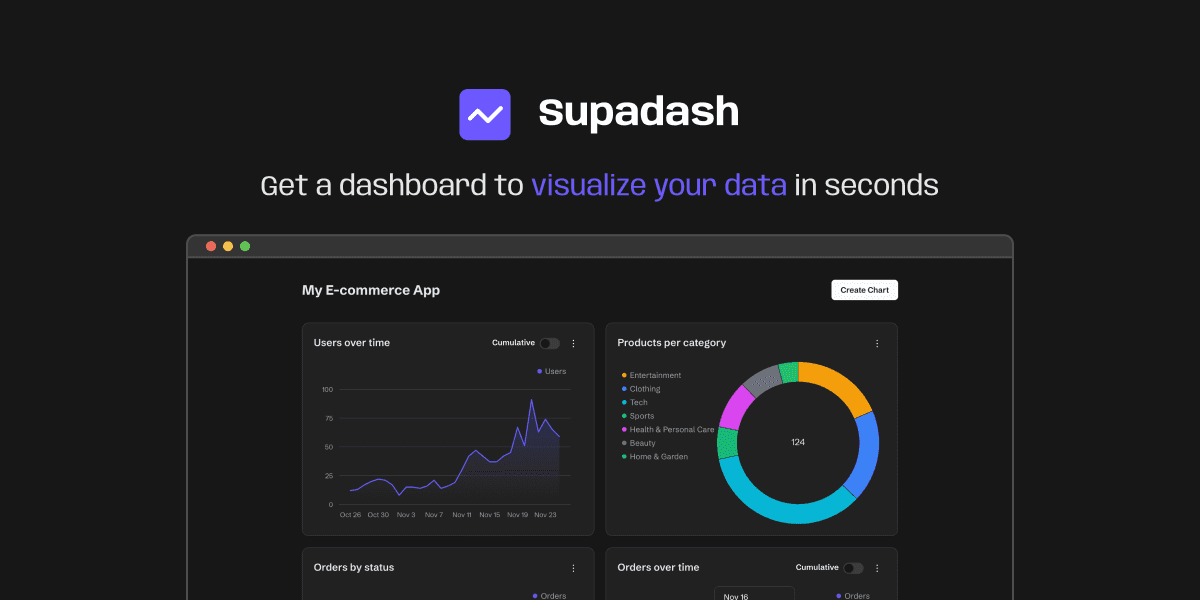
Supadash allows users to connect their database and instantly generate AI-powered charts and dashboards to visualize their data and analytics. This no-code solution eliminates the need for periodically running SQL queries to track metrics, as Supadash automatically creates time series charts and other visualizations. It transforms raw database tables into insightful and visually appealing dashboards in seconds, making data analysis accessible and efficient for users who need to understand their data better without extensive technical knowledge.
gradio_rerun
gradio_rerun provides a seamless integration between Gradio applications and the Rerun viewer, enabling real-time visualization of multimodal data. Users can upload images or set numeric parameters within their Gradio app, and the tool streams the processing results directly to an interactive Rerun viewer. This is particularly useful for machine learning and robotics applications where visualizing dynamic data, such as repeated blurring, 3D point clouds, or keypoint annotations, is crucial for development and debugging. The integration simplifies the process of observing and understanding complex data flows within a Gradio environment, making it an efficient solution for developers and researchers working with visual and numerical data.
Graphy app
Graphy app is an AI-powered data visualization tool designed to transform messy data into beautiful, actionable graphs and marketing reports quickly. It allows users to consolidate data from various tools into a single, shareable view, making it as simple as taking a screenshot yet as powerful as a dashboard. The platform supports a wide array of graph types, including bar, line, pie, funnel, and heatmaps, and offers features like custom colors, unlimited charts, and AI capabilities. Graphy is ideal for enhancing data-driven communication and supporting strategic decisions, with options for integrating into platforms via SDK and Embed APIs.
Marple
Marple is a powerful time series data analysis platform designed for engineering teams, offering robust features for high-frequency data. It provides interactive dashboards for deep data exploration, allowing users to zoom in on specific points and visualize data from various angles. The platform excels at time series data mining, enabling the discovery of trends across hundreds of datasets and aggregation of billions of data points. Marple supports real-time data analysis, comparing live data with historical records for instant performance validation. It seamlessly integrates with databases like TimescaleDB and Influx, and allows for the creation of calculated signals dynamically. Key differentiators include automatic anomaly detection, a wide range of engineering tools, and optimization for telemetry data ranging from 1Hz to 10kHz, handling hundreds of sensors simultaneously. Marple DB, a component of the platform, is purpose-built for high-frequency telemetry data, offering efficient data segmentation and integration with Marple Insight.
Julius AI
Julius AI is an AI data analyst designed for comprehensive data analysis and visualization. It empowers users to explore and understand complex datasets with the assistance of artificial intelligence. The tool is adept at generating actionable insights from raw data and creating compelling visualizations, making it an invaluable asset for data-driven decision-making. While specific features are not detailed, its core functionality revolves around simplifying the data analysis process, allowing users to quickly identify trends, patterns, and anomalies. This makes Julius AI particularly useful for professionals who need to derive meaningful conclusions from their data efficiently.
SwanLab
SwanLab is an open-source, modern-design AI training tracking and visualization tool built for AI model training teams. It provides comprehensive features for experiment analysis, metric observation, and collaboration. Researchers can track key metrics, record hyperparameters, and visualize training processes through an intuitive UI, helping to identify issues and accelerate model iteration. SwanLab supports a wide range of data types including scalar metrics, images, audio, text, video, 3D point clouds, and biochemical molecules, along with various chart types like line, media, bar, and custom ECharts. It offers both cloud and self-hosted deployment options and integrates with over 50 mainstream frameworks, including PyTorch, Transformers, and Keras. Key functionalities include experiment comparison, multi-person collaboration, hardware monitoring, and an open API for extended capabilities.

FLYBI
FLYBI is an industrial intelligence platform specializing in drone-based data capture and geospatial analytics for critical sectors like mining, steel, thermal power, infrastructure, and defense. The platform offers two flagship products: AeroMagnetic Intelligence for subsurface exploration without drilling, and Stockpile Intelligence for audit-grade volumetric measurements with sub-2% variance against weighbridge data. Beyond these, FLYBI provides structural inspection, air quality monitoring, mining digitization, and counter-UAS solutions. The entire process, from sensor capture to decision delivery, is managed through a hardened pipeline ensuring engineering-grade accuracy and rapid 48-hour report turnarounds. FLYBI aims to replace estimates with precise, verifiable measurements, integrating with enterprise systems like ERP and GIS.

4mAnalytics
4mAnalytics offers a comprehensive Utility AI Platform designed to provide instant, reliable, and verified subsurface utility data. It compiles millions of scattered public utility records into one easy-to-use map, eliminating the need for manual research. The platform provides detailed utility owner and line information, including material, size, and installation date, along with above-ground utility objects and road markings detected via AI-driven computer vision and satellite imagery. It also integrates land ownership, topography, and environmental constraints for a complete site overview. 4mAnalytics aims to reduce project delays, cost overruns, and improve alignment by offering a centralized, interactive map that is scalable for any project size.

Wobby
Wobby equips teams with AI Analysts that deliver business-ready insights directly from data warehouses. It translates natural language queries into trusted SQL, allowing business users to ask questions and receive answers, charts, and summaries instantly in platforms like Slack and Teams. The tool integrates with existing data catalogs for semantic understanding and provides full control for data teams to set rules, sign off query templates, and track usage. Wobby emphasizes a zero-copy, enterprise architecture, ensuring data remains secure in its original location. It also features continuous improvement through memory and feedback, refining approved queries into smarter templates over time. Governance features include built-in validation, version control, and role-based access.
Chapa- Developer Impact, Decoded.
Chapa redefines how developers quantify their impact in the era of AI-assisted coding, moving beyond simple commit counts. It analyzes 12 months of development activity across core dimensions such as Delivery, Quality, Consistency, and Breadth, with an optional Craft dimension for AI tool mastery. The tool generates a live, embeddable SVG badge that showcases a developer's archetype (e.g., Builder, Quality Champion, Marathoner) and an adjusted composite impact score. This badge updates daily from fresh data, ensuring it always reflects current contributions. Chapa also offers cryptographic verification for scores, an activity timeline visualization, and dynamic radar charts. For enterprise users, it can merge GitHub Enterprise Managed Users (EMU) contributions into a unified badge, providing a comprehensive view of a developer's impact.
Datou1111-shou Xin
Datou1111-shou Xin is a user-friendly AI tool hosted on Hugging Face Spaces, designed for generating images from text prompts. Users can simply enter a textual description, and the application will produce a corresponding image, making it ideal for creative projects and visual content creation. This tool leverages AI to transform imagination into visual form, providing an accessible way to create unique graphics without requiring advanced technical skills. It's perfect for anyone looking to quickly visualize ideas or generate custom imagery based on specific textual inputs.
pytorch-cnn-visualizations
pytorch-cnn-visualizations offers a comprehensive collection of PyTorch implementations for visualizing convolutional neural networks. This repository includes techniques such as gradient visualization (vanilla, guided, saliency maps), various forms of class activation mapping (Grad-CAM, Guided-Grad-CAM, Score-CAM), SmoothGrad, CNN filter visualization, inverted image representations, Deep Dream, and class-specific image generation. It's designed for researchers and developers working with CNNs to gain deeper insights into model behavior and decision-making processes. The code is well-commented and structured, with each technique having its own Python file for ease of understanding and porting.

DoubleCloud
DoubleCloud offers a comprehensive platform for building data analytics infrastructure, leveraging fully managed open-source solutions like ClickHouse, Apache Kafka, and Apache Airflow. The platform streamlines data pipelines from ingestion to visualization, providing integrated, reliable, and zero-maintenance services. Key offerings include a no-code ELT tool for real-time data syncing, and a managed open-source Data Visualization tool for creating dashboards and charts. Designed for engineers, DoubleCloud focuses on exceptional performance, security with ISO 27001, SOC 2, GDPR compliance, and cost-effectiveness through a pay-as-you-go model and hybrid storage options. It aims to simplify day-to-day operations by handling routine maintenance, allowing engineers to focus on product development.

Simple AI Stock Valuation
Simple AI Stock Valuation is a mobile application available on both iOS and Android, designed to simplify stock research for investors. It leverages AI to quickly gather and analyze public data, producing a comprehensive, professional PDF research report for any selected stock within minutes. This tool eliminates the need for extensive financial knowledge or manual spreadsheet work, offering insights into business and financial overviews, AI-assisted valuation, trends, risk considerations, and news highlights. Users can search by company name or ticker, or utilize a built-in Stock Screener to identify potential investments, making informed decisions faster and more efficiently.
Arcwise
Arcwise is an AI-powered platform designed to help businesses identify and understand significant shifts in their key metrics. It provides hallucination-free AI explanations for metric movements, tracing them directly back to your data and documentation. This enables teams to make faster, more informed decisions. The tool detects early metric changes, delivers decision-focused insights, and offers explainable, auditable AI. Arcwise also preserves explanations and decisions as reusable institutional memory and can embed decisions directly into existing workflows. It connects securely to data warehouses and BI tools like Snowflake, BigQuery, and Databricks, and learns from business context, documentation, and operating logic to generate grounded explanations.
Graphy
Graphy is an AI-powered data visualization tool designed to radically simplify how data is presented and communicated. It enables users to become skilled data storytellers by transforming raw, messy data into beautiful, clear graphs with a single click. The platform leverages AI to find insights, allows users to chat with their data for specific answers, and instantly generates stunning visualizations. Graphy supports various data inputs including live Google Sheets, CSV, and Excel files, and offers API access. Users can brand their charts with custom colors and fonts, add annotations, and easily share or embed their creations into presentations, social media, or documents, making data-driven communication effortless.
GeoSpy
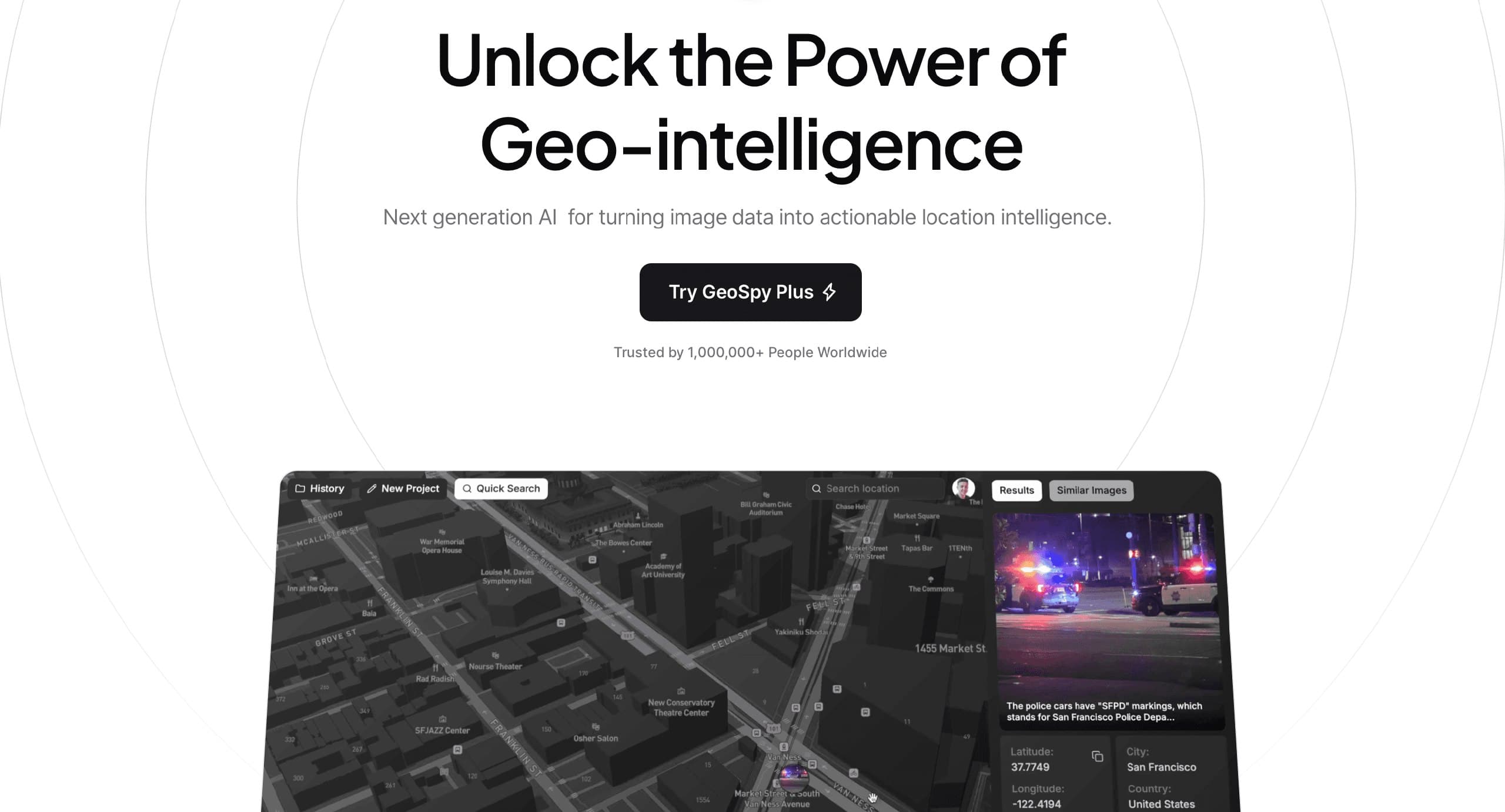
GeoSpy is an AI-powered image intelligence tool designed for precise photo geolocation. It analyzes visual features within images, such as landmarks and architecture, to estimate their exact location. This tool is specifically built to support law enforcement, government agencies, and enterprise teams in their investigative efforts. GeoSpy provides users with accurate coordinates, detailed region descriptions, and interactive maps, making it an invaluable asset for OSINT investigations, journalism, and disaster response scenarios where rapid and accurate location identification is critical.

AI Interior Design: LilaAI
LilaAI is an AI-powered interior decorator and designer tool that allows users to visualize room transformations quickly and affordably. By simply uploading a photo of a room, the AI generates high-resolution renderings within minutes, applying various design styles. This tool is ideal for individuals seeking interior design inspiration for home remodels or redesigns, as well as professional interior decorators and designers who want to provide clients with a clear idea of how their space will look. It offers stunning premade styles, the ability to add custom prompts for unique designs, and a fast turnaround time, making professional-grade interior design accessible and efficient.

Pydroid 3 - IDE for Python 3
Pydroid 3 is an Android mobile application designed to provide a comprehensive and offline Python 3 Integrated Development Environment (IDE). It allows users to write, run, and debug Python programs directly on their mobile devices, eliminating the need for an internet connection. The app supports a wide array of scientific libraries, including popular ones like NumPy and SciPy, making it particularly suitable for mobile data science and machine learning projects. This functionality empowers developers and data scientists to work on their projects on the go, leveraging the convenience of a mobile platform for coding and computation.

Sourcetable — AI spreadsheet & data analyst v1.0
Sourcetable is an AI spreadsheet and data analysis platform designed for analysts, operators, and finance teams. It integrates AI capabilities directly into a spreadsheet interface, allowing users to analyze data, build financial models, generate Excel templates, graphs, and reports. The tool connects to various data sources like Postgres, Robinhood, Stripe, Notion, Facebook Ads, and GA4, enabling users to query databases and applications using AI. Sourcetable supports advanced analysis, data cleaning, and visualization, with features like a command bar for data manipulation, a chart generator, and a template generator. It also incorporates Python for custom logic and offers built-in research tools, making it a comprehensive solution for data science tasks without requiring coding.