
Research & Education
Browsing page 8 of AI tools for Academic Research in Research & Education. Sorted by confidence score — our independent quality rating.

Lateral
Lateral was a research tool that aimed to streamline the process of literature reviews for academics and researchers. It provided functionalities to seamlessly search, save, and organize findings extracted from research papers, helping users complete their research up to 10x faster. The platform was designed to enhance scientific collaboration and discovery, exploring new possibilities with the emergence of large language models (LLMs). However, Lateral has been sunset on June 26, 2025, with sign-ups now closed. The team is transitioning to a new open-source platform, coordination.network, which will offer expanded research capabilities and new ways to support and connect researchers.

Duke Master of Engineering in AI Product Innovation
The Duke Master of Engineering in AI Product Innovation program is designed to cultivate professionals adept at applying artificial intelligence and machine learning to real-world industry challenges. This program emphasizes a hands-on approach, preparing students to innovate and lead in the rapidly evolving AI landscape. It focuses on developing creative and informed individuals who can translate complex AI concepts into practical product solutions. The curriculum likely covers advanced topics in AI, machine learning algorithms, product development, and strategic innovation, equipping graduates with the skills to drive technological advancements and solve critical business problems using AI.

LIDIA
LIDIA is a comprehensive AI ecosystem specifically designed for legal professionals, offering an integrated platform for legal research, analysis, and decision-making. Developed by experienced lawyers, LIDIA applies advanced technology to legal work with the goal of enhancing quality, reducing errors, and supporting professional reasoning. It acts as a co-thinker, not an automation tool, for complex and high-responsibility tasks. Key features include organizing internal studio knowledge for AI querying, extending and validating information through official sources, guiding decision-making with AI agents, and integrating AI directly into document drafting and revision within Word. LIDIA also offers specialized AI agents for legal workflows, a Smart Answer function for natural language queries on archived documents, and a Workflow Builder for custom legal processes.
The Generator @ Babson College
The Generator @ Babson College is an initiative dedicated to fostering interdisciplinary collaboration in the field of Artificial Intelligence. It serves as a platform that unites industry leaders, visionary thinkers, and researchers to collectively explore the vast potential of AI while proactively addressing its inherent risks. The program aims to shape a future for AI that is both vibrant and inclusive, emphasizing entrepreneurial leadership in the age of AI. Through various courses and programs, it covers topics such as AI in action, creating agents and solutions with AI, mastering generative AI in business, and the fundamentals of AI, catering to individuals and professionals seeking to understand and leverage AI.
TigerBot
TigerBot is a multi-language, multi-task Large Language Model (LLM) designed to serve as a foundational platform for developing custom LLMs. It stands out for its strong focus on Chinese language innovation, featuring the world's first Chinese clinical terminology system (MedCT) and corresponding medical NER models, which have achieved new SOTA results in both English and Chinese medical NER tasks. The tool also provides real clinical annotation data. TigerBot supports extensive context lengths, up to 100K for its 70b and 13b chat models, and offers function calling capabilities. It is open-source and available on platforms like Hugging Face and ModelScope, making it accessible for research and commercial use. The platform has undergone continuous upgrades, improving its comprehensive capabilities across various models and offering features like search-augmented modes and document enhancement (RAG).
TTS-WebUI
TTS-WebUI is an open-source project offering a unified Gradio and React-based web interface for numerous text-to-speech (TTS) and audio generation models. It integrates a comprehensive suite of models such as ACE-Step, OmniVoice, Kimi Audio, Piper TTS, GPT-SoVITS, CosyVoice, XTTSv2, OpenVoice, ParlerTTS, and Stable Audio, alongside audio conversion and music generation tools like MusicGen, Tortoise, and RVC. The platform is designed for developers and researchers, providing a flexible environment for experimenting with different AI audio technologies. It supports easy installation via an installer or Docker, and features an extension marketplace for expanding its capabilities. The project emphasizes ethical and responsible use, with clear guidelines against malicious activities, impersonation, and fraudulent use.
rag-cookbooks
rag-cookbooks is a comprehensive, open-source repository dedicated to advanced and agentic Retrieval-Augmented Generation (RAG) techniques. It serves as a valuable resource for researchers and developers looking to implement and evaluate sophisticated RAG systems. The repository progresses from naive RAG to more complex methods, offering clear implementations and explanations for each technique. It also includes research papers and references for further reading. Key features include various RAG techniques like Hybrid RAG, Hyde RAG, Parent Document Retriever, RAG fusion, Contextual RAG, Rewrite Retrieve Read, Unstructured RAG, and several agentic RAG approaches such as Basic Agentic RAG, Corrective RAG, Self RAG, Adaptive RAG, and ReAct RAG. The repository also provides guidance on RAG evaluation, often integrating with Athina AI for end-to-end implementation and assessment.
shap
SHAP (SHapley Additive exPlanations) provides a game theoretic approach to interpret the outputs of various machine learning models. It connects optimal credit allocation with local explanations using classic Shapley values and their extensions. The tool supports high-speed exact algorithms for tree ensemble methods like XGBoost, LightGBM, and CatBoost, as well as specific support for natural language models from Hugging Face transformers. It also offers DeepExplainer for TensorFlow/Keras models and GradientExplainer for TensorFlow/Keras/PyTorch models, alongside a model-agnostic KernelExplainer for any function. SHAP helps users understand feature importance and interaction effects through various visualization plots.

Bizmorphic Research
Bizmorphic Research specializes in bridging the gap between cutting-edge academic AI research and practical enterprise applications. They develop and implement intelligent, scalable, and replicable AI systems to empower businesses. Their offerings include AI products such as Wisemelon, an intelligent customer experience (CX) platform, and Resfeld, which uses AI to simplify and speed up research by organizing, analyzing, and presenting insights. Bizmorphic also provides core AI and engineering solutions, derived from their ongoing research, and offers research-driven AI consultation to help businesses strategically plan and integrate AI, effectively cutting down time to launch and avoiding potential pitfalls. They focus on research areas like Graph Neural Networks, Customer Intelligence, Marketing Intelligence, Intelligent Automation, Document Intelligence, and Reasoning LLMs.

Idiap Research Institute
The Idiap Research Institute is an independent, nonprofit research foundation affiliated with EPFL, dedicated to Artificial Intelligence for Society. Its activities span basic research, graduate and post-graduate training, and technology transfer. Key areas of focus include multimedia information management, human-computer interaction, perceptual and cognitive systems, natural language processing, social media, biometric person recognition, multimodal information interfaces, applied AI, and large-scale machine learning. The institute's research programs, such as Human-AI Teaming and AI for Life, are driven by global challenges and Switzerland’s societal and industrial needs, aligning with UN Sustainable Development Goals. Idiap also emphasizes innovation through software disclosures, open-access software releases, and industry collaboration.
The AI Foundation
The AI Foundation is dedicated to responsibly moving the world forward by empowering individuals with personalized AI that aligns with their values and goals. The organization conducts breakthrough research in areas such as synthetic media, digital humans, and conversation generation, which enables the creation of groundbreaking companies and AI-powered products. Their work extends to personal applications, commercial brand and business solutions, and philanthropic efforts like defending reality against misinformation. They actively partner with other organizations, such as ElevenLabs and Reality Defender, on AI safety initiatives, focusing on detecting and combating deepfakes and AI-generated audio threats.
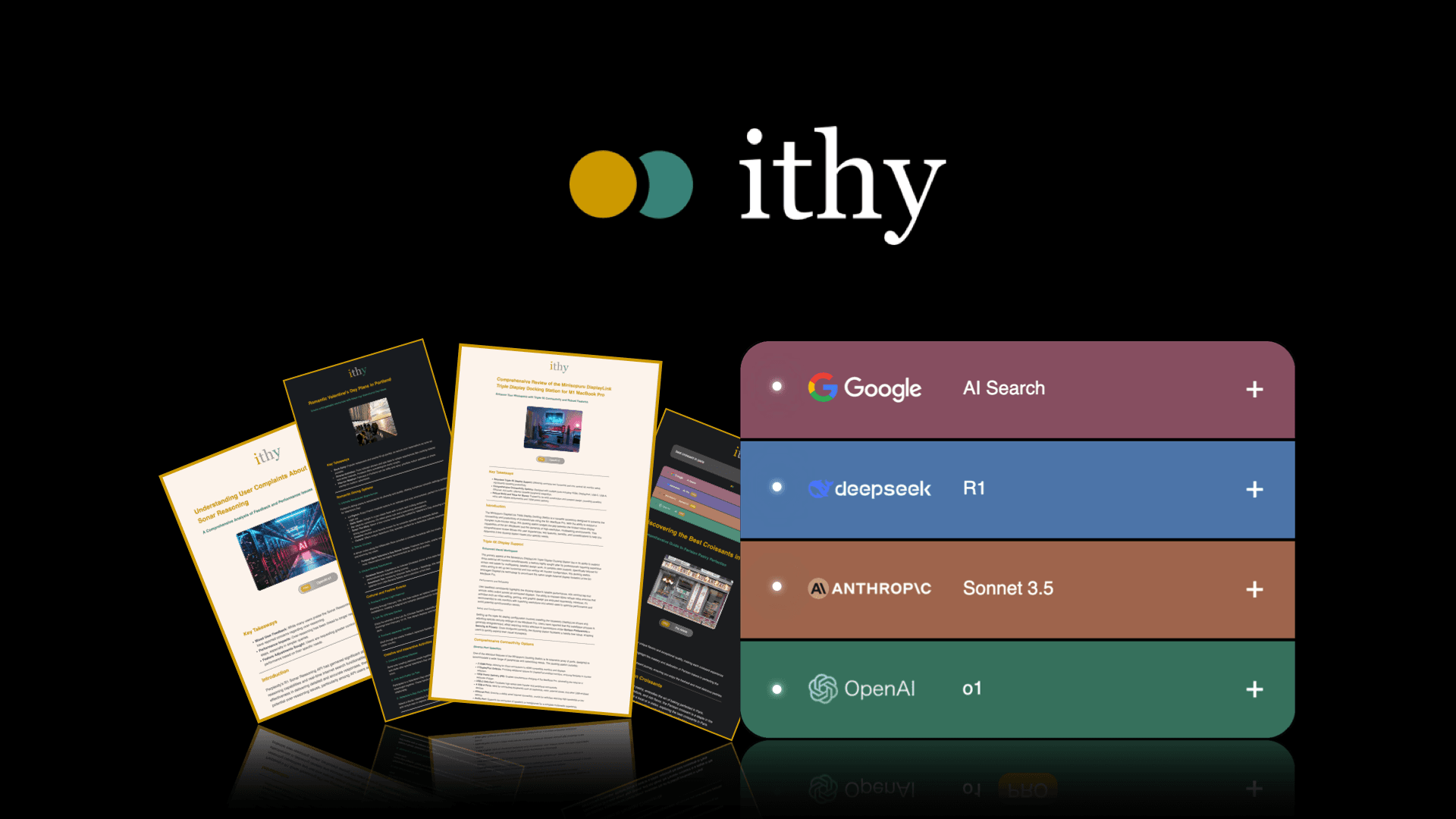
Ithy
Ithy is an innovative AI research assistant that aggregates the world's best AI models to produce comprehensive, article-quality answers. Users can ask any question and receive highly visual and interactive articles, complete with charts, buttons, and videos. The platform offers two primary research modes: Fast Research for quick answers and Deep Research for more in-depth analysis, both powered by an ensemble of strong AIs. Ithy claims to consistently outperform leading LLMs in benchmarks, providing a superior alternative to traditional AI chat tools by combining responses from various AIs for smarter, more integrated results. It also features a reward system where users earn points for searches, unlocking perks like Ithy Pro.
Film Flow
Film Flow is an AI-powered tool designed for visualizing and analyzing the emotional pulse of films. It leverages artificial intelligence to provide deep insights into the emotional dynamics of any movie. Users can explore the captivating world of cinema and understand the emotional journey within films. The tool operates by establishing a direct connection with OpenAI when a user enters their API Key, ensuring that no user keys are stored or utilized by Film Flow itself. This focus on user privacy and direct API integration makes it a secure option for film analysis.
MultiDiffusion
MultiDiffusion is an official PyTorch implementation for "MultiDiffusion: Fusing Diffusion Paths for Controlled Image Generation," presented at ICML 2023. This unified framework allows for versatile and controllable image generation using existing text-to-image diffusion models, eliminating the need for further training or fine-tuning. The core of its approach is an optimization task that combines multiple diffusion generation processes with shared parameters or constraints. MultiDiffusion can generate high-quality and diverse images that adhere to user-provided controls, such as desired aspect ratios (e.g., panoramas) and spatial guiding signals, from segmentation masks to bounding boxes. It is integrated into the `diffusers` library and offers a Gradio UI for easy interaction.

Archimedes: AI, Data Science, and Algorithms Research Hub
Archimedes is a vibrant research hub dedicated to advancing basic and applied research in Artificial Intelligence and its supporting disciplines, including Algorithms, Statistics, Learning Theory, and Game Theory. Established in January 2022 as a unit of the Athena Research Center, it aims to position Greece as a leading player in AI and Data Science. The hub connects the global AI and Data Science research community, fostering groundbreaking research and providing enriching opportunities for students through collaborations with Greek and foreign universities and research institutes. Archimedes is funded by the EU Recovery and Resilience Facility (RRF) and focuses on leveraging AI to address real-world challenges and promote innovation within the Greek ecosystem.
ChatGLM3
ChatGLM3 is a collaborative project between ZhipuAI and Tsinghua University's KEG Lab, offering a series of open bilingual chat Large Language Models. The ChatGLM3-6B model, a key offering, builds upon its predecessors with enhanced conversational fluency and low deployment barriers. It introduces a more robust base model, ChatGLM3-6B-Base, which demonstrates leading performance among models under 10B parameters across diverse datasets including semantics, mathematics, reasoning, code, and knowledge. The series also features a newly designed Prompt format, enabling native support for advanced functionalities like Function Call, Code Interpreter, and Agent tasks. Beyond the conversational model, ChatGLM3 provides a comprehensive open-source sequence, including ChatGLM3-6B-Base, ChatGLM3-6B-32K for extended text, and ChatGLM3-6B-128K for even deeper long-text comprehension. All models are fully open for academic research and permit free commercial use upon registration, fostering community-driven large model technology development.

Neuromorphicism
Neuromorphicism serves as a dedicated platform for news and resources within the field of neuromorphic computing. It offers updates on the latest advancements, research, and technological developments in this specialized area. The platform focuses on key concepts such as Spiking Neural Networks (SNN), low-power artificial intelligence, and efficient embedded hardware and software solutions like TinyML, FPGA, and ASIC. It also covers related topics like snnTorch and SystemVerilog/HDL. This resource is ideal for individuals and professionals seeking to stay informed about the evolving landscape of neuromorphic computing and its practical applications.

Archivara
Archivara is an open platform dedicated to machine-generated research, offering a public archive for AI-generated papers, code, and model artifacts. It allows users to run, inspect, and browse AI-generated content with full reproducibility information. Researchers and AI agents can allocate compute to run experiments on isolated cloud VMs, ensuring instant reproducibility without environment setup. The platform supports autonomous AI agents that can iterate on research code, track progress, and generate reports. Key features include a paper archive with rich metadata, linking models and code for reproducibility, and cloud VMs with desktop and terminal access. Archivara also provides citation graphs and semantic search capabilities.
Pusa-VidGen
Pusa-VidGen is a groundbreaking video diffusion model that introduces a paradigm shift through frame-level noise control with vectorized timesteps. This approach enables fine-grained temporal control within a unified video diffusion framework. By finetuning the SOTA Wan-T2V-14B model with vectorized timestep adaptations (VTA), Pusa V1.0 achieves unprecedented efficiency, surpassing Wan-I2V on Vbench-I2V with significantly lower training costs and data. It supports both Wan2.1 and Wan2.2 architectures, with the latter leveraging a MoE DiT architecture for enhanced quality. The integration of LightX2V allows for lightning-fast 4-step inference while maintaining high quality, making it suitable for various tasks like text-to-video, image-to-video, video extension, and video transitions.
Resoomer
Resoomer is a free "cognitive studio" designed to process, study, and manipulate information from various documents. It allows users to import PDFs, EPUBs, DOCX, ODT, and TXT files, then summarize, listen, rephrase, translate, paraphrase, synonymize, and correct the content. The platform is multilangual and requires no account or character limits, making it accessible for a wide range of users. Each processed result can be seamlessly integrated into other tools within the studio, ensuring a smooth workflow. Resoomer aims to transform passive reading into total mastery of information, catering to students, professors, journalists, writers, and individuals with ADHD or dyslexia by simplifying complex texts and offering audio reading options.
GoatStack.AI
GoatStack.AI is an AI agent system designed to keep users updated with the latest advancements in artificial intelligence by discovering and summarizing trending AI research papers. The platform offers a 7-day free trial, allowing users to explore its features, including automated AI summaries and the ability to pick specific topics of interest. GoatStack.AI provides contextual search capabilities and can generate summaries, making it a valuable resource for staying informed about cutting-edge AI insights and research trends. It also offers various plans, including a Pro monthly option and a Business plan with unlimited newsletters and team collaboration features.

Kakao Brain
Kakao Brain is the AI research and development arm of Kakao Corp, dedicated to pushing the boundaries of artificial intelligence. The organization focuses on making AI an integral part of daily life, allowing everyone to experience its benefits. While specific research areas like AutoML, Vision, Voice, and NLP are mentioned in the current description, the live website emphasizes a broader commitment to AI technology and its integration into Kakao's services. Kakao Brain also develops its own platforms to optimize resource usage and enhance research efficiency, contributing to the overall technological advancement within the Kakao ecosystem.
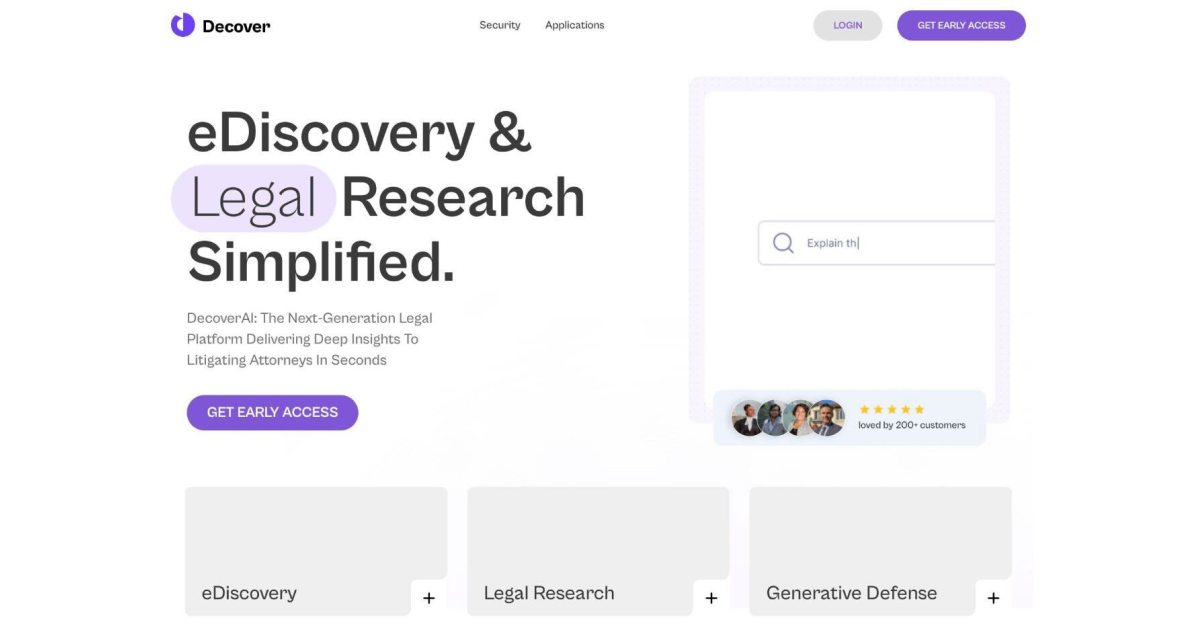
DecoverAI
DecoverAI is an AI-powered legal discovery platform designed to simplify and accelerate the entire litigation lifecycle for law firms and in-house legal teams. It automates critical tasks such as document classification, privilege review, redaction, and production, enabling teams to focus on strategy rather than manual sorting. The platform boasts an 80% reduction in review time by classifying documents for responsiveness, privilege, and confidentiality, with production ready in under an hour, including Bates numbering, redaction, and privilege logging. DecoverAI ensures full attorney control, allowing review and override of all AI classifications and redactions. It is SOC 2 compliant, offering enterprise-grade security and full audit trails, and supports various stages of litigation including eDiscovery, early case assessment, internal investigations, and trial preparation.
Research Solutions
Research Solutions provides a comprehensive suite of cloud-based products designed to advance the world's knowledge by streamlining the research workflow. Key offerings include Article Galaxy for on-demand access to scholarly articles, Article Galaxy Scholar to supplement academic collections, and Scite, an AI-powered tool that shows how claims are supported or challenged across literature with citation-backed insights. The platform also features References for managing literature libraries, APIs for seamless integration, and an AI Assistant for evidence-based answers. It enables full-text search, smart citations, unified access to scholarly content, and rights management, serving corporate R&D, universities, government, and independent researchers.