
Research & Education
Browsing page 93 of AI tools for Academic Research in Research & Education. Sorted by confidence score — our independent quality rating.

mader
mader is an open-source trajectory planner specifically designed for use in multi-agent and dynamic environments. It has been accepted for publication in the IEEE Transactions on Robotics (T-RO), highlighting its academic rigor and practical applicability. The tool facilitates trajectory planning for robotic systems, including single-agent and multi-agent simulations, with features like obstacle avoidance and dynamic environment handling. Users can set up and run simulations using ROS, with options for both Docker and non-Docker installations. It supports backend optimizers like Gurobi and NLOPT, providing flexibility for different computational needs. The project is hosted on GitHub by MIT-ACL, making it accessible for researchers and developers in the robotics community.
spacy-models
spacy-models offers a collection of pre-trained models specifically designed for use with the spaCy Natural Language Processing (NLP) library. These models are essential for data scientists and machine learning engineers who are building applications that require advanced text processing capabilities. The models support a wide range of NLP tasks, including efficient text analysis, named entity recognition, and dependency parsing. By leveraging these pre-trained models, users can significantly accelerate their NLP development workflows, reducing the need for extensive custom training. The integration with spaCy ensures high performance and ease of use for various linguistic tasks.
SlowFast
PySlowFast is an open-source video understanding codebase developed by FAIR, designed to provide high-performance, lightweight PyTorch implementations of state-of-the-art video backbones. It supports various video understanding research tasks, including classification and detection, and is built for rapid implementation and evaluation of novel video research ideas. The repository features implementations of methods like SlowFast Networks, Non-local Neural Networks, X3D, Multiscale Vision Transformers (MViTv1 and MViTv2), Reversible Vision Transformers (Rev-ViT and Rev-MViT), and supports advanced techniques such as Multigrid Training, MAE for Video, and MaskFeat. It also includes a comprehensive model zoo with pre-trained models and baselines, along with visualization tools for analysis and inference.
siggraph2016_colorization
siggraph2016_colorization is an open-source tool offering code for automatic image colorization, leveraging deep learning techniques. It specifically implements a method for joint end-to-end learning of global and local image priors, allowing for nuanced and context-aware colorization. A key feature is its ability to perform simultaneous classification during the colorization process of grayscale images, which can enhance the accuracy and quality of the output. This tool is ideal for researchers, developers, and enthusiasts interested in computer vision and image processing, providing a foundational codebase for further experimentation and application in image restoration and enhancement.
Scholarcy
Scholarcy is an AI-powered research assistant designed to simplify academic research by transforming complex texts into concise, interactive summary flashcards. It allows users to summarize any paper, article, textbook, or even videos, highlighting key information and enabling quick comprehension. The tool offers features like enhanced summaries, spotlighting key findings, and critical analysis tools to evaluate research quality. Users can organize their knowledge by saving flashcards to a personal library, adding notes, and exploring related concepts. Scholarcy also supports synthesizing insights by exporting summaries to various formats compatible with research and productivity apps like Zotero, Notion, and Excel, and can generate one-click bibliographies.
TensorFlow-VAE-GAN-DRAW
TensorFlow-VAE-GAN-DRAW is an open-source collection of generative methods implemented using TensorFlow. This repository offers implementations of Deep Convolutional Generative Adversarial Networks (DCGAN), Variational Autoencoders (VAE), and DRAW: A Recurrent Neural Network For Image Generation. It allows users to experiment with and run these different generative models, providing a foundation for research and development in image generation. The project highlights that DCGANs produce decent results after 10 epochs with default parameters and outlines future enhancements like more complex data integration and replacing the current attention mechanism with a Spatial Transformer Layer.
BMInf
BMInf (Big Model Inference) is an open-source toolkit designed to facilitate efficient inference for large-scale pretrained language models (PLMs). It enables the execution of models with over 10 billion parameters, even on low-resource hardware like a single NVIDIA GTX 1060 GPU. The tool offers significant performance improvements over existing PyTorch implementations, particularly for GPUs like V100 or A100. BMInf 2.0.0 introduced compatibility with any transformer-based model, making it a versatile solution for researchers and developers working with big AI models. It provides methods for automatic model conversion using `bminf.wrapper` or manual replacement of modules like `torch.nn.ModuleList` and `torch.nn.Linear` for optimized performance.
ETM
ETM (Topic Modeling in Embedding Spaces) is a research tool designed to perform topic modeling by representing words and topics within a unified embedding space. This approach allows for the likelihood of a word under ETM to be modeled as a Categorical distribution, derived from the dot product between the word embedding and its assigned topic's embedding. ETM is particularly effective as a document model, capable of learning interpretable topics and word embeddings. Its design makes it robust against large vocabularies, including those with rare words and stop words, which is a significant advantage in natural language processing. The tool provides scripts for data preprocessing, training, and evaluation, supporting various datasets like 20NewsGroup and New York Times.
ViZDoom
ViZDoom is an open-source platform designed for developing AI bots that play the classic 1993 game Doom using only visual information from the screen buffer. It is primarily intended for research in machine visual learning and deep reinforcement learning. The tool offers a robust API for Python (including Gymnasium/Gym wrappers) and C++, supporting multi-platform deployment on Linux, macOS, and Windows. Key features include high performance (up to 7000 frames/steps per second), lightweight footprint, and easy creation of custom scenarios with visual editors and a powerful scripting language. Researchers can leverage its async and sync single-player/multiplayer modes, customizable rendering, access to depth and audio buffers, object labeling, and in-game data for advanced AI experimentation. ViZDoom is reinforcement learning friendly, suitable for learning from demonstration, apprenticeship learning, and inverse reinforcement learning.
xlstm
xlstm is the official GitHub repository for the xLSTM, a new Recurrent Neural Network architecture based on the original LSTM. This tool provides the necessary code and resources for researchers and practitioners to implement and experiment with this novel LSTM variant. xLSTM utilizes Exponential Gating with appropriate normalization and stabilization techniques, along with a new Matrix Memory, to overcome the limitations of traditional LSTMs. It demonstrates promising performance in Language Modeling compared to Transformers or State Space Models. The repository includes a 7B parameter xLSTM Language Model trained on 2.3T tokens, optimized for fast and efficient inference, and offers detailed instructions for installation and usage.

Project Numina
Project Numina is a non-profit initiative dedicated to advancing mathematics through open collaboration between humans and AI. It focuses on building open-source AI tools, models, and datasets specifically designed for mathematical collaboration and research. The platform aims to deepen how humans and machines engage with mathematics by providing accessible resources and fostering a community of shared exploration. Users can discover flagship projects, current research directions, and access all models and datasets which are open and available. The initiative encourages community involvement through contributions, resource exploration, and donations to support its mission of open, collaborative mathematics.
Writeless AI - Create High-Quality Essays in Seconds
Writeless AI is an advanced AI essay writer designed to help users create high-quality academic papers quickly and efficiently. The tool generates well-structured essays, complete with real citations, ensuring academic integrity. A key differentiator is its ability to produce content that mimics human writing styles, making it undetectable by common AI detection software. This feature is particularly beneficial for students and writers who need to submit original and authentic work. Writeless AI aims to streamline the essay-writing process, allowing users to focus on research and critical thinking while the AI handles the drafting.

DrugCards
DrugCards offers AI-powered solutions for comprehensive literature screening and pharmacovigilance, streamlining drug safety routines for pharmaceutical companies, Contract Research Organizations (CROs), and freelancers. The platform automates literature monitoring, regulatory intelligence, and adverse event management, significantly reducing the time spent on manual tasks. It supports over 100 languages and covers medical journals from 121+ countries, continuously monitoring more than 2200 local journals. DrugCards aims to improve compliance, enhance traceability, and provide accurate, complete, and holistic data. It is designed to be scalable, multi-language, multi-region, and cost-effective, offering up to 60% time savings compared to human-only approaches.

Profluent Bio
Profluent Bio is at the forefront of authoring new biology, leveraging advanced AI to design and engineer proteins. The platform aims to revolutionize fields like medicine and agriculture by creating novel biological solutions. A key innovation is OpenCRISPR, the world's first AI-designed gene editor, showcasing the company's capability in authorship. Profluent's AI can design proteins from scratch or inspired by natural scaffolds, addressing complex challenges in protein design. The company collaborates with partners to drive innovation and applies its AI-authored proteins across various industries, from new therapeutics to industrial enzymes. Their expert team combines machine learning and biology to unlock these solutions.

Prime Intellect
Prime Intellect offers an open superintelligence stack, providing a comprehensive compute and infrastructure platform for developing and deploying agentic AI models. The platform supports hosted reinforcement learning (RL) training, allowing users to run end-to-end RL jobs with managed infrastructure and integrated environments. It also facilitates hosted evaluations for benchmarking model performance and offers flexible deployment options including dedicated or serverless inference with support for custom LoRA adapters. Prime Intellect provides access to a rich Environments Hub with hundreds of open-source RL environments and offers robust compute solutions, from single-node to large-scale clusters, across various providers with features like multi-node on-demand access, SLURM/K8s orchestration, and Infiniband networking.
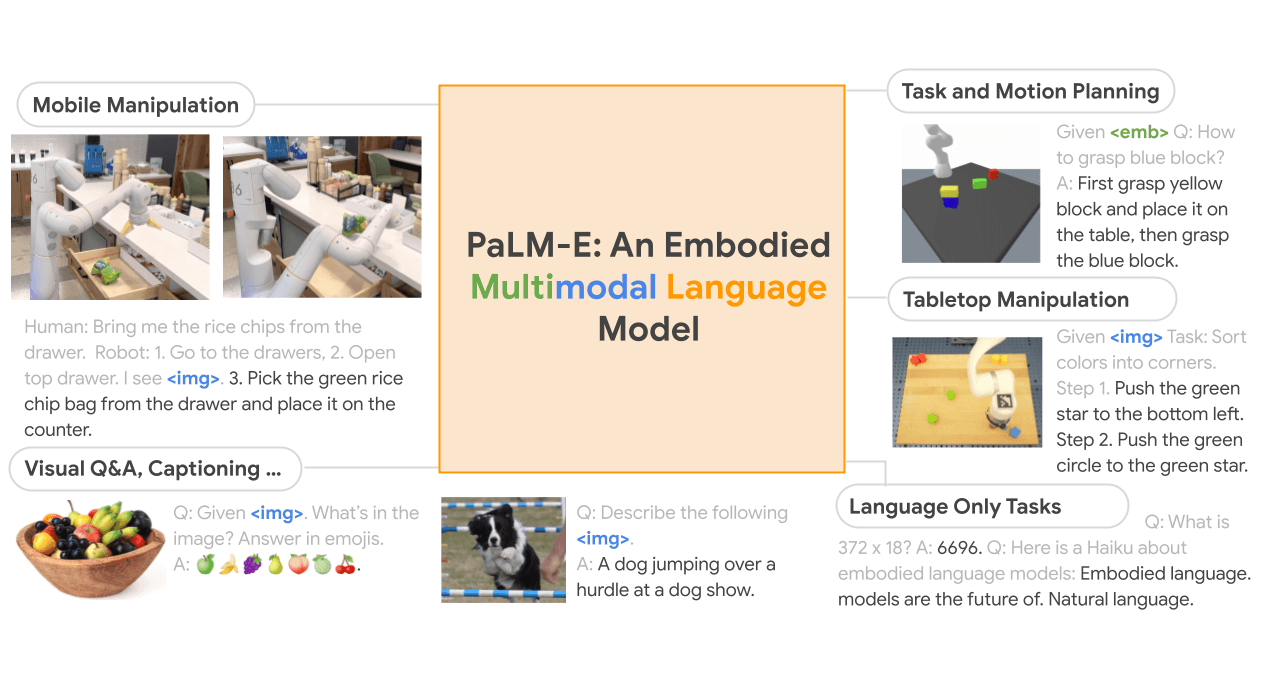
PaLM-E: An Embodied Multimodal Language Model
PaLM-E is an embodied multimodal language model designed to bridge the gap between large language models and real-world physical interaction, particularly for robotics. It achieves this by directly incorporating continuous sensor modalities, such as visual and state estimation inputs, into the language embedding space of a pre-trained language model like PaLM. This allows PaLM-E to process multi-modal sentences that interleave visual, continuous state, and textual input encodings. The model is trained end-to-end for various embodied tasks, including sequential robotic manipulation planning, visual question answering, and captioning. PaLM-E demonstrates the ability to address diverse embodied reasoning tasks across multiple observation modalities and embodiments, exhibiting positive transfer from diverse joint training across internet-scale language, vision, and visual-language domains. The largest version, PaLM-E-562B, also achieves state-of-the-art performance on OK-VQA while retaining generalist language capabilities.

NemoAI
NemoAI is an AI essay writing and note-taking copilot designed to enhance academic productivity. It leverages advanced AI models and proven study techniques to assist users in generating structured essay drafts and detailed outlines. The tool provides access to millions of academic sources, enabling automatic generation of proper citations in various formats like MLA, APA, and Harvard. Users can engage in intelligent conversations with an AI Chat to refine their writing, receive instant feedback, and get rewrites. Its Notion-like editor offers a familiar and intuitive writing environment with blocks, headings, and rich formatting options, making writing and note-taking seamless.
caffe-cvprw15
caffe-cvprw15 is a deep learning framework developed by Kevin Lin, Huei-Fang Yang, and Chu-Song Chen for fast image retrieval. It introduces a novel approach to generate hash-like binary codes by adding a latent-attribute layer to a deep Convolutional Neural Network (CNN). This method efficiently learns domain-specific image representations and hash functions without relying on pairwise similarities, making it highly scalable for large datasets. The framework has demonstrated significant improvements in retrieval precision on datasets like MNIST and CIFAR-10, and its computational cost for Hamming distance calculation is substantially lower than traditional Euclidean distance measures, offering a speedup of approximately 982,600x. It provides resources for downloading pre-trained models and datasets, and includes scripts for training custom models.

Halcyon
Halcyon is the AI platform for energy, offering automated and always-on energy market intelligence. It helps professionals navigate the energy buildout and accelerate speed to power. Key features include Halcyon Search & Query, which allows users to search millions of energy dockets, filings, and regulatory documents, filtering by topic, keywords, and filing type, and asking follow-up questions in plain English. The platform also provides Agentic Alerts, combining precise search filters with AI-powered analysis to deliver signals from hundreds of pages of energy filings. Additionally, Halcyon offers Data Subscriptions for asset-level precision across gas plants, large load tariffs, rate cases, battery storage, and new substations, sourced from authoritative regulatory filings and updated monthly.

Reshape Biotech
Reshape Biotech offers an AI-driven operating system for microbiology, automating data capture, structuring results, and surfacing insights to accelerate scientific research and product development. The platform features a scalable robotic system with built-in incubation and automated imaging, designed to make R&D labs more efficient and data-driven. It supports experiment-driven discovery with automated data capture and insight generation across various conditions, alongside standardized QC testing workflows for consistent, scalable assays. Key hardware includes a Smart Incubator for timelapse imaging and incubation, and a High-throughput Imaging Device for rapid analysis. Reshape Biotech aims to build a 'lab in the loop,' where predictive AI learns from each experiment, making subsequent runs smarter and more effective.

Chemistry
Chemistry is a comprehensive mobile and desktop application designed to simplify the study of chemistry. It features an interactive periodic table, allowing users to access detailed information on each element with ease. The app includes a powerful chemical reactions solver that can find answers for equations even when variables are unknown, supporting both organic and inorganic chemistry with reactions displayed in standard and ionic forms. Additionally, Chemistry provides an interactive solubility table, a molar mass calculator, and other useful resources like electronegativity of elements, reactivity series, and acid strengths charts. It also offers an AI-powered chemistry assistant, ChemAI Tutor, and is available on multiple platforms including Apple Vision Pro for a spatial computing experience.
Curiosity.AI
Curiosity.AI provides a context graph for industrial AI, connecting fragmented enterprise data into a structured knowledge layer. This enables both humans and AI to reliably use information in real workflows, going beyond simple chat functionalities. The platform is designed for complex environments, modeling structured data and relationships to allow AI to operate on real enterprise context. It offers solutions for knowledge management, technical customer support, engineering, quality management, and contracts & compliance. Curiosity.AI runs on your infrastructure, offering in-memory speed at scale and supporting various industries like Aerospace & Defense, Automotive & Mobility, Energy & Infrastructure, and Industrial Manufacturing.
BISITE Research Group
The BISITE Research Group is a multidisciplinary team dedicated to advancing technology through artificial intelligence and machine learning. They specialize in developing innovative products and solutions across various domains, including Industry 4.0 and smart cities. The group actively participates in national and international research projects, fostering collaborations with both companies and universities. Their work encompasses scientific activity, university research institutes, and support services for research, aiming to transfer results and manage international projects. The Universidad de Salamanca, which hosts the BISITE Research Group, emphasizes scientific production, intellectual property, and cultural scientific initiatives.
Atlas Browser
Atlas Browser is a fast, lightweight, and private-by-default AI browser designed to enhance productivity and organization. It leverages Perplexity Comet technology to provide intelligent features such as context-aware AI that can compare multiple sources on a story, automatically categorize and group tabs, and even assist in drafting emails or creating study plans. The browser aims to streamline daily tasks by offering AI-powered solutions for research, communication, planning, and online shopping. It's built to transform how users interact with the web, offering a clutter-free environment where AI assists in understanding information, organizing content, and building solutions.