
Research & Education
Browsing page 126 of AI tools for Research & Education. Sorted by confidence score — our independent quality rating.
London.AI
London.AI is a meetup series presented by Air Street Capital and Nathan Benaich, focusing on both research and applied AI topics. These events gather members of the research, product, engineering, and founder communities to discuss advancements and applications in artificial intelligence. The meetups feature speakers from various AI-first companies and include networking opportunities. Air Street Capital, a venture capital firm investing in AI-first companies, also publishes the State of AI Report and Air Street Press, further contributing to the AI ecosystem. The events are designed to foster collaboration and knowledge sharing within the London AI community.
Maple Learning Solutions
Maple Learning Solutions specializes in providing AI-powered eLearning solutions, leveraging technologies like Augmented Reality (AR), Virtual Reality (VR), gamification, and video to create highly engaging and effective training experiences. The company offers custom eLearning solutions, intelligent learning technologies, and AI-powered learning platforms that personalize content, track progress, and optimize results in real-time. They also focus on ROI-focused learning strategies, designing data-driven solutions with clear objectives and measurable business impact. Maple Learning Solutions caters to startups, enterprises, and individuals, aiming to transform learning, empower teams, and drive real results through innovative digital and eLearning solutions.

Nabat
Nabat.ai is a UAE climate tech venture that leverages AI and autonomous robotics for large-scale ecological restoration and conservation. Developed at Abu Dhabi’s Technology Innovation Institute, their solution enables data-driven strategies tailored to unique habitats. Nabat provides science-backed technology for managing, restoring, and monitoring coastal, marine, and arid ecosystems, including mangroves, coral reefs, forests, desert areas, and farmland. Their methodology involves assessment using high-resolution satellite and drone imagery, AI-powered planning for optimal restoration sites, autonomous drone seeding for precise seed dispersal, and real-time monitoring of restored areas. Nabat is actively involved in the UAE's national mangrove restoration program.

Hope Street Group
Hope Street Group offers FutureMe, an AI-powered platform designed to help high school students explore career pathways and make informed decisions about their future. Built using Hope AI, a human-guided AI system, FutureMe inspires students and amplifies human strengths by providing interactive quests to uncover interests and evaluate career options. The platform is designed to be safe, self-moderating, and inspiring, acting as a mentor to students. It also provides educators with powerful tools to support student guidance, integrating real-world context and fostering student ownership over their futures. Hope Street Group is a nonprofit with over 20 years of experience in education and workforce systems, aiming to make every student confident, capable, and connected.

MatHud
MatHud is an AI-assisted mathematics playground and 2D graphing calculator built with Brython, designed to help users visualize, analyze, and solve a wide range of math problems. It features an interactive drawing canvas where users can manipulate geometric objects and an AI assistant that responds to conversational prompts. The tool supports arithmetic, geometry, algebra, calculus, and statistics, offering LaTeX-formatted explanations for solutions. Key capabilities include plotting functions, comparing intersections, shading bounded regions, fitting regression models, and computing descriptive statistics. Users can also create and analyze graph theory graphs, save/load workspaces, and utilize a vision mode for the AI to analyze drawings. MatHud supports multiple AI providers like OpenAI, Anthropic, and OpenRouter, allowing users to choose based on their configured API keys.

MBZUAI Incubation and Entrepreneurship Center (IEC)
The MBZUAI Incubation and Entrepreneurship Center (IEC) is an AI-native incubator launched at the Mohamed bin Zayed University of Artificial Intelligence (MBZUAI). It is dedicated to fostering the growth of AI startups and assisting innovators in bringing their AI-driven ideas to fruition. The center uniquely combines deep technical AI expertise with crucial strategic business insights, aiming to incubate value-creating startups. It provides a supportive ecosystem for entrepreneurs, leveraging the university's research capabilities and academic environment to accelerate the development and market entry of innovative AI solutions. The IEC is part of MBZUAI's broader 'Innovate' initiative, which also includes consulting and various institutes focused on specific AI applications.

Polyrific
Polyrific provides AI solutions designed for insurance and other regulated industries, focusing on transforming underwriting, claims, and policy operations. Their platform, Polyrific Catalyst, offers persistent memory, agent orchestration, and governance infrastructure, ensuring enterprise AI is deployable and compliant. Key applications include SubmissionAdvisor™ for AI-powered submission pre-review, PolicyAdvisor™ for intelligent policy analysis, and QualityAdvisor™ for automating quality assurance in life insurance interviews. Polyrific emphasizes rapid deployment, with solutions going into production in weeks, not months, and offers full audit trails and explainable AI decisions crucial for regulated environments. The platform is model-agnostic and built with compliance as a foundational element.
Project Read AI
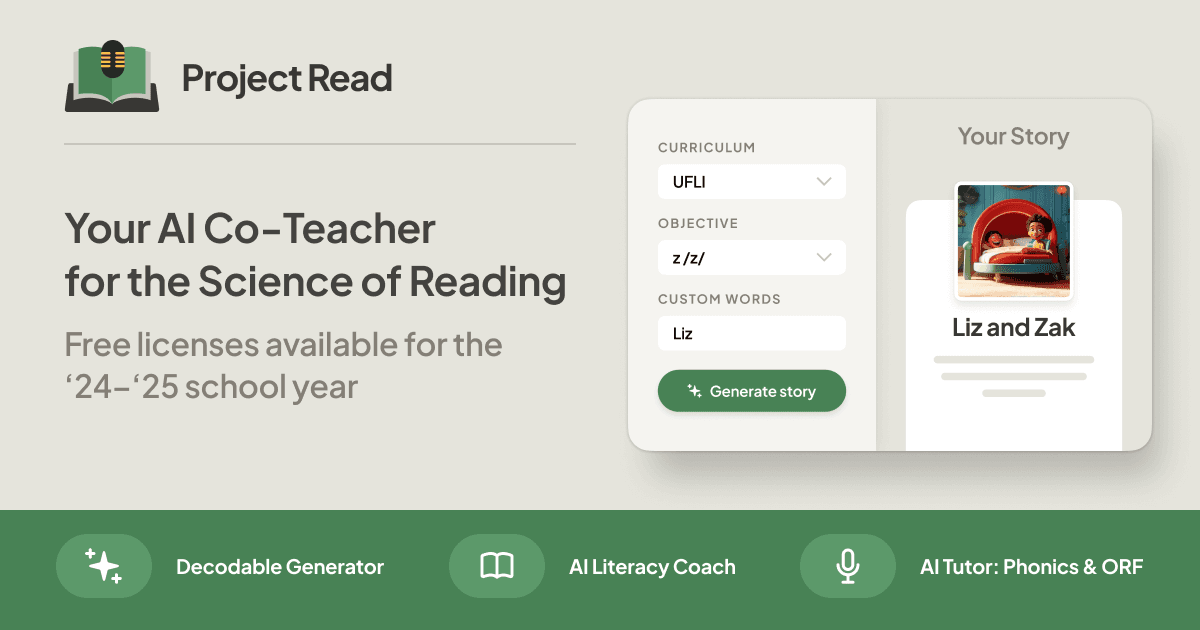
Project Read AI is an AI-powered platform designed to significantly enhance literacy instruction for educators. It provides powerful tools for teaching phonics, fluency, and comprehension, all rooted in the Science of Reading and aligned with various curricula like IMSE, UFLI, and CKLA. Key features include a Decodable Generator for personalized stories, a Fluency Passage Generator, and a Comprehension Question Generator. The platform also offers an AI Tutor that listens, adapts, and delivers targeted phonics practice with real-time feedback, tracking student progress and providing differentiated instruction. Additionally, Project Read AI includes Lola, an AI instructional coach for lesson planning, and a UFLI Assessment and Planning Portal for automated lesson planning based on student data.

Raycaster
Raycaster is an AI-native workspace specifically designed for the biopharmaceutical industry, aiming to accelerate drug development by streamlining document management. It ensures that protocols, reports, Module 2/3, and quality documents remain consistent and synchronized with the underlying scientific data. The platform offers features like regulatory research across various documents, AI-powered drafting of protocols and reports, and impact analysis to trace changes across the entire dossier. Raycaster helps teams spend less time on document reconciliation and more on scientific interpretation, ultimately leading to stronger submissions with significantly reduced rework for clinical, CMC, regulatory, quality, and nonclinical teams.

Recipio
Recipio is an AI-powered recipe organizer and cooking companion designed to help home cooks stop losing recipes and start cooking more efficiently. It allows users to save recipes from various online sources, including websites, blogs, and even images, with AI automatically extracting ingredients, instructions, and tagging them by cuisine. The platform centralizes all recipes, making them easy to find and manage. Key features include smart extraction, voice dictation for hands-free entry while cooking, and the ability to export ingredients to a shared shopping list. Recipio aims to simplify kitchen life for thousands of home cooks by providing a comprehensive solution for recipe management and meal planning.
ArXivChatGuru
ArXivChatGuru is an open-source Streamlit application designed to facilitate interaction with research papers from arXiv. It functions by allowing users to specify a topic and the number of papers to load. The app then retrieves these papers, splits them into manageable chunks, and generates OpenAI embeddings for each chunk. These chunks and embeddings are stored in a topic-scoped Redis vector index, which also acts as a semantic cache. Utilizing LangChain, the tool retrieves the most relevant chunks for user questions, providing context to a chat model for grounded Q&A. This project is intentionally simple, serving as a valuable learning resource for understanding Retrieval Augmented Generation (RAG) workflows in an academic context, rather than a production-ready research assistant.
Wonda VR
Wonda VR is an AI-powered training platform designed to create tailored, immersive simulations for learners in healthcare, business, and language learning. It allows educators to adapt scenarios, personalize conversational practice, and develop assessment learning content. The platform enables the design of hyper-realistic AI conversations with customizable characters, environments, and evaluation frameworks, deploying them seamlessly across devices including desktop, mobile, and VR. Wonda Pro provides unlimited AI-powered adaptive practice and instant feedback, focusing on competency-based education and measurable skill progression. It integrates with LMS systems or can be deployed via direct web links, offering personalized virtual coaching and detailed performance analytics for individuals and groups.

Q.ANT
Q.ANT is at the forefront of photonic computing, offering solutions for more energy-efficient AI and High-Performance Computing (HPC). Their flagship product, the Native Processing Server (NPS), is the first commercial photonic processor designed to integrate seamlessly into existing computing ecosystems. This technology promises up to 30 times higher energy efficiency compared to conventional CMOS technologies, significantly reducing operational costs and environmental impact for data centers. Q.ANT's approach addresses the limitations of traditional computing by providing a scalable and sustainable alternative for complex AI training, inference, machine learning, physics simulations, and time-series analysis.

Flalingo
Flalingo is an online English learning platform that connects students with native English tutors. It leverages Oxford University Press resources and its proprietary FLAI artificial intelligence for analysis and personalized feedback. The platform's smart algorithm helps match students with the perfect tutor, ensuring a tailored learning experience. Flalingo offers 24/7 live support and caters to individual learners, kids, businesses, and those preparing for exams. Users can track their progress and benefit from flexible scheduling. The platform emphasizes a systematic approach to English education, aiming for guaranteed results through certified teachers and AI-driven insights.
bert_score
BERTScore is an automatic evaluation metric for text generation, leveraging pre-trained contextual embeddings from BERT to compare candidate and reference sentences. It calculates precision, recall, and F1 scores based on cosine similarity, offering a robust method for assessing the quality of generated text. The tool supports approximately 130 models, with `microsoft/deberta-xlarge-mnli` currently offering the best correlation with human evaluation. It is compatible with Huggingface's transformers library and provides both a Python function and a command-line interface for ease of use. BERTScore also supports multiple reference sentences and offers options for rescaling scores with baselines and using inverse document frequency (idf) for weighted word importance.
GPT Zero
GPT Zero is a leading AI detection tool designed to identify content generated by large language models such as ChatGPT, GPT-5, and Gemini. It offers a high accuracy rate, with independent benchmarks showing 99% accuracy in spotting AI-generated text. The tool provides an overall AI score and highlights specific phrases detected as AI-generated. Beyond basic detection, GPT Zero includes features like an advanced AI scan, AI vocabulary identification, a hallucination detector, and a plagiarism checker. It also offers integrations with Google Docs, Canvas, and a Chrome extension, making it suitable for educators, students, writers, and businesses focused on authentic content.
Interview Optimiser
Interview Optimiser is an AI-powered, real-time interview practice tool designed to help job seekers excel in their career journey. It offers a unique voice-to-voice interaction experience, simulating actual interviews and providing instant feedback on delivery, confidence, and vocal tone. Users can practice for specific job roles by uploading their CV and the target job description, ensuring tailored questions and relevant scenarios. The platform helps identify and correct nervous habits like speaking too fast or using filler words. With detailed performance feedback, including prosody analysis and skills assessment reports, users can track their improvement and walk into interviews with unshakeable confidence. It offers flexible, pay-as-you-go pricing without subscriptions.
coco-app
Coco AI App is an open-source unified search platform designed to connect all your enterprise applications and data, including Google Workspace, Dropbox, Confluence Wiki, and GitHub, into a single, powerful search interface. Available for desktop and mobile, it allows users to search and interact with their enterprise data across various platforms. Beyond unified search, Coco AI offers a Gen-AI Chat tailored to your team’s unique knowledge and internal resources, enhancing collaboration by making information instantly accessible and providing AI-driven insights. The backend services for data indexing and search functionality are handled separately, ensuring a focused and efficient application experience. Built with Rust and Tauri 2.0, it prioritizes high performance and a modern UI.
Kompas AI
Kompas AI is a personal knowledge management tool designed to help users capture, organize, and leverage their thoughts and research. It integrates AI sessions that use past notes and reading to ask better questions, fostering a deeper engagement with content. The tool builds a graph of your thinking, where every session becomes nodes and edges, connecting decisions, memories, and retrieved passages. This graph then aids in retrieval-first writing, allowing users to pull sessions and fragments into their drafts, ensuring their unique voice and context are preserved. Kompas emphasizes data ownership, with content stored locally in a SQLite file, and offers both a free desktop app and a forthcoming Pro cloud tier with included AI.
ChatALL
ChatALL is an open-source desktop application designed to streamline interactions with various large language models (LLMs). It enables users to send a single prompt to multiple AI bots simultaneously, including popular ones like ChatGPT, Bing Chat, Bard, Claude, and many others. This concurrent querying helps users compare responses and identify the best answers or creations from different LLMs. The tool is particularly useful for LLM gurus seeking optimal results, researchers comparing model strengths, and developers debugging prompts. It supports a wide range of AI bots, offering features like quick-prompt mode, local chat history saving, response highlighting, and multi-column views. ChatALL is available for Windows, macOS, and Linux.
CogDL
CogDL is a comprehensive, open-source library designed for graph deep learning, enabling researchers and developers to efficiently train and compare models. It supports key tasks such as node classification, graph classification, and other important graph domain applications. The library emphasizes efficiency through optimized operators for faster training and reduced GPU memory usage, ease of use with intuitive APIs for hyper-parameter search, and extensibility for applying GNN models to new scenarios. CogDL also incorporates features like fast sparse matrix-matrix multiplication (SpMM) for accelerated GNN training and supports mixed-precision training. It has been accepted by WWW 2023 and offers resources like a free GNN course and a discussion forum.

Stream Ocean
Stream Ocean is an environmental technology company launched in 2022, dedicated to making the invisible visible in our oceans. It offers an AI-powered solution for real-time marine life monitoring, utilizing easy-to-deploy underwater camera systems and advanced AI-driven data analytics. This innovative approach delivers continuous high-definition video and daily data points, transforming how we understand and engage with marine environments. The system supports various sectors including coastal hospitality, marine industries, coral restoration, and scientific research, empowering users with tools to effectively monitor the underwater world. By providing unique monitoring and engagement opportunities, Stream Ocean aims to accelerate ocean health and science.
cnn-text-classification-tf
cnn-text-classification-tf is an open-source project offering a simplified implementation of a Convolutional Neural Network (CNN) for text classification using TensorFlow. This tool is based on the principles outlined in Kim's "Convolutional Neural Networks for Sentence Classification" paper. It provides the necessary code and scripts for users to train and evaluate their own text classification models, making it accessible for those looking to implement CNNs in their natural language processing tasks. The repository includes Python scripts for data helpers, model evaluation, the CNN architecture itself, and training, along with configurable parameters for embedding dimensions, filter sizes, dropout, and more.

ZenoX AI
ZenoX AI offers the Vydar Threat Intelligence platform, an AI-powered solution designed to help organizations proactively identify, prioritize, and prevent cyberattacks. It specializes in real-time monitoring and analysis of vast amounts of threat data from sources like the dark web, Telegram channels, and specialized forums. The platform utilizes the Tellyu AI engine for advanced pattern recognition, natural language understanding of fraudster terminology, and interactive data search. Key features include cyber threat intelligence, dark web monitoring, brand protection, supply chain intelligence, phishing detection, and fraud mitigation. ZenoX AI helps companies protect against leaked credentials, stolen cards, and fraudulent domains, ensuring a strong security posture.