
Research & Education
Browsing page 352 of AI tools for Research & Education. Sorted by confidence score — our independent quality rating.

Granite Docling 258M WebGPU
Granite Docling 258M WebGPU is an open-source AI tool developed by IBM Granite, available as a Hugging Face Space. It allows users to upload images of various document types, including documents, charts, tables, and code. The application processes these images to generate Docling markup, which can then be viewed as formatted HTML. Users also have the option to inspect the raw Docling text, providing flexibility for different use cases. This tool leverages WebGPU for efficient processing, making it suitable for tasks involving document understanding and natural language processing.
pytorch-pose-hg-3d
pytorch-pose-hg-3d is an open-source PyTorch implementation designed for 3D human pose estimation. This tool utilizes a weakly-supervised approach to accurately estimate human poses in diverse, real-world scenarios. It has been updated to incorporate a ResNet50 backbone with deconvolution layers, significantly improving training speed by approximately three times compared to the original hourglass network. The depth regression sub-network has also been changed to a one-layer depth map, as described in the StarMap project. Furthermore, it supports the official Human3.6M dataset release for ECCV18 challenge and is compatible with Python 3.6 and PyTorch v0.4.1. This makes it a robust solution for researchers and developers focused on advanced computer vision and machine learning applications involving human pose analysis.
100-Days-of-ML-Code-Chinese-Version
100-Days-of-ML-Code-Chinese-Version is an open-source project offering a Chinese translation of machine learning infographics and code implementations, designed to help users learn and practice machine learning concepts. The resource provides a structured curriculum covering a wide range of topics, including data preprocessing, various linear regression models, logistic regression, K-nearest neighbors (k-NN), Support Vector Machines (SVM), decision trees, and random forests. It also delves into unsupervised learning with K-means and hierarchical clustering. Beyond theoretical explanations, the project includes practical code implementations, deep dives into essential libraries like NumPy, Pandas, and Matplotlib, and foundational mathematical concepts such as linear algebra and calculus, making it a comprehensive learning companion for aspiring machine learning practitioners.
Knowji AI
Knowji AI is an intelligent vocabulary acquisition platform designed to significantly improve language proficiency, particularly for individuals preparing for academic and professional examinations. The tool leverages advanced artificial intelligence to create personalized learning paths, ensuring that users can efficiently memorize new words and achieve long-term retention. By adapting to individual learning styles and progress, Knowji AI helps users build a robust lexicon crucial for high-stakes standardized tests and general language mastery. Its focus on personalized learning and retention makes it an effective solution for serious language learners aiming for substantial vocabulary improvement.

ToftH
ToftH, operating as Juli4d, is an online platform dedicated to providing live results and data for the Macau lottery, specifically the Toto Macau Prize. It features live draw broadcasts, allowing players to witness the drawing of winning numbers in real-time. The platform also compiles historical Macau lottery results into a data table, enabling players to analyze past outcomes and verify their tickets. Juli4d aims to offer accurate and timely information, sourcing its data directly from Macau Prize and ensuring compliance with WLA standards. It caters to players seeking quick access to Macau lottery results and comprehensive data analysis.
AI SuperConnector
AI SuperConnector is an intensive 6-month startup accelerator program designed for early career researchers at Imperial College London, University of Liverpool, University of Leeds, and University of York. It supports participants in transforming their AI research into viable commercial ventures. The program combines entrepreneurship fundamentals with AI capabilities, offering masterclasses, 1:1 venture building support, and £20k in non-dilutive seed funding. Participants gain access to extensive expert networks, showcasing opportunities, and resources from a partnership with Google for Startups Cloud Program, aiming to foster robust, ethical, and impactful AI innovations.
AAAMLP-CN
AAAMLP-CN is the Chinese translated version of Abhishek Thakur's influential article, "Approaching (Almost) Any Machine Learning Problem." This resource provides a comprehensive guide to building an automated machine learning framework, originally published on LinkedIn. The project offers an online reading website and an EPUB version for convenient access. It includes completed translations, corrections for textual and code errors, and future plans to analyze excellent solutions from Kaggle Playground series competitions. The translation covers key topics such as supervised and unsupervised learning, cross-validation, evaluation metrics, feature engineering, hyperparameter optimization, and various classification and regression methods.
Math AI - AI Math Solver App
Math AI is a mobile application designed to empower students with instant solutions to complex mathematical problems. Users can simply snap a photo of an equation, and the AI-powered tool will provide detailed, step-by-step explanations, making difficult concepts more accessible. This app functions as a personal tutor, aiming to improve users' comprehension and proficiency across various mathematical subjects. It is particularly useful for students seeking immediate assistance and clear guidance outside of traditional classroom settings.
DL
DL is an open-source educational project offering a deep learning course developed by Alexander Dyakonov for Lomonosov Moscow State University. The repository contains extensive materials, including lecture videos, covering fundamental and advanced topics in deep learning. Users can explore concepts like neural networks, convolutional neural networks (CNNs), recurrent neural networks (RNNs), and transformer architectures. The course also delves into practical aspects such as fighting overfitting, optimization techniques, and text analysis. It's an invaluable resource for students and researchers looking to deepen their understanding of deep learning principles and applications.
ArxivCopilot
ArxivCopilot is an AI-powered research assistant hosted on Hugging Face Spaces, designed to streamline the research process. It enables users to create a personalized research profile based on their name, which helps in tailoring content discovery. The tool actively identifies and presents trending topics and relevant papers, ensuring researchers stay updated with the latest advancements in their field. Additionally, ArxivCopilot offers chat support, providing two distinct answer options for each query, which can aid in exploring different perspectives or solutions. While the current status indicates a build error, its intended functionality focuses on enhancing research efficiency and personalized content delivery for academics and students.
Deep-Learning-with-TensorFlow-book
Deep-Learning-with-TensorFlow-book is an open-source educational resource designed for individuals looking to learn deep learning using the TensorFlow 2.0 framework. This comprehensive book combines theoretical concepts with practical, real-world case studies, making it highly suitable for beginners. The repository includes a downloadable PDF ebook, complete with a detailed table of contents, along with all the accompanying source code. Additionally, it offers supplementary courseware, including IPython Notebooks for interactive learning. The resource has been widely recognized, adopted by numerous universities as a textbook or reference material, and has received acclaim from authoritative media outlets.
R1-V
R1-V is an open-source project focused on enhancing the super generalization ability of Vision Language Models (VLM) with minimal computational cost. It aims to improve the perception and reasoning capabilities of VLMs through reinforcement learning. The project provides new VLM-RL environments, a comprehensive training codebase, and research papers. R1-V supports various models like Qwen2-VL and Qwen2.5-VL, and offers training datasets for tasks such as item counting and geometry reasoning. It also includes evaluation scripts for benchmarks like SuperClevr and GEOQA, making it a valuable resource for researchers and developers in the VLM domain.
Realize
Realize is a performance marketing platform designed to help advertisers scale beyond traditional search and social channels. It leverages specialized AI to identify and qualify high-intent prospects, accelerating their path to conversion. The platform offers hard-coded integrations with brand-safe publishers, providing unique first-party data signals and visibility into paid and organic user behavior. Advertisers gain full control over campaigns, including bidding, targeting, and placements, with transparent performance reporting and no hidden ad-tech fees. Realize enables the use of multiple formats across various placements, allowing users to re-use existing assets and maximize top-performing social creatives, ultimately driving conversions and increasing brand affinity.
HighwayEnv
HighwayEnv offers a comprehensive collection of environments specifically designed for autonomous driving and tactical decision-making tasks. Developed and maintained by Edouard Leurent, this tool is ideal for researchers and developers working on AI algorithms for self-driving vehicles. It includes diverse scenarios such as highway driving, merging traffic, roundabouts, parking, intersections, and racetracks. Users can implement and test various reinforcement learning agents like Deep Q-Network, Deep Deterministic Policy Gradient, Value Iteration, and Monte-Carlo Tree Search. The environment is compatible with Gymnasium and provides a flexible platform for simulating complex driving situations, making it a valuable resource for advancing autonomous driving research.
ChatGPT Sugar
ChatJourney is an open-source browser extension designed to transform your ChatGPT history into a clear and interactive visual timeline. It operates by processing all data locally on your device, ensuring privacy and security as no personal data is stored or accessed externally. This tool allows users to easily track prompts, analyze their train of thought, and find past ideas within their AI conversations. ChatJourney is free to use, ad-free, and available for installation on Chrome and Firefox. It requires a ChatGPT account to function, as it integrates directly with the ChatGPT web application.

XEROTECH LTD UK
XEROTECH builds privacy-first AI products and services specifically designed for regulated sectors such as energy, legal, health, education, and governance. Their flagship product, PULVINIR, is an AI regulatory intelligence platform that provides board-ready compliance assessments for various regulatory bodies like Ofgem, SRA, HMRC, CQC, and Ofsted. PULVINIR uses deterministic rules engines for auditable figures and AI-generated narratives, ensuring every claim has an epistemic confidence tag and no data leaves the client infrastructure. XEROTECH also offers consultancy for bespoke AI systems, automation pipelines, and implementation guidance, alongside their Sovereign AI Lab (SAIL) for applied research.
DANN
DANN provides a PyTorch implementation of the Domain-Adversarial Training of Neural Networks (DANN) paper, enabling unsupervised domain adaptation through backpropagation. This open-source tool is designed for researchers and developers working with neural networks who need to improve model performance across different data distributions or domains without extensive labeled data for the target domain. It includes the necessary network structure and training scripts, with specific instructions for setting up the environment using PyTorch 1.0 and Python 2.7. Users can download the required mnist_m dataset from provided links to begin training. The project also offers a separate version, DANN_py3, for Python 3 and Docker environments, indicating ongoing development and support for modern setups. Its primary utility lies in allowing models trained on one domain to generalize effectively to another, reducing the need for costly data annotation in new environments.
Amodal3R
Amodal3R is an AI-powered tool designed for amodal 3D reconstruction, enabling users to create 3D models from 2D images, even when objects are partially occluded. By uploading an image and adding point prompts, users can highlight target objects and their occluders, guiding the reconstruction process. The application then generates a 3D model of the scene, providing semantically meaningful 3D assets with reasonable geometry and plausible appearance. Users have the flexibility to customize various reconstruction settings, ensuring the output meets their specific requirements. The generated 3D models are also downloadable, making them suitable for further use in other applications or projects. This tool is available as a Hugging Face demo, making it accessible for experimentation and use.

SRSWTI
SRSWTI is a Knowledge and Inference Platform designed to facilitate the understanding and application of knowledge. While specific features are not detailed on the publicly available pages, the platform's core offering revolves around providing tools and resources for knowledge management and inference. It aims to support users in various contexts, likely including educational and research environments, by enabling them to process, organize, and derive insights from information. The platform's focus on "Knowledge and Inference" suggests capabilities related to data analysis, pattern recognition, and potentially predictive modeling, catering to those who need to manage and leverage complex information effectively.
Audio To Text
Audio To Text is an AI tool hosted on Hugging Face, developed by thealphamerc, that provides audio-to-text transcription capabilities. The application is built using the Gradio framework, which allows for a user-friendly web interface. While the live website currently indicates a build error, suggesting the application may not be fully functional at this moment, its core purpose is to automate the transcription process, saving users time and effort in converting spoken words into written text. As a Hugging Face Space, it is typically accessible as a free-to-use tool within the community-driven platform.
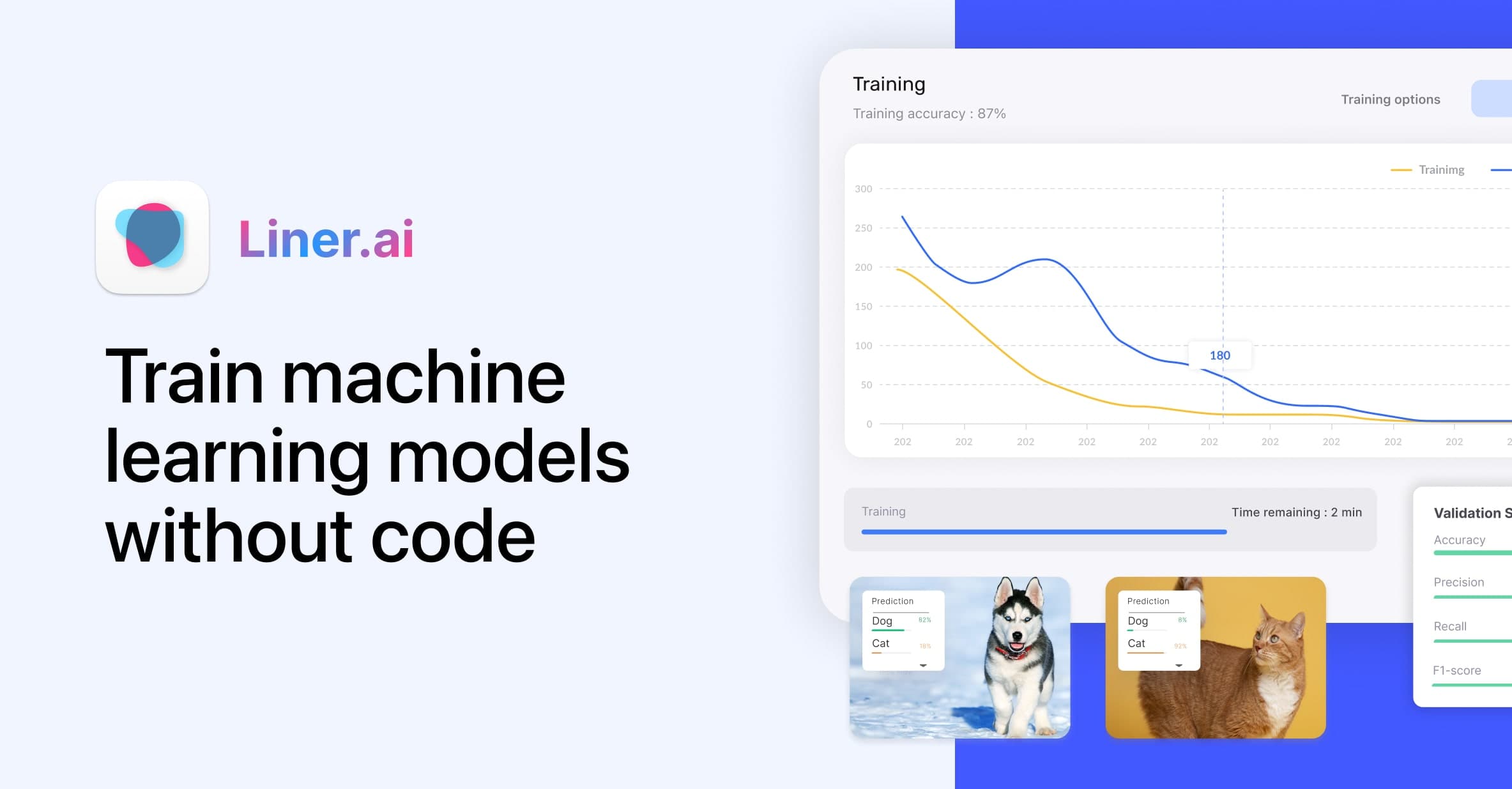
Liner.ai
Liner.ai is a free, no-code machine learning tool designed to simplify the process of building and deploying AI applications. Users can train and integrate ML models within minutes, without needing coding skills or prior machine learning expertise. The tool supports various project types, including image, text, audio, and video classification, as well as object detection, image segmentation, and pose classification. Liner.ai optimizes models for speed and accuracy, allowing training to occur quickly on CPUs without requiring a GPU. It also supports exporting models for use on mobile and edge devices, ensuring data privacy by performing all training locally on the user's computer.

Buluttan
Buluttan is an AI-based hyper-local weather intelligence platform designed to enhance operations, safeguard assets, and protect people with precision. The tool optimizes forecast algorithms and data flow to improve accuracy and precision, leveraging a Zoomcast AI Weather Model trained precisely to specific locations. It offers tailored insights for various sectors, including renewable energy, where it provides accurate power generation forecasts for wind farms and solar plants. For aviation, Buluttan delivers hyper-localized forecasts for airports, ensuring safer take-offs and landings. It also caters to the logistics, mobility, and port operations industries, providing advanced weather insights to navigate planning efficiently and manage tasks effectively.

Mindojo
Mindojo is an innovative adaptive e-learning platform designed to instill knowledge effectively and affordably. It functions as an AI private tutor, engaging students through personalized dialogues and adapting to their individual learning styles. The platform builds a robust model of each student’s mind, using sophisticated algorithms to predict the most efficient teaching interactions. Mindojo offers intuitive and powerful authoring tools, enabling users to model course knowledge, compose interactive lessons, and collaborate. It's versatile, suitable for standalone commercial products, in-house training, university course supplements, or flipped classrooms. Mindojo currently powers successful prep courses for exams like GMAT and CFA, demonstrating its capability to significantly improve student outcomes.
OpenNE
OpenNE is an open-source package designed for network embedding (NE) and serves as a comprehensive toolkit for network representation learning (NRL). It offers a standardized interface for both training and testing different NE models, ensuring scalability and flexibility. The package includes implementations of several typical NE models, such as DeepWalk, LINE, node2vec, GraRep, GCN, HOPE, GF, SDNE, and LE. A key feature is TADW, which allows for the incorporation of text attributes of nodes, enhancing the embedding process. OpenNE leverages TensorFlow, enabling GPU-accelerated training for improved performance. The toolkit also provides evaluation capabilities through node classification tasks, reporting Micro-F1, Macro-F1, and running time for various methods and datasets like Wiki and Cora.