
Research & Education
Browsing page 17 of AI tools for Study Assistants in Research & Education. Sorted by confidence score — our independent quality rating.

DET Practice
DET Practice is an all-in-one platform and Platinum Partner for Duolingo English Test preparation, designed to help students achieve higher scores. It provides an extensive question bank with over 18,000 practice questions, continuously updated with high-scoring answers and detailed explanations. The platform features powerful full-length mock tests that closely simulate the real DET exam, complete with adaptive exams and accurate AI scoring, delivering results within minutes. Additionally, DET Practice offers AI correction support for writing and speaking sections, providing detailed evaluation reports and teacher guidance. Users can also access comprehensive DET courses to develop an in-depth understanding of the test sections and benefit from an AI tutor for grammar correction, translation, and content generation.
IELTS Cream
IELTS Cream is an AI-powered platform designed to significantly enhance IELTS speaking preparation. It provides access to a comprehensive collection of real IELTS speaking exam questions, including up-to-date seasonal questions, covering both Part 2 and Part 3 of the test. The tool categorizes topics into five major areas for well-rounded practice. Users benefit from a database of over 12,000 core vocabulary words and phrases, meticulously crafted for IELTS speaking, alongside over 1,800 guiding sentences to aid in topic discussion. Additionally, IELTS Cream offers more than 4,000 high-scoring sample answers that adhere strictly to official IELTS standards, providing diverse perspectives and insights for effective learning. An AI assistant helps organize and complete scripts, expanding and customizing sample essays to align with individual preparation needs.
Teachally
Teachally is an AI-powered platform designed to empower educators by streamlining lesson planning and content creation. It generates HQIM compliant lesson plans, teaching guides, assessments, and enrichments without the need for complex prompting. The tool effortlessly aligns educational content to over a million national, state, AP, and specialized standards, ensuring accuracy and consistency. Teachally also offers extensive differentiation tools, allowing teachers to tailor lessons for individual student needs and translate resources into over 100 languages. It supports various lesson models like 5E, UDL, and Montessori, and provides classroom-ready presentations, activities, and printable worksheets. The platform emphasizes privacy, stripping out PII before LLM use and complying with FERPA, GDPR, and COPPA.
OfferGenie
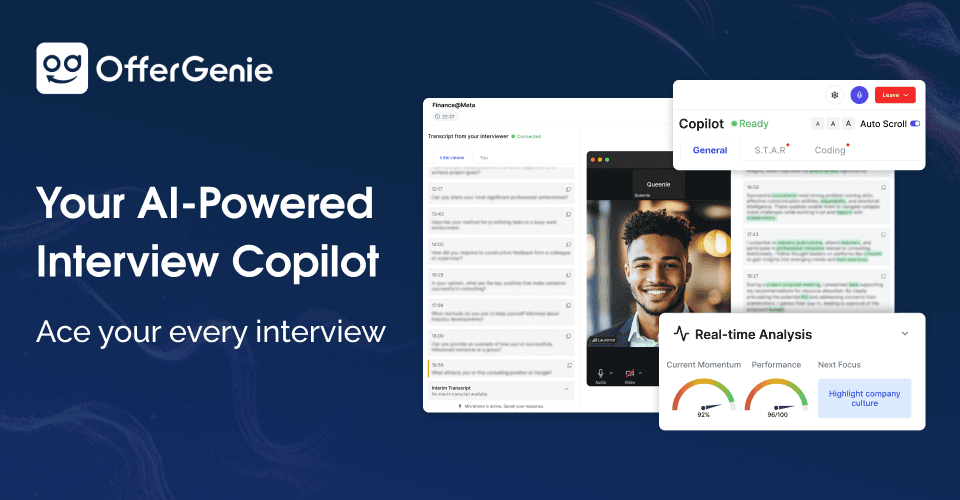
OfferGenie is a comprehensive AI-powered career advancement platform designed to help job seekers ace interviews, build resumes, and secure their dream jobs. It offers a real-time AI Interview Copilot that provides instant suggestions and answer guidance during live interviews, compatible with platforms like Zoom, Teams, and Meet. Beyond interview assistance, OfferGenie includes AI mock interviews with personalized feedback, an ATS-optimized resume builder, LinkedIn profile generator, and cover letter generator. The platform also features Job Match AI, an Interview Question Predictor, and Career Path Recommendations, making it an all-in-one solution for job search preparation and success.
Math-To-Manim
Math-To-Manim is an open-source AI tool designed to generate epic math and physics animations and study notes from text and images. It utilizes advanced AI pipelines, including Google Gemini 3, Claude Sonnet 4.5, and Kimi K2.5 Swarm, to analyze concepts, discover prerequisites, enrich content with LaTeX equations, and design visual specifications. The tool then composes verbose prompts to generate working Manim Python code, enabling the creation of complex animations without manual coding. It focuses on building pedagogically sound animations that flow from foundational to advanced topics, making it ideal for educational content creation.
ProfBot
ProfBot is a revolutionary AI-powered chatbot designed to enhance the learning experience for university students. It offers personalized feedback in real-time, allowing students to engage more deeply with their education and significantly improve academic performance. Available 24/7 on any device, ProfBot provides flexible access to learning support. The tool integrates with OpenAI to create powerful learning tools, ensuring a user-friendly interface and tailored learning experiences. Dr. Sean Wise, Professor of Entrepreneurship and Co-Founder of ProfBot.ai, highlights its capabilities in providing personalized learning experiences and feedback.
deep_learning_cookbook
Deep_learning_cookbook is an open-source repository featuring 35 Python notebooks that illustrate fundamental machine learning techniques using the Keras framework. These notebooks are designed to accompany the book "Deep Learning Cookbook" but are fully functional as standalone educational resources. The collection covers a wide range of topics, from using pre-trained word embeddings and building recommender systems to generating text, classifying sentiments, and working with image recognition networks. It also includes examples for productionizing embeddings and preparing Keras models for deployment on platforms like TensorFlow Serving and iOS. While a GPU is not strictly required, its use is recommended for faster processing.
deeplearning-notes
deeplearning-notes offers a detailed collection of study materials for the Deep Learning Specialization courses by deeplearning.ai on Coursera, led by Andrew Ng. This resource is designed to help students and professionals understand the core principles of deep learning, including neural networks, convolutional networks (CNNs), recurrent neural networks (RNNs), and sequence models. It covers practical aspects like hyperparameter tuning, optimization algorithms, and structuring machine learning projects. The notes delve into various topics such as Adam, Dropout, BatchNorm, Xavier/He initialization, and provide insights into real-world applications in healthcare, autonomous driving, and natural language processing. The content is structured to support learning in Python and TensorFlow, making it a valuable companion for those mastering deep learning theory and its industrial application.
deeplearning4nlp-tutorial
deeplearning4nlp-tutorial offers a hands-on tutorial for deep learning, specifically tailored for Natural Language Processing (NLP). This GitHub repository provides comprehensive resources, including slides and source code, from various lectures and seminars. Users can explore different deep learning models such as Feed Forward Architectures for sequence classification, Convolutional Neural Networks for sentence/text classification and relation extraction, and Long-Short-Term-Memory (LSTM) Networks for sequence classification. The tutorial supports Python 2.7 or 3.6, Keras, and either Theano or TensorFlow as backend, making it a valuable resource for students and practitioners looking to implement deep learning methods in NLP.
ML-University
ML-University is a comprehensive, open-source platform designed for free learning in the field of machine learning. Curated by an ML enthusiast for the global community, it serves as a continuously updated repository of educational resources. The platform covers a wide array of topics, including Mathematics for ML, Machine Learning, Deep Learning, Natural Language Processing, Reinforcement Learning, Large Language Models, ML in Production, Quantum ML, and provides access to datasets, useful websites, and research papers. Users can contribute to its growth by suggesting improvements or sharing valuable resources through pull requests, fostering a collaborative learning environment for ML practitioners at all levels.
Modern-Computer-Vision-with-PyTorch
Modern Computer Vision with PyTorch is an open-source code repository published by Packt, accompanying a book of the same name. It offers a hands-on approach to solving over 50 computer vision problems using PyTorch 1.x on real-world datasets. The repository includes code examples for training neural networks from scratch, implementing 2D and 3D multi-object detection and segmentation, generating digits and DeepFakes with autoencoders and GANs, and manipulating images using various GAN architectures. It also covers combining computer vision with natural language processing for OCR, image captioning, and object detection, and with reinforcement learning for building agents. The resource is ideal for beginners to PyTorch and intermediate-level machine learning practitioners.
DL4NLP
DL4NLP is a comprehensive GitHub repository dedicated to Deep Learning for Natural Language Processing (NLP). It serves as a valuable resource hub, offering state-of-the-art materials for various NLP sequence modeling tasks such as machine translation, image captioning, and dialog systems. The repository includes detailed notes on fundamental concepts like neural networks, RNNs, and LSTMs. It also curates links to prominent academic courses, including Stanford CS 224D and Oxford Deep Learning for NLP, complete with syllabi, slides, and lecture videos. Additionally, it provides access to seminal papers, code, and tutorials on key NLP topics like word vectors, sentiment analysis, neural machine translation, and conversation modeling, making it an essential reference for anyone studying or working in the field.
SlowMo AI
SlowMo AI is an advanced AI-powered educational platform specifically designed for children aged 6-12. It provides a safe and engaging environment for young learners to explore the world of artificial intelligence through interactive games, AI literacy modules, and prompt engineering challenges. The platform aims to foster critical thinking skills and introduce fundamental AI concepts in an age-appropriate manner. With a focus on educational safety, SlowMo AI ensures content is filtered and suitable for its target audience, making learning about AI both fun and secure. It helps children understand how AI works and how to interact with it responsibly, preparing them for a future increasingly shaped by technology.
Teachify
Teachify is an AI-powered teaching assistant designed to empower educators by streamlining the creation of engaging and personalized assignments. This tool focuses on enhancing the teaching process and improving student learning outcomes. By leveraging artificial intelligence, Teachify helps educators save time on administrative tasks, allowing them to focus more on direct instruction and student interaction. The platform is built to be intuitive, making it accessible for teachers of varying technical skill levels. Its core functionality revolves around generating customized educational content, which can significantly benefit both teachers looking to diversify their teaching methods and students seeking more tailored learning experiences.
revix ai
Revix AI is an AI-powered study platform designed to enhance learning efficiency for students. It transforms textbooks into smart notes and flashcards, acting as a personalized study assistant. The tool helps users stay organized, motivated, and on track with their studies. Key features include personalized learning experiences, adaptive study tools, and an intelligent tutoring system. It leverages machine learning to optimize academic performance and improve memory retention. Revix AI is ideal for exam preparation, offering automated study notes and a digital learning companion to support various learning techniques.

Brisk Teaching
Brisk Teaching is an AI-powered education platform designed to assist teachers and students by integrating AI capabilities directly into existing workflows. It enables educators to quickly generate instructional materials like lesson plans, quizzes, and presentations from various resources such as Google Docs, YouTube videos, or PDFs. The platform also offers robust feedback tools, including targeted, Glow & Grow, and rubric-aligned feedback, which can be applied to individual assignments or entire classes. Additionally, Brisk Teaching features an "Inspect Writing" tool to help teachers understand student writing processes and identify potential AI-generated content, promoting academic integrity. For students, Brisk Boost provides a teacher-controlled AI workspace for personalized, interactive learning experiences.
Roadmap-To-Learn-Agentic-AI
Roadmap-To-Learn-Agentic-AI is an open-source GitHub repository offering a comprehensive guide to mastering agentic AI systems. It begins with foundational knowledge in Python programming and essential machine learning concepts, including Natural Language Processing (NLP) techniques like TFIDF and Word2vec. The roadmap then progresses to in-depth Deep Learning for NLP, transformer explanations, and extensive Generative AI tutorials with end-to-end projects. A significant portion is dedicated to Agentic AI tutorials, exploring various frameworks such as Langchain, LangGraph, Agno, Phidata, CrewAI, and Autogen. This resource is ideal for individuals looking to build a strong understanding and practical skills in the rapidly evolving field of agentic AI.
hands-on-transfer-learning-with-python
Hands-on-transfer-learning-with-python is a comprehensive GitHub repository designed to simplify deep learning through the application of transfer learning techniques. It leverages the Python deep learning ecosystem, including TensorFlow and Keras, to provide practical examples and code. The resource is structured into three main sections: deep learning foundations, essentials of transfer learning, and transfer learning case studies. It covers important deep learning architectures like CNNs, DNNs, RNNs, LSTMs, and capsule networks, and explores state-of-the-art pretrained networks such as VGG, Inception, and ResNet. The repository includes real-world case studies in computer vision, audio analysis, and natural language processing (NLP), making it an invaluable resource for practitioners looking to implement advanced deep learning models.
stanford-cme-295-transformers-large-language-models
Stanford CME 295 Transformers & Large Language Models offers a comprehensive VIP cheatsheet for the Stanford CME 295 course. This resource condenses key concepts related to Transformers and Large Language Models, including self-attention mechanisms, architectural variants, and optimization techniques like sparse attention and flash attention. It also covers LLM-specific topics such as prompting, fine-tuning (SFT, LoRA), preference tuning, and optimization methods like mixture of experts, distillation, and quantization. The cheatsheet extends to practical applications like LLM-as-a-judge, RAG, agents, and reasoning models, making it an invaluable study aid for students and researchers.
Professor Chucky
Professor Chucky is an advanced real-time AI teaching platform designed to provide personalized learning experiences for students of all levels. It offers AI-powered tutoring in any subject and language, allowing users to learn at their own pace. Key features include transforming notes into interactive quizzes and AI-powered summaries, with options for custom quiz generation and ELI10 explanations. The platform also facilitates study groups for peer-to-peer learning and offers a magical storytelling adventure for kids to boost reading skills and creativity. Additionally, it includes an educational game called Pots & Pans to sharpen deduction skills, making learning interactive and fun.
aivancity School of AI & Data for Business & Society
aivancity School of AI & Data for Business & Society is a unique educational institution dedicated to Artificial Intelligence and Data Science, with campuses in Paris-Villejuif and Nice. It offers a range of programs from Bachelor's to Master's degrees, including a Grande École program, MSc in Data Engineering, Cloud Computing, Data Management, and AI for Business, as well as specialized MSc in Generative AI. The school emphasizes a hybrid approach combining AI, business management, and ethics, preparing students to become "IAgénieurs®" capable of addressing complex challenges in the economy and society. aivancity is recognized by the French state and aims to ensure long-term employability through its innovative "diploma update guarantee."
LearnEase
LearnEase is an AI-powered learning platform specifically designed to help students master the CBSE curriculum for grades 8-12. It provides comprehensive study materials, interactive quizzes, and personalized learning assistance to make complex topics more accessible. The platform leverages artificial intelligence to offer tailored explanations and practical examples, enhancing understanding and retention. LearnEase aims to simplify the learning process, allowing students to effectively prepare for their exams and improve their academic performance through engaging and adaptive content.
Gooru
Gooru Learning offers MyGooru AI for Personalized Pathways (MAP), an AI-driven personalization infrastructure designed to deliver assured outcomes across various industries including learning, finance, health, and enterprise. MAP goes beyond generative AI by using formal reasoning to build beliefs about each user and generate mathematically certain pathways, ensuring engagement and completion. It actively senses user mindsets, motivation, confidence, and intent, continuously updating probabilistic beliefs across knowledge, mindsets, interests, abilities, and community. This approach helps lower customer acquisition costs through personalized discovery and smarter conversion funnels, while increasing lifetime value via adaptive engagement and outcome completion. Gooru also provides tools for instructors, institution leaders, and curriculum developers.
zero_to_gpt
zero_to_gpt offers a comprehensive, open-source course designed to take individuals from no deep learning knowledge to implementing their own GPT models. The curriculum balances theoretical foundations, such as gradient descent and backpropagation, with practical applications like weather prediction and language translation. It covers essential topics from neural network architectures and training methods to advanced concepts like transformers, GPU programming, and distributed training. The course is structured sequentially, with lessons, optional videos, and implementations to solidify understanding, preparing users to successfully train and utilize models in real-world scenarios.