
AI Agents & Automation
Browsing page 420 of AI Agents & Automation. Sorted by confidence score — our independent quality rating.

Collection Cloner
Collection Cloner is an AI tool hosted on Hugging Face Spaces, designed for automating tasks related to cloning collections. While the live website currently shows a runtime error, its purpose, as indicated by its name and platform, is to facilitate the duplication and management of AI model collections. This functionality is crucial for data scientists and developers who need to replicate environments or share specific sets of models for research, development, or deployment. The tool's presence on Hugging Face suggests it is intended for those working within the machine learning ecosystem, providing a utility for managing and experimenting with AI models.
neuronpedia
Neuronpedia is an open-source interpretability platform designed to help users understand and analyze AI models. It offers a comprehensive suite of tools for examining neuron activations, visualizing complex neural circuits and graphs, and benchmarking model performance. Key functionalities include steering, scoring, inference, and advanced search capabilities within neural networks. The platform supports various features such as interactive dashboards, cosine similarity analysis, UMAP for dimensionality reduction, embeddings, probes, and SAEs. It also facilitates data import, export, and custom dashboard generation, making it a versatile tool for AI researchers and developers focused on model interpretability.

Suki AI
Suki AI offers an Ambient Clinical Intelligence platform designed to automate clinical documentation and coding for healthcare professionals. It captures entire patient conversations to generate comprehensive notes, patient instructions, and orders, going beyond simple transcription. The platform features voice-enabled editing and problem-based charting, adapting to clinicians' workflows. Suki AI integrates deeply with major EHRs like Epic, Oracle Health, athenahealth, and MEDITECH, ensuring seamless data synchronization. It aims to reduce administrative burden, allowing clinicians to be more present with patients, and supports the entire workflow from pre-charting to clinical reasoning.
Hunyuan Turbos
Hunyuan Turbos is an AI chatbot developed by Tencent, accessible through Hugging Face Spaces. It allows users to enter any question or prompt and receive a helpful, streaming response. This real-time interaction capability enables natural conversations, making it suitable for various conversational AI tasks. The tool is designed to provide immediate feedback, enhancing the user experience by delivering answers as they are generated, rather than waiting for a complete response.

AJournal - Planner & Journal
AJournal is an iPad daily digital planner, calendar, and journal app designed for use with the Apple Pencil, though it also supports finger drawing. Users can choose from over 100 pre-designed templates for various needs, including daily/weekly/monthly planners, project planners, budget trackers, and habit trackers. The app allows for full customization of templates and elements, supporting handwriting, text input with Scribble or keyboard, and image integration. It connects with digital calendars for event management and offers real-time goal tracking through integration with ATracker. AJournal also provides an iPhone version with iCloud sync, ensuring data consistency across iOS devices. The app prioritizes user privacy by not collecting or storing any user data on its servers.
OmniAnomaly
OmniAnomaly is an open-source AI tool designed for robust anomaly detection in multivariate time series. It leverages a stochastic recurrent neural network architecture, combining Gated Recurrent Unit (GRU) and Variational Autoencoder (VAE) components. The core functionality involves learning the normal patterns within complex time series data and then using reconstruction probability to identify deviations that signify anomalies. This model is particularly useful for analyzing datasets like SMAP, MSL, and SMD, which include server machine data and satellite telemetry. The tool provides a comprehensive workflow from data preprocessing to model training, anomaly scoring, and threshold determination using the POT model, making it suitable for researchers and developers working with time series anomaly detection.
on-policy
on-policy is the official implementation of Multi-Agent PPO (MAPPO), a multi-agent variant of Proximal Policy Optimization. This open-source tool is heavily based on an existing PyTorch A2C-PPO-ACKTR-GAIL implementation and is used in the paper "The Surprising Effectiveness of PPO in Cooperative Multi-Agent Games." It supports various environments, including StarCraftII (SMAC and SMAC v2), Hanabi, Multiagent Particle-World Environments (MPEs), and Google Research Football (GRF). The repository provides core code for algorithms, environment wrappers, training rollouts, and policy updates, with default hyperparameters available for replication.
PaddleFL
PaddleFL is an open-source federated learning framework built upon PaddlePaddle, designed to address data isolation and secure knowledge sharing among organizations. It provides researchers with an easy way to replicate and compare various federated learning algorithms. Developers can leverage PaddleFL to deploy robust federated learning systems in large-scale distributed clusters. The framework supports both horizontal and vertical federated learning strategies, including Federated Averaging, Differential Privacy, and Secure Aggregation. Key components include Data Parallel for common horizontal strategies and Federated Learning with MPC (PFM) for secure training and prediction using multi-party computation protocols like ABY3 and PrivC. PaddleFL also offers an FL-mobile simulator for algorithm simulation, training, and deployment on mobile terminal devices.
OpenSpec
OpenSpec is a spec-driven development (SDD) framework designed to enhance the predictability and organization of AI coding assistant workflows. It introduces a lightweight specification layer, allowing human developers and AI to align on requirements before any code is generated. The tool promotes an iterative approach, moving away from rigid waterfall models, and is built to integrate seamlessly into existing brownfield projects while scaling from personal use to enterprise-level applications. OpenSpec works with over 25 AI assistants via slash commands, ensuring compatibility with tools users already employ. It organizes each change into its own folder, containing proposals, specifications, designs, and implementation tasks, ensuring clarity and traceability throughout the development process.
Chatpad AI
Chatpad AI is a free, open-source application offering a clean and user-friendly interface for interacting with ChatGPT. Designed with privacy in mind, it stores all user data locally, ensuring no tracking or cookies are used. The tool supports advanced models like GPT-4, providing a robust platform for various AI interactions. Its open-source nature means the code is publicly available on GitHub, allowing for transparency and community contributions. Chatpad AI is ideal for users seeking a private, customizable, and efficient way to engage with AI models without compromising data security.
Isaac 0.1
Isaac 0.1 is an AI tool designed to analyze images and provide generated text responses based on user-defined prompts. Users can upload an image, provide a prompt, and the application will process the image to detect objects, drawing bounding boxes around them for visual identification. The tool then uses this information to formulate a text response relevant to the prompt. While the current live website indicates a runtime error, the intended functionality is to offer image analysis and text generation capabilities, making it suitable for tasks requiring visual understanding and descriptive output.
ottomator-agents
ottomator-agents is a community-driven platform developed by oTTomator, offering a curated collection of open-source AI agents. The platform aims to be an educational resource, enabling users to explore cutting-edge AI agents and learn how to implement them for personal or business use. All agents featured on the Live Agent Studio are open source, with their source code and workflow JSON available in this GitHub repository. This initiative fosters a community where users can learn from each other and contribute to a growing library of agents covering diverse use cases. While the platform is in beta, it provides initial tokens for free usage, with additional tokens purchasable for ongoing LLM usage costs.

Picktime
Picktime provides a comprehensive online appointment scheduling software designed for various businesses. It enables users to manage appointments, classes, and interviews, alongside rooms and equipment. The platform supports 24/7 online bookings, class management with waitlists, and integrates with popular video conferencing tools like Google Meet and Zoom. Key features include automated reminders, secure online payments via PayPal, Stripe, and Square, invoicing, and resource management. A standout feature is the 24/7 AI Receptionist that answers calls, automates routine tasks, captures customer details, and guides them to confirmed bookings, ensuring no booking is missed. It also offers multi-location management and personal calendar synchronization.
Point-e
Point-e is an open-source AI tool developed by OpenAI for synthesizing 3D models using point cloud diffusion. It enables users to generate 3D point clouds from either complex text prompts or synthetic view images. The tool provides code and model releases, including notebooks for sampling point clouds conditioned on images (image2pointcloud.ipynb) and directly from text descriptions (text2pointcloud.ipynb). Additionally, Point-e features an SDF regression model for converting generated point clouds into meshes (pointcloud2mesh.ipynb), offering a comprehensive solution for 3D model creation. Its capabilities, while limited for the pure text-to-3D model, understand simple categories and colors.
Inkwise AI
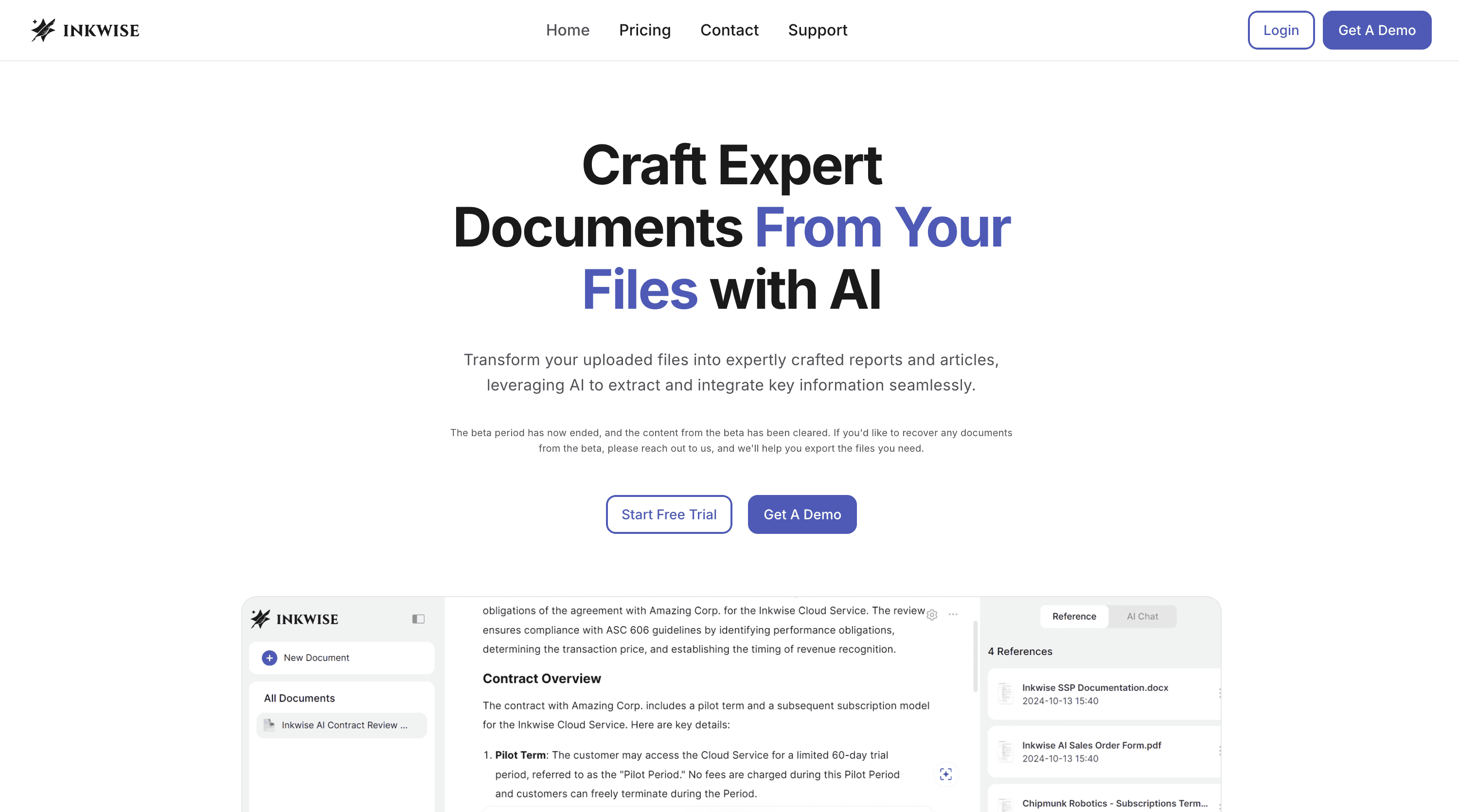
Inkwise AI, integrated within the CPAAutomation platform, offers professional-grade AI extraction and writing capabilities tailored for accounting, finance, and legal teams. It accurately extracts data from invoices, financial statements, contracts, and other documents, supporting various file types including PDFs, DOCX, and scanned images. Beyond extraction, Inkwise provides AI-powered writing that generates memos, reports, and analyses with citation-grounded references from your uploaded documents. The platform also features document automation, allowing for email-triggered processing and auto-export to Google Drive, alongside tools for form filling and upcoming features like time tracking and autonomous AI agents.
DeepBrain AI: Seek AI Chat
DeepBrain AI: Seek AI Chat is a completely free Android application designed for unlimited AI conversations powered by the DeepSeek AI model. Users can chat freely, explore ideas, and receive instant answers without any limits, ads, or hidden costs. The app ensures 24/7 availability and saves all conversations automatically, allowing users to pick up where they left off. Optimized for Android devices, it provides a smooth, fast, and responsive chat experience with minimal latency. DeepBrain AI aims to deliver an uninterrupted and accessible AI chatting experience for everyone, requiring no registration or setup—simply download and start chatting.
Quantus
Quantus is an open-source eXplainable AI (XAI) toolkit designed for the responsible evaluation of neural network explanations. It offers a comprehensive suite of over 35 metrics categorized into faithfulness, robustness, localisation, complexity, randomisation (sensitivity), and axiomatic properties. The toolkit supports various data types including image, time-series, tabular, and NLP (upcoming), and is compatible with both PyTorch and TensorFlow models. Quantus aims to provide richer insights into how different XAI methods compare, moving beyond simple visual comparisons to offer holistic quantification and sensitivity analysis. It also includes built-in support for popular explanation methods like Captum, tf-explain, and Zennit, making it a versatile tool for researchers and developers in the AI field.
Mistral Ocr App
Mistral Ocr App is a powerful AI-powered OCR tool designed for efficient text extraction from both images and PDF documents. Users can upload their files, and the application will process them to identify and display the embedded text content. A key feature for image uploads is its ability to return structured JSON with the OCR results, making it highly valuable for automated data processing and integration. This tool leverages Mistral OCR technology to provide accurate and reliable text recognition, catering to various needs from data entry automation to converting image-based text into editable formats.
ASKTOWEB
ASKTOWEB offers enterprise AI-powered User Experience Health monitoring for businesses. This advanced analytics platform provides comprehensive UX insights, allowing companies to understand how users interact with their websites and identify areas for improvement. By leveraging AI, ASKTOWEB facilitates information retrieval and helps optimize website content to enhance the overall user experience. It is designed to give businesses the data and analysis needed to make informed decisions about their digital presence, ultimately leading to better user satisfaction and engagement.
Mistral Ocr Demo
Mistral Ocr Demo provides a straightforward way to extract text from various document types, including images and PDFs. Users can either upload a file directly or provide a URL for the document they wish to process. The application then extracts the text content and presents it in a clear markdown format, making it easy to review and utilize. This tool serves as a practical demonstration of the Mistral OCR Model's capabilities, allowing individuals to quickly test and evaluate its performance in converting visual documents into editable text.
Qwen2.5 Omni 7B Demo
Qwen2.5 Omni 7B Demo is an AI tool designed to showcase and explore omnimodal capabilities, allowing users to experiment with various AI model modalities. The tool is built to understand and analyze diverse inputs including text, images, audio, and video, generating natural text and speech responses. Users can upload different types of content and receive detailed answers or explanations, making it suitable for developers and researchers interested in advanced AI chatbot development and multimodal interaction. The current demo, however, is experiencing a runtime error, preventing full functionality.
Pre-Switch, Inc.
Pre-Switch, Inc. is a Silicon Valley power architecture company specializing in AI-driven solutions for e-mobility and power conversion. Their core technology, CleanWave™, eliminates switching losses in inverters, allowing for 10X higher switching frequencies and significantly improved efficiency. This results in smaller, lighter, and cooler inverters, increased motor efficiency, and extended EV range by 5-12%. The embedded AI adapts for all loads and voltages, ensuring high peak (>99.5%) and low-load inverter efficiency. Pre-Switch offers products like the CleanWave EV Inverter Evaluation System, CleanWave Inverter Platform, and Pre-Flex SoC, which contains AI algorithms for soft switching and motor control.
Protein
Protein is an AI chatbot developed by Jade Choghari on Hugging Face, specifically designed for exploring proteins and molecules. This tool facilitates interaction with and learning about complex molecular structures, making it suitable for both educational purposes and scientific research. While currently in a sleeping state due to inactivity, its core functionality aims to provide an accessible platform for molecular exploration. The tool is hosted on Hugging Face Spaces, indicating its web-based nature and potential for community-driven development and use.
LoRA Ease
LoRA Ease is a Hugging Face Space designed to make the process of training LoRA (Low-Rank Adaptation) models more accessible. Users can upload their own images and captions, or leverage the app's AI to generate captions if needed. The platform offers customizable training settings, allowing for the creation of various model types, such as those focused on faces, distinct artistic styles, or specific objects. This tool is ideal for individuals looking to fine-tune AI models without deep technical expertise, providing a user-friendly interface for a complex task.