
AI Agents & Automation
Browsing page 506 of AI Agents & Automation. Sorted by confidence score — our independent quality rating.

Federato
Federato is the first AI-native insurance platform designed to manage the entire policy lifecycle, from submission to quote and beyond. It leverages agentic AI to enable smarter risk decisions, accelerate quoting processes, and ensure portfolio alignment. The platform helps insurance carriers, MGAs, MGA aggregators, and mutuals to build and launch products faster with Product Studio, manage billing and payments, and achieve real-time portfolio steering through Control Tower. Federato aims to consolidate disparate systems into a single, proven solution, reducing time to quote and increasing high-appetite premiums. It provides a single pane of glass view for workflow management and real-time visibility into appetite and goal progress.
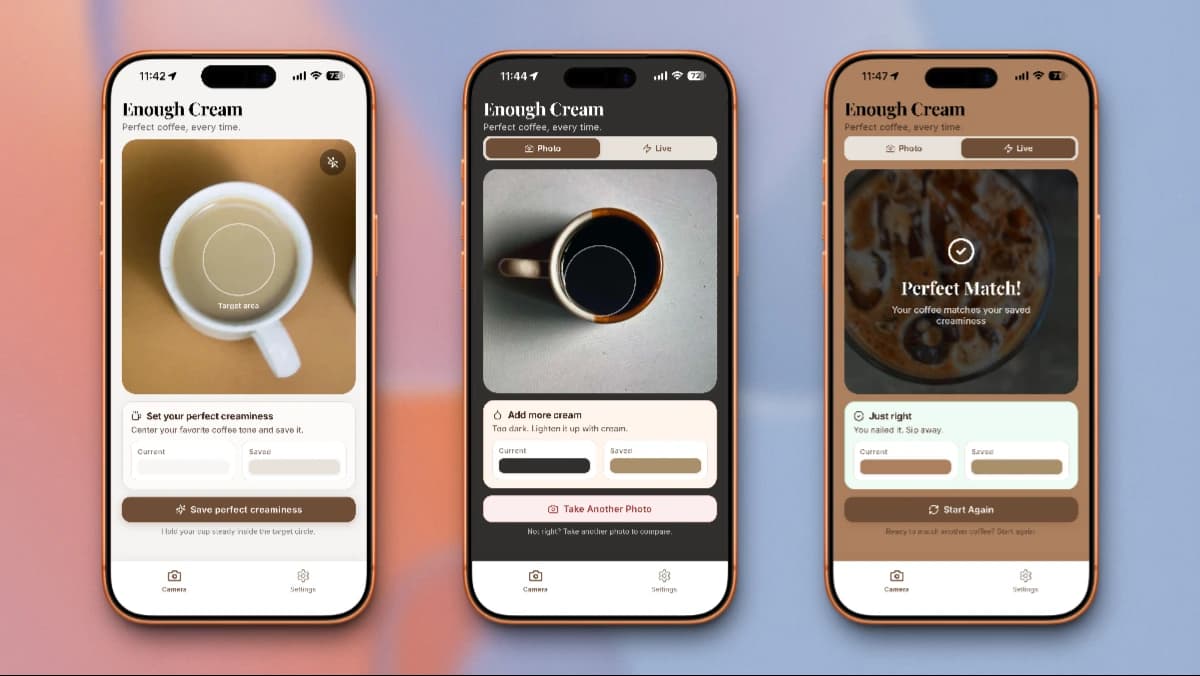
Enough Cream
Enough Cream is an innovative app designed to help users achieve their perfect cup of coffee every time. Utilizing advanced computer vision and color analysis, the app analyzes the hexadecimal color value of your coffee as you add cream. Users first set a target by snapping a photo of their ideal coffee shade. Then, in real-time, the app compares the live pour against this profile, alerting you the exact moment to stop. It goes beyond simple light or dark analysis, considering saturation, hue, and brightness, and even adapts to ambient lighting conditions for consistent results. This ensures your coffee matches your precise taste preference, eliminating guesswork and delivering a consistently enjoyable morning ritual.
Una by Polydom
Una by Polydom is an advanced AI host specifically designed for the hospitality industry, including Airbnb, short-term rentals, long-term rentals, and hotels. It operates 24/7, handling guest communications across multiple channels such as phone calls (inbound and outbound), live chat via website widgets, email auto-responses, and messengers like WhatsApp, Telegram, and Facebook. Una integrates seamlessly with existing Property Management Systems (PMS) and Channel Managers to manage bookings in real-time, including creating, modifying, and canceling reservations. Beyond communication and bookings, it also coordinates tasks like housekeeping and maintenance for staff, tracking their completion. This AI solution aims to significantly reduce operational costs by providing an AI employee at a fraction of the cost of human staff.

dataset-api
dataset-api is an Open Source toolkit specifically developed for the ApolloScape Open Dataset, a comprehensive resource for autonomous driving research. It supports innovations across perception, navigation, control, and simulation for autonomous vehicles. The toolkit includes functionalities for trajectory prediction, 3D Lidar object detection and tracking, scene parsing, lane segmentation, self-localization, 3D car instance understanding, stereo estimation, and video inpainting. Researchers and developers can utilize this API to access and process large-scale datasets, facilitating the development and evaluation of advanced autonomous driving algorithms. The project is hosted on GitHub, providing code, examples, and detailed documentation for each subfolder.
DeepRec
DeepRec is a high-performance deep learning framework specifically designed for recommendation models, built upon TensorFlow 1.15, Intel-TensorFlow, and NVIDIA-TensorFlow. Developed since 2016, it powers core businesses like Taobao Search and advertising, offering robust features for training and inference. The framework excels in super large-scale distributed training, supporting models with trillions of samples and over ten trillion parameters. It includes in-depth performance optimizations for both CPU and GPU platforms, featuring advanced embedding variables, asynchronous and synchronous distributed training frameworks, and various runtime and graph-level optimizations. DeepRec also provides capabilities for delta checkpoint loading, super-scale distributed serving, and online deep learning with low latency.
Gemma3n Visual (Audio) Question Answering
Gemma3n Visual (Audio) Question Answering is an AI tool that enables users to interact with images using audio queries. By uploading an image and speaking a question, users receive a text-based answer. This functionality makes it a valuable resource for multimodal AI research, allowing for exploration into how AI can process and respond to combined visual and auditory inputs. The tool is built as a Hugging Face Space, indicating its accessibility and potential for community-driven development and experimentation in the field of AI agents and automation.
neurodiffeq
neurodiffeq is an open-source Python library built on PyTorch, designed for solving ordinary and partial differential equations (ODEs and PDEs) using neural networks. It provides a flexible framework for implementing existing techniques of using artificial neural networks (ANNs) to approximate solutions. Unlike traditional numerical methods, neurodiffeq aims to compute continuous and differentiable solutions. The library supports various features including solving systems of ODEs and PDEs, handling initial and boundary conditions, and customizing network architectures. It also offers tools for monitoring training progress, implementing transfer learning, and defining custom sampling strategies for training points. Additionally, neurodiffeq supports solving solution bundles and inverse problems, making it suitable for complex scientific and engineering applications.
Neuton TinyML
Neuton TinyML, part of the Nordic Edge AI Lab, is a platform designed for building and deploying ultra-compact AI models specifically optimized for Nordic System-on-Chips (SoCs). It caters to both CPU-run edge AI with Neuton's self-growing models and NPU-enabled devices with LiteRT models, requiring no-code for wake word models and LiteRT configuration. The platform simplifies the AI development process into three steps: data upload, automated or configured model training, and deployment. It supports various intelligent applications like gesture recognition, anomaly detection, and health monitoring, focusing on low-power consumption, balanced memory and performance, and extended battery life for always-on sensing. It also includes data preprocessing tools like windowing, feature extraction, and selection, alongside model analysis features such as quality diagrams and confusion matrices.
Nummi
Nummi is a spiritual and personal AI designed to provide clarity, guidance, and reflection. It integrates advanced AI memory capabilities with insights from Vedic astrology, helping users understand patterns and connect various aspects of their lives. The tool offers daily clarity messages and focuses on pattern recognition, aiming to support mental wellness and emotional balance. Nummi is available on both Android and iOS platforms, providing a private and secure environment for personal exploration and self-awareness. It is ideal for individuals seeking a deeper understanding of themselves and their life's journey through a blend of AI and ancient wisdom.
object-detection-opencv
object-detection-opencv provides a Python-based solution for object detection using the YOLO (You Only Look Once) framework, integrated with OpenCV's dnn module. This tool allows developers to perform inference on pre-trained deep learning models from popular frameworks like Caffe, Torch, and TensorFlow. Specifically, it leverages YOLOv3 weights for efficient object detection in images. The project is open-source and available on GitHub, offering a practical example for computer vision tasks. It's particularly useful for those looking to implement object recognition capabilities in their applications using Python and OpenCV, providing a foundation for further development in areas like real-time video analysis or image processing.
oie-resources
oie-resources offers a comprehensive, curated list of resources focused on Open Information Extraction (OIE). This GitHub repository serves as a central hub for researchers and academics, providing access to a wide array of materials including research papers sorted chronologically and by category, code implementations, and datasets. It covers not only core OIE systems but also related work such as taxonomizing open relations and various downstream applications like Question Answering, Knowledge Base Population, and Event Extraction. The resource also features information on OIE systems for different languages, supervised OIE, PhD theses, and demos, making it an invaluable reference for anyone working in the field of natural language processing and information extraction.
qlib
Qlib is an AI-oriented quantitative investment platform developed by Microsoft, designed to empower quantitative research using AI technology. It supports diverse machine learning modeling paradigms, including supervised learning and reinforcement learning, making it suitable for various financial analysis tasks. The platform is equipped with tools to automate the research and development process, streamlining the creation and testing of investment strategies. As an open-source project available on GitHub, Qlib provides a robust framework for developers and data scientists to build and experiment with advanced AI models in the finance domain, fostering innovation in quantitative investment.
Attri
Attri specializes in creating AI employees designed for enterprise teams, offering a robust platform for managing and deploying these agents. The system, known as EnterpriseOS, allows for flexible deployment either on the client's cloud infrastructure or Attri's own. These AI agents are engineered to be trustworthy and are aimed at transforming operational workflows within large organizations. By providing a scalable and manageable AI workforce, Attri helps enterprises automate complex tasks, enhance efficiency, and innovate their business processes. The focus is on delivering reliable AI solutions that integrate seamlessly into existing enterprise environments.
relational-networks
relational-networks is an open-source Pytorch implementation of the "A simple neural network module for relational reasoning" paper, also known as Relational Networks. This tool is designed for researchers and developers working on visual reasoning and relational AI tasks. It has been thoroughly tested on the Sort-of-CLEVR task, a simplified version of CLEVR, which involves processing images with various colored shapes and answering both relational and non-relational questions. The implementation demonstrates superior performance compared to traditional CNN + MLP models, particularly in relational reasoning tasks, and includes modifications for improved computational efficiency.
rulesync
rulesync is an open-source Node.js CLI tool designed to automate the generation of configuration files for AI coding agents. This tool is particularly useful for developers and teams working on AI development projects, as it streamlines workflows and simplifies the management of agent configurations. By automating these tasks, rulesync helps to ensure consistency and reduce manual effort, fostering better collaboration within development teams. Its command-line interface makes it accessible for integration into existing development pipelines, providing a flexible solution for managing the underlying settings that drive AI coding agents.
ScreenAgent
ScreenAgent is a sophisticated computer control agent driven by visual language large models, designed to automate complex desktop tasks. It creates an environment where Visual Language Model (VLM) agents can interact with real computer screens by observing screenshots and executing mouse and keyboard operations. The tool employs an automatic control process encompassing planning, action, and reflection stages, guiding the agent to continuously interact with the environment and complete multi-step tasks. ScreenAgent supports various action types and attributes, leveraging a VNC remote desktop connection protocol for universal applicability across different desktop operating systems and applications. It also includes the ScreenAgent dataset, which comprises screenshots and action sequences from diverse daily computer tasks like file operations, web browsing, and gaming, facilitating the training of agents in task planning, image understanding, visual positioning, and tool use.
rl-agents
rl-agents is an open-source project providing a comprehensive collection of Reinforcement Learning agent implementations. This tool is designed for researchers and developers working in the field of AI, offering a variety of planning and learning algorithms. It serves as a valuable resource for experimentation and building new RL applications. The project's open-source nature fosters community contributions and allows for flexible integration into diverse research and development environments, making it suitable for both academic and practical applications in reinforcement learning.
slime
slime is an advanced post-training framework designed for Reinforcement Learning (RL) scaling, specifically tailored for large language models. It achieves high-performance training by seamlessly integrating Megatron with SGLang, enabling efficient and scalable operations. The framework supports flexible data generation through custom data workflows, allowing users to adapt to various training requirements. slime facilitates efficient training across different modes, making it a versatile solution for developers and researchers working with large language models and RL applications. Its focus on performance and flexibility makes it suitable for complex AI development tasks.
Sherlock
Sherlock is an open-source JavaScript library designed to parse natural language event descriptions into structured data. It excels at interpreting plain English phrases like "The party is tomorrow from 3pm to 5pm" and returning an object with properties such as `eventTitle`, `startDate`, `endDate`, and `isAllDay`. This tool supports a wide variety of input formats common in US English, handling times, days, date ranges, and event titles. For enhanced customization, Sherlock can be paired with Watson, which provides preprocessor and postprocessor layers to manipulate input strings or modify returned data, making it adaptable for specific application logic or data validation needs. Installation is straightforward via npm.
SwiftSpeech
SwiftSpeech is a dedicated speech recognition framework designed specifically for SwiftUI applications. It streamlines the integration of voice recognition capabilities into iOS apps, abstracting away the complexities of authorization and audio engine management. This allows developers to concentrate on building intuitive user interfaces and experiences, rather than getting bogged down in low-level system configurations. By providing a straightforward API, SwiftSpeech aims to make voice-enabled features accessible to a wider range of SwiftUI developers, enhancing app interactivity and accessibility without extensive boilerplate code.
Impulse AI
Impulse AI, operating as Kèo Bóng Đá, is a comprehensive platform for football enthusiasts and bettors, offering real-time updates on football betting odds and match information. The tool provides continuously updated odds from various bookmakers, live scores, match schedules, and detailed league standings. Users can access expert analysis and predictions from experienced tipsters, helping them make informed betting decisions. It covers a wide range of football leagues globally, including the Premier League, La Liga, Champions League, and V-League, ensuring a diverse selection of betting options like Asian Handicap, Over/Under, 1x2, Corner Bets, and Correct Score. The platform emphasizes speed and accuracy in its data delivery, making it a reliable resource for tracking odds fluctuations and match outcomes.
Starter Template
Starter Template offers a foundational structure for initiating new projects within the CrewAI framework, designed to simplify the setup and development process. It provides fully functional CrewAI applications that serve as practical examples for building real-world AI agent orchestration solutions. This resource is part of a broader collection of examples, demonstrating end-to-end implementations and best practices for leveraging CrewAI's capabilities. Developers can utilize these templates to quickly prototype, learn, and deploy complex AI agent systems, accelerating their development cycles and ensuring adherence to effective architectural patterns within the CrewAI ecosystem.
TencentPretrain
TencentPretrain is a powerful PyTorch-based framework designed for pre-training and fine-tuning AI models, supporting various data modalities including text and vision. Its modular architecture facilitates the use of existing pre-training models and provides clear interfaces for users to further develop and customize their own models. This makes it an ideal solution for researchers and developers looking to experiment with or deploy advanced AI models. The framework emphasizes flexibility and extensibility, allowing for adaptation to diverse research and application needs in the AI domain.
UI-TARS-desktop
UI-TARS-desktop is an open-source multimodal AI agent stack designed to connect various AI models and agent infrastructure, enabling the creation of sophisticated GUI agents. This tool is particularly useful for integrating vision capabilities across different platforms, allowing for the development of AI-driven automated workflows. It provides a robust framework for developers to build and deploy intelligent applications, leveraging advanced AI functionalities to automate complex tasks and enhance user interfaces. The platform supports a wide range of features for managing code changes, automating workflows, and securing applications, making it a comprehensive solution for modern software development.