
AI Agents & Automation
Browsing page 503 of AI Agents & Automation. Sorted by confidence score — our independent quality rating.

pysc2-examples
pysc2-examples offers a collection of Deep Reinforcement Learning examples specifically designed for StarCraft II. Built upon Deepmind's pysc2, OpenAI's baselines, and Blizzard's s2client-proto, it provides a robust framework for developers and researchers. The project leverages TensorFlow 1.3 and includes examples for tasks like 'CollectMineralShards' using Deep Q Networks and A2C algorithms. Users can quickly set up the environment, install necessary libraries like pysc2 and baselines, download StarCraft II maps, and then train and enjoy their AI agents. It supports various parameters for training, including algorithm choice (deepq, a2c), total timesteps, exploration fraction, and options for prioritized replay or dueling networks.
eyeballer
Eyeballer is a convolutional neural network designed by Bishop Fox for analyzing penetration testing screenshots. It helps security professionals identify "interesting" targets from a vast collection of web-based hosts, particularly useful in large-scope network penetration tests. Users can employ their favorite screenshotting tools like EyeWitness or GoWitness, then process the outputs through Eyeballer to categorize them. The tool labels screenshots into categories such as "Old-Looking Sites" (indicating potential vulnerabilities), "Login Pages" (suggesting further functionality and credential enumeration opportunities), "Webapp" (signifying a larger attack surface), "Custom 404's" (to filter out uninteresting pages), and "Parked Domains" (to remove invalid attack surfaces from scope). Eyeballer provides results in both human-readable HTML and machine-readable CSV formats, offering performance metrics like Overall Binary Accuracy and All-or-Nothing Accuracy.
pytorch_diffusion
pytorch_diffusion offers a PyTorch reimplementation of Denoising Diffusion Probabilistic Models, complete with checkpoints converted from the original TensorFlow implementation. This tool allows users to load diffusion models with pretrained weights for various datasets like CIFAR-10, LSUN-bedroom, LSUN-cat, and LSUN-church. It provides a quickstart guide for running a Streamlit demo, making it accessible for immediate use. Users can also instantiate and configure the U-Net model for denoising independently. The repository includes instructions for producing samples, evaluating results against TensorFlow models, and converting TensorFlow checkpoints to PyTorch, making it a comprehensive resource for researchers and developers working with diffusion models.
Reachy Language Partner
Reachy Language Partner is an AI chatbot designed to help users practice and improve their language skills. Hosted on Hugging Face Spaces, this tool offers an interactive platform where individuals can engage in conversations with an AI to enhance their fluency and comprehension. It provides a practical way to apply learned vocabulary and grammar in a conversational setting, making language acquisition more dynamic and engaging. The tool is accessible online, offering a convenient and free resource for language learners looking for a conversational partner.
HybrIK
HybrIK is an open-source project offering a hybrid analytical-neural inverse kinematics (IK) solution for 3D human pose and shape estimation. It provides the official code for the research papers "HybrIK: A Hybrid Analytical-Neural Inverse Kinematics Solution for 3D Human Pose and Shape Estimation" (CVPR 2021) and "HybrIK-X: Hybrid Analytical-Neural Inverse Kinematics for Whole-body Mesh Recovery" (TPAMI 2025). The tool allows users to convert accurate 3D keypoints into parametric body meshes. Key features include demo code for visualizing HybrIK on videos and images, support for both SMPL and SMPL-X models, and a Blender add-on for importing results as FBX files. It also supports multi-person demos with pose-tracking and provides pretrained models with various backbones.
langdetect
langdetect is a Python library that serves as a direct port of Google's language-detection library, enabling developers to easily identify the language of text. It supports a wide array of 55 languages, including common ones like English, Spanish, French, and German, as well as many others. The library is compatible with Python versions 2.7 and 3.4+. While the language detection algorithm is non-deterministic for short or ambiguous texts, consistent results can be enforced by seeding the DetectorFactory. Users can also add new language profiles by generating them from Wikipedia abstract database files or plain text using a provided Java tool.
DeepRobust
DeepRobust is a comprehensive PyTorch adversarial library designed for both attack and defense methods across image and graph domains. It offers a robust toolkit for researchers and engineers to develop and evaluate the resilience of machine learning models against adversarial attacks. The library includes various algorithms for generating adversarial examples and implementing defense strategies, with continuous updates adding new attacks like UGBA for backdoor attacks on graphs and PRBCD for scalable graph attacks. DeepRobust also supports robust models like AirGNN and provides tools for converting datasets between PyTorch Geometric and DeepRobust, making it a versatile platform for adversarial machine learning research.
SWARM Biotactics
SWARM Biotactics specializes in creating Biobots and autonomous cyborg swarms capable of entering, sensing, and reporting in environments where traditional technology cannot operate. Their system, SWARM OS, provides mission control, swarm autonomy, and sensor fusion, enabling persistent presence and real-time intelligence gathering. This technology is designed for critical applications in defense, security, police, and search & rescue, offering solutions for GPS-denied, cluttered, and high-risk terrains. SWARM Biotactics focuses on providing low-signature, always-on ground truth, reducing risk and protecting personnel and infrastructure.
Inverse-Reinforcement-Learning
Inverse-Reinforcement-Learning is an open-source project providing implementations of various inverse reinforcement learning (IRL) algorithms. Developed as part of COMP3710, it was supervised by Dr Mayank Daswani and Dr Marcus Hutter. The project includes linear programming IRL (Ng & Russell, 2000), maximum entropy IRL (Ziebart et al., 2008), and deep maximum entropy IRL (Wulfmeier et al., 2015). Additionally, it features implementations of MDP domains like Gridworld (Sutton, 1998) and Objectworld (Levine et al., 2011). The repository also provides a final report detailing the implemented algorithms and offers module documentation for functions and classes.
VPTQ Demo
VPTQ Demo is a Hugging Face Space application designed for generating text with a highly compressed language model. It serves as a demonstration of Vector Post Training Quantization (VPTQ), a technique aimed at reducing the size of AI models while striving to maintain performance. Users can input text prompts and receive generated responses, exploring how quantization impacts model efficiency. The platform is hosted on Hugging Face, offering various pricing tiers for enhanced features, storage, and compute resources, including options for PRO accounts, team subscriptions, and enterprise solutions. It provides a practical environment for developers and researchers to experiment with compressed language models.
open-pi-zero
open-pi-zero is an open-source re-implementation of the pi0 vision-language-action (VLA) model from Physical Intelligence. This project aims to replicate the model's architecture, which adopts a Mixture-of-Experts (MoE) like design, where each expert has its own parameters and interacts through attention. The model integrates a pre-trained 3B PaliGemma VLM and a new set of action expert parameters (0.315B). It employs block-wise causal masking for efficient attention mechanisms and is trained using flow matching loss on the action chunk output. The repository provides installation instructions, details on testing with pre-trained weights, training specifics, and evaluation results, making it a valuable resource for researchers and developers in the field of VLA models.

Composo
Composo is a quality layer for production AI, designed to identify and rectify silent AI failures before they impact customers. It connects to production traces to generate a detailed failure report, categorizing issues by type, severity, and frequency. The system learns from domain expert corrections, adapting to evolving quality standards and improving over time. Composo replaces lengthy internal evaluation infrastructure builds, deploying in 2-4 weeks compared to 3-6 months. It creates custom failure taxonomies for specific domains, leveraging insights from over 30 deployments across various industries. Confirmed failure patterns are converted into guardrails that block bad outputs at runtime with sub-second latency, ensuring quality enforcement on 100% of outputs.
machine-learning-and-simulation
machine-learning-and-simulation is a comprehensive GitHub repository offering handwritten notes and source code files that accompany YouTube videos on Machine Learning & Simulation. This resource caters to a broad audience, providing materials in both English and German. Key topics include foundational math for ML, essential probability functions, probabilistic machine learning (like VAEs and GANs), miscellaneous computer science topics, sparse matrices, continuum mechanics, automatic differentiation, Fenics tutorials, and various simulations implemented in Python or Julia. The repository also outlines future topics such as tensor calculus, ODEs, PDEs, and advanced machine learning techniques, making it a valuable learning hub for students and professionals alike.
Machine-Learning-for-Asset-Managers
Machine-Learning-for-Asset-Managers is an open-source GitHub repository offering practical implementations of code snippets and exercises from the book 'Machine Learning for Asset Managers' by Prof. Marcos López de Prado. This resource is designed for individuals looking to apply machine learning techniques to financial data, specifically within asset management. It covers topics such as denoising and detoning, distance metrics, optimal clustering, financial labeling methods like triple-barrier and trend-scanning, feature importance analysis, and portfolio construction techniques including Hierarchical Risk Parity (HRP) and Nested Clustered Optimization (NCO). The repository serves as a learning aid, allowing users to explore and replicate the book's concepts with real-world data.

Standard Practice AI
Standard Practice AI offers a Voice AI solution specifically designed for revenue cycle teams in healthcare. This tool automates outbound phone calls to insurance payors for tasks such as claim follow-up, benefits verification, prior authorization, and EDI enrollment. By leveraging AI for these repetitive tasks, Standard Practice AI enables healthcare organizations to scale their operations, reduce administrative burdens, and get paid faster. The platform is HIPAA and SOC 2 compliant, ensuring data security and privacy. It aims to improve efficiency and streamline the revenue cycle process, allowing teams to focus on more complex tasks.
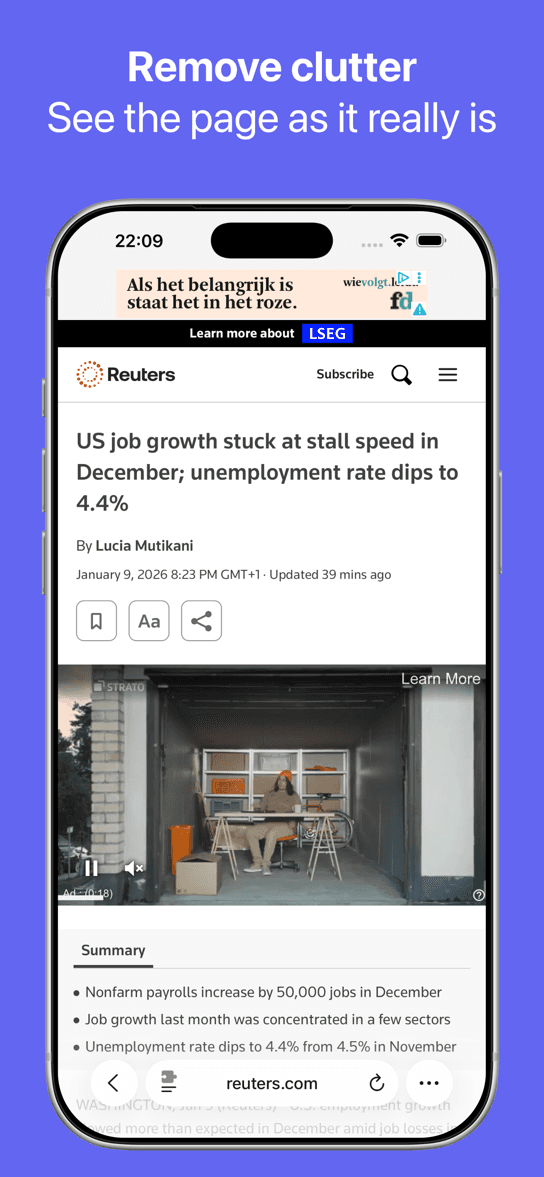
Clarity Reader for Safari
Clarity Reader for Safari is an iOS Safari extension designed to enhance your reading experience by stripping away ads, popups, and visual clutter from webpages. With a single tap, it transforms any article into a clean, distraction-free format, allowing you to focus solely on the content. Users can personalize their reading environment with customizable themes (light, sepia, dark), adjustable typography including font size, line height, and page width. It works on most article-based websites, including news sites and blogs, and goes beyond Safari's built-in Reader Mode by offering more customization and broader compatibility. The app processes everything on your device, ensuring your browsing data remains private.
PiML-Toolbox
PiML-Toolbox (Python Interpretable Machine Learning) is a comprehensive Python toolbox designed for the development and diagnostics of interpretable machine learning models. It offers both low-code interfaces and high-code APIs, supporting a growing list of inherently interpretable ML models such as GLM, GAM, Tree, FIGS, XGB1, XGB2, EBM, GAMI-Net, and ReLU-DNN. The toolbox facilitates various outcome testing, including accuracy, explainability (PFI, PDP, ALE, LIME, SHAP), fairness, weak spot identification, overfitting detection, reliability assessment, robustness, and resilience evaluation. PiML-Toolbox aims to empower model developers and validators with tools for transparent, interpretable, and robust machine learning, particularly in high-stakes regulatory settings.
Reachy Mini
Reachy Mini is an open-source companion robot developed by Pollen Robotics, offering a platform for human-robot interaction, creative coding, and AI experimentation. This Hugging Face Space serves as a comprehensive resource hub, providing essential information for users interested in building and getting started with the Reachy Mini. It includes details on its features, demonstrations, and guidance for various projects. The platform is ideal for robotics enthusiasts, developers, and researchers looking to explore the capabilities of a versatile and accessible robot in AI and interactive applications.
AIScriptReader
AIScriptReader is an automated tool designed to provide professional AI screenplay coverage and feedback in minutes. It leverages industry-leading technology and proprietary algorithms to generate detailed story analysis, character breakdowns, and development notes. The platform specializes in analyzing movie scripts, with plans for future expansion. Users can upload their scripts and receive actionable reports, including comprehensive coverage reports and development notes. An AI Chat Assistant is also included, allowing users to interact with their script analysis for deeper insights into characters, plot, and themes. AIScriptReader aims to save time and money for writers, producers, and production companies by transforming weeks of waiting into minutes of insight.

VOS.Health — Your Way to a Balanced Life
VOS.health is an AI-driven mental health application designed to boost mental well-being. It provides personalized plans and mood tracking features to help users conquer stress, anxiety, and depression, while also enhancing productivity. The platform offers a variety of exercises and tools, including over 20 for stress reduction, 50 for self-confidence, 10 for productivity, and 30 to improve sleep. VOS.health aims to create a supportive community for its users. However, it is important to note that the service will be discontinued, and the app removed from app stores, on April 4, 2026.
EmailWhiz for Gmail™
EmailWhiz for Gmail™ is a powerful add-on designed to streamline email management within Gmail. It offers key features such as summarizing lengthy emails into concise key points, generating relevant reply suggestions based on email context, and automatically creating follow-up tasks to ensure no action items are missed. A standout capability is its ability to extract, parse, and enrich contact information from email messages, including names, titles, organizations, and contact details from 195 countries, eliminating manual data entry. The tool also allows users to save important details like decisions, commitments, and key dates for easy reference. Powered by Google Vertex AI PaLM, EmailWhiz aims to boost productivity and organization for anyone dealing with high email volumes.
Bunch
Bunch is an AI-powered leadership coaching application designed to help managers and leaders enhance their skills in just two minutes a day. It provides personalized daily leadership guidance, AI-powered coaching, and insights to improve communication, run better meetings, and grow high-performing teams. Users can discover their leadership style, join peer learning groups for accountability, and access expert-curated sprints on specific skills. The platform also features Bunchee, an AI coach available 24/7 to answer leadership questions and offer advice. Bunch aims to make leadership development simple, practical, and accessible for first-time managers, scaling startup leaders, and HR departments.
navsim
navsim is an open-source platform designed for autonomous driving simulation and benchmarking. It introduces Pseudo-Simulation, a novel evaluation methodology that merges the efficiency of open-loop evaluation with the robustness of closed-loop evaluation. By augmenting real data with synthetic observations, navsim achieves strong correlation with traditional closed-loop simulations while significantly reducing computational resources. This tool is ideal for researchers and developers in the autonomous driving field, providing a faster and more scalable approach to validate AV algorithms and behaviors. It supports data-driven, non-reactive autonomous vehicle simulation and benchmarking, making it a valuable resource for large-scale, rapid validation.

Van de Satpura
Van de Satpura provides business AI platforms and consulting services designed to help companies achieve measurable outcomes and growth. Through its Levitate ecosystem, it offers three core solutions: Essential AI for high utility and critical tasks, Targeted AI for immediate and measurable outcomes with ready-to-use AI components, and Turnkey AI for comprehensive advisory and consulting across the full AI journey. The company focuses on simplifying the user experience and addressing the challenge of doing more with less in a rapidly changing business and technology landscape. Van de Satpura aims to bring a fresh perspective to how customers, businesses, and technology interact, making operations faster, more cost-effective, and opening new business possibilities.