
Coding & Development
Browsing page 96 of AI tools for Code Assistants in Coding & Development. Sorted by confidence score — our independent quality rating.

Coder
Coder is an AI software developer tool designed to streamline and enhance the process of AI software development and code generation. This tool is particularly useful for individuals looking to learn coding or automate various software-related tasks. It operates by loading a given website within a border-less, full-screen iframe, providing a seamless and immersive development environment. The tool is hosted on Hugging Face Spaces, indicating its accessibility and potential for community-driven enhancements. Coder aims to simplify complex development workflows, making it an asset for both novice and experienced developers in the AI domain.
Phone App & AI for Calls
NAIL is a private AI for calls tool designed to enhance your calling experience while prioritizing data security. It provides an AI call assistant with real-time scam detection, call notes, transcripts, and summaries. The tool leverages on-device processing and confidential computing for both speech and text, ensuring that basic AI features like scam detection and transcripts run entirely offline. For more advanced LLM-powered features, data remains encrypted, and inference runs within a secure enclave, isolated from the OS, infrastructure provider, and human access. This approach prevents AI companies from accessing your data, offering a secure and private solution for managing calls, improving productivity, and streamlining business workflows.
Huggingface Hub Python Library
The Huggingface Hub Python Library is a versatile tool designed for developers working with AI models and datasets. It simplifies the process of managing and integrating these resources within AI projects using Python. A key feature is its ability to read a model's README file and display its contents as formatted Markdown, providing a clear and easy-to-understand model card without requiring any user input. This functionality is particularly useful for quickly assessing model details and ensuring proper usage. The library supports various applications, from educational projects to more complex content generation tasks, making it a valuable asset for anyone looking to streamline their AI development workflow.
r_tips
r_tips is a comprehensive GitHub repository providing R programming tips for various data science tasks. It covers essential areas such as data cleaning, data visualization, statistical modeling, and machine learning. Users can find practical guidance on setting up a Positron IDE, an introduction to ggplot2 for creating volcano plots, and instructions for using DiagrammeR to draw flow charts. The repository also delves into data cleaning techniques using data.table, tidyverse, or Python Pandas, and explains how to clean strings with regular expressions. For productionization, it offers tutorials on creating SQL <> R workflows and automating R Markdown report generation. The resource is designed to help developers and data scientists enhance their R programming skills.
PyHessian
PyHessian is a Pytorch library designed for advanced analysis and training of neural network models using second-order methods. It provides functionalities to compute critical metrics such as the top Hessian eigenvalues, the trace of the Hessian matrix, and the full Hessian Eigenvalues Spectral Density (ESD). This library is particularly useful for researchers and developers looking to gain deeper insights into the optimization landscape of neural networks, understand model behavior, and explore second-order optimization techniques. It supports both installation via pip and from source, and includes examples for training ResNet20 models on Cifar-10 and performing Hessian analysis on saved checkpoints.
AFML
AFML is an open-source GitHub repository offering experimental answers and solutions to exercises found in 'Advances in Financial Machine Learning' by Dr. Marcos López de Prado. This resource is invaluable for individuals seeking to develop a solid understanding of quantitative strategies and their implementation. The repository includes Python notebooks covering various chapters and concepts from the book, such as triple barriers and bet sizing, which are applicable across different strategy types like volatility and trends. While the original book's code was in Python 2.7, AFML provides updated solutions compatible with modern Python versions and libraries. It serves as a reference for those who wish to write their own code from scratch, offering guidance and explanations for complex financial machine learning concepts.
supervision
supervision is an open-source Python library designed to simplify and accelerate computer vision development. It offers a comprehensive suite of reusable tools for common tasks such as loading datasets, drawing detections on images and videos, and counting objects within defined zones. The library is model-agnostic, supporting integration with popular frameworks like Ultralytics, Transformers, MMDetection, and Inference. Developers can leverage a wide range of highly customizable annotators for visualization and utilize utilities for loading, splitting, merging, and saving datasets in various formats like COCO, YOLO, and Pascal VOC. supervision aims to provide a robust foundation for building computer vision applications more efficiently and reliably.
text-clustering
text-clustering is an open-source repository from Hugging Face designed to simplify the process of embedding, clustering, and semantically labeling text datasets. It offers a minimal yet robust codebase that can be adapted for various use cases, making it suitable for researchers and developers working with large text corpora. The tool's pipeline consists of several distinct, customizable blocks, ensuring flexibility and control over the text analysis process. It supports installation via pip and provides clear usage examples for running the pipeline, visualizing results, and performing inference on new texts. The repository also includes options for customizing plotting and integrating with Hugging Face datasets for visualization.
Jit Codes
Jit Codes is an AI Code Playground designed to help developers play, experiment, and build with AI. The platform offers fast code generation, multi-model support, and live preview capabilities to accelerate the coding process. Users can collaborate and share their projects with features like real-time editing, shareable links, and free hosting. It supports various programming languages and includes versioning and auto-deploy functionalities. For more control, Jit Codes offers a Pro plan with private code, priority models, advanced tools, and cost control. It aims to make AI-powered coding accessible and collaborative for individuals and teams.
Mobile-Voice-AI-Agent
Mobile-Voice-AI-Agent is a GitHub repository showcasing the implementation of a mobile voice AI agent built with the Model-View-ViewModel (MVVM) architectural pattern. This project leverages modern Android development technologies including Kotlin, Retrofit2 for network requests, Hilt for dependency injection, Coroutines and Kotlin Flow for asynchronous programming, and testing frameworks like mockK, Espresso, and Junit5. It serves as a comprehensive template for developers looking to create robust and scalable voice-enabled AI applications on the Android platform, emphasizing best practices for architecture, state management, and asynchronous operations.
nnom
NNoM is a high-level inference Neural Network library specifically designed for microcontrollers, aiming to provide a lightweight, user-friendly, and flexible interface for fast deployment on MCUs. It allows users to deploy Keras models to NNoM models with a single line of code and supports complex neural network structures such as Inception, ResNet, DenseNet, and Octave Convolution. The library features high-performance backend selections, including an optimized CMSIS-NN/DSP for ARM-Cortex-M, and onboard evaluation tools like runtime analysis and confusion matrix. NNoM manages structure and memory, simplifying embedded AI development. It is released under the Apache License 2.0.
JustCode
JustCode is an AI-powered extension designed for Visual Studio Code that streamlines the process of generating documentation for JavaScript code. It integrates directly into the VSCode environment, allowing developers to automate the creation of accurate and consistent documentation without leaving their IDE. This tool is particularly useful for maintaining code clarity, facilitating onboarding for new team members, and ensuring project maintainability. By leveraging AI, JustCode aims to reduce the manual effort involved in documentation, enabling developers to focus more on coding while still adhering to best practices for project documentation.
Ropes
Ropes is an AI-powered platform designed for staffing firms to validate candidate skills and authenticity at scale. It helps prevent identity fraud, proxy test-taking, and skills inflation through advanced verification techniques and real-world challenges. The platform includes 'Scout' to automatically filter out fraud at the top of the funnel and 'Assessments' to provide verifiable proof of candidate abilities. Ropes monitors real-time geolocation to detect VPNs and masked IPs, and analyzes ATS data to identify fake identities and fabricated work histories. It enables the creation of custom simulations from client requirements, providing full visibility into candidate problem-solving with unified timelines of video, audio, and highlights.
Goast.ai
Goast.ai is an AI assistant designed to automate bug fixing and error resolution for engineering teams. It integrates with popular error monitoring platforms like Sentry, Datadog, BugSnag, and Google Cloud to automatically analyze issues as they arise. Goast can perform root cause analysis, generate step-by-step solution plans, create context-aware code, and push fixes as pull requests directly to your git provider. This significantly reduces the time-to-resolution for bugs, with users reporting 10x faster fixes and an 83% merge rate for AI-generated pull requests. It supports major frameworks and languages including React, Flutter, TypeScript, Go, JavaScript, and Python, making it a versatile tool for various development environments. Teams can interact with Goast via Slack, GitHub, or its web app, and even iterate on PRs by commenting feedback.
Code AI : AI Code Writer
Code AI, offered by iTech Gemini, functions as an AI-powered coding companion designed to enhance productivity and efficiency for developers. This tool assists users in various coding tasks, including generating code snippets, debugging existing code, and providing answers to programming questions. It aims to streamline the development process and support skill growth for coders. While the primary focus of iTech Gemini is on providing remote AI development talent and staff augmentation services, Code AI is presented as one of their proprietary products, suggesting it leverages their expertise in AI and software development to offer practical assistance to individual coders.

QR Scanner, AI QR Generator
QR Scanner, AI QR Generator is an iOS mobile application designed to enhance digital sharing and marketing efforts through advanced QR code functionalities. The app provides a robust QR code scanner, enabling users to quickly and accurately scan various QR code formats using their iPhone camera or by importing images from their photo library. Beyond scanning, its standout feature is the AI QR Generator, which allows users to create unique and artistic QR codes in diverse styles. This transforms standard QR codes into visually engaging elements, making them more attractive for personal or business use. The app focuses on ease of use, making the creation of custom, artistic QR codes accessible to a broad audience.
Screenshot HTMLcode
Screenshot HTMLcode is an AI-powered tool hosted on Hugging Face that simplifies the process of converting visual web designs into functional code. Users can upload a screenshot of any webpage, and the tool will analyze the image to generate the complete HTML and CSS code required to replicate its design and style. This capability is particularly useful for web developers and designers looking to quickly prototype, reconstruct, or learn from existing web layouts without manually coding from scratch. The tool aims to automate a significant portion of the front-end development workflow, making it easier to translate visual concepts into code efficiently.
StarCoder Search
StarCoder Search is an AI-powered tool hosted on Hugging Face, designed for developers to efficiently search through the vast StarCoder training dataset. Users can input a piece of code or text, up to 200 characters, and the tool will return a list of matching or similar code snippets. This functionality is invaluable for understanding code patterns, identifying potential plagiarism, or finding examples of how certain functionalities are implemented. The search results include details like the repository and file where the code was found, making it a practical resource for code analysis and learning. It's a free, web-based application, making it accessible for a wide range of coding-related tasks and educational purposes.
Tango2
Tango2 is an AI tool developed by declare-lab that allows users to convert text descriptions into audio recordings. It functions by taking text prompts, which can describe various sounds or scenes, and then generating the corresponding audio. This application is hosted on Hugging Face Spaces, making it accessible for users to experiment with text-to-audio generation. The generated audio outputs are versatile, as they can be downloaded in either WAV or MP3 format, catering to different user needs for quality and file size. Tango2 provides a straightforward interface for exploring the capabilities of AI in sound synthesis from textual input.
Visual Studio Code
Visual Studio Code is a widely-used code assistant tool that offers a comprehensive environment for software development. It facilitates efficient code editing, debugging, and version control, making it a staple for developers. The tool is designed to provide a streamlined workflow, enhancing productivity for various programming tasks. While the provided information indicates a paused Hugging Face Space, the core functionality of Visual Studio Code revolves around supporting the entire software development lifecycle, from writing and testing code to managing different versions of projects. It is a powerful and versatile platform, catering to the needs of software developers and programmers looking for a robust and integrated development environment.
Zsp
Zsp is an AI tool designed for the analysis of protein mutations. Users can input a protein sequence along with desired substitutions, and the application will generate images that visually represent the impact of these changes. This visual analysis helps in understanding the effects of mutations on protein structures and functions. The tool is hosted as a Hugging Face Space, making it accessible for researchers and scientists working in bioinformatics and molecular biology to quickly visualize and interpret protein mutation data.
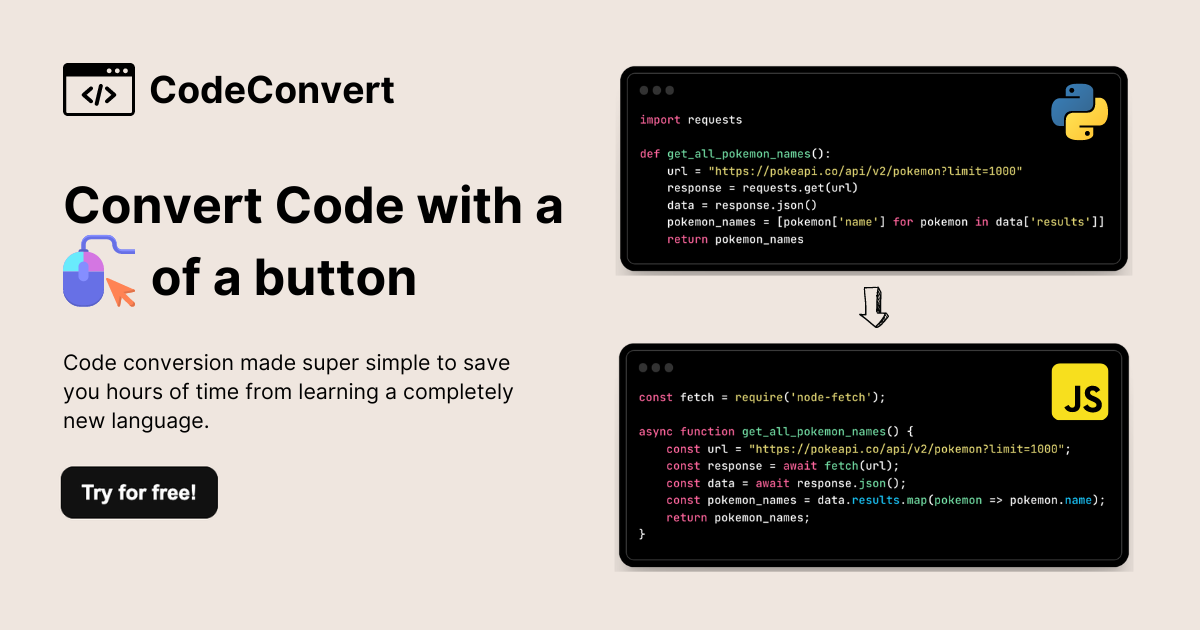
CodeConvert AI
CodeConvert AI offers a straightforward solution for converting code between more than 50 programming languages, including popular ones like Python, Java, JavaScript, and C++. The platform leverages advanced AI models to deliver high-quality and accurate code transformations, saving developers significant time and effort that would otherwise be spent on manual rewriting or learning new languages. It requires no setup or installation; users simply paste their code and initiate the conversion. CodeConvert AI emphasizes privacy and security, stating that it does not retain user input or generated output code. Beyond conversion, the platform also provides free tools for code generation, explanation, comment removal, and checking, making it a comprehensive assistant for various coding tasks.
ExplainGitHub
ExplainGitHub is an AI-powered tool designed to help developers quickly understand any GitHub or GitLab repository. It provides instant AI explanations, context-rich history, and insights to accelerate code comprehension. By integrating with your development workflow, it aims to reduce the hours typically spent trying to grasp new codebases. The tool offers an AI chat feature for interactive explanations and helps developers onboard faster to unfamiliar projects, improving overall productivity.
nvvl
NVVL (NVIDIA Video Loader) is an open-source library designed to accelerate machine learning training by efficiently loading sequences of video frames from compressed video files. It utilizes FFmpeg's libraries for parsing and reading compressed packets and offloads video decoding to NVIDIA GPUs, providing ready-for-training tensors in GPU device memory. The library also supports data augmentation during loading, including scaling, cropping, and horizontal flipping, using the GPUs' dedicated texture mapping units. While NVVL itself is no longer maintained, its functionality has been incorporated into the NVIDIA DALI library, which is recommended for new projects. It significantly reduces storage and I/O demands compared to using individual image frames.