
Coding & Development
Browsing page 6 of AI tools for Database & SQL in Coding & Development. Sorted by confidence score — our independent quality rating.

SDF
SDF, now part of dbt Labs, is a powerful tool designed to bring advanced SQL understanding to data tools, specifically enhancing the dbt developer experience. It introduces robust SQL comprehension into dbt, aiming to supercharge developer efficiency. The integration of SDF's technology into dbt promises to make dbt faster and significantly more cost-efficient, while also unlocking new metadata use-cases such as true column-level lineage. This capability helps teams ship trusted data faster by providing a deeper understanding of SQL queries and their impact. SDF has quickly emerged as a valuable asset in the data analytics space since its launch into GA in mid-2024.

Sync Notion
Sync Notion is an iOS application designed to streamline the management of schedules and habits within Notion. It allows users to connect directly to their Notion databases, enabling quick data entry and tracking from their mobile devices. The app features widget display for immediate viewing of plans and habits, and includes a habit tracker function that links to Notion databases. Sync Notion aims to solve common pain points like managing schedules across multiple services, needing quick access to habit status, and simplifying habit recording. It offers both an easy setup option for existing databases and a manual setup for more control, and is available for free with a Pro plan upgrade for full functionality.

databasesample.com
Databasesample.com offers a comprehensive platform for database design and management, providing resources, templates, and open-source database designs for various software applications. Its standout feature is an AI tool that automates database generation, simplifying the creation of complex database structures. Users can explore pre-designed samples, modify existing databases, or build new ones from scratch using an intuitive online designer. The platform supports visual schema design, table alteration, relationship modification, and SQL script export. It also includes a sandbox environment for experimenting with database samples, running queries, and testing operations without affecting live databases, making it an ideal resource for developers, students, and data enthusiasts.
English To Sql
English To Sql is an AI-powered tool designed to translate natural language descriptions into SQL queries. The intention behind the tool is to simplify database management and SQL learning by allowing users to generate complex SQL code from simple English commands, thereby eliminating the need for manual SQL writing. This can be particularly beneficial for individuals who are not proficient in SQL or who wish to accelerate their development process. However, at the time of review, the application hosted on Hugging Face Spaces is encountering a runtime error and is not functional, preventing users from interacting with its features.
rowy.io
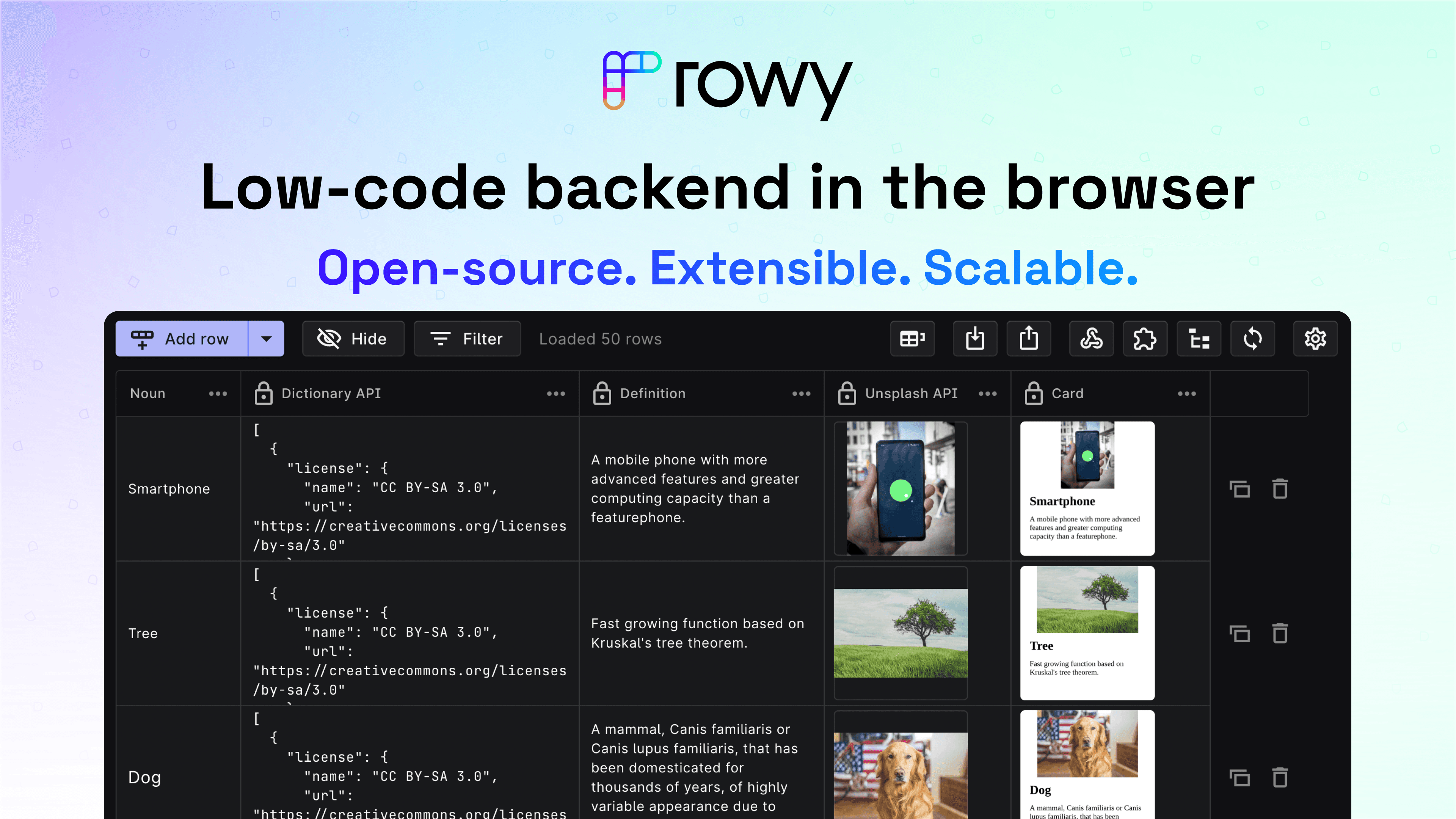
Rowy provides a low-code backend solution built on Google Cloud and Firebase, presenting database management through a familiar spreadsheet UI. It enables users to build powerful backend cloud functions and APIs directly from the browser, supporting over 30 field types and full scalability. The platform simplifies backend logic development by handling boilerplate tasks, allowing users to leverage any npm package or API. Rowy also facilitates team collaboration on a single source of truth with auditing and access controls down to the field level, alongside field validation and default values. It supports automations, derivative fields, action fields, extensions to external services like SendGrid and Slack, and webhooks for receiving data from various sources. Rowy is open-source and offers templates for quick development, making it suitable for both developers and non-technical team members.
Lite Queen
Lite Queen is an open-source SQLite database management software designed to simplify the management and monitoring of SQLite databases. It offers a user-friendly interface that allows users to interact with their databases efficiently. By running on a server, Lite Queen provides a centralized solution for database administration, making it easier to perform common tasks such as querying, updating, and maintaining database structures. This tool is particularly useful for developers and data professionals who work extensively with SQLite and require a robust, accessible management solution.
powersync-js
powersync-js is an SDK designed for building local-first and real-time reactive applications, leveraging embedded SQLite for JavaScript clients, including React Native and Web. It acts as a sync engine, facilitating seamless data synchronization between client-side SQLite databases and server-side databases such as Postgres, MongoDB, MySQL, or SQL Server. This enables developers to create apps with instantly-responsive user interfaces and simplified state transfer. The monorepo includes SDKs for React Native, Web, and Node.js, along with integrations for popular frameworks like React, Vue, and ORMs like Kysely and Drizzle. It also provides demo applications for various backend and client-side frameworks, showcasing its versatility.
tingodb
TingoDB is an embedded JavaScript database designed for Node.js environments, providing an in-process, filesystem, or in-memory data storage solution. It boasts upward compatibility with MongoDB's v1.4 API, meaning applications built with TingoDB can transition to MongoDB with minimal code changes, significantly reducing implementation risks. The database supports various configuration options, including API level adjustments for MongoDB 2.x behavior, in-memory mode for testing, and options for native integer ObjectIDs for performance. TingoDB also offers API extensions like `compactCollection` and `compactDatabase` for optimizing storage. It's a drop-in replacement for existing MongoDB-based applications, with documented integrations for frameworks like Sails.js and KeystoneJS.
goatdb
GoatDB is an embedded, distributed document database designed for speed and developer experience, allowing the creation of real-time collaborative applications that function even when offline. It incorporates Git-like features such as cryptographically signed commits, three-way merges, and automatic conflict resolution, inspired by distributed version control systems. The database is TypeScript-first and includes React hooks for seamless integration into UIs. Key differentiators include automatic syncing when reconnected, instant UI updates from local changes, smart conflict resolution, and self-healing capabilities where clients can restore crashed servers from the commit graph. GoatDB is under active development, with a warning that full backward compatibility is not guaranteed before v1.0.0.

my own alternative
Schemawavy is a visual database schema designer and ERD tool built for developers working with PostgreSQL, MySQL, and MariaDB. It allows users to design schemas on a drag-and-drop canvas, generating production-ready DDL in real-time to ensure diagrams and code are always in sync. Key features include SQL import to instantly create diagrams from existing schemas, multi-dialect SQL export, version control with commit and diff, and team collaboration with role-based access. Schemawavy also offers unique capabilities like custom type definitions and a live DDL panel that regenerates SQL as changes are made, providing a comprehensive toolkit for designing, versioning, and shipping database schemas.
doris
Apache Doris is an easy-to-use, high-performance, and real-time analytical database built on MPP architecture. It delivers sub-second query results for massive datasets, handling both high-concurrency point queries and complex analytical scenarios. This makes it ideal for report analysis, ad-hoc queries, unified data warehousing, and data lake query acceleration. Users can build applications like user behavior analysis, AB test platforms, and log retrieval analysis. Doris supports real-time data analysis, real-time reporting, ad hoc analysis, user profiling, lakehouse analytics, federated queries, and SQL-based observability. It uses the MySQL protocol, is highly compatible with MySQL syntax, and integrates seamlessly with various BI tools. Its architecture consists of Frontend (FE) for metadata and query planning, and Backend (BE) for data storage and execution, both horizontally scalable for high availability and data reliability.
Awesome-Text2SQL
Awesome-Text2SQL is a comprehensive, curated list of tutorials and resources specifically focused on Large Language Models (LLMs) and Text2SQL technologies. The repository extends its coverage to related areas such as Text2DSL, Text2API, and Text2Vis, offering a broad spectrum of materials. It serves as a valuable resource for both developers and researchers who are actively working on or interested in these advanced natural language processing applications. Being an open-source project hosted on GitHub, it facilitates community contributions and access to cutting-edge information.
tonbo
Tonbo is an embedded database specifically designed for serverless and edge runtimes, bridging the gap between stateless compute and persistent data. It stores data as Parquet files on S3, with coordination handled through a manifest, ensuring compute remains fully stateless. The entire storage and query engine is async-first, making it ideal for modern cloud environments. Tonbo supports rich data types and declarative schemas, allowing users to query with zero-copy RecordBatch. It runs anywhere, including Tokio, WASM, and various edge runtimes, and can serve as a storage engine for custom data infrastructure. With open formats, its standard Parquet files are readable by any tool, offering flexibility and interoperability.
AIHelperBot
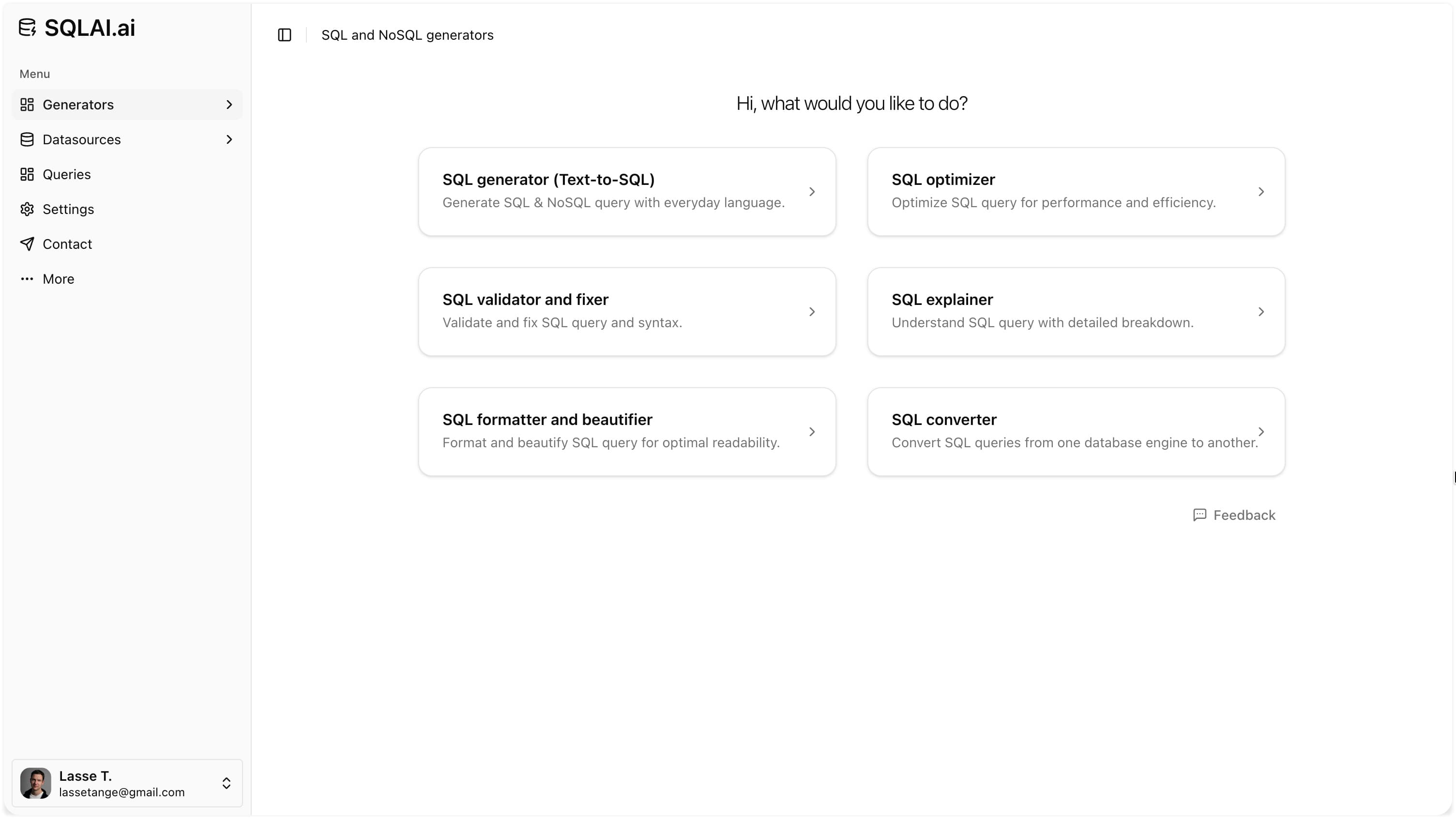
SQLAI.ai is an AI SQL assistant designed to streamline SQL query workflows for developers, data analysts, and database professionals. It offers a comprehensive suite of tools including a text-to-SQL generator that converts natural language into accurate SQL and NoSQL queries, an SQL optimizer for performance improvements, and a validator to detect and fix syntax errors. The platform also provides an SQL explainer for step-by-step breakdowns of complex queries and a formatter for consistent code style. Users can connect data sources to improve query accuracy, enforce schema rules, and run natural-language insights. It supports large database schemas with over 900 tables and offers helper tools like a query runner, formatter, diff viewer, and a VS Code-style editor.
badgerhold
BadgerHold is an embeddable NoSQL store designed for querying Go types, built on top of a Badger instance. It offers a higher-level interface to simplify data persistence and retrieval, abstracting away some of the complexities of direct Badger DB interaction. The tool supports various querying capabilities, including filtering, sorting, and aggregation, with options for indexing to optimize performance on read-heavy datasets. Users can define indexes using struct tags or implement a custom Storer interface. BadgerHold also provides features for updating and deleting data based on query criteria, handling unique constraints, and working with auto-incrementing keys. It's open-source and free to use, making it a flexible solution for Go developers needing an efficient, embeddable database.
tstorage
tstorage is a lightweight, open-source, embedded time-series database designed for efficient handling of large volumes of time-series data. It features a straightforward API with massively optimized ingestion capabilities, ensuring goroutine-safe writes and reads. The database partitions data points by time, using a linear data model structure rather than B-trees or LSM trees, which is ideal for time-series workloads that are mostly append-only. It supports both in-memory and persistent disk storage, allowing users to specify a data path for on-disk persistence. tstorage also handles out-of-order data points by buffering them in memory partitions, making it robust against network latency or clock synchronization issues. This design ensures fast read operations, especially for recent data, and efficient storage by sequentially writing larger files when partitions are full.
MasterMemory
MasterMemory is a high-performance, source generator based embedded typed readonly in-memory document database designed for .NET and Unity applications. It boasts impressive speed, claiming to be 4700 times faster than SQLite with zero allocation per query, and maintains a small database footprint. The tool automatically generates a typed database structure from schemas, ensuring type-safe queries with full autocompletion support for optimal performance and usability. Key features include memory efficiency through aggressive string interning, fast load speeds due to MessagePack for C# serialization, flexible search capabilities with multiple key, result, and range/closest queries, and custom data validation. It is particularly well-suited for master data management in embedded applications, data analysis, and game development.
pglite
PGlite is an innovative solution offering a WASM build of Postgres, packaged as a TypeScript client library. This enables developers to embed and run a full Postgres database directly within various environments, including web browsers, Node.js, Bun, and Deno, eliminating the need for external installations. It's designed for building reactive, real-time, and local-first applications. PGlite is remarkably lightweight, at only 3MB gzipped, and supports numerous Postgres extensions, including pgvector. It can function as an ephemeral in-memory database or persist data to the file system (Node/Bun/Deno) or IndexedDB (Browser). Unlike other "Postgres in the browser" projects, PGlite does not rely on a Linux virtual machine, instead leveraging Postgres's single-user mode compiled to WASM.
Raphtory
Raphtory is an in-memory vectorized graph database engineered in Rust, providing powerful Python APIs for seamless integration. It boasts exceptional speed and scalability, capable of managing hundreds of millions of edges even on a laptop. Users can easily incorporate it into existing pipelines via a simple `pip install`. Key features include time traveling, full-text search, multilayer modeling, and advanced analytics such as automatic risk detection, dynamic scoring, and temporal motifs. Raphtory also supports out-of-memory (on-disk) scaling without performance degradation through its subscription model. It can be run embedded or as a server instance using GraphQL, with a bundled web playground for query experimentation and data visualization.
vectordb
vectordb, hosted on GitHub, offers a range of plans tailored for developers, from individuals to large enterprises. The platform provides essential features like unlimited public and private repositories, Dependabot security updates, and CI/CD minutes for automating software development workflows. Users can also host software packages and manage projects with integrated Issues & Projects. For teams, advanced collaboration tools such as repository rules, multiple reviewers in pull requests, and code owners are available. Enterprise plans further enhance security, compliance, and flexible deployment options, including data residency and enterprise managed users, making it suitable for diverse development needs.
embedded-redis
embedded-redis is an open-source tool designed to provide an embedded Redis server specifically for Java integration testing. It allows developers to easily start and stop a Redis instance within their test environment, eliminating the need for a separate Redis installation. The tool supports various configurations, including custom Redis executables, fluent API for server creation, and setting up HA Redis clusters with Sentinels and master-slave replication. It also offers the flexibility to use ephemeral or predefined ports for testing. This makes it an ideal solution for Java developers looking to streamline their integration testing process with Redis.
native_db
native_db is a fast, drop-in embedded database written in Rust, designed for multi-platform applications including server, desktop, and mobile. It simplifies data management by allowing effortless synchronization of Rust types and supports multiple indexes (primary, secondary, unique, non-unique, optional). The database boasts transparent serialization/deserialization using `native_model`, enabling compatibility with various serialization libraries like `bincode` or `postcard`. Key features include query type safety, automatic model migration, thread-safe and fully ACID-compliant transactions powered by `redb`, and real-time subscription capabilities with filters for insert, update, and delete operations. It is compatible with all Rust types and supports hot snapshots, making it a versatile solution for developers seeking an efficient embedded database.
go-sqlite
go-sqlite provides a pure-Go SQLite driver designed for Golang's native `database/sql` package. Its key differentiator is the embedded SQLite implementation, meaning developers do not need to install SQLite separately, simplifying deployment and development. This driver is a fork of `cznic/sqlite` with specific changes to ensure compatibility with GORM, a popular ORM for Go. It supports both in-memory and on-disk SQLite databases, offering flexibility for various application needs. Developers can easily configure SQLite pragmas, such as `journal_mode` or `busy_timeout`, directly within the connection string, allowing for fine-grained control over database behavior.
VectorDBBench
VectorDBBench is a comprehensive benchmark tool designed for evaluating and comparing the performance and cost-effectiveness of mainstream vector databases and cloud services. It provides an intuitive visual interface, making it accessible even for non-professionals to reproduce benchmark results and test new systems. The tool offers comparative result reports, including cost-effectiveness reports specifically for cloud services, to aid in selecting the optimal vector database. VectorDBBench closely mimics real-world production environments by setting up diverse testing scenarios such as insertion, searching, and filtered searching. It utilizes public datasets from actual production scenarios like SIFT, GIST, Cohere, and OpenAI-generated datasets to ensure credible and reliable data. Sponsored by Zilliz, it supports a wide array of vector databases including Milvus, Qdrant, Pinecone, Weaviate, Elastic, and many others.