
Coding & Development
Browsing page 49 of AI tools for Open Source & Models in Coding & Development. Sorted by confidence score — our independent quality rating.

stable-diffusion-tensorflow
stable-diffusion-tensorflow offers a TensorFlow/Keras implementation of Stable Diffusion, enabling users to generate images from text prompts and perform image-to-image modifications. The tool ports weights from the original Stable Diffusion implementation, ensuring consistent quality. It provides several Colab notebooks for easy experimentation, including options for GPU, image-to-image, inpainting, and even video generation. Users can install it as a Python package or clone the GitHub repository, with clear instructions for setting up virtual environments and managing dependencies. The tool supports various parameters for image generation, such as image height, width, number of steps, and guidance scale, making it flexible for different creative needs.
StyleTTS2
StyleTTS2 is an advanced text-to-speech (TTS) model designed to produce human-level speech synthesis. It innovates by modeling styles as a latent random variable through diffusion models, allowing it to generate suitable styles for text without needing reference speech. This approach ensures efficient latent diffusion while benefiting from the diverse speech synthesis capabilities of diffusion models. The tool also incorporates large pre-trained speech language models (SLMs), such as WavLM, as discriminators with novel differentiable duration modeling for end-to-end training, significantly improving speech naturalness. StyleTTS2 has demonstrated superior performance, surpassing human recordings on the LJSpeech dataset and matching them on the VCTK dataset. It also excels in zero-shot speaker adaptation on the LibriTTS dataset, outperforming other publicly available models.
Joonote
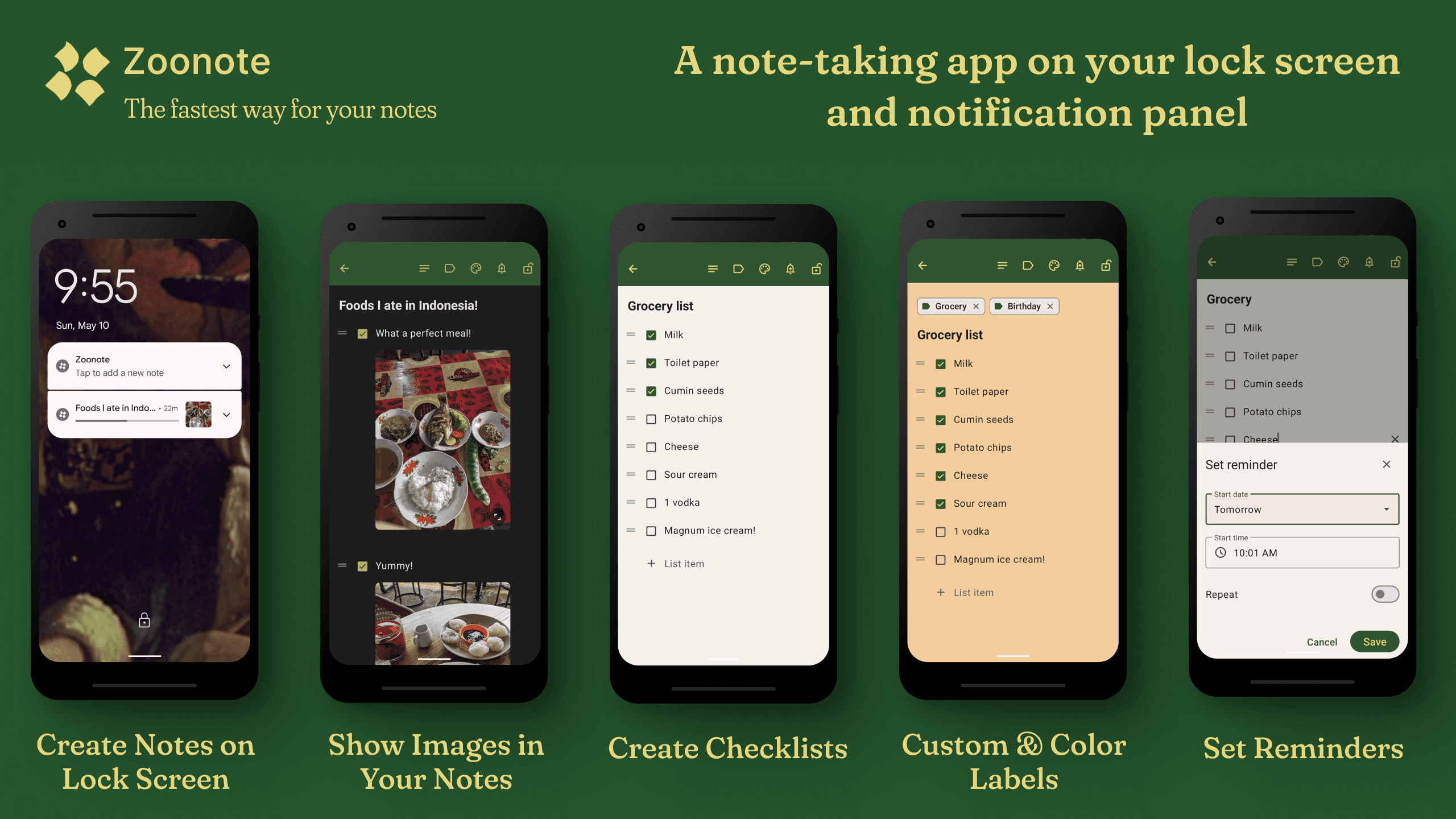
Joonote, also referred to as Zoonote on its website, is an innovative Android note-taking application designed for speed and accessibility. It allows users to view and edit notes, to-do lists, and reminders directly from their lock screen and notification panel, eliminating the need to unlock the device or open a separate app. This ensures users can capture thoughts and manage tasks without breaking their flow. Key features include private notes, customizable labels, speech-to-text transcription, and automatic Google Drive backup. It also offers a widget for fast homescreen access and a dark mode. Zoonote is ideal for busy individuals, students, and professionals who need instant access to their information and want to minimize distractions, enhancing daily productivity by making note management seamless and secure.
UltraChat
UltraChat is a comprehensive open-source project focused on creating large-scale, informative, and diverse multi-round dialogue data. Powered by Turbo APIs, it aims to facilitate the development of powerful language models with advanced conversational capabilities. The dataset is structured into three main sectors: 'Questions about the World' for inquiries related to real-world concepts, 'Writing and Creation' for tasks involving creative writing and content generation, and 'Assistance on Existent Materials' for tasks like rewriting, summarization, and inference based on existing texts. UltraChat emphasizes automatic data generation, ensuring no direct use of internet data as prompts to safeguard privacy. It also includes UltraLM, a series of chat language models trained on UltraChat, with versions like UltraLM-13B and UltraLM-65B available.
AI-Engineering.academy
AI-Engineering.academy is a free, open-source educational platform dedicated to mastering applied AI concepts. It curates and organizes essential knowledge into clear learning paths, making complex AI topics accessible and practical for everyone. The academy emphasizes structured learning, hands-on practice with real-world projects, and industry-aligned skills focused on production readiness. Current learning paths cover Prompt Engineering, Retrieval Augmented Generation (RAG), Fine-tuning, and AI Agents, with Deployment coming soon. It fosters a community-driven environment where peers and experts can collaborate and contribute to improving the curriculum.

Tuya Smart
Tuya Smart (NYSE: TUYA; HKEX: 2391) is a leading global AI cloud platform service provider dedicated to building an AIoT developer ecosystem. The platform empowers businesses and developers to create AI-driven smart products across various categories, from smart home devices to commercial lighting and hospitality solutions. Leveraging cutting-edge AI and extensive expertise, Tuya provides a comprehensive suite of tools including TuyaOS, App SDKs, MiniApp development, and a Cloud Development Platform. It supports the entire product lifecycle, from idea to reality, offering solutions for product development, app creation, data analytics, and value-added services like Matter Certification and Smart Voice Skills. Tuya Smart aims to simplify the development of interconnected ecosystems and integrate with prominent AI voice platforms.
Layla Network AI
Layla Network AI is a cutting-edge platform that integrates state-of-the-art AI and blockchain technology to offer unparalleled deepfake detection and media authentication. It meticulously analyzes images, audio, and video content to identify deepfakes with high precision, utilizing advanced machine learning and computer vision. The platform provides detailed score reports indicating whether content is AI-generated or human-crafted, offering transparency and reliability for enterprise investors. Layla Network AI also offers free file and format analysis to combat disinformation, supporting a wide range of file formats and providing user-friendly reports. Additionally, it features deepfake document verification for official documents like ID cards, passports, and diplomas, ensuring authenticity and security.
Hex Security
Hex Security offers an AI-powered autonomous penetration testing solution designed to continuously identify critical vulnerabilities in web applications, APIs, and infrastructure. Unlike traditional manual assessments that are time-consuming and often outdated, Hex Security's AI agents work continuously to uncover issues like SQL injection, broken access controls, and authentication bypasses. The platform provides validated findings with working proofs-of-concept, ensuring no false positives. It aims to integrate security at the speed of development, allowing users to connect their applications and receive continuous testing and reporting with remediation guidance. Trusted by YC companies, Hex Security helps teams protect their systems in minutes, not months, by reasoning like elite security researchers.
I built an AI API gateway that gives you access to 30+ models with one key — Looking for feedback
Axion AI provides an OpenAI-compatible API gateway, allowing developers to access over 30 frontier AI models, including GPT-4o, Claude Opus, Llama, and DeepSeek, with a single API key. This platform simplifies AI integration by offering a unified routing engine, enabling model swapping with a single parameter and eliminating the need for multiple API keys, SDKs, and billing accounts. Users pay only for what they use through a credit-based system, with transparent per-1K-token rates for each model. Key features include real-time telemetry for monitoring usage and performance, enterprise-grade security with API key rotation and rate limiting, and a Neural Playground for testing models instantly. Axion AI is designed to streamline AI inference for individuals and teams, offering various plans starting from $9/month.
Gaslighting ChatGPT
Gaslighting ChatGPT, presented by Abscondita, delves into the critical security vulnerability of special token injection in large language models. The tool explains how attackers can exploit the invisible delimiters that structure LLM conversations to fabricate interaction history, making models believe they have agreed to actions they never took. It highlights the danger of LLMs ignoring safety guardrails and misinterpreting code reviews, such as missing obvious reverse shells. The platform offers an interactive playground where users can experiment with injecting malicious payloads, observe how models re-interpret conversations, and understand the 'confused deputy problem' where LLMs cannot distinguish legitimate context from injected data. This resource is crucial for developers and security professionals working with LLMs to identify and mitigate such vulnerabilities.
Model Fine Tuner
Model Fine Tuner is a Hugging Face Space designed for fine-tuning GPT-2 models. Users can upload their own datasets, select relevant columns, and adjust various training parameters to customize the model's behavior. Once trained, the tool facilitates text generation based on user-defined prompts, offering customizable settings for the output. This makes it a valuable resource for individuals looking to experiment with and adapt large language models for specific tasks or domains, providing a straightforward interface for model training and text generation.
MobileLLM R1 950M
MobileLLM R1 950M is a language model designed for engaging in conversations, providing assistance with questions, coding tasks, and more. Users can input text messages and receive detailed responses. This tool is hosted on Hugging Face Spaces, indicating its potential for integration into various applications. While the direct interface is currently inaccessible due to gated repository restrictions, its core function is to facilitate interactive AI-powered communication. It is linked to a Facebook model, suggesting a robust underlying architecture for natural language processing and generation.
The Machine Learning Company
The Machine Learning Company (TMLC) specializes in providing custom AI and data science solutions for enterprises. Their services encompass a wide range of offerings, including data engineering to design and implement scalable data pipelines, advanced data analytics for actionable insights, and AI & Machine Learning for building and deploying models to automate processes. TMLC also focuses on MLOps and Cloud solutions to streamline ML model deployment, monitoring, and scaling. Recognized by Stanford and trusted by leading firms across BFSI, IT, and Healthcare, TMLC aims to empower businesses to harness the full potential of their data through innovative solutions and expert guidance, delivering tangible results that drive growth and efficiency.
Axelera AI
Axelera AI provides an advanced AI acceleration platform, combining powerful hardware with the Voyager SDK software, designed to bring data insights and analytics to the edge. Their AI processing units (AIPUs), including Metis® and Europa®, offer extreme performance and efficiency for AI inference applications. These chips are engineered for seamless integration into innovations, allowing businesses to focus on their customers. The platform supports a wide range of use cases, from industrial manufacturing and retail to security, healthcare, and smart cities, by enabling high-performance computer vision and LLM/VLM processing at a fraction of the cost and power consumption of traditional GPU-based solutions. Axelera AI also offers various M.2 and PCIe AI accelerator cards, compute boards, and development systems.
Xm_transformer_600m
Xm_transformer_600m is a transformer-based language model developed by Facebook, featuring 600 million parameters. This open-source model is designed for a wide range of natural language processing (NLP) tasks, making it a valuable resource for researchers and developers. It can be utilized for applications such as text generation, language understanding, and other advanced NLP functionalities. The model's architecture and parameter count position it as a robust tool for those working on complex language-related projects, offering a foundation for building and experimenting with AI-driven language solutions.
Awesome-LLM-Post-training
Awesome-LLM-Post-training is a comprehensive, open-source repository dedicated to advancing research in Large Language Model (LLM) post-training methodologies. It serves as a curated collection of influential papers, code implementations, benchmarks, and various resources. The primary focus is on enhancing the reasoning capabilities of LLMs through techniques such as fine-tuning, reinforcement learning, and test-time scaling. The repository categorizes approaches into areas like LLMs in Reinforcement Learning, Reward Learning, Policy Optimization, LLMs for Reasoning & Decision-Making, Exploration & Generalization, Multi-Agent RL, and Applications & Benchmarks. It is an invaluable resource for AI researchers and practitioners looking to explore the latest advancements and contribute to the field of LLM post-training.
Lynote ai detector
Lynote AI Detector provides a free AI checker for various AI models, including ChatGPT, GPT-5, and Gemini 3. It allows users to instantly verify the authenticity of any text by pasting content or uploading documents in formats like .docx, .pdf, and .txt. The tool boasts a 99% accuracy rate and is trained to detect content from advanced AI models such as GPT-5, Gemini, Claude, and LLaMA. A key feature is its paraphrase detection capability, identifying content that has been 'humanized' by AI tools. It supports multiple languages, including English, Spanish, French, Portuguese, and German, and offers intuitive, color-coded results that highlight potentially AI-generated sentences.
Flux AI AIVerified
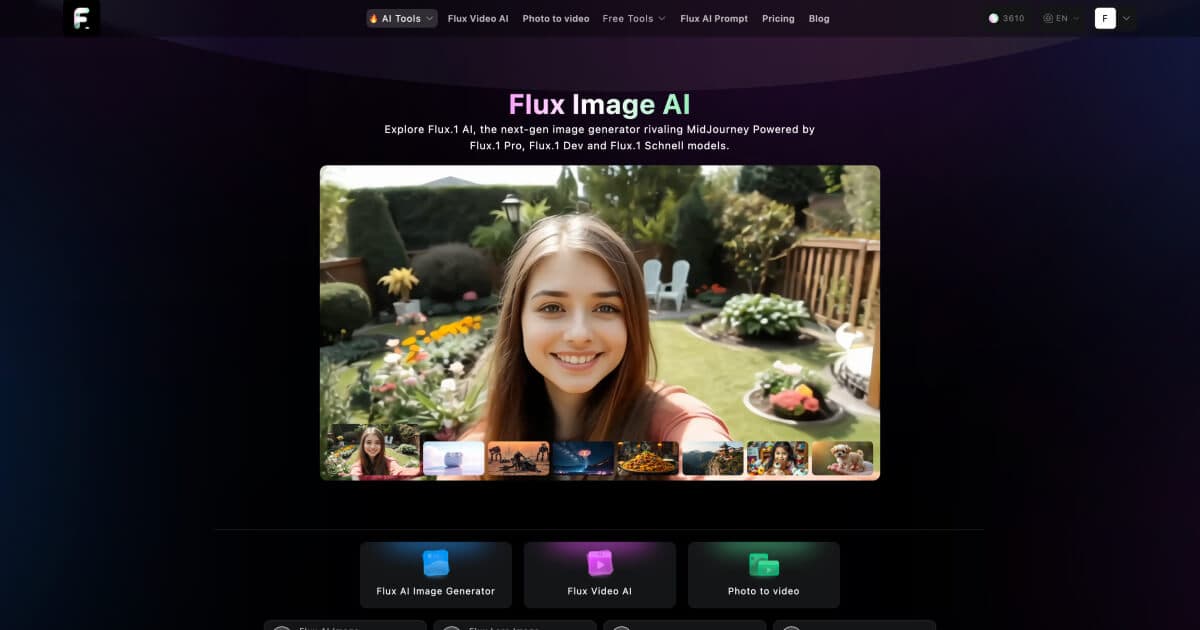
Flyne AI is a comprehensive platform for generating high-quality images and videos using advanced AI models. Users can transform text or existing images into stunning visuals, including AI-generated images, anime, avatars, and product photography. The platform also offers robust video generation capabilities, such as text-to-video, photo-to-video, and consistent character videos. Flyne AI integrates cutting-edge models like Nano Banana, Seedream, Seedance, Veo3, and Kling, providing a wide range of styles and functionalities. It features an intuitive interface, smart prompt assistant, and enhanced stability for a streamlined creation process, delivering high-resolution results with industry-leading speed.
AI App
AI App is an AI platform designed to simplify access to advanced large language models such as GPT-4, Google PaLM 2, and Mistral 7B. It aims to make sophisticated AI technology accessible to a broad audience, regardless of their technical expertise. The platform supports various environments, including web, mobile, and desktop, ensuring flexibility in how users interact with AI. Key features include real-time web search capabilities, robust speech-to-text functionality, and comprehensive multilingual support, enhancing its utility for diverse applications and users globally. AI App focuses on abstracting the complexities of AI, allowing users to leverage powerful models without deep technical knowledge.
deeplearning-models
deeplearning-models is a comprehensive collection of various deep learning architectures, models, and practical tips, presented in Jupyter Notebooks. It supports both TensorFlow and PyTorch frameworks, offering implementations for traditional machine learning, multilayer perceptrons, convolutional neural networks (including AlexNet, DenseNet, LeNet, MobileNet, VGG, ResNet), transformers, ordinal regression, normalization layers, metric learning, autoencoders (fully-connected, convolutional, variational, conditional variational), generative adversarial networks (GANs), graph neural networks (GNNs), and recurrent neural networks (RNNs). The repository also includes notebooks on model evaluation, data augmentation, tips and tricks, transfer learning, visualization, and PyTorch/TensorFlow workflows, making it an invaluable resource for learning and implementing deep learning concepts.
deepjazz
deepjazz is an open-source project designed for deep learning-driven jazz music generation. Developed using Keras and Theano, it leverages a two-layer LSTM to learn from provided MIDI files and compose new jazz pieces. This tool offers a unique opportunity for developers and music enthusiasts to experiment with AI in creative music composition, specifically within the jazz genre. While no longer actively developed, it serves as a valuable historical example of AI's application in music, demonstrating how deep learning can be used to create something as inherently human as music. The project was built during a hackathon, showcasing rapid prototyping in AI music generation.
Deep-Learning-For-Hackers
Deep-Learning-For-Hackers is a comprehensive collection of machine learning tutorials designed to equip users with practical skills for real-world problems. The resource utilizes TensorFlow 2 and Keras in Python, with all tutorials provided as Jupyter notebooks for hands-on learning. It covers a wide array of topics including LSTMs, hyperparameter tuning, data preprocessing, bias-variance tradeoff, anomaly detection, autoencoders, time series forecasting, object detection, sentiment analysis, and intent recognition with BERT. This guide is ideal for those looking to build a strong foundation in machine learning and apply these techniques to computer vision, natural language processing, and time series analysis tasks.
llm-numbers
llm-numbers is a comprehensive GitHub repository curated by ray-project, offering critical numerical insights for Large Language Model (LLM) developers. This resource details various metrics, such as the cost ratios between different OpenAI models (GPT-4 vs. GPT-3.5 Turbo, embedding costs), the cost-effectiveness of self-hosting embeddings versus using commercial APIs, and the financial implications of fine-tuning versus training models from scratch. It also provides crucial information on GPU memory capacities and requirements for serving LLMs, including the impact of batching on throughput. The repository aims to equip developers with the knowledge needed for back-of-the-envelope calculations, enabling informed decisions on infrastructure, cost optimization, and model deployment.
LoRA the Explorer SDXL
LoRA the Explorer SDXL is an AI tool hosted on Hugging Face that enables users to explore various LoRAs (Low-Rank Adaptation) and generate 1024x1024 images using the Stable Diffusion XL model. Users can select a LoRA from a gallery, input a prompt and an optional negative prompt, and adjust the LoRA strength to customize their image generation. This tool is designed for experimenting with different AI models and is suitable for content creation and AI art. While the current live website indicates a runtime error, its intended functionality is to provide an accessible platform for AI image generation.