
Coding & Development
Browsing page 70 of AI tools for Open Source & Models in Coding & Development. Sorted by confidence score — our independent quality rating.

textgrad
TextGrad is an open-source framework designed for automatic "differentiation" via text, leveraging large language models (LLMs) to backpropagate textual gradients. It provides a powerful and intuitive API, similar to PyTorch, allowing users to define loss functions and optimize them using text feedback. The tool supports optimizing various variables, including code snippets, solutions to problems, molecules, and prompts. Recent updates introduce a new engine based on LiteLLM, expanding compatibility to models like Bedrock, Together, and Gemini, and enabling caching. TextGrad has been published in Nature, highlighting its significance in the field.
DistillKit
DistillKit is an open-source toolkit designed for the knowledge distillation of large language models (LLMs). It offers flexible and production-ready solutions for both online and offline distillation workflows, including advanced logit compression techniques. The toolkit is battle-tested, powering the training of Arcee's popular open-source models like Virtuoso, SuperNova Medius, and Blitz. Key features include real-time teacher inference for online distillation, training from pre-captured teacher outputs with compression for offline distillation, and novel polynomial approximation, quantization, and bit-packing for logit compression. It also provides flexible loss functions, sparse and dense distribution support, and HuggingFace integration, making it a robust solution for LLM optimization.

Anthropic
Anthropic is an AI safety and research company dedicated to developing reliable, interpretable, and steerable AI systems. Their flagship product, Claude, is an advanced AI assistant designed for a wide range of applications, from generating code and visualizing data to writing and editing content. Claude offers features like web search, memory across conversations, and the ability to create and execute code. It integrates with platforms like Microsoft 365, Slack, and Chrome, and provides various models including Opus, Sonnet, and Haiku. Anthropic emphasizes responsible AI scaling and offers solutions for individuals, teams, and enterprises, with options for enhanced security and compliance.
KITT By LiveKit
KITT by LiveKit is an open-source AI agent designed for live, real-time conversations, integrating ChatGPT and WebRTC for low-latency audio and video interactions. It functions as a versatile AI assistant, capable of answering questions, summarizing meetings, and acting as a multi-language translator. The tool prioritizes minimal latency through optimized speech-to-text (STT), GPT processing, and text-to-speech (TTS) pipelines, streaming audio segments incrementally for a natural conversational flow. Built on LiveKit's developer tools, KITT can join and interact within LiveKit sessions, subscribing to audio tracks and responding dynamically. Its architecture allows for client-side React components for visual identity and uses data messages for live transcriptions and state changes, making it a powerful foundation for building advanced AI communication applications.
VibeThinker
VibeThinker-1.5B is a 1.5B-parameter dense model developed by WeiboAI, challenging the conventional belief that small models inherently lack robust reasoning capabilities. It employs an innovative post-training methodology centered on the "Spectrum-to-Signal Principle (SSP)" to systematically enhance output diversity. This involves a "Two-Stage Diversity-Exploring Distillation" in the SFT phase and a "MaxEnt-Guided Policy Optimization (MGPO)" framework in the RL phase. VibeThinker-1.5B demonstrates superior reasoning in mathematical and coding tasks, outperforming larger models like DeepSeek R1 and achieving comparable results to GPT OSS-20B Medium, all at a significantly lower cost.
visualnav-transformer
visualnav-transformer offers official code and checkpoint releases for mobile robot foundation models, including GNM, ViNT, and NoMaD. This open-source repository facilitates the training of these models with custom data and their deployment on robots like TurtleBot2/LoCoBot. It supports diverse, cross-embodiment training data and allows for efficient fine-tuning or adaptation to new robots and tasks. The tool provides scripts for processing datasets, training models, and deploying them for navigation and exploration, making it a comprehensive solution for robotics researchers and AI developers in the field of visual navigation.
Synthetic Sciences
Synthetic Sciences offers an AI co-scientist platform designed to automate and accelerate scientific research workflows. It enables users to delegate tasks such as literature reviews, training models on cloud GPUs, designing experiments, and generating publication-ready LaTeX papers. The platform features four distinct modes—Core Research, SOTA Biology, Flywheel, and Write—each tailored for specific research objectives and execution styles. It provides a unified workspace for continuous research, integrating with various tools like GitHub, Hugging Face, and Weights & Biases, and offers persistent agent runtimes for long-running workflows with automatic checkpointing and elastic compute profiles.

Aligned AI
Aligned AI is an artificial intelligence research lab dedicated to developing safe, ethical, and aligned AI systems. Their core mission is to ensure that AI technologies are built with humanity's best interests at heart, emphasizing safety and ethical considerations in every development phase. The lab conducts research and offers a platform called Canvas, which is currently in a waitlist phase. They publish research papers and maintain a blog to share their insights and progress in the field of AI alignment. Aligned AI aims to create AI that consistently performs as intended, doing more of what it should and less of what it shouldn't, thereby fostering trust and responsible AI deployment.
DDPG
DDPG is an open-source project that provides a reimplementation of the Deep Deterministic Policy Gradient (DDPG) algorithm, a method used in continuous control with deep reinforcement learning. The project is built upon OpenAI Gym for environment interaction and TensorFlow for neural network computations. It offers a foundational framework for developers and researchers to experiment with and train AI agents for tasks requiring continuous action spaces. While the actor network functions well with Batch Normalization, the implementation notes that integrating Batch Normalization on the critic network remains a challenge. The repository also highlights that some Mujoco environments within OpenAI Gym are currently unsolved using this implementation. It includes essential components like actor and critic networks, an OU noise generator, and a replay buffer.

Allora Labs
Allora Labs is at the forefront of building industry-leading AI and crypto infrastructure, focusing on creating a decentralized AI network. Their mission is to commoditize the world's intelligence by empowering developers with a source of self-improving collective intelligence. The team comprises professionals with extensive experience from top financial institutions, technology companies, and leading crypto projects. Backed by prominent crypto funds like Polychain, Framework, Blockchain Capital, and CoinFund, Allora Labs supports various applications including lending protocols, marketplaces, oracles, wallets, and indices. Developers can leverage this infrastructure to build AI-powered applications that benefit from collective intelligence.
Confident AI
Confident AI is an AI quality platform designed for engineering, QA teams, and product leaders to ensure the reliability and performance of large language model (LLM) applications. It offers comprehensive tools for benchmarking LLM systems with research-backed metrics, tracing and monitoring production LLM systems, and setting up alerts for quality degradation. The platform integrates with DeepEval, its open-source evaluation framework, to enable local testing and CI/CD pipeline integration. Confident AI facilitates collaboration through dataset management, real-time monitoring, and dashboards. Key features include turning traces into evaluation datasets, auto-categorizing failures, simulating chat conversations, and managing prompts with a Git-based versioning workflow. It supports both cloud and self-hosted deployments, offering enterprise-grade compliance and security.
Socratic Models Image Captioning
Socratic Models Image Captioning is an AI tool available on Hugging Face that specializes in generating descriptive captions for images. It leverages Socratic Models in conjunction with BLOOM, a large language model, to produce relevant and informative captions. While the live website currently shows a runtime error, the tool's core functionality is designed for image captioning, making it valuable for AI research and educational purposes. It aims to provide a platform for exploring advanced AI capabilities in understanding and describing visual content.
Stablediffusionapi Explicit Freedom Nsfw Wai
Stablediffusionapi Explicit Freedom Nsfw Wai is an AI image generation tool hosted on Hugging Face Spaces, designed for creating explicit images using stable diffusion models. While the tool aims to provide freedom in content generation, the current live website indicates a runtime error, suggesting it may not be fully operational or accessible at this time. It is intended for users interested in exploring the capabilities of AI for generating NSFW content, leveraging the underlying stablediffusionapi/explicit-freedom-nsfw-wai model. The tool is presented as a free resource for AI enthusiasts and creative professionals interested in this specific niche of image generation.

Censornet
TrustLayer delivers intelligent IT security solutions designed to anticipate threats, manage vulnerabilities, and protect users globally. The platform offers full control and visibility over cybersecurity without the need for multiple tools, proxies, or stitched-together solutions. It integrates four key layers: TrustLayer Browse for web and cloud activity control, TrustLayer Posture for continuous cloud and SaaS security best practices enforcement, TrustLayer Mail for email threat prevention, and TrustLayer Users for security awareness training. This direct-by-design approach aims to simplify security and strengthen control, stopping threats at the source without rerouting traffic.
MCP Directory
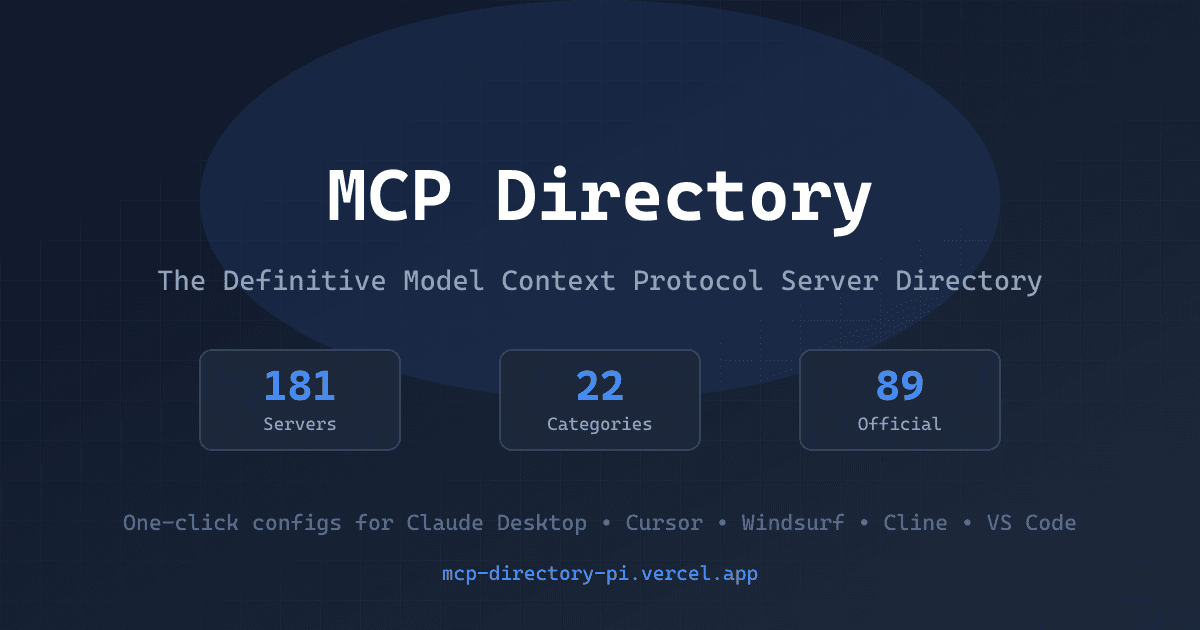
The MCP Directory serves as the definitive resource for discovering Model Context Protocol (MCP) servers, offering a comprehensive listing of over 180 servers categorized across 22 different areas. This platform is designed to help users, particularly developers and AI enthusiasts, find the perfect tools to enhance their AI workflows. Users can browse servers by name, category, or specific features, making it easy to locate relevant MCP servers for various applications. The directory also highlights official and popular servers, provides information on client compatibility (such as Claude Desktop and Cursor), and showcases the latest additions to the MCP ecosystem. It's an essential tool for anyone looking to integrate or build with MCP servers.
Baichuan2
Baichuan2 is a new generation of open-source large language models developed by Baichuan Intelligent Technology. These models are trained on an extensive corpus of 2.6 trillion high-quality tokens, achieving state-of-the-art results across various authoritative Chinese, English, and multilingual benchmarks. The release includes 7B and 13B base and chat versions, with 4-bit quantization available for the chat models. Baichuan2 models are fully open for academic research and offer free commercial use upon application and official approval. The models demonstrate strong performance in general, legal, medical, mathematics, code, and multilingual translation domains, making them suitable for a wide range of NLP applications.
codeshell
CodeShell is a robust series of code large language models developed by PKU-KCL, featuring 7 billion parameters and trained on 500 billion tokens with an 8192 context window. It excels in code evaluation benchmarks like HumanEval and MBPP, outperforming similar-sized models such as CodeLlama and Starcoder. The project offers a comprehensive ecosystem including base models, chat models (with 4-bit quantization for reduced memory), and C++ versions for local deployment without a GPU. CodeShell also provides IDE plugins for VS Code and JetBrains, along with various demo options including Web-UI, CLI, and OpenAI API compatibility, making it a versatile solution for code generation, fill-in-the-middle tasks, and code-related Q&A.
awesome-open-gpt
awesome-open-gpt is a comprehensive collection of over 170 open-source projects related to GPT, curated to help enthusiasts discover and utilize GPT applications. The repository features a wide range of tools, from GPT mirrors and desktop versions to programming language clients, automation tools like Auto-GPT, and integrations with third-party platforms such as WeChat and Discord. It also includes various GPT tools for documentation, programming, audio/video, and more. The collection is continuously updated, with daily automatic updates of star counts, and aims to provide valuable resources for anyone interested in learning about and implementing GPT models.
FastDeploy
FastDeploy is an open-source, high-performance inference and deployment toolkit built on PaddlePaddle, designed for Large Language Models (LLMs) and Vision Language Models (VLMs). It provides production-ready deployment solutions with key features like load-balanced PD decomposition, unified KV cache transmission, and compatibility with OpenAI API services and vLLM. The toolkit supports a wide range of quantization formats including W8A16, W8A8, W4A16, W4A8, W2A16, and FP8. It also incorporates advanced acceleration technologies such as speculative decoding, multi-token prediction (MTP), and chunked prefilling. FastDeploy supports various hardware platforms including NVIDIA GPUs, Kunlunxin XPUs, Hygon DCUs, and Intel Gaudi, making it a versatile tool for AI developers and machine learning engineers.

API Privacy
Perfai.ai is an AI-agent platform designed to automate app privacy, security, and governance. It provides comprehensive testing and fixing capabilities to ensure applications meet industry standards and compliance requirements like GDPR and CCPA. The platform helps CTOs deliver secure and compliant apps effortlessly by automating various aspects of testing, including privacy, security, governance, and code. Key features include service leak detection and automated app contract testing, making it an essential tool for maintaining high standards in app development and deployment.
prompt-optimizer
Prompt Optimizer is a powerful open-source AI prompt optimization tool designed to enhance the quality of AI outputs by refining prompts. It offers intelligent, one-click optimization with multi-round iterative improvements to boost AI response accuracy. The tool supports both system and user prompt optimization, catering to diverse usage scenarios. Users can analyze and compare evaluation results to determine prompt effectiveness. It integrates with mainstream AI models like OpenAI, Gemini, and DeepSeek, and supports image generation (T2I, I2I). Available as a web application, desktop app, Chrome extension, and Docker deployment, it also features advanced testing modes, secure client-side processing, and password protection.
optillm
OptiLLM is an OpenAI API-compatible optimizing inference proxy designed to significantly enhance LLM accuracy and performance on reasoning tasks. It integrates over 20 state-of-the-art techniques, such as Multi-Agent Reasoning Systems (MARS), Cerebras Planning and Optimization (CePO), and Monte Carlo Tree Search (MCTS), to achieve 2-10x accuracy improvements without any model training or fine-tuning. The tool functions as a drop-in replacement for any OpenAI-compatible API endpoint, supporting multiple providers including OpenAI, Anthropic, Google, and Cerebras via LiteLLM. It's production-ready and used by companies and researchers globally, offering features like system prompt learning, long-context processing, and various plugins for memory, privacy, and code execution.
generative-models
Generative-models is a comprehensive open-source repository from Stability AI, offering a suite of advanced generative models. It features cutting-edge diffusion models such as Stable Video 4D 2.0 (SV4D 2.0), an enhanced video-to-4D model designed for high-fidelity novel-view video synthesis and 4D asset generation. The repository also includes Stable Video 4D (SV4D) for novel-view video synthesis, SV3D for image-to-video multi-view synthesis, and Stable Video Diffusion (SVD) for image-to-video generation. Additionally, it hosts text-to-image models like SDXL-Turbo and SDXL-base/refiner. The codebase emphasizes modularity, using a config-driven approach with PyTorch Lightning for training. It separates guiders from samplers and adopts a denoiser framework for both training and inference, supporting continuous time models. This makes it a valuable resource for researchers and developers working with generative AI.

Emcie
Emcie is designed to optimize Parlant inference, enabling businesses to deploy AI agents in production environments with high performance and cost efficiency. The platform focuses on serving customer-facing AI agents, ensuring they operate effectively and reliably. Emcie addresses the practical challenges of integrating AI agents into existing systems, providing a solution that prioritizes compliance and scalability. It aims to streamline the deployment process for Parlant agents, making it easier for developers and organizations to leverage AI in their operations while maintaining optimal performance and managing expenses.