
Coding & Development
Browsing page 15 of AI tools for Testing & QA in Coding & Development. Sorted by confidence score — our independent quality rating.

Nadi
Nadi is a comprehensive crash care companion designed to revolutionize application monitoring for developers, particularly those working with PHP. It offers real-time error tracking, full stack traces, and smart deduplication for 10 issue types including exceptions, slow queries, and failed jobs. Beyond backend monitoring, Nadi provides Real User Monitoring (RUM) with a JavaScript SDK to capture Core Web Vitals, session tracking, JavaScript errors, and rage click detection. The platform includes a configurable alerting engine with multi-channel notifications (Slack, Teams, Telegram) and robust organization and access management features for teams. Nadi supports Laravel and WordPress, with upcoming support for Node.js, Python, and Go, making it a versatile solution for maintaining code quality and application health.
light-speed
Light-Speed offers advanced AI vision systems designed for the security and monitoring of sports facilities and smart cities. The technology utilizes state-of-the-art Artificial Intelligence and Computer Vision to process real-time image streams from digital cameras, converting them into valuable information about ongoing events. It can recognize complex interactions between people and objects, generate augmented reality images, and assist surveillance operators by monitoring numerous cameras simultaneously or replacing them where human presence is impractical. The system is highly customizable, capable of being trained to detect new types of complex events, including specific behaviors of people, animals, vehicles, and infrastructure. Light-Speed prioritizes privacy, operating on a "Privacy by Design" principle, ensuring no biometric data is extracted or saved. It is compatible with any digital camera and can be updated remotely to add new functionalities.
Rainforest QA
Rainforest QA is an AI-accelerated UI testing tool designed to automate end-to-end testing with a no-code approach. It helps SaaS startups and other organizations ship software faster by significantly reducing the burden of test maintenance. The platform blends artificial intelligence with QA expertise to improve software release cycles, allowing developers and QA teams to focus on innovation rather than repetitive testing tasks. Key features include no-code test automation, AI-accelerated UI testing, and integrations with popular development and communication tools like Jira, Slack, and Microsoft Teams. Rainforest QA also offers an API and CLI for programmatic control over tests and runs.
LLMTest_NeedleInAHaystack
LLMTest_NeedleInAHaystack is an open-source tool designed to evaluate the in-context retrieval capabilities of Large Language Models (LLMs). It operates by embedding a specific 'needle' (a random fact or statement) within a lengthy 'haystack' (a long context window) and then prompts the LLM to retrieve this statement. The tool allows for iteration over various document depths and context lengths to comprehensively measure model performance. It supports major LLM providers including OpenAI, Anthropic, and Cohere, offering flexibility in testing different models. The package can be easily installed via PyPi and executed from the command line, with options to customize test parameters such as provider, model name, context lengths, and document depths. It also includes features for multi-needle evaluation and integration with LangSmith for orchestrating and storing evaluation results.

Ottic
Ottic functions as an HR platform specifically designed for AI agents, enabling businesses to hire and manage AI agents as if they were human employees. These AI agents are integrated with your existing tools and follow your established processes, aiming to reduce operational costs by up to 75% after the initial three months. The platform is designed to replace junior-level positions with AI agents that offer consistent performance and never quit. Ottic highlights an average saving of $4,200 per month, positioning itself as a solution for business automation and workforce optimization through AI.
Thunder Code
Thunders is an AI-powered test automation platform designed to streamline software testing workflows for all teams. It enables users to generate, execute, and monitor tests across various products and workflows, significantly boosting QA efficiency. The tool allows for no-code test creation using natural language, making it accessible to QA engineers, developers, product managers, and functional leaders. Thunders features self-healing tests that adapt to UI or logic changes, reducing maintenance and false positives. It offers comprehensive testing capabilities including E2E, accessibility, and security testing, all managed through a single interface. The platform integrates seamlessly into CI/CD pipelines and supports enterprise-grade security, ensuring intelligent testing runs where software runs.
QA Architect
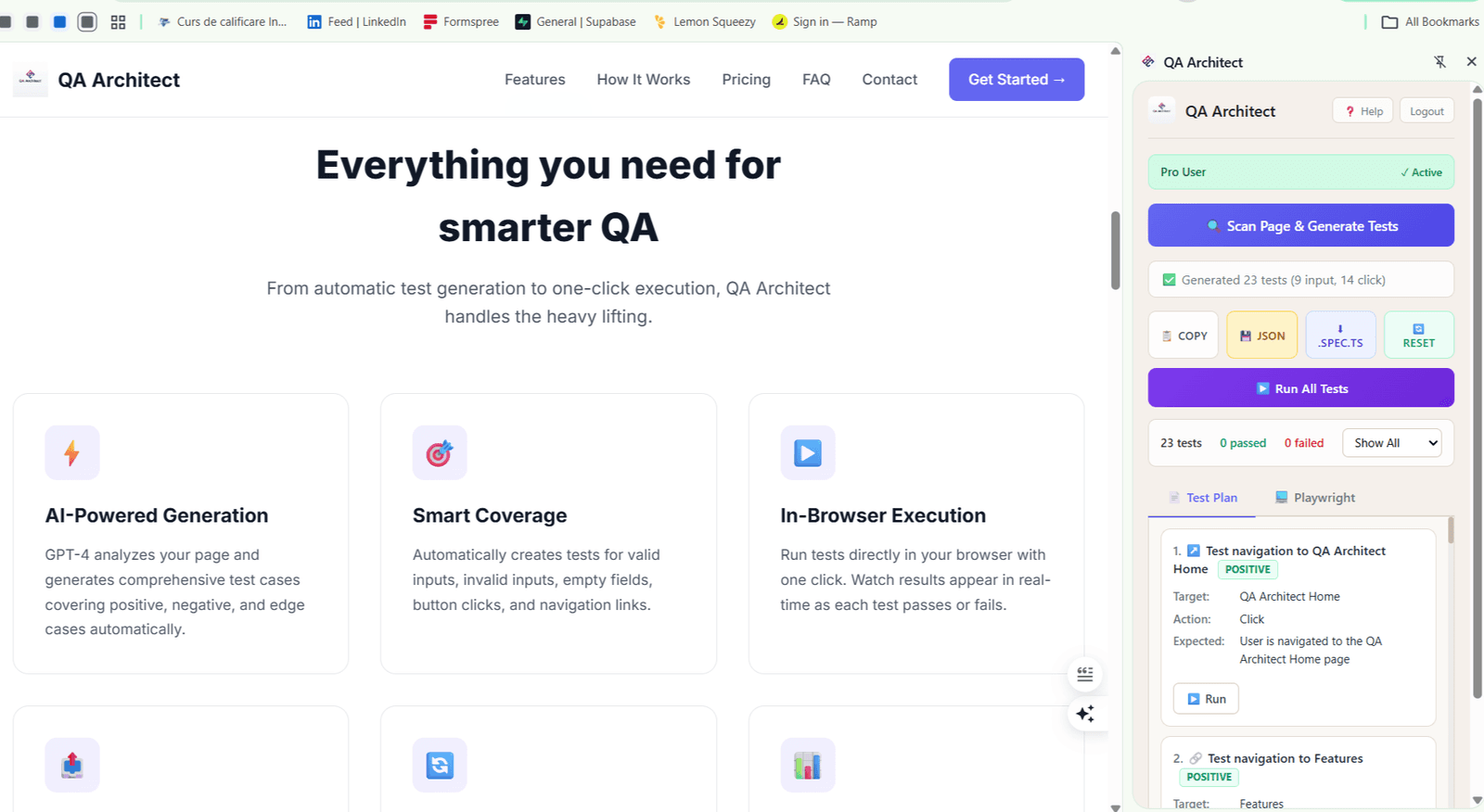
QA Architect is an AI-powered Chrome extension designed to accelerate the QA workflow by generating comprehensive automated tests for any webpage in seconds. It scans pages and instantly creates a complete test suite, covering positive, negative, and edge cases for form inputs, button interactions, and navigation links. Users can run these tests directly in their browser with one click, observing real-time pass/fail results. For advanced automation, tests can be exported as ready-to-run Playwright code, making it ideal for integration into CI/CD pipelines. The tool also features smart retry for flaky elements and detailed JSON reports, making it accessible for both technical and non-technical users.

Trueflaw
Trueflaw specializes in AI-powered solutions for Non-Destructive Evaluation (NDE) and ultrasonic testing. The platform offers industry-leading AI analysis for automatic defect recognition, trained using a combination of client data and Trueflaw's proprietary virtual cracks to achieve human-level performance. These detection systems are tailored for each customer and validated using Probability of Detection (POD) evaluations, which Trueflaw also offers as a service. Beyond software, Trueflaw provides comprehensive ultrasonic testing solutions, encompassing design, hardware, and software integration. They are also known for manufacturing realistic flawed samples using a unique thermal fatigue technology to grow real cracks on real components, which is crucial for training and validating their AI models.
Regression Games
Regression Games offers an ultimate AI agent testing platform specifically designed for Unity game development. It enables developers to create and deploy bots for QA testing, streamlining the process of building end-to-end automated tests. The platform features a Smart Recording tool and OCR techniques for quick test setup, and its Bot Sequences runtime allows for combining various approaches like scripted code, recorded playback, computer vision, and exploratory bots. Beyond known scenarios, Regression Games supports chaos testing and exploratory tools like the Monkey Bot to uncover issues efficiently. It also provides comprehensive insights by capturing game state, screenshots, logs, and performance data.
Gradio 🤝 TGI
Gradio 🤝 TGI integrates Gradio and Text Generation Inference (TGI) within a unified environment, simplifying the process of deploying and testing AI models. This setup is particularly useful for developers and researchers who need to quickly create interactive web interfaces for their text generation models. By packaging both Gradio, a popular library for building UI components for machine learning models, and TGI, an optimized solution for serving large language models, this tool aims to streamline AI development workflows. It allows for efficient experimentation and demonstration of AI capabilities without the complexity of managing separate infrastructures for UI and model serving.
Whybug
Whybug is an AI-powered tool designed to assist developers in understanding and resolving coding errors efficiently. By leveraging a large language model trained on extensive data, including StackExchange, it can predict the underlying causes of bugs and propose effective solutions. Users simply paste an error or exception message into the tool, and Whybug provides a clear explanation of what went wrong, how to fix it, and even offers example code for implementation. This functionality aims to save developers significant time and reduce frustration during the troubleshooting process, allowing them to quickly identify and rectify issues in their code.
Gradio OpenAI CLIP Grad-CAM
Gradio OpenAI CLIP Grad-CAM is a tool designed for visualizing the decision-making process of artificial intelligence models, specifically focusing on image-based predictions. It integrates Gradio for the user interface, OpenAI CLIP for understanding image-text relationships, and Grad-CAM for generating visual explanations of model predictions. This combination allows users to gain insights into which specific regions or features within an image are most influential in a model's output. The tool is particularly valuable for educational purposes, helping students and practitioners understand complex AI behaviors, and for researchers who need to analyze and debug model performance by observing its internal reasoning.
Grok 1 Test
Grok 1 Test is a demonstration space hosted on Hugging Face, specifically designed for users to interact with and test the Grok-1 model. Built using Gradio, it offers a direct interface for exploring the model's functionalities. While the current live website indicates a runtime error, the intention is to provide a platform where individuals can experiment with the Grok-1 model and understand its capabilities. This tool is ideal for those interested in AI model testing and development, offering a hands-on experience with a specific large language model.
Trails
Trails is an AI agent analytics tool designed to help developers and teams quickly identify and resolve issues in their AI agent runs. It offers aggregate analysis to provide an overview of failing patterns across thousands of agent runs, eliminating the need to review traces individually. The tool automatically detects, tags, and groups issues, allowing users to filter and prioritize problems efficiently. Trails also provides a step-by-step replay feature, showing exactly what the agent did with screenshots, browser state, and reasoning, highlighting errors without requiring users to dig through raw JSON logs. It supports parsing browser-use format execution logs out of the box, streamlining the process from trace upload to issue resolution.
MTEB Arena
MTEB Arena is a Hugging Face Space designed for benchmarking text embeddings, providing an interface for users to evaluate the performance of different text representation models. This tool is intended to help in assessing semantic similarity and text retrieval performance across various models and tasks. While the application aims to offer a platform for interaction and comparison, it is currently not operational due to resource constraints. The project is created by the Massive Text Embedding Benchmark (MTEB) organization, indicating its focus on rigorous evaluation within the AI and machine learning community.
agentation
Agentation is an open-source, agent-agnostic visual feedback tool designed to assist AI coding agents. It enables users to click and annotate elements on a webpage, select text, or define specific areas, generating structured output that helps AI agents identify exact code references. The tool features automatic selector identification, multi-select and area selection capabilities, and an animation pause function to capture specific states. It provides structured markdown output including selectors, positions, and context, and supports both dark and light modes. Agentation is built with zero dependencies, using pure CSS animations, and requires React 18+ and a desktop browser.
giskard-oss
giskard-oss is an open-source Python library designed for comprehensive evaluation and testing of agentic AI systems, including LLM agents. The latest v3 rewrite focuses on modularity and efficiency, offering a lightweight framework for dynamic, multi-turn testing. Key features include Giskard Checks for creating and applying evaluations, such as LLM-as-judge assessments, to catch regressions, validate RAG quality, and enforce safety rules. It also includes an agent vulnerability scanner for red teaming and prompt injection detection, and planned capabilities for RAG evaluation and synthetic data generation. The library supports testing various AI components, from LLMs to black-box agents and multi-step pipelines.
tensorwatch
TensorWatch is a powerful debugging and visualization tool developed by Microsoft Research, designed for data science, deep learning, and reinforcement learning. It integrates seamlessly with Jupyter Notebooks, offering real-time visualizations of machine learning training processes. Beyond traditional logging, TensorWatch features a unique 'Lazy Logging Mode' that allows users to execute arbitrary queries against live ML training, returning streams for visualization without prior logging. The tool is highly flexible and extensible, enabling users to build custom visualizations, UIs, and dashboards. It supports various diagram types like histograms, pie charts, and 3D plots, and facilitates comparing results from multiple experimental runs. TensorWatch also incorporates libraries like hiddenlayer and torchstat for pre-training and post-training analysis, including model graph viewing, statistics, t-SNE for dataset visualization, and prediction explanations using techniques like Lime.
webarena
WebArena is a self-hostable, open-source web environment designed for building and evaluating autonomous AI agents. It provides a realistic web environment, enabling researchers and developers to reproduce results from academic papers and conduct new experiments. The platform has been significantly enhanced by AgentLab, offering features like parallel experiments using BrowserGym, integration of popular web navigation benchmarks such as VisualWebArena, and a unified leaderboard for reporting results. It also includes improved handling of environment edge cases, making it a robust framework for developing and testing AI agents in complex web interactions. The repository provides detailed instructions for installation, environment setup, and end-to-end evaluation, including generating test data and launching evaluations with various reasoning agents.
wtf.nvim
wtf.nvim is a Neovim plugin designed to enhance the debugging experience by providing AI-powered explanations and solutions for diagnostic messages. It integrates with Neovim's Language Server Protocol (LSP) support, making it compatible with any language. Key features include debugging diagnostics with AI, automatic fixing of issues, and web search integration for diagnostic messages. Users can choose from various AI providers like Anthropic, Copilot, DeepSeek, Gemini, Grok, Ollama, and OpenAI, and configure their preferred search engines. The plugin also offers multiple picker supports for history and grep functions, making it a comprehensive tool for developers seeking to streamline their debugging workflow within Neovim.
alpaca_eval
AlpacaEval is an automatic evaluator designed for instruction-following language models, providing a fast, cheap, and highly correlated alternative to human evaluation. It boasts a Spearman correlation of 0.98 with ChatBot Arena, costing less than $10 of OpenAI credits and running in under 3 minutes. The tool offers precomputed leaderboards for common models, an automatic evaluator validated against 20K human annotations, and a toolkit for building advanced automatic evaluators with features like caching, batching, and multi-annotators. It also includes 20K human evaluation data and a simplified AlpacaFarm evaluation dataset. AlpacaEval is particularly useful for rapid model development and iterative testing, though it cautions against replacing human evaluation for high-stakes decision-making due to potential biases and limitations in instruction representativeness.
AutoCoder
AutoCoder is an advanced AI model specifically designed for code generation tasks. It boasts impressive accuracy, surpassing GPT-4 Turbo (April 2024) and GPT-4o on the HumanEval base dataset. A key differentiator of AutoCoder is its innovative code interpreter, which automatically installs necessary packages and iteratively runs the generated code until it's deemed issue-free. This feature significantly expands the utility of the code interpreter compared to other models that may not access external libraries or run all generated code. AutoCoder is available in several model sizes, including AutoCoder (33B), AutoCoder-S (6.7B), and AutoCoder_QW_7B, with base models like deepseeker-coder and CodeQwen1.5-7b. It provides quick start guides for testing performance on benchmarks like HumanEval, MBPP, and DS-1000, and offers a web demo for interactive use.
Chronos
Chronos is a groundbreaking debugging-first language model developed by Kodezi, specifically engineered for repository-scale code understanding. It boasts state-of-the-art results on SWE-bench Lite (80.33%) and achieves an impressive 67% real-world fix accuracy, significantly outperforming general-purpose models like GPT-4. Chronos is built upon key innovations including a debugging-first architecture trained on 42.5M examples, Persistent Debug Memory (PDM) for repository-specific learning, and Adaptive Graph-Guided Retrieval (AGR) for intelligent multi-file context handling. Its seven-layer system design incorporates an execution sandbox and an explainability layer, making it a comprehensive solution for autonomous debugging. The model is slated for general availability in Q1 2026 via Kodezi OS, with limited enterprise beta access in Q4 2025.
data-validation
TensorFlow Data Validation (TFDV) is a powerful open-source library designed for exploring and validating machine learning data. It offers highly scalable capabilities for calculating summary statistics of training and test data, integrating seamlessly with a viewer for data distributions and statistics. TFDV automates data-schema generation to define expectations about data, including required values, ranges, and vocabularies, and provides a schema viewer for inspection. A key feature is its anomaly detection system, which identifies issues like missing features, out-of-range values, or incorrect feature types, complemented by an anomalies viewer to help users correct these issues. TFDV is built to work effectively with TensorFlow and TensorFlow Extended (TFX), making it an essential tool for maintaining data quality in ML pipelines.