
Data & Analytics
Browsing page 22 of AI tools for Data Cleaning & Prep in Data & Analytics. Sorted by confidence score — our independent quality rating.

Turkish Tokenizer
Turkish Tokenizer is a specialized tool designed for the morphological tokenization of Turkish text. Hosted on Hugging Face Spaces, this application allows users to input any Turkish text and receive a detailed breakdown of its individual words and their morphological components. This process is crucial for natural language processing (NLP) tasks, as it provides a foundational understanding of the text's structure. By revealing how text is divided, the tool aids in preprocessing data for linguistic analysis, machine translation, and other AI applications that require a deep understanding of Turkish grammar and word formation. It offers a straightforward interface for easy use.
Tokenizers Languages
Tokenizers Languages is a tool hosted on Hugging Face, specifically designed to assist with language tokenization. While the live website currently displays a runtime error, its intended purpose, as indicated by its name and platform, is to support educational and research endeavors in natural language processing. Users would typically leverage such a tool for tasks involving breaking down text into smaller units (tokens) for linguistic analysis, model training, or other NLP applications. Its availability on Hugging Face suggests it is part of a community-driven ecosystem for machine learning tools and applications.
Trocr Scene Text Recognition
Trocr Scene Text Recognition is an AI-powered tool hosted on Hugging Face Spaces, designed for optical character recognition (OCR). It allows users to upload images that contain text and then processes them to extract and convert the visual text into a readable digital format. This tool is particularly useful for tasks requiring the digitization of text from various scenes or documents. Its intuitive interface, typical of Hugging Face Spaces, enables quick interaction, making it accessible for anyone needing to extract text from images without complex setups. Users can experiment with their own images or utilize provided examples to understand its capabilities.
Jsonify
Jsonify is a market intelligence platform that automates the extraction and structuring of data from public websites and apps. It continuously monitors sources like menus, retailers, and e-commerce sites to collect product, price, and promotion data at scale. The platform offers two main products: Radar, for continuous market visibility and tracking product presence, pricing, and availability; and Benchmark, which simulates real customer journeys to extract personalized pricing and offer structures from competitor websites. Jsonify transforms raw web data into clean, unified datasets, delivering insights through dashboards, CSV/API exports, or direct feeds into tools like PowerBI and Snowflake. It is designed for enterprise scale, processing millions of data points daily with high accuracy, and is used across industries like F&B, retail, insurance, and real estate for competitive intelligence and market analysis.
synmetrix
Synmetrix, formerly MLCraft, is an open-source data engineering platform designed to provide a production-ready semantic layer on Cube. It offers a comprehensive framework for modeling, integrating, transforming, aggregating, and distributing metrics data at scale. Key features include flexible data modeling using SQL and Cube data models, a unified semantic layer to consolidate metrics from various sources, scheduled reports and alerts for monitoring, and versioning for schema changes. It also supports role-based access control, data exploration through a UI or BI tool integration via a SQL API, and performance optimization through caching with Cube. Synmetrix is ideal for data democratization, business intelligence, embedded analytics, and enhancing LLM accuracy in data handling.
dilation
Dilation is an open-source project that implements dilated convolution for semantic image segmentation. It focuses on multi-scale context aggregation, a technique detailed in its ICLR 2016 conference paper. The repository includes network definitions and pre-trained models, allowing users to segment images using vanilla Caffe. For those interested in training their own models, comprehensive documentation is provided. The project also highlights that dilated convolution is implemented in other deep learning packages like Torch and Lasagne, offering flexibility for developers. It serves as a foundational resource for researchers and developers working on advanced image segmentation tasks.
vlmrun-hub
vlmrun-hub is a comprehensive, open-source repository offering pre-defined Pydantic schemas specifically designed for extracting structured data from unstructured visual domains like images, videos, and documents. It is built for Vision Language Models (VLMs) and optimized for real-world use cases, simplifying the integration of visual ETL into various workflows. The hub addresses the common challenge of VLMs lacking strongly-typed, validated outputs for automation by providing schemas that ensure data conforms to expected types and structures, eliminating complex parsing and validation. Key benefits include ease of use, automatic data validation, type-safety, model-agnostic compatibility, and optimization for visual ETL across industries such as healthcare, finance, and retail.
Optible AI
Optible AI offers an advanced AI-powered platform designed to transform grant management for government departments and foundations. It automates workflows, significantly reducing review times by up to 90% through AI-driven assessment and allocation. The platform ensures fair, accurate, and consistent decisions at scale by screening applications faster and providing highly accurate eligibility screening. Key features include automated setup, real-time document validation to detect fraud, and AI-driven screening that processes thousands of applications in minutes. Optible AI also delivers 300x more data insights through detailed, customizable reports, enabling organizations to track progress, refine policies, and maximize their impact efficiently.
torch-audiomentations
torch-audiomentations is a PyTorch library designed for efficient audio data augmentation, crucial for deep learning applications. It prioritizes speed by supporting both CPU and GPU (CUDA) processing, making it suitable for large-scale model training. The library handles batches of multichannel or mono audio and its transforms extend `nn.Module`, allowing direct integration into PyTorch neural network models. Most transforms are differentiable, offering flexibility for advanced use cases. It features three modes—per_batch, per_example, and per_channel—for applying augmentations, along with a permissive MIT license and cross-platform compatibility. The library includes a variety of waveform transforms such as Gain, PolarityInversion, AddBackgroundNoise, PitchShift, and various filters, aiming for high test coverage and continuous development.

Qritrim
Qritrim.com is a domain name currently listed for sale on HugeDomains.com for $6,295. Buyers have the option to purchase it outright or utilize a 24-month payment plan at $262.29 per month with 0% interest. HugeDomains.com ensures a safe and secure shopping experience with SSL encryption and offers PayPal or Escrow.com checkout options. The purchase includes immediate ownership, with domain access typically available within one to two hours. A 30-day money-back guarantee is provided, allowing returns if the buyer is unsatisfied. The platform also facilitates domain transfers to other registrars like GoDaddy once all payments are complete.
Altimate AI
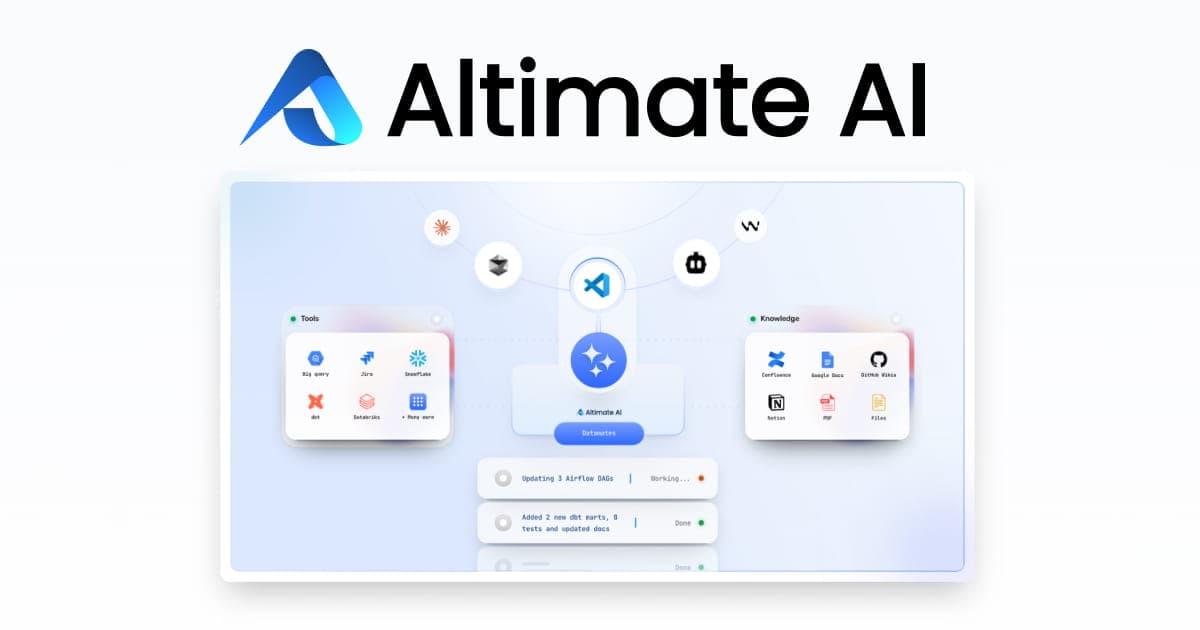
Altimate AI offers a suite of AI tooling specifically designed for data engineering, aiming to accelerate data work by providing autonomous, coachable, and context-aware AI teammates. The platform integrates seamlessly with existing data ecosystems like Snowflake, Databricks, BigQuery, dbt, and GitHub, ensuring zero context switching and 100% PII protection. Key functionalities include automating routine data tasks, optimizing dbt development, and intelligent infrastructure management. It helps convert SQL to dbt models, optimize model performance, generate documentation, and maintain data quality. Altimate AI is enterprise-ready, offering custom integrations and robust security features, making it a trusted solution for leading data companies.
synthcity
synthcity is a comprehensive open-source Python library designed for generating and evaluating synthetic tabular data. It provides a flexible, plugin-based architecture that allows for easy extension and integration of new models. The library includes a wide array of reference models, categorized by type, such as GAN-based (AdsGAN, CTGAN), VAE-based (TVAE), Normalizing Flows, Bayesian Networks, and LLM-based (GReaT) for general-purpose data. It also features specialized generators for time series (TimeGAN, FourierFlows), static survival analysis (SurvivalGAN), and even images (Image ConditionalGAN). synthcity emphasizes privacy-focused generation with models like DECAF and DP-GAN, and offers several evaluation metrics for correctness and privacy. It's ideal for researchers and developers working on data privacy, fairness, and augmentation tasks, though it requires prior imputation for missing data.
Fleak
Fleak is an AI-powered data workflow tool designed to ingest, transform, and normalize complex data rapidly. It allows for one-click deployment and real-time monitoring for data correctness and cost. Fleak automatically fixes schema drift and delivers consistent, clean, AI-ready output to any destination. It helps data teams onboard new data sources in hours, free up engineering time by automating data integration, and de-risk data integrity with high field accuracy. The platform breaks down data silos, enabling faster, AI-ready insights across enterprises by generating engine-agnostic configurations for deployment on various platforms like Apache Spark, Flink, and Vector.
RegGenome
RegGenome provides high-quality regulatory data by transforming fragmented, unstructured regulation into machine-readable, machine-consumable source-linked data. This structured data is designed to power the next generation of compliance, GRC, and regulatory systems, enabling earlier signal detection, reliable change tracking, and audit-ready outputs. The platform offers three modular layers: AI-optimised Data for faster compliance tools, a Control & Obligations Library for accelerating control mapping, and a Policy Intelligence Suite for evidence-based benchmarking and framework assessments. RegGenome serves solution providers and regulators, helping them reduce content development overheads, accelerate feature delivery, and align regulatory publishing with digitisation and AI. Founded at the University of Cambridge, its data is built for trust and reviewed with regulators.

Striim
Striim is a comprehensive platform for real-time data integration and streaming, designed to unify data across various sources including databases, applications, and cloud environments. It leverages Change Data Capture (CDC) to stream trillions of events in real-time, enabling businesses to build AI-ready data pipelines. The platform offers solutions for AI & ML data unification, high-throughput streaming integration, and high availability through real-time database replication. Striim supports over 100 connectors for popular sources like AWS, Google Cloud, Azure, Databricks, and Snowflake, and features capabilities such as streaming SQL, intelligent schema evolution, and pipeline monitoring. It is available as a fully managed SaaS (Striim Cloud) or a self-managed platform (Striim Platform), catering to diverse deployment needs.

Tablextract
Tablextract is a powerful data extraction tool designed to streamline the process of extracting tabular data from a wide range of sources, including PDFs, PNGs, JPGs, and screenshots. It eliminates the need for manual data entry, allowing users to quickly and efficiently convert complex tables into structured formats like Excel, CSV, or directly copy them to the clipboard. The tool is built to save users significant time and effort, offering a user-friendly experience that promises table extraction in less than three clicks. This makes it an invaluable asset for anyone dealing with large volumes of data embedded in documents or images, ensuring accuracy and reducing the potential for human error.
DeepXi
DeepXi is a deep learning framework implemented in TensorFlow 2/Keras, designed for a priori Signal-to-Noise Ratio (SNR) estimation. This tool is primarily used for speech enhancement, noise estimation, and mask estimation, and can also serve as a front-end for robust Automatic Speech Recognition (ASR). It supports various deep neural network architectures, including MHANet, RDLNet, ResNet, ResLSTM, and ResBiLSTM, to efficiently model noisy speech. DeepXi offers both causal and non-causal versions of its models, providing flexibility for different application requirements. It operates on mono/single-channel audio at a standard sampling frequency of 16000 Hz, with configurable window duration and shift. The tool supports common audio codecs like .wav, .mp3, and .flac, and provides pre-trained models and datasets for research and development.
onefilellm
OneFileLLM is a command-line tool designed to simplify data aggregation for Large Language Models (LLMs). It automates the process of collecting information from diverse sources, including local files, GitHub repositories, web pages, PDFs, and YouTube transcripts. The tool then combines this multi-source data into a single, structured XML output, which is automatically copied to your clipboard. This structured format is optimized for LLM context, making it easier for models to process and understand complex information. OneFileLLM also features an alias system for creating simple and complex shortcuts to frequently used inputs, and advanced web crawling options for comprehensive documentation sites and academic sources.

Collibra
Collibra is a comprehensive data intelligence platform designed to unify governance for both data and AI, enabling organizations to achieve Data Confidence™ and scale AI initiatives from pilot to production. The platform offers a best-in-class catalog, flexible governance, continuous quality, and built-in privacy features. Key capabilities include AI Governance for cataloging, assessing, and monitoring AI use cases, Data Access for defining and enforcing data policies, Data Catalog for discovery, Data Governance for transparency, Data Lineage for visualizing data flow, Data Quality & Observability for monitoring, and Data Privacy for automated enforcement. Collibra also features Deasy Labs for transforming unstructured data into AI-ready assets, making it ideal for regulated organizations seeking trusted and valuable AI.
PageLlama
The website for PageLlama, pagellama.com, currently displays content for "yl9193永利集团(中国)股份有限公司," which translates to a Chinese university or college. The site details academic activities, research, faculty, student affairs, and partnerships related to political science and public administration. It features news articles, announcements, academic forums, and information about various research centers. There is no indication on the live website that this is an AI tool for converting web pages to Markdown, as suggested by the previous description. The site seems to be a legitimate academic portal for a Chinese institution.
synthetic-data-generator
The Synthetic Data Generator (SDG) is an open-source framework designed to create high-quality structured tabular synthetic data. This synthetic data retains the essential characteristics of original data but is exempt from privacy regulations, making it suitable for data sharing, model training, debugging, and system development. SDG integrates both statistical data synthesis algorithms and LLM-based generation models, offering features like synthetic data generation without training data and off-table feature inference. It is optimized for big data, significantly reducing memory consumption, and continuously tracks academic and industry advancements. SDG also supports differential privacy and anonymization for enhanced security and is easily extensible through a plug-in system for models, data processing, and connectors.
TextBlob
TextBlob is a Python library designed for simplified text processing, offering a straightforward API for various natural language processing (NLP) tasks. Key functionalities include sentiment analysis, part-of-speech tagging, and noun phrase extraction. It also supports classification, tokenization, word and phrase frequency analysis, parsing, n-grams, word inflection (pluralization and singularization), lemmatization, and spelling correction. Built upon the foundations of NLTK and Pattern, TextBlob allows for the addition of new models or languages through extensions and integrates with WordNet. It's an open-source tool, making it accessible for developers and researchers working with textual data.
CLUENER2020
CLUENER2020 offers a PyTorch implementation of various models for Named Entity Recognition (NER), focusing on Chinese language tasks. It includes baseline code for the CLUENER2020 competition, featuring models like BiLSTM-CRF, BERT-base with Softmax/CRF/BiLSTM+CRF, and Roberta with Softmax/CRF/BiLSTM+CRF. The project utilizes the CLUENER2020 dataset, a Chinese fine-grained NER dataset derived from THUCNEWS, with 10 distinct categories such as organization, person name, and address. Users can configure model parameters and other hyperparameters, and the repository provides instructions for setting up the environment and running the models. It also includes pre-trained BERT and Roberta models for convenience.
Tesseract & Marvinj OCR System for Academic Portal Verification
The Tesseract & Marvinj OCR System for Academic Portal Verification is an AI Chrome extension designed to automate the often-frustrating process of entering CAPTCHA codes on academic portals. Leveraging Tesseract and Marvinj's fuzzy image recognition technology, this system automatically detects and inputs verification codes, even when they are blurry or difficult to read. This significantly streamlines the login experience for students and faculty, eliminating manual entry and potential errors. The tool focuses on enhancing accessibility and efficiency for users frequently accessing academic platforms.