
Data & Analytics
Browsing page 16 of AI tools for Statistical & Scientific in Data & Analytics. Sorted by confidence score — our independent quality rating.

TFC-pretraining
TFC-pretraining is a specialized tool designed for self-supervised contrastive learning, specifically tailored for time series data. It leverages a novel approach called time-frequency consistency to significantly improve the learning process and the quality of representations derived from complex time series. The tool provides researchers and practitioners with not only the underlying methodology but also includes processed datasets and readily available code for implementing the technique. This makes it an invaluable resource for those working in time series analysis, enabling them to explore advanced predictive analytics and pattern recognition with greater efficiency and accuracy. Its focus on robust representation learning addresses key challenges in handling sequential data.
Muttdata
Muttdata specializes in building modern data platforms and AI systems, offering consulting services to help businesses transform their data into actionable insights and growth engines. They work with leading retailers, e-commerce, CPGs, and financial services, implementing scalable solutions tailored to existing technology environments. Their services span MarTech, Gen AI, predictive models, measurement & attribution, and modern data platform development, powered by partnerships with Databricks and AWS. With over 300 projects delivered and a team of 200+ data experts, Muttdata focuses on driving measurable ROI and improving business metrics within weeks.
Immunai
Immunai is an advanced AI tool dedicated to decoding the immune system, offering solutions for drug discovery and development. It partners with biopharmaceutical companies and research institutions to identify novel targets, prioritize drug candidates, and optimize clinical trials. The platform transforms complex therapeutic questions into actionable recommendations by generating high-quality, multiomic data, augmenting it with AMICA (the world's largest immune-focused single-cell database), and leveraging advanced machine learning to compute novel immune features. Immunai validates ML-driven hypotheses through functional genomics, providing clear, actionable paths for decision-making in drug development.
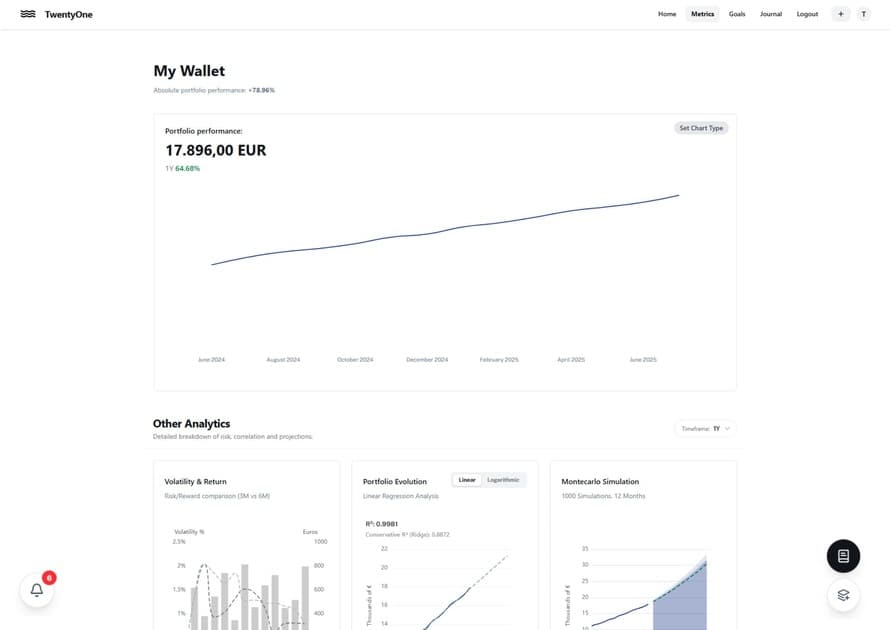
TwentyOne Portfolio
TwentyOne Portfolio is an advanced financial data analysis software designed for long-term investors to organize their wealth and investments. It provides SmartInsight™ analytics, offering instantaneous mathematical and statistical insights like CAGR, volatility, and Monte Carlo simulations. The platform emphasizes privacy with a non-custodial, 'Read-Only' approach, meaning it never connects to bank accounts or requests API keys; users manually input their balances. It features an AES-256 encrypted journal for documenting investment journeys and aims to replace complex, error-prone spreadsheets with automated wealth management. TwentyOne offers various plans, including a 3-month free trial without requiring a credit card.

Gurobi Optimizer
Gurobi Optimizer is a powerful optimization technology designed to tackle complex business challenges by translating them into mathematical models. It provides the indisputable, optimal solution, not just an approximation. The software scales to handle real-world models with millions of variables and constraints, offering agility to adapt plans quickly as new data emerges. Gurobi gives users control to model problems, explore 'what-if' scenarios, and make defensible decisions. It integrates easily with modern analytics and development environments, offering flexible APIs, including a widely used Python API, to build and deploy optimization models within applications and data pipelines. Gurobi is built on decades of optimization research by PhD mathematicians and experts, ensuring numerical stability and proven performance across various industries.
OpenNE
OpenNE is an open-source package designed for network embedding (NE) and serves as a comprehensive toolkit for network representation learning (NRL). It offers a standardized interface for both training and testing different NE models, ensuring scalability and flexibility. The package includes implementations of several typical NE models, such as DeepWalk, LINE, node2vec, GraRep, GCN, HOPE, GF, SDNE, and LE. A key feature is TADW, which allows for the incorporation of text attributes of nodes, enhancing the embedding process. OpenNE leverages TensorFlow, enabling GPU-accelerated training for improved performance. The toolkit also provides evaluation capabilities through node classification tasks, reporting Micro-F1, Macro-F1, and running time for various methods and datasets like Wiki and Cora.

Valence Labs
Valence Labs, powered by Recursion, functions as an AI research engine dedicated to accelerating the mission of decoding biology to radically improve lives. The platform utilizes Recursion’s extensive data generation capabilities, including over 60 petabytes of phenomics and transcriptomics data, alongside its BioHive supercomputer for massive computing power. Valence Labs focuses on predicting cellular responses to perturbations, explaining molecular interactions, and discovering novel therapeutic hypotheses through lab-in-the-loop engines. This approach aims to build 'virtual cells'—mechanistic models of cellular function—to guide the discovery of new therapeutics and improve drug discovery outcomes.
Teacher-free-Knowledge-Distillation
Teacher-free-Knowledge-Distillation provides an implementation for a novel approach to knowledge distillation, as detailed in a CVPR2020 Oral paper. This method, titled "Revisiting Knowledge Distillation via Label Smoothing Regularization," enables significant improvements in model accuracy without the need for a stronger teacher model or extensive computational resources. The framework supports "self-training" and "manually-designed regularization" strategies. For instance, it can enhance powerful student models like ResNeXt101-32x8d by 0.48% on ImageNet or ResNeXt29 by over 1.0% on CIFAR100. The repository includes code for environment setup, dataset handling (CIFAR100, CIFAR10, Tiny_ImageNet), training baseline models, and conducting exploratory experiments like Reversed KD and Defective KD, alongside the core Teacher-free KD implementations.
AI Energy Score Leaderboard
The AI Energy Score Leaderboard is a Hugging Face Space designed to provide insights into the energy efficiency of different AI models. Users can explore and compare models based on their energy consumption across a variety of tasks, including text generation and image classification. The platform allows for sorting and filtering models by energy consumption and parameters, making it a valuable resource for understanding the environmental impact of AI. It is built using Gradio and is licensed under Apache-2.0, indicating its open-source nature and potential for community contributions. This tool is particularly useful for researchers and developers interested in sustainable AI development.
Chinese Chess Recognition
Chinese Chess Recognition is an AI-powered tool hosted on Hugging Face Spaces that allows users to upload an image of a Chinese chessboard. The tool then processes the image to detect and recognize the type and position of each chess piece. It provides a step-by-step visual analysis, including an annotated table of the chessboard with all identified pieces. This functionality is particularly useful for analyzing Chinese chess games, studying positions, or converting physical board states into a digital format for further analysis or record-keeping. The tool is built with Gradio, making it accessible via a web interface.
Clustering With Sklearn
Clustering With Sklearn is an AI tool hosted on Hugging Face Spaces, designed to demonstrate various clustering algorithms available within the scikit-learn library. This tool provides an interactive platform for users to explore and visualize how different clustering techniques work. It is an invaluable educational resource for anyone looking to deepen their understanding of machine learning concepts, particularly in the domain of unsupervised learning. Data scientists, machine learning engineers, and students can utilize this space to experiment with algorithms, observe their behavior on datasets, and gain practical insights into data partitioning and pattern recognition. The tool aims to make complex clustering methodologies more accessible and understandable through practical application.
DePlot+LLM (multimodal chain-of-thought reasoning on plots)
DePlot+LLM is an AI tool hosted on Hugging Face Spaces, designed for multimodal chain-of-thought reasoning on plots. This application is built using Gradio, providing an interactive interface for users to experiment with its capabilities. It leverages advanced AI models to interpret and reason about information presented in plots, making it a valuable resource for data analysis and research. The tool is licensed under the MIT license, indicating its open and accessible nature for developers and researchers. While the live website currently shows a runtime error, its intended function is to provide a platform for exploring AI-driven plot reasoning.
Deep Spectral Segmentation
Deep Spectral Segmentation is an AI tool designed for advanced image segmentation and spectral analysis. This tool is particularly beneficial for researchers and data scientists who work extensively with image data, providing capabilities to process and analyze visual information with deep learning techniques. It can be effectively utilized for developing sophisticated image processing applications, offering a robust platform for tasks that require detailed spectral insights. The tool is available as a Hugging Face Space, making it accessible for experimentation and integration into various projects.
F1 Analysis - Tracing Insights
F1 Analysis - Tracing Insights is an AI-powered tool designed for Formula 1 enthusiasts and analysts. It offers comprehensive data-driven insights into F1 racing, including pre-race forecasts and detailed post-race analysis. The application presents all information through easy-to-read visuals, making complex data accessible. Users do not need to provide any input; simply opening the app provides immediate access to the insights. This tool is ideal for anyone looking to understand F1 performance and strategy better, leveraging AI to process and present racing data effectively.
Fathom DeepResearch
Fathom DeepResearch is an AI-powered tool designed to streamline the research process. Users can enter a text question, and the application automatically conducts web searches and utilizes various other tools to gather relevant information. The core functionality lies in its ability to synthesize this retrieved data and present a clear, concise answer, accompanied by a preview of the source material. This makes it particularly useful for quickly obtaining summarized information from diverse online sources, leveraging fathom search and synthesizer models for deep research capabilities. It is hosted on Hugging Face Spaces by Fractal AI Research.
Federated Learning with Substra
Federated Learning with Substra is an open-source platform designed for federated learning research and development. It facilitates secure data analysis and collaborative model training, allowing multiple parties to train a common model without sharing their raw data. The platform leverages technologies like Gradio for its interface and is licensed under GPL-3.0, promoting community contributions and transparency. While the current live website indicates a runtime error, the underlying purpose is to provide a robust environment for advancing federated learning techniques, which is crucial for privacy-preserving AI development.
Facial Expression Classifier
The Facial Expression Classifier is an AI tool designed to analyze facial images and determine the emotions and overall sentiment expressed. Users can upload a facial image, and the application will process it to identify different emotional states, such as happiness, sadness, anger, or surprise. For each detected emotion and sentiment category, the tool provides a probability score, offering a quantitative measure of the likelihood of that expression. This makes it a valuable resource for researchers, developers, and anyone interested in emotion recognition and sentiment analysis from visual data.
Facial Feature Detector
Facial Feature Detector is an AI-powered tool available as a Hugging Face Space that analyzes facial features from uploaded images. Users can upload up to two photos to receive detailed insights into various facial attributes, including age, gender, symmetry, proportions, and texture. The tool provides both predictive analyses and visual representations of these features. A key aspect of its design is privacy, as it explicitly states that it does not store any uploaded images. This makes it suitable for quick, on-demand facial analysis without concerns about data retention.
Florence-2 for Videos
Florence-2 for Videos is an AI tool designed for video analysis, leveraging the Florence-2 model to process video content. Users can upload a video, and the application will automatically generate a concise caption for the entire clip. Following this, it identifies and tracks the objects referenced in the generated caption, providing visual bounding boxes and labels around them. This functionality is particularly useful for tasks requiring automated video content understanding and object localization over time. It is available as a Hugging Face Space, making it accessible for experimentation and use.
GlobEnc
GlobEnc is an AI research tool hosted on Hugging Face Spaces, providing a platform for researchers and developers to explore and test AI models. While the live website indicates a configuration error, suggesting it may not be fully operational at the moment, its intended purpose aligns with academic research and development. The tool is suitable for tasks such as data analysis and algorithm testing, making it a valuable resource for educational demonstrations and experimental work within the AI community. Its presence on Hugging Face underscores its focus on collaborative and open-source AI development, catering to those who wish to engage with cutting-edge machine learning applications.
Compare Biomedical LLMs
Compare Biomedical LLMs is a tool hosted on Hugging Face designed for evaluating and analyzing the performance of various biomedical language models. This platform provides a centralized space for researchers and professionals in the biomedical field to assess the capabilities and limitations of different LLMs tailored for biological and medical applications. While the current live website indicates a runtime error, suggesting it may not be fully operational at this moment, its intended purpose is to facilitate comparative studies of these specialized AI models. This tool would be particularly useful for academic research, helping to inform decisions on which LLMs are best suited for specific biomedical tasks.
Prithvi 100M Sen1floods11
Prithvi 100M Sen1floods11 is a demonstration tool developed by IBM-NASA Geospatial, designed for analyzing flood data using artificial intelligence. Users can upload Sentinel-2 image files, which must contain all 12 spectral bands and be scaled by 10,000. The application then processes these images to return an original RGB picture alongside a black-and-white mask. In this mask, white areas indicate water, while black areas represent land. This tool is particularly useful for exploring geospatial data and testing AI models related to flood detection and environmental monitoring. It operates as a web application, making it accessible for various research and analytical purposes.
text-clustering
text-clustering is an open-source repository from Hugging Face designed to simplify the process of embedding, clustering, and semantically labeling text datasets. It offers a minimal yet robust codebase that can be adapted for various use cases, making it suitable for researchers and developers working with large text corpora. The tool's pipeline consists of several distinct, customizable blocks, ensuring flexibility and control over the text analysis process. It supports installation via pip and provides clear usage examples for running the pipeline, visualizing results, and performing inference on new texts. The repository also includes options for customizing plotting and integrating with Hugging Face datasets for visualization.
LookinGlassRGBD
LookinGlassRGBD is an AI tool designed for processing RGBD (Red, Green, Blue, Depth) images, facilitating advanced 3D scene understanding. It allows users to analyze depth information alongside color data, which is crucial for applications requiring precise spatial awareness. The tool is particularly beneficial for researchers and developers in the computer vision field, offering capabilities for tasks such as object recognition, environmental mapping, and robotic navigation. Hosted on Hugging Face Spaces, it leverages community-driven machine learning models, providing a platform for experimentation and development in 3D computer vision.