
Research & Education
Browsing page 311 of AI tools for Research & Education. Sorted by confidence score — our independent quality rating.
BugFree.ai
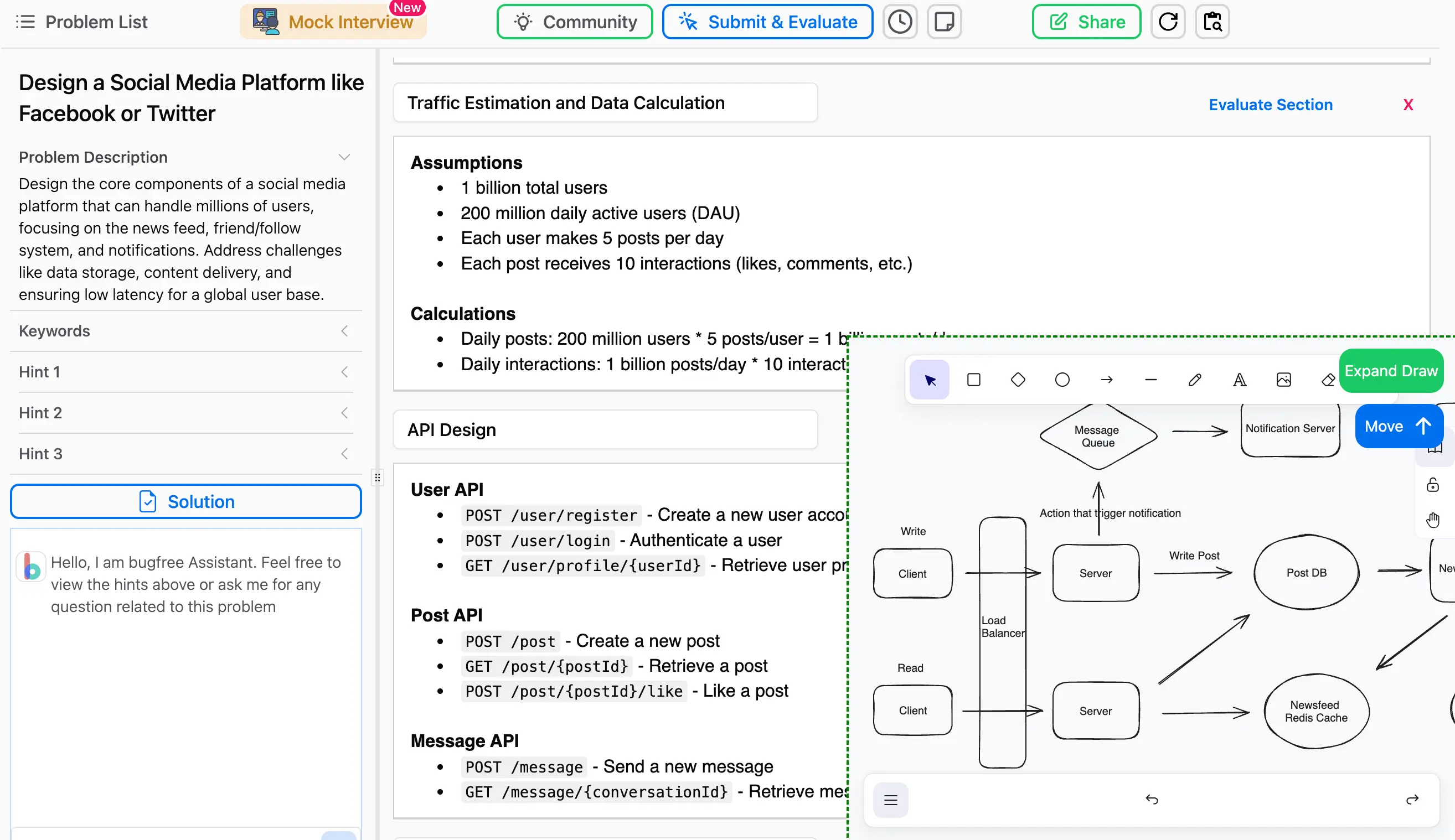
BugFree.ai is a comprehensive AI-powered platform designed to help software engineering job seekers excel in system design and behavioral interviews. The platform offers over 150 system design questions, 30+ behavioral questions, and 500+ data interview questions, complete with guided learning materials and solutions. Users can practice with AI-driven mock interviews that provide personalized feedback, similar to a Leetcode-style experience. It also features 3000+ real interview experiences from top tech companies like Google, Amazon, and Meta, allowing users to learn from others' successes. BugFree.ai aims to provide a one-stop shop for interview preparation, helping users build confidence and refine their answers for critical interview scenarios.

mapEDU
mapEDU is an AI-powered platform designed to automate curriculum mapping and analytics specifically for healthcare professions schools. It rapidly maps educational content like lectures, handouts, and assessments to learning objectives, providing objective insights to identify curricular gaps and redundancies. The tool streamlines accreditation reporting and helps validate curriculum revisions, ultimately aiming to improve student outcomes. It integrates with existing Learning Management Systems (LMS) and supports various file formats, offering features like automated content mapping, assessment mapping, and national benchmarking reports. mapEDU significantly reduces the manual effort and time traditionally associated with curriculum mapping, offering instant insights and continuous improvement capabilities.
deepmd-kit
DeePMD-kit is a Python/C++ package designed to facilitate the creation of deep learning-based models for interatomic potential energy and force fields, and to perform molecular dynamics simulations. It addresses the accuracy-versus-efficiency dilemma in molecular simulations by leveraging deep learning. The package is highly modularized and interfaces with popular deep learning frameworks like TensorFlow, PyTorch, JAX, and Paddle, as well as high-performance classical and quantum MD packages such as LAMMPS, i-PI, and GROMACS. It implements the Deep Potential series models, which have been successfully applied to various systems, including organic molecules, metals, and semiconductors. DeePMD-kit also supports MPI and GPU for efficient parallel and distributed computing, making it suitable for complex scientific research.
mini-sglang
Mini-SGLang is a compact and high-performance inference framework specifically designed for Large Language Models (LLMs). It serves as a lightweight implementation of SGLang, aiming to simplify the complexities of modern LLM serving systems. With a codebase of approximately 5,000 lines of Python, it functions as both a capable inference engine and a transparent reference for researchers and developers. Key features include advanced optimizations such as Radix Cache for KV cache reuse, Chunked Prefill to reduce peak memory usage, Overlap Scheduling to hide CPU overhead, Tensor Parallelism for multi-GPU scaling, and optimized kernels like FlashAttention and FlashInfer for maximum efficiency. It supports online serving with an OpenAI-compatible API and an interactive shell mode for direct model interaction.

StudyMonkey
StudyMonkey is an AI-powered tutoring platform designed to help students master any subject with personalized support. It offers 24/7 homework assistance, providing step-by-step solutions and AI-powered tutoring across a wide range of academic disciplines, including Math, Science, Language, History, and Computer Science. The platform aims to make learning accessible and efficient by offering on-demand help for complex concepts, problem-solving, and essay writing. StudyMonkey supports various educational levels, from elementary school to college and even professional exams like the BAR and CFA, making it a versatile tool for diverse learning needs.
MM-EUREKA
MM-EUREKA is a cutting-edge project exploring the frontiers of multimodal reasoning through rule-based reinforcement learning. It introduces powerful models such as MM-Eureka-Qwen-7B and MM-Eureka-Qwen-32B, which significantly advance performance in multidisciplinary K12 and mathematical reasoning tasks. The project has iterated on model architecture, algorithms, and data, moving from InternVL to the more robust Qwen2.5-VL base models. Key improvements include enhanced online filtering, adaptive online rollout adjustment (ADORA), and novel RL algorithms like Clipped Policy Gradient Optimization with Policy Drift (CPGD). MM-EUREKA also open-sources a comprehensive pipeline, including self-collected MMK12 datasets, to foster further research and development in multimodal AI.

DreamDiscover: Interpretation
DreamDiscover is an ultimate dream interpretation and journaling application that leverages advanced AI technology to serve as a personal dream dictionary and analyzer. Users can get detailed dream analysis in approximately 3 seconds, helping them understand the hidden meanings and symbols within their dreams. The app also features a dream journal, allowing users to keep a record of their dreams and see patterns in their waking life, with every journal entry being analyzed by AI. DreamDiscover aims to provide insights and answer further questions about dreams, making self-discovery accessible and engaging.
ClipBERT
ClipBERT is an official PyTorch code implementation for an efficient framework designed for end-to-end learning across image-text and video-text tasks. Recognized with a CVPR 2021 Best Student Paper Honorable Mention, ClipBERT processes raw videos/images and text inputs to generate task predictions. It leverages 2D CNNs and transformers, incorporating a sparse sampling strategy to enable efficient multimodal learning. The framework supports end-to-end pretraining and finetuning for tasks such as image-text pretraining on COCO and VG captions, text-to-video retrieval on MSRVTT, DiDeMo, and ActivityNet Captions, video-QA on TGIF-QA and MSRVTT-QA, and image-QA on VQA 2.0. Its modular design allows for easy integration of additional image-text or video-text tasks.
breast_cancer_classifier
breast_cancer_classifier is an open-source deep learning model designed to assist radiologists in breast cancer screening. It utilizes deep neural networks to analyze mammography images, offering both an image-only model and an image-and-heatmaps model for classification. The tool processes four standard mammography views (L-CC, R-CC, L-MLO, R-MLO) and outputs probabilities of benign and malignant findings for each breast. While the provided model is from 2019 and not clinically used at NYU Langone Health, it serves as a foundational implementation for researchers and developers interested in breast cancer classification using AI.
Stellon Labs
Stellon Labs is an AI research lab dedicated to developing powerful, tiny AI models specifically optimized for edge applications. Their focus is on creating 'frontier AI' solutions that can operate efficiently on minimal hardware, making advanced artificial intelligence accessible for devices with limited computational resources. The lab aims to push the boundaries of AI performance in constrained environments, enabling new possibilities for on-device intelligence without requiring extensive infrastructure. Their work is geared towards practical applications where low-power and small-footprint AI is crucial.
MindHalo
MindHalo is an intelligent study companion exclusively for macOS, designed to help students master their textbooks using local AI. Users can upload PDF textbooks and other documents, transforming them into an intelligent, searchable study database. The AI tutor provides answers grounded in the user's materials, citing specific pages for accuracy. It also generates study guides, flashcards, and practice quizzes from any chapter with a single click. MindHalo operates 100% locally on Apple Silicon Macs, ensuring privacy and fast performance without cloud dependency or data fees. It offers a gamified learning experience with coins and streaks, and is free to start with an optional Pro upgrade for unlimited access.
Morningscore
Morningscore is a comprehensive SEO and GEO tool designed to boost website traffic from Google and ChatGPT. It features an intuitive design, making complex SEO tasks accessible. The platform includes a rank tracker, backlink checker, keyword research tools, and competitor analysis to optimize online visibility. Users can also benefit from SEO missions, a website health scan, and AI SEO capabilities for automation. Morningscore offers various plans with different keyword tracking, website, user, and AI credit allowances, catering to a range of business needs.
TensorFlow-VAE-GAN-DRAW
TensorFlow-VAE-GAN-DRAW is an open-source collection of generative methods implemented using TensorFlow. This repository offers implementations of Deep Convolutional Generative Adversarial Networks (DCGAN), Variational Autoencoders (VAE), and DRAW: A Recurrent Neural Network For Image Generation. It allows users to experiment with and run these different generative models, providing a foundation for research and development in image generation. The project highlights that DCGANs produce decent results after 10 epochs with default parameters and outlines future enhancements like more complex data integration and replacing the current attention mechanism with a Spatial Transformer Layer.
torchscale
torchscale is a PyTorch library specifically engineered to facilitate the scaling of Transformer models, which are fundamental to modern large language models. It emphasizes key aspects such as modeling generality and capability, ensuring that the models can be applied across a wide range of tasks and perform robustly. The library also prioritizes training stability and efficiency, crucial for developing and managing large-scale foundation models. By providing tools and frameworks within the PyTorch ecosystem, torchscale aims to empower researchers and developers to build, train, and deploy increasingly complex and powerful AI models more effectively.
Lateron.email
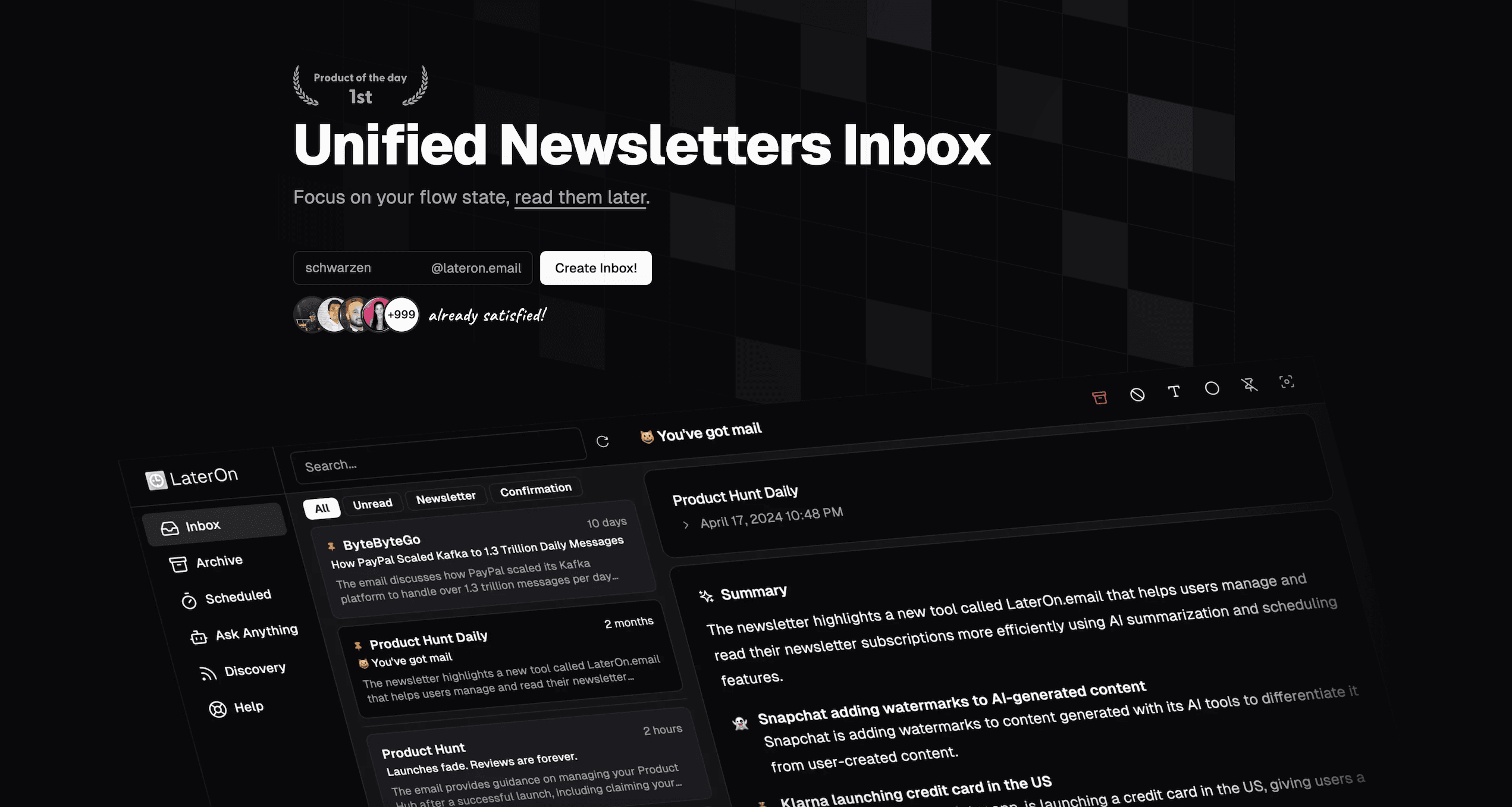
Lateron.email acts as an inbox buffer for newsletter subscriptions, designed to help users manage and prioritize their incoming content. It aggregates newsletters and offers AI summarization, allowing users to quickly grasp the main points without having to read every email in full. The tool aims to reduce inbox overload by scheduling when summarized content is delivered, ensuring users stay inspired and informed without constant interruptions. It's ideal for anyone looking to declutter their email and maintain productivity by streamlining their newsletter consumption.
Socratic (acquired by Google)
Socratic, now integrated into Google Lens, is an AI-powered tool that transforms your phone's camera into a powerful search engine. It allows users to identify objects, translate text in real-time across over 100 languages, and even get step-by-step homework help for subjects like math, history, chemistry, biology, and physics. Beyond academic assistance, Google Lens can help identify plants and animals, and find similar clothing or home decor items from images. It's available across various Google apps and devices, including the Google app, Google Camera, Google Photos, and Chrome, making visual search and information retrieval seamless and accessible.
Calcish
Calcish is a versatile macOS application that integrates a programmable calculator, an enhanced JavaScript engine, AI capabilities, and an intuitive notebook into a single tool. It allows users to instantly solve complex math problems, work with big numbers, fractions, vectors, and matrices, and perform advanced scientific computing. The enhanced JavaScript engine, powered by QuickJS, supports arbitrary-precision integers and decimals, going beyond typical browser console limitations. Users can organize calculations, code, and AI chats in editable notebooks, with rich output and easy export options. AI integration supports both local and remote models for brainstorming, code generation, and data analysis, all accessible via a global hotkey for quick access.
Transformer-TTS
Transformer-TTS is a PyTorch implementation of the "Neural Speech Synthesis with Transformer Network," designed for efficient and high-quality speech synthesis. This model boasts training speeds 3 to 4 times faster than well-known seq2seq models such as Tacotron, while maintaining comparable synthesized speech quality. It utilizes a post-network based on the CBHG model from Tacotron and converts spectrograms into raw audio waves using the Griffin-Lim algorithm. The project includes detailed instructions for data preparation, training the autoregressive attention network and post-network, and generating TTS samples, making it a valuable resource for researchers and developers in speech synthesis.
QuizCanvasAi
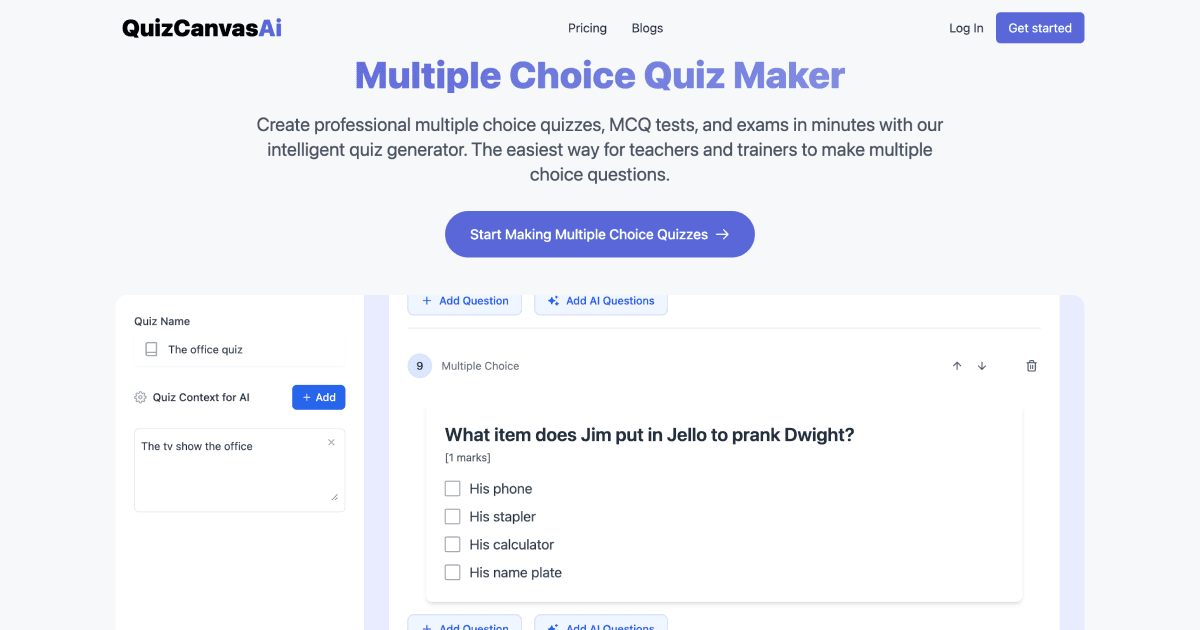
QuizCanvasAi, also known as QuizoVerse, is an AI-driven quiz maker designed to streamline the creation of multiple-choice tests for various educational and training purposes. It leverages advanced AI to generate high-quality questions and plausible answer options from user-provided content, saving significant time compared to manual question writing. The platform supports both live quiz competitions and self-paced assessments, making it versatile for classroom activities, homework, or corporate training. Users can customize quizzes with flexible scoring, including partial credit for multiple correct answers, and track performance through detailed analytics and leaderboards. Quizzes can be easily exported as professional PDF documents or shared via direct links, enhancing flexibility for printing or online distribution.
Meiro
Meiro is an AI-powered platform designed for quickly building interactive quizzes and tests. Users can create engaging content from a prompt, existing text, files, links, or videos, and enhance it with integrated AI image generation. The platform offers extensive customization options, including white-labeling, and provides real-time analytics to measure lead generation and overall challenge success. Meiro supports various question types like single choice, multiple choice, picture choice, and fill-in-the-gaps, along with fully-equipped lead forms. It's suitable for marketing, HR, education, and content creation, offering unlimited challenges, views, and completions across all plans.
Clore AI
Clore AI offers a decentralized GPU cloud marketplace, enabling users to rent powerful GPUs for various high-performance computing tasks such, as AI training, inference, and 3D rendering. The platform supports flexible payment options, including Bitcoin and CLORE tokens, with per-minute billing. It features a robust API for seamless integration, extensive developer documentation, and secure data storage solutions. Clore AI is optimized for AI, rendering, and scientific simulations, providing unmatched scalability and speed. Users can choose from a wide variety of CPUs, GPUs, and memory configurations, with over 20,000 GPUs available. The platform also includes a Proof of Holding (POH) system, rewarding users for holding CLORE tokens with increased rewards and service discounts.
Scholarcy
Scholarcy is an AI-powered research assistant designed to simplify academic research by transforming complex texts into concise, interactive summary flashcards. It allows users to summarize any paper, article, textbook, or even videos, highlighting key information and enabling quick comprehension. The tool offers features like enhanced summaries, spotlighting key findings, and critical analysis tools to evaluate research quality. Users can organize their knowledge by saving flashcards to a personal library, adding notes, and exploring related concepts. Scholarcy also supports synthesizing insights by exporting summaries to various formats compatible with research and productivity apps like Zotero, Notion, and Excel, and can generate one-click bibliographies.
Archive Intel
Archive Intel is an AI-powered platform designed for financial firms to ensure compliance with SEC and FINRA regulations. It offers two core solutions: AI Communications Archiving and AI Marketing Review. The communications archiving solution automatically captures and archives all digital client communications, including text (iMessage, Android SMS, WhatsApp), email, chat (Slack, Teams, Zoom, Bloomberg), social media (LinkedIn, YouTube, X/Twitter, Meta), and web content. This system reduces manual compliance workload by up to 95% and cuts false positives by 99%. A key differentiator is its ability to archive text messages from personal phones without requiring additional apps or devices, supporting BYOD policies. The AI Marketing Review solution simplifies content compliance by scanning documents for high-risk terms and providing compliant suggestions, streamlining approval workflows and ensuring audit readiness. Archive Intel offers instant reporting, full audit trails, and customizable pricing based on users and connectors, with no hidden export fees.

FirePrep.chat
FirePrep.chat is an AI-powered training platform specifically designed by firefighters for firefighters and first responders. It leverages advanced AI to deliver efficient and flexible training solutions, helping users enhance their skills and readiness for various professional demands. The platform provides access to essential resources and simulations, available anytime and anywhere. Users can prepare for exams, recertification, and advanced training modules. A key differentiator is the ability for Pro Level members to upload their own materials, enabling the creation of custom quizzes with unlimited credits, making it a highly personalized and adaptable learning tool for the fire service community.