
Research & Education
Browsing page 312 of AI tools for Research & Education. Sorted by confidence score — our independent quality rating.

Lingostar
Lingostar is an AI-powered language learning platform designed to help users improve their speaking skills and build confidence through natural interactions. The platform offers personalized study plans tailored to individual learning needs, focusing on practical conversation practice. Users can engage with an AI conversation partner to practice English, Spanish, and French, receiving feedback to enhance pronunciation and fluency. This tool aims to create an immersive and supportive environment for language acquisition, making it easier for learners to overcome speaking barriers and achieve their language goals.
ClipBERT
ClipBERT is an official PyTorch code implementation for an efficient framework designed for end-to-end learning across image-text and video-text tasks. Recognized with a CVPR 2021 Best Student Paper Honorable Mention, ClipBERT processes raw videos/images and text inputs to generate task predictions. It leverages 2D CNNs and transformers, incorporating a sparse sampling strategy to enable efficient multimodal learning. The framework supports end-to-end pretraining and finetuning for tasks such as image-text pretraining on COCO and VG captions, text-to-video retrieval on MSRVTT, DiDeMo, and ActivityNet Captions, video-QA on TGIF-QA and MSRVTT-QA, and image-QA on VQA 2.0. Its modular design allows for easy integration of additional image-text or video-text tasks.

Repetico - Study flashcards
Repetico is a comprehensive flashcard application designed to help users efficiently learn and retain large amounts of information. It leverages scientifically-backed learning algorithms, including Leitner and SuperMemo 2, to optimize study sessions and adapt to individual learning needs. Users can create their own flashcards or multiple-choice questions, with the added benefit of AI tools to convert documents like PDFs or DOCX files into flashcards, or generate them from a given topic. The platform supports collaborative learning through study groups, allowing users to share card sets and track friends' activities. Repetico is available online and via mobile apps for iOS and Android, ensuring study material and progress are synchronized across devices.
EmojiIntelligence
EmojiIntelligence is an open-source project showcasing a neural network implemented entirely in Swift within Apple Playground. Designed to make machine learning and neural networks more accessible and fun, this tool allows users to experiment with teaching a machine to recognize emojis. The network features an input layer of 64 binary numbers derived from an 8x8 pixel image, a hidden layer, and an output layer, all fully-connected with weighted connections and a sigmoid activation function. It's an excellent resource for students and developers looking to understand the fundamentals of neural networks and machine learning through a practical, interactive example on macOS.
WritingTools
WritingTools is an Apple Intelligence-inspired application designed to supercharge writing across Windows, Linux, and macOS. It functions as a system-wide grammar assistant, allowing users to proofread, rewrite, and optimize text with AI using a single hotkey. Beyond basic grammar, it can summarize webpages, YouTube videos, and documents, and even chat with the summaries. The tool supports various LLMs, including the free Gemini API and a wide range of local LLMs via Ollama, offering greater intelligence than Apple's Writing Tools or Grammarly Premium. It is completely free, open-source, privacy-focused, and supports multiple languages and custom commands, making it a versatile and powerful writing companion.

Feynman Nurse AI
Feynman Nurse AI is an AI-powered study companion specifically designed for nursing students, available on Android and web, with iOS coming soon. It streamlines the study process by allowing users to record lectures, import PDFs, and even capture content from YouTube or TikTok links. The AI then instantly generates flashcards, practice quizzes, and organized notes tailored to nursing classes like Pharmacology, Med-Surg, and Pathophysiology. A key differentiator is its "Feynman Mode," which challenges students to explain concepts back to an AI mascot, ensuring deep understanding rather than rote memorization. The tool also includes over 150 pharmacology drug cards with spaced repetition and NCLEX-style quizzes, covering the entire nursing journey from fundamentals to NCLEX preparation. It aims to consolidate scattered study tools into one platform, offering a free-to-start model.
SwiftGPT
SwiftGPT is a native macOS application designed to enhance the ChatGPT experience for Mac users. It provides a fast and seamless interface for interacting with OpenAI's conversational AI, streamlining workflows and improving productivity. Key features include the ability to use your own OpenAI API key, maintain a history of conversations, and track associated costs. The app also supports dark mode and offers a familiar, native chat UI, making it feel like a natural extension of other macOS applications. SwiftGPT aims to elevate your ChatGPT game by providing a robust and customizable environment for your AI interactions.
Federated-Learning-PyTorch
Federated-Learning-PyTorch provides an open-source implementation of the vanilla federated learning paradigm, as described in the paper 'Communication-Efficient Learning of Deep Networks from Decentralized Data'. This tool is built using PyTorch and allows researchers and developers to conduct experiments on popular datasets such as MNIST, Fashion MNIST, and CIFAR10. It supports both independent and identically distributed (IID) and non-IID data distributions, with options for equal or unequal data splits among users. The implementation focuses on simple models like MLP and CNN to illustrate the effectiveness of federated learning, making it a valuable resource for understanding and experimenting with this distributed machine learning approach.
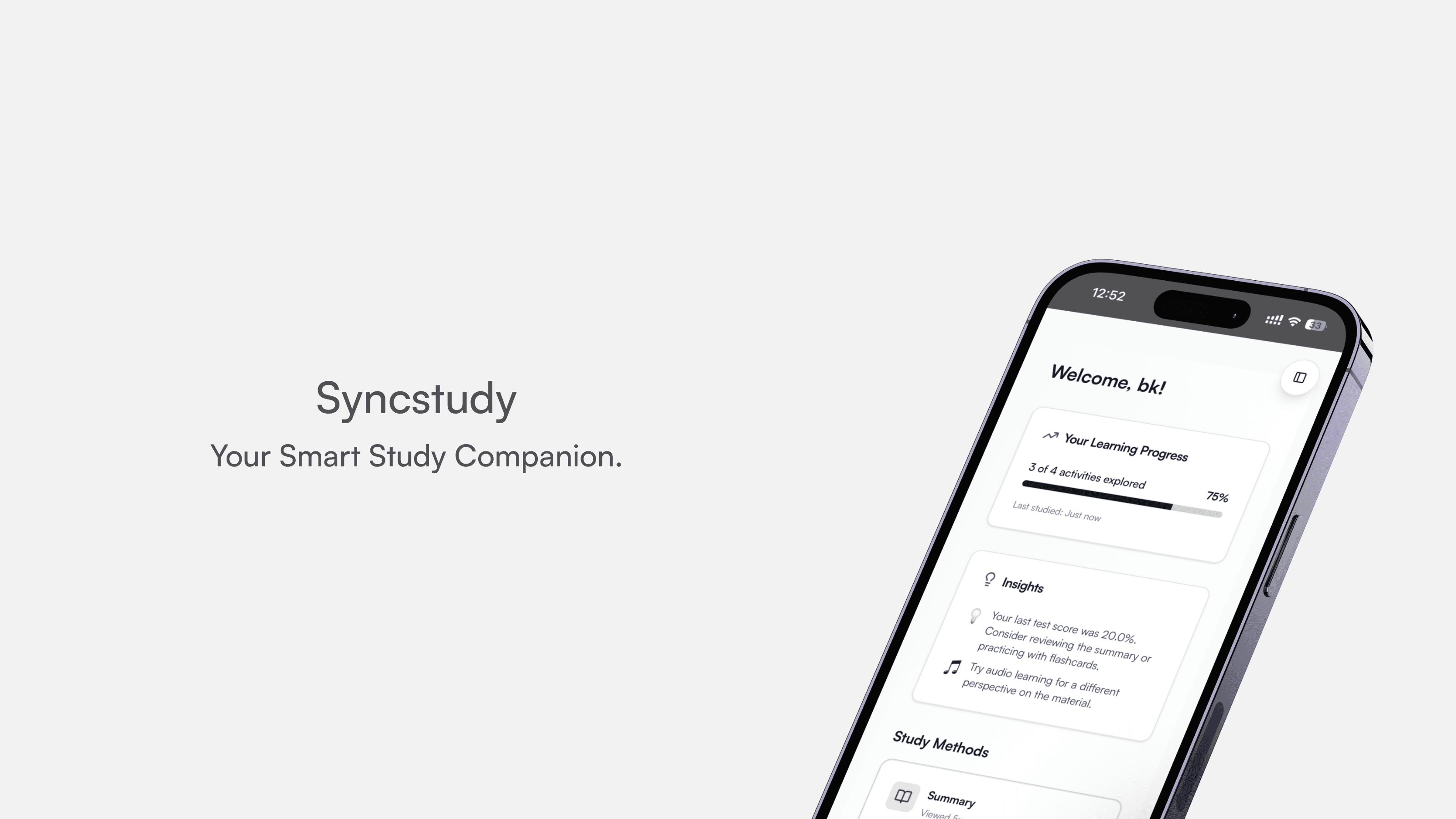
SyncStudy
SyncStudy is an AI-powered study platform designed to transform your learning experience. Users can upload various materials such as PDFs, YouTube lectures, links, notes, and slides, which SyncStudy then processes to generate structured lessons, adaptive flashcards, and personalized quizzes. A key feature is the personal AI tutor, which adapts to individual learning styles based on a quick assessment, providing tailored explanations and assistance. The platform incorporates spaced repetition (SM-2 scheduling) for flashcards and adjusts quiz difficulty dynamically, explaining wrong answers. It allows for continuous material uploads, making the study space smarter over time, and offers an AI tutor for each study space to answer questions and work through problems within the context of the uploaded content.
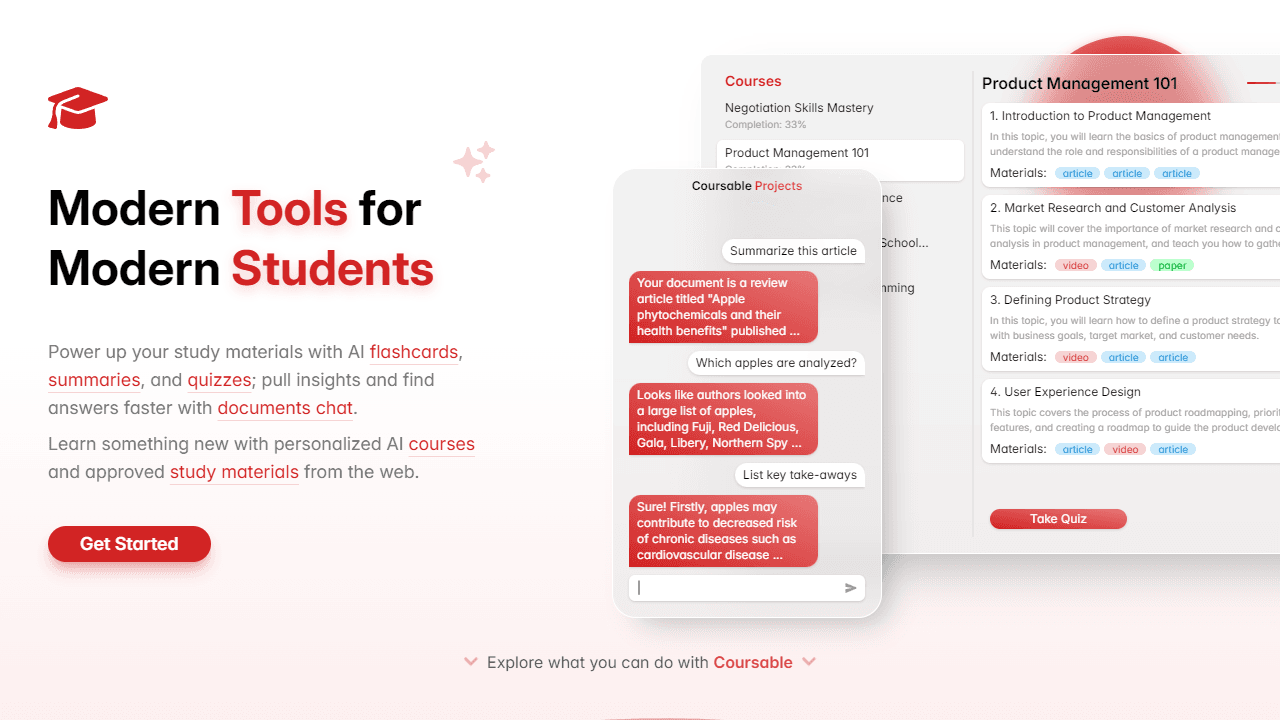
Coursable.io
Coursable.io is an AI-powered student workspace designed to significantly enhance learning efficiency. The platform provides a comprehensive suite of tools to power up study materials, including the ability to generate AI flashcards, summaries, and quizzes. Users can also leverage a document chat feature to pull insights and find answers faster from their study documents. Beyond existing materials, Coursable.io enables users to learn something new with personalized AI courses and access approved study materials from the web, making it a versatile tool for various learning needs. It aims to streamline the study process and provide a more interactive and effective learning experience for students.
summarize.site
summarize.site is a browser extension designed to efficiently summarize web page content using OpenAI ChatGPT. Available for Chrome and Edge, this tool helps users quickly grasp the main points of articles and web content, making reading and research more efficient. It allows for local installation or building from source, offering flexibility for users. The extension also provides options to customize the summary prompt, including configurations for different languages like Chinese, enabling users to tailor the output to their specific needs, such as brevity, outline form, or translation. This makes it a versatile tool for anyone looking to condense information quickly.
AI-Resume-Analyzer
AI-Resume-Analyzer is an open-source tool designed to assist job applicants and recruiters by parsing resume information using natural language processing. It extracts keywords, clusters them into relevant sectors, and offers recommendations, predictions, and analytics based on keyword matching. The tool can structure resume data into tabular formats and CSV for organizational analytics. It also provides applicants with insights to improve their resumes, including predicted job roles, course recommendations, and an overall score. For administrators, it offers features like viewing applicant data, downloading CSVs, and analyzing user feedback and ratings through pie charts.

Sakura - Chat with AI Bots
Sakura AI provides a platform for users to chat with a diverse range of AI characters, offering engaging conversations and roleplay experiences. The tool allows for exploration of popular AI bots, categorized by tags such as Male, Female, Anime, Movies & TV, Yandere, and Tsundere. Users can also create their own AI characters, defining their appearance, personality, and evolving them over time. The platform fosters immersive interactive experiences through user-generated AI companions and various role-playing scenarios, encouraging imagination and creativity in AI-powered interactions.

Olovka AI Essay Writer
Olovka AI Essay Writer is an advanced AI tool specifically designed for students to streamline academic writing and enhance learning. Powered by OpenAI, it assists in writing perfect essays, conducting detailed research, and transforming written content into interactive quizzes. The platform features an advanced text editor that guides users with targeted suggestions, enabling them to write essays significantly faster. Olovka supports various academic papers including reflective journals, thesis papers, research papers, literature reviews, case studies, and project reports. It also allows users to chat with the AI writer for instant insights and explanations, helping to overcome writer's block and streamline the research process. The tool is developed with students from leading universities and is designed to assist, not replace, the writing process, making it undetectable by academic institutions.
Notaty - smart voice notes
Notaty is a smart voice note application designed to help users efficiently capture and organize their thoughts. It transforms spoken words into structured notes, making it easier to manage information. The app focuses on effortless thought capture, organization, and retrieval, allowing users to concentrate on their ideas rather than the mechanics of note-taking. This tool is ideal for anyone who needs to quickly record information, whether it's during meetings, lectures, or when an idea strikes, and then easily access and manage those notes later.

TikClass
TikClass is a no-code gamification layer designed to transform passive online learners into engaged students. It integrates seamlessly with popular learning management systems such as Thinkific, Kajabi, and Teachable. Course creators can easily add interactive elements like daily streaks, competitive leaderboards, and custom badges to their courses, fostering an addictive learning habit. This tool aims to boost student retention and completion rates by making the learning experience more dynamic and rewarding, ultimately helping creators capture and maintain their students' attention.

Camu – Unified Digital Campus Platform
Camu is a comprehensive cloud-based Student Information System (SIS) designed for schools, colleges, and universities. It streamlines the entire student lifecycle from admissions to graduation by automating key processes such as admissions, academic governance, student administration, and campus facilities management. The platform offers features like online admissions, assessment and exam management with Outcome-Based Education (OBE) support, secure student and staff record keeping, and a flexible fee management system. Camu also centralizes and automates academic and non-academic student services, provides real-time dashboards and analytics for data-driven decision-making, and supports multi-campus institutions. It integrates seamlessly with LMS platforms, finance systems, and payment gateways.

Complexio
Complexio offers an intelligence layer designed for enterprise AI, connecting an organization's data, people, and systems into a unified operational view. It builds a live map of how work happens, called the Event Knowledge Graph (EKG), providing real-time insights. The Context Broker links this EKG to existing systems and teams, ensuring all insights and actions are grounded in a shared understanding of operational reality. Users can ask questions in natural language through Stevie and receive answers based on their real operations. Additionally, the Automated Automations Engine (AAE) identifies patterns and orchestrates executable workflows, turning observations into automated actions with traceability and control.
.webp&w=3840&q=75)
Quench AI
Ollo, formerly known as Quench AI, functions as an AI operating system designed for mid-market companies. It integrates with existing company tools like Slack, Notion, and Google Drive to deliver accurate, context-aware responses and automate workflows. The platform addresses common AI challenges by providing solutions that understand unique company data, policies, and processes, moving beyond generic internet responses. Key features include deep secure search with organizational context, agentic workflow orchestration, and robust security measures like SOC II and ISO27001 certifications. Ollo aims to reduce the time spent searching for information and streamline operations without requiring massive IT overhead.
multiagent-competition
multiagent-competition offers the foundational code for environments detailed in the paper "Emergent Complexity via Multi-agent Competition." This tool is designed for researchers and academics focusing on multi-agent reinforcement learning, providing a platform to simulate and study emergent behaviors in competitive scenarios. It includes agent policies for various environments such as run-to-goal, you-shall-not-pass, sumo, and kick-and-defend tasks. The repository, though archived and read-only, serves as a valuable resource for understanding and replicating the experiments described in the associated paper, allowing for in-depth analysis of complex interactions between AI agents.

Quizwhiz
Quizwhiz is an AI-powered platform designed to help students and teachers generate comprehensive practice quizzes from various sources like lecture notes, PDFs, text, or URLs in seconds. It supports five question types: Multiple Choice, True/False, Fill-in-the-Blanks, Short Answer, and Scenario-based. The platform provides instant feedback, tracks skill mastery over time, and offers features like Focused Quizzes to target weak areas and Level Up Quizzes for higher-order thinking. Users can set learning goals, receive personalized study plans, and interact with an AI coach for guidance. Quizwhiz also supports math, science, and over 50 languages, making it a versatile tool for diverse academic needs.
Pose-Transfer
Pose-Transfer is an open-source project providing the code for person image generation, implementing the Progressive Pose Attention method detailed in a CVPR19 paper. This tool allows users to transfer poses from one image to another, and also supports generating videos from a single input image. It offers functionalities for data preparation, including dataset splitting and keypoint annotation for datasets like Market1501 and DeepFashion. Users can train and test models, and evaluate performance using metrics such as SSIM, IS, DS, and PCKh. The project is built on PyTorch and provides pre-trained models for convenience.
GraphGPT
GraphGPT is a research framework presented in a SIGIR'24 full paper, focusing on Graph Instruction Tuning for Large Language Models. It enhances LLMs' understanding of graph structural information by aligning graph encoding with natural language space through a text-graph grounding paradigm. The framework employs a dual-stage graph instruction tuning process to adapt language models for graph learning tasks and incorporates Chain-of-Thought (CoT) Distillation to improve reasoning and accuracy, especially with diverse graph data. The repository offers code, data, and model weights, including efficient training scripts for two Nvidia 3090 GPUs, making it a valuable resource for researchers in the field.
lmm-r1
LMM-R1 is an open-source project designed to enhance the reasoning capabilities of 3B Large Multimodal Models (LMMs) by extending the OpenRLHF framework. It addresses the challenges of limited parameter capacity and scarce high-quality multimodal reasoning data through a novel two-stage rule-based RL approach. The first stage, Foundational Reasoning Enhancement (FRE), builds strong reasoning foundations using text-only data. The second stage, Multimodal Generalization Training (MGT), extends these capabilities to multimodal domains. LMM-R1 supports various LMMs like Qwen2.5-VL, Phi3.5-V, and Phi4-Multimodal, and offers distributed PPO and REINFORCE++/RLOO implementations based on Ray, achieving significant speedups. It also integrates with vLLM for accelerated generation, FlashAttention2, and supports QLoRA/LoRA for efficient fine-tuning.