
Research & Education
Browsing page 347 of AI tools for Research & Education. Sorted by confidence score — our independent quality rating.

devops-ai-guidelines
devops-ai-guidelines is a comprehensive resource designed to guide DevOps engineers through their AI journey, from initial AI tool usage to becoming an AI Infrastructure Architect. The repository offers structured learning paths, practical tips, and enterprise guidelines for implementing AI safely and effectively within teams and organizations. It covers a wide range of topics including building MCP servers with Golang and Kubernetes, creating AI agents with LangChain, and leveraging AI for AWS infrastructure management and project management. The resource also includes strategies for career acceleration, interview preparation, and daily productivity tips, making it a valuable asset for individuals and teams looking to integrate AI into their DevOps practices.
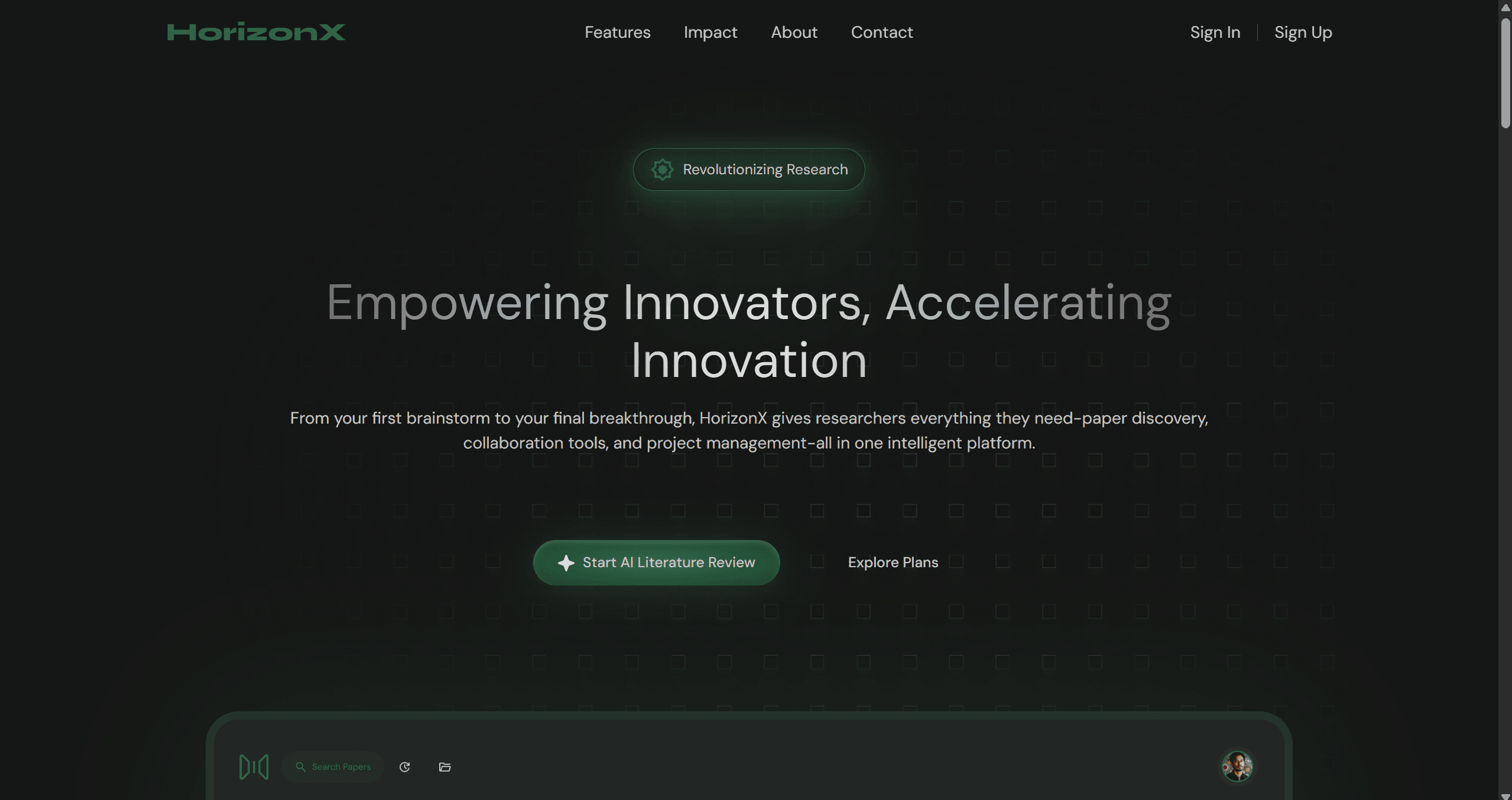
HorizonX
HorizonX is an AI-native research workspace designed for ML engineers and researchers, offering a comprehensive platform to streamline the research process. It provides access to over 300 million research papers, ensuring zero hallucinations with verified citations. The tool features agentic brainstorming, allowing users to ask questions and receive structured, cited answers grounded in real research. Its literature review capability pinpoints relevant papers, while the 'Chat with PDF' function enables conversational interaction with single or multiple documents. HorizonX also includes an integrated writing canvas that provides full context from research, along with inline AI editing tools to sharpen, formalize, or restructure text without switching tabs. This end-to-end solution aims to accelerate research from question to published-grade work.
audio-ai-timeline
audio-ai-timeline is an open-source GitHub repository that serves as a comprehensive timeline of the latest AI models specifically designed for waveform-based audio generation. Starting its tracking from 2023, this resource meticulously lists various models, including their release dates, links to research papers (arXiv), code repositories (GitHub), and sometimes even trained models or sample outputs. It's an invaluable tool for researchers, developers, and enthusiasts who need to stay updated on the rapid advancements in AI audio generation, offering a centralized hub for exploring new techniques and models in the field.
ML_for_Hackers
ML_for_Hackers is a GitHub repository that hosts all the code examples accompanying the book "Machine Learning for Hackers" (2012). This resource is designed for individuals looking to gain practical experience with machine learning algorithms. The repository includes code for various topics such as Introduction, Exploration, Classification, Ranking, Regression, Regularization, Optimization, PCA, MDS, Recommendations, SNA, and Model Comparison. Users can get started by installing necessary R libraries, including RCurl and XML, using the provided `package_installer.R` script. While the code may have minor modifications since publication, it remains a valuable tool for learning and applying machine learning techniques.
mlbook
mlbook is a free online book titled "Machine Learning from Scratch" available as a GitHub repository. This resource offers a comprehensive guide to understanding machine learning concepts and algorithms, making it accessible for self-study. The repository includes the full book content, a PDF version, and encourages community contributions through pull requests to the gh-pages branch. It's an excellent resource for individuals looking to delve into machine learning fundamentals, providing both theoretical knowledge and practical insights through its open-source nature and Jupyter Notebook content.
machine-learning-open-source
Machine-learning-open-source is a GitHub repository that provides a monthly curated list of the top 10 open-source machine learning projects. Mybridge AI, which ranks articles by shares, minutes read, and its own machine learning algorithm, selects these projects. Each month, 100 to 300 new or major release open-source projects in Machine Learning are compared, with only the 10 finest being picked. Users can subscribe to email notifications for new releases by starring or watching the repository. The project also publishes similar monthly lists for other categories like JavaScript, Python, and Web Development, alongside annual compilations of amazing open-source projects.
machine-learning-specialization-andrew-ng
Machine-learning-specialization-andrew-ng is a comprehensive repository offering notes and practical implementations of machine learning algorithms, directly aligned with Andrew Ng's renowned machine learning specialization. This resource is structured around three core courses: Supervised Machine Learning (Regression and Classification), Advanced Learning Algorithms, and Unsupervised Learning, Recommenders, and Reinforcement Learning. It includes programming assignments completed using Jupyter Notebooks and Python, with clearly marked code sections for easy modification. The repository also provides detailed notes, high-level overviews, practical tips, and mathematical concept walkthroughs, making it an invaluable study aid for anyone delving into machine learning.
machine-learning-visualized
Machine-learning-visualized is an open-source project offering a Jupyter Book filled with Jupyter Notebooks. These notebooks meticulously implement and mathematically derive various machine learning algorithms from first principles, making complex concepts accessible. A key feature includes Interactive Notebooks built with Marimo, allowing users to dynamically observe how weight adjustments impact loss functions. Each notebook's output visualizes the machine learning algorithm's training phase, demonstrating its convergence to optimal weights. The project is structured such that this repository configures and builds the Jupyter Book, while individual machine learning algorithms reside in separate GitHub repositories, which are downloaded via a provided script.
mcp-for-beginners
This open-source curriculum, `mcp-for-beginners`, introduces the core concepts of Model Context Protocol (MCP) using practical, cross-language examples in .NET, Java, TypeScript, JavaScript, Rust, and Python. Designed for developers, it focuses on building modular, scalable, and secure AI workflows from session setup to service orchestration. The curriculum includes hands-on labs, clear explanations, and guidance on integrating AI models with various tools and services. It covers essential background concepts like protocols and client-server relationships, security best practices, and deployment strategies, aiming to empower developers to build their own MCP servers and integrate them with popular AI platforms.
MachineLearningNote
MachineLearningNote is an open-source GitHub repository dedicated to providing comprehensive notes and practical code examples for various machine learning algorithms. Primarily utilizing the Sklearn library in Python, this resource covers a wide array of topics including Logistic Regression, Decision Trees, K-Nearest Neighbors, Naive Bayes, K-Means & DBSCAN, Ensemble Learning, One-Class SVM, PCA, LDA, EM (GMM), SVM, XGBoost, Isolation Forest, Random Forest, LOF, and SVD. Each algorithm is accompanied by detailed explanations and code implementations, often linking to external blog posts for deeper understanding. It serves as an excellent reference for students and practitioners looking to enhance their knowledge and practical skills in machine learning with Python and Sklearn.
Responsible AI
Responsible AI is an educational tool hosted on Hugging Face Spaces, designed to help users learn about and develop ethical AI systems. It focuses on understanding AI ethics and identifying bias within artificial intelligence applications. The tool is intended for students, educators, and AI enthusiasts who are keen on building AI solutions with a strong foundation in ethical considerations. While the current live website indicates a runtime error, the tool's purpose is clearly to provide resources and a platform for exploring the critical aspects of responsible AI development.
MathsDL-spring18
MathsDL-spring18 is an open-source repository offering comprehensive materials for the 'Mathematics of Deep Learning' topics course, taught at NYU in Spring 2018. It provides detailed logistics, instructor information, and a full syllabus covering geometric aspects of deep learning, optimization, and generalization. The repository includes lecture slides, references, and outlines for parallel curricula focusing on topics like Dynamic Programming, Policy Learning, and Monte-Carlo Tree Search, with specific readings and questions for each session. This resource is invaluable for students and researchers interested in the theoretical and mathematical foundations of deep learning, offering a structured approach to complex concepts and open problems in the field.
matrixcalc
matrixcalc is an open-source GitHub repository hosting the materials for the MIT IAP short course, "Matrix Calculus for Machine Learning and Beyond." Taught by Professors Alan Edelman and Steven G. Johnson, this resource extends traditional calculus to matrix functions and arbitrary vector spaces, crucial for modern applications like machine learning and large-scale optimization. It covers topics such as derivatives as linear operators, multidimensional chain rules, automatic differentiation, and adjoint methods. The course emphasizes matrices as holistic objects and includes practical aspects like numerical computations using the Julia language, making it a valuable resource for those looking to deepen their understanding of advanced calculus in a computational context.
mattersim
MatterSim is a deep learning atomistic model developed by Microsoft, designed for simulating materials across a wide range of elements, temperatures, and pressures. It enables researchers and scientists to predict and analyze material behavior using advanced deep learning techniques. The tool offers two pre-trained models, MatterSim-v1.0.0-1M and MatterSim-v1.0.0-5M, based on the M3GNet architecture, with the larger version providing higher accuracy. Users can install MatterSim via PyPI or from source, and it supports finetuning on custom datasets. While primarily for bulk materials, it can be fine-tuned for specific applications like surfaces or interfaces.
Cambridge Spark
Cambridge Spark provides comprehensive AI and data upskilling programs, including apprenticeships and corporate training, designed to empower workforces and drive business transformation. Their offerings range from foundational skills to advanced AI engineering, catering to individuals and organizations seeking to build data and AI capabilities. A key differentiator is their patented learning platform, EDUKATE.AI, which provides instant feedback and accelerates learning through real-world projects. Cambridge Spark emphasizes a blended learning approach, combining virtual instructor-led training with self-paced e-learning, and focuses on delivering measurable ROI, with apprentices reportedly generating over £300 million in business value.

3D2cut SA
3D2cut SA offers comprehensive digital vine pruning training solutions designed to improve vineyard health and productivity. Co-founded with Simonit & Sirch, the platform provides short video lessons and interactive exercises, including pruning cut simulations, to teach various pruning methods in multiple languages. It also features manager dashboards for tracking progress and an innovative AI/AR pruning guidance system, which uses augmented reality glasses to suggest optimal cut zones. This tool addresses challenges like inconsistent pruning quality, high training burdens for new crews, and the increasing complexity of modern viticulture, making expert knowledge accessible and repeatable.
NakedTensor
NakedTensor serves as a foundational resource for understanding machine learning concepts within TensorFlow. It presents simplified, bare-bones examples, focusing on fitting straight lines to data through gradient descent. The project is structured to introduce users to TensorFlow's mechanics, starting with a serial processing example, then progressing to tensor operations for parallel computation, and finally demonstrating how to handle large datasets using placeholders and data sampling. This approach makes complex topics like error definition, optimization, and distributed computing accessible, providing a clear pathway for beginners to grasp the core principles of machine learning with TensorFlow.
OmniIsaacGymEnvs
OmniIsaacGymEnvs offers a robust platform for developing and testing reinforcement learning agents within the Omniverse Isaac Gym ecosystem. It leverages PPO from the rl_games library and is built upon Isaac Sim's omni.isaac.core and omni.isaac.gym frameworks. Users can train policies, load pre-trained models for inference, and run simulations in both graphical and headless modes for optimized performance. The tool supports various tasks, from Cartpole to complex robotic simulations like Humanoid and ShadowHand, and provides extensive configuration options via Hydra. It also integrates with Docker for streamlined deployment and offers livestreaming capabilities for real-time visualization.
Paper-List
Paper-List is an open-source GitHub repository curated by Yanjie Ze, offering a comprehensive collection of research papers across the domains of robotics, learning, and computer vision. The list is meticulously organized by publication year and conference, including prominent venues like RSS, CVPR, ICLR, NeurIPS, CoRL, ICCV, ICML, and SIGGRAPH. It features papers on topics such as humanoid robots, dexterous manipulation, 3D robot learning, and robot foundation models. The repository also highlights 'Best Papers' and 'Recent Random Papers,' providing direct links to arXiv preprints, official websites, and other resources, making it an invaluable resource for researchers and academics to track cutting-edge advancements in these fields.
pytorch_diffusion
pytorch_diffusion offers a PyTorch reimplementation of Denoising Diffusion Probabilistic Models, complete with checkpoints converted from the original TensorFlow implementation. This tool allows users to load diffusion models with pretrained weights for various datasets like CIFAR-10, LSUN-bedroom, LSUN-cat, and LSUN-church. It provides a quickstart guide for running a Streamlit demo, making it accessible for immediate use. Users can also instantiate and configure the U-Net model for denoising independently. The repository includes instructions for producing samples, evaluating results against TensorFlow models, and converting TensorFlow checkpoints to PyTorch, making it a comprehensive resource for researchers and developers working with diffusion models.

Entalpic
Entalpic is an AI-driven platform designed to accelerate chemistry and materials research and development, focusing on surface-driven industrial processes. It leverages cutting-edge AI, quantum modeling, and atomistic simulations to discover new materials and chemistry, enabling more sustainable industrial processes. The platform integrates multimodal datasets, including quantum simulations, scientific literature, patents, and experimental data, to power its predictive and generative models. Entalpic's technology includes a high-throughput discovery engine for screening chemical spaces, process modeling for simulating material behavior under manufacturing conditions, and a robust data curation system. It applies AI and atomic-scale modeling to solve industrial challenges in semiconductors, batteries, catalysis, and advanced materials.
Model Medicines
Model Medicines is an AI-driven company dedicated to building better medicines by innovating at the intersection of data science, biology, and drug development. The platform utilizes AI to model chemistry and human biology, accelerating the discovery and development of life-changing drugs. With 192 compounds and 67 validated assets in disease-relevant cellular models across 12 therapeutic targets, Model Medicines focuses on areas such as virology, oncology, inflammation, and longevity. Their proprietary GALILEO™ and AmesNet™ technologies enable ultra-large virtual screening and agentic AI breakthroughs, leading to the identification of best-in-class potential therapeutics, such as MDL-001, a direct-acting, broad-spectrum antiviral.
PINNpapers
PINNpapers is a comprehensive, open-source repository maintained by the IDRL lab, dedicated to curating essential research papers on Physics-Informed Neural Networks (PINNs). Since PINNs have gained significant traction in scientific computing, this resource serves as a valuable collection of representative works in the field. The repository categorizes papers across various aspects of PINNs, including foundational models, parallel computing approaches, acceleration techniques, model transfer and meta-learning, probabilistic PINNs, uncertainty quantification, and diverse applications. It also lists relevant software libraries like DeepXDE and SciANN, providing links to papers and code where available. Researchers and practitioners can use this resource to stay updated on the latest advancements and foundational concepts in PINN research.
pysc2-examples
pysc2-examples offers a collection of Deep Reinforcement Learning examples specifically designed for StarCraft II. Built upon Deepmind's pysc2, OpenAI's baselines, and Blizzard's s2client-proto, it provides a robust framework for developers and researchers. The project leverages TensorFlow 1.3 and includes examples for tasks like 'CollectMineralShards' using Deep Q Networks and A2C algorithms. Users can quickly set up the environment, install necessary libraries like pysc2 and baselines, download StarCraft II maps, and then train and enjoy their AI agents. It supports various parameters for training, including algorithm choice (deepq, a2c), total timesteps, exploration fraction, and options for prioritized replay or dueling networks.