
Coding & Development
Browsing page 14 of AI tools for Code Assistants in Coding & Development. Sorted by confidence score — our independent quality rating.

EngineLabs
EngineLabs is an AI-powered platform designed for building applications, agents, and startups. It leverages advanced AI models from providers like Anthropic and OpenAI, eliminating the need for credit cards or API keys to get started. The platform supports the development of web apps, mobile apps, and intelligent AI agents, offering features like autonomous coding, multi-agent teams, and web browsing capabilities. EngineLabs integrates with various tools and services, including Convex for authentication and databases, and provides one-click deployment with hosting and SEO readiness. It emphasizes speed and security with cloud sandboxes and aims to streamline the development process for a wide range of projects, from business applications to custom code and GitHub repositories.
cloudcli.ai
CloudCLI offers persistent cloud development environments specifically designed for AI coding agents like Claude Code, Cursor CLI, OpenAI Codex, and Gemini CLI. These environments keep running even when you close your laptop, ensuring session continuity across devices. Developers can initiate sessions from their phone, browser, or via API, and seamlessly continue in VS Code or Cursor over SSH. The platform is open-source (based on ClaudeCodeUI with over 8,500 GitHub stars) and supports self-hosting. It also includes team features for sharing configurations and context files, eliminating setup inconsistencies and speeding up developer onboarding. CloudCLI requires users to bring their own AI API keys, providing flexibility across different AI providers.

IGNESA
IGNESA is a Dubai-based GeoAI company specializing in advanced spatial analytics and location intelligence. They leverage AI, big data, and intelligent mapping to provide solutions for various sectors, from urban infrastructure to environmental monitoring. Their offerings include AI-powered spatial analytics, custom GIS application development, big data geospatial integration, and smart decision support systems. IGNESA's in-house developed GIS product suite provides cutting-edge tools for spatial analysis, mapping, and location-based decision-making, designed for scalability, accuracy, and user experience. These solutions help organizations visualize complex geospatial data, streamline workflows, and gain actionable insights.
Locofy.ai
Locofy.ai is an AI-powered tool that transforms Figma, Penpot, and Adobe XD designs into clean, modular, and responsive frontend code. It supports popular frameworks like React, React Native, HTML-CSS, Flutter, Vue, Angular, and Next.js. The tool features a Lightning flow trained on millions of designs to understand layout intent and component structure, generating high-quality code rapidly. Users can refine their UI with Agent Mode, which offers prompt-based enhancements for accessibility, theming, responsiveness, and internationalization without manual code editing. Projects can be synced to Locofy.ai Builder for further customization, component creation, and code configuration, with options to deploy, export as a ZIP, or integrate with GitHub and VS Code via Locofy MCP.
Sagify
Sagify is a powerful tool designed to streamline machine learning workflows on AWS SageMaker, enabling users to concentrate on developing ML models instead of managing complex infrastructure. Its modular architecture features an LLM Gateway, providing a unified interface for interacting with both open-source and proprietary large language models like OpenAI, Anthropic, and various models deployed on AWS SageMaker. Sagify accelerates ML pipelines, allowing for rapid deployment from idea to production. It handles infrastructure provisioning, distributed training, hyperparameter tuning, and deployment, significantly reducing DevOps overhead. The platform supports custom training and deployment, Docker image building, and various AWS SageMaker operations including training, deployment, hyperparameter optimization, and batch inference. For LLMs, Sagify offers intuitive CLI commands for managing infrastructure, deploying models with no code, and setting up a FastAPI LLM Gateway for seamless integration.
CCgather
CCgather is a free, open-source global leaderboard and community platform for Claude Code developers. It tracks token usage, costs, and sessions, allowing developers to compare their rankings worldwide. Key features include a real-time 3D globe visualization of developer activity, AI-translated community for multilingual interaction, country-based competitive leagues, and a 10-tier level system with 27 achievement badges. Developers can sync their usage data automatically using a CLI tool (npx ccgather) available for Windows, macOS, and Linux. CCgather ensures privacy by only collecting aggregated usage metadata, never source code or prompts, and is open-source under the Apache 2.0 license.
Adan
Adan is an open-source PyTorch implementation of the Adaptive Nesterov Momentum Algorithm, designed to accelerate the optimization of deep learning models. It offers significant improvements in training speed and efficiency across a wide range of applications, including large language models (LLMs) like MoE and GPT2, vision tasks such as ViTs and ResNets, and NLP tasks like BERT and Transformer-XL. Adan is integrated into popular frameworks like NVIDIA's NeMo, Huggingface's Timm, and OpenMMLab's MMClassification. It also serves as the default optimizer for projects like High-Fidelity Text-to-3D Generation and Masked Diffusion Transformer V2. The tool provides a 'FusedAdan' version for reduced memory footprint and offers detailed instructions and experimental results for reproducibility.

eidos.ai
eidos.ai specializes in delivering custom Machine Learning solutions for startups and product departments. Their services encompass the entire development lifecycle, from initial prototyping and requirements gathering to full end-to-end development, including integration and deployment. They also offer staff augmentation to help businesses incorporate machine learning expertise into their existing projects. With a strong focus on long-term client relationships and a proven track record of high job success, eidos.ai aims to enable businesses to effectively adopt AI and foster growth. Their expertise spans areas like sports analytics, human motion, Industry 4.0, and data engineering, backed by significant experience in handling large datasets and GPU hours for AI model training.

Ailevate
Ailevate Revenue Recovery is an on-premise AI solution designed for healthcare providers to address denied claims. It leverages AI agents to automatically identify and correct coding errors in denied claims, significantly reducing the need for manual rework and accelerating revenue recovery. The platform integrates directly with existing billing systems, ensuring no workflow disruption. Unlike cloud-based RCM tools, Ailevate runs on-premise, eliminating excessive token-based AI pricing models, third-party data risks, and reliance on external AI vendors, thus keeping patient data secure and maximizing ROI. It aims to recover up to 40% more denied claims and reduce billing team workload by as much as 60%.
open-ai
open-ai is a comprehensive PHP SDK designed for seamless integration with OpenAI's powerful AI models, including GPT-3 and DALL-E. It offers robust support for various PHP frameworks such as Laravel, Symfony, Yii, and Cake PHP, making it highly versatile for PHP developers. A key feature is its ChatGPT-like streaming capability, enabling real-time interaction with AI models. The SDK is open-source, community-maintained, and provides free support through Discord and email. It also supports NVIDIA NIM integration, allowing developers to leverage models like MixtralAI. The package is highly downloaded, forked, and supported by a large community, ensuring continuous improvement and reliability for integrating advanced AI functionalities into PHP applications.
refact
Refact is an open-source AI Agent designed to streamline software development by handling engineering tasks end-to-end. It deeply understands codebases and integrates seamlessly with existing developer tools like GitHub, GitLab, PostgreSQL, MySQL, Pdb, and Docker. The agent plans, executes, and iterates on tasks, mimicking a developer's workflow to achieve successful results. Key features include unlimited, context-aware auto-completion powered by Qwen2.5-Coder-1.5B with RAG, integrated in-IDE chat, and support for over 25 programming languages. Developers can deploy Refact on-premise for maximum security and access state-of-the-art models like GPT-5, Claude 4.5, and Gemini 3.0, or bring their own API keys for various LLMs. It assists with code generation, refactoring, explanation, debugging, unit test generation, code review, and documentation.
sketch
Sketch is an AI code-writing assistant tailored for pandas users, designed to understand the context of your data to provide highly relevant code suggestions. It offers a natural language interface, allowing users to ask questions and generate code blocks for various data analysis tasks. Sketch supports data cataloging, cleaning, feature creation, analysis, and visualization. It can be integrated into a workflow by simply importing the library and using the `.sketch` extension on any pandas DataFrame. Users can leverage its `ask`, `howto`, and `apply` functions for querying data, generating code, and parsing fields or creating new features, respectively. Sketch uses efficient approximation algorithms to summarize data for language models and can run locally with pre-built Hugging Face models or connect to OpenAI directly.
cali
cali is an AI agent designed to streamline React Native app development by exposing CLI utilities and functions to a Large Language Model (LLM). This allows developers to interact with their React Native projects using natural language, eliminating the need to memorize complex commands or spend time troubleshooting common errors. The tool supports build automation for iOS and Android, device management for connected devices and simulators, and dependency management for npm packages and CocoaPods. Additionally, cali can search and list React Native libraries from the React Native Directory, making it easier to discover and integrate new functionalities. It can be used standalone, with Vercel AI SDK, or with other compatible MCP clients like Claude and Zed.
Accretional
Accretional offers a comprehensive platform designed to take ideas from concept to deployed application with cutting-edge tools and zero-friction integration. Key features include Hosted Version Control with Git, providing managed repositories and deep IDE integrations. The Brilliant Agentic IDE enables AI coding directly in your browser within secure, remote, cloud-based Linux development environments. Additionally, the Statue Static Site Generator allows for quick setup and customization of modern websites. Accretional aims to be an open, modular ecosystem for software development, catering to hackers, professionals, and builders alike, facilitating the creation and management of AI-driven software.
Spiral
Spiral is an AI-powered platform designed to analyze customer feedback from various sources, including reviews, live chats, and phone calls. It acts as an AI agent, processing millions of feedback pieces to identify key insights such as common complaints, frequently requested features, and sentiment trends over time. The tool offers different plans, from a free tier for basic review analysis to enterprise solutions with unlimited feedback processing, advanced KPI tracking, and custom integrations. Spiral aims to transform customer support data into actionable intelligence, helping businesses understand their customers better and drive proactive improvements. It supports over 76 languages and ensures data security with SOC 2 compliance and PII redaction.

Streamdown
Streamdown is a React component library designed as a drop-in replacement for `react-markdown`, specifically optimized for streaming content from AI models. It addresses unique challenges like incomplete syntax, partial code blocks, and unterminated links that traditional Markdown renderers struggle with during real-time streaming. Streamdown intelligently parses incomplete blocks, applies progressive formatting, and ensures seamless transitions from incomplete to complete states, providing a smooth user experience. It features built-in typography, streaming carets, animations, and a robust plugin system for features like syntax highlighting (Shiki), LaTeX math (KaTeX), interactive Mermaid diagrams, and CJK support. The tool also includes security hardening for links and images, and is fully customizable through components, styles, and configuration, while maintaining a lean bundle size with tree-shakeable plugins.
full-stack-fastapi-nextjs-llm-template
The full-stack-fastapi-nextjs-llm-template is a production-ready project generator for AI applications, featuring a FastAPI backend and a Next.js 15 frontend. It supports six AI agent frameworks including PydanticAI, LangChain, and CrewAI, alongside a robust RAG pipeline with multiple vector stores like Milvus and Qdrant. Key features include WebSocket streaming for real-time chat UIs, conversation sharing, and enterprise-grade integrations for authentication, background tasks, and observability. The template is designed to accelerate the development of AI chatbots, ML applications, and enterprise SaaS solutions, providing a comprehensive foundation to minimize boilerplate and allow developers to focus on core AI product features.
llm-python
llm-python is a comprehensive repository offering instructional materials and code samples for working with Large Language Models (LLMs) in Python. It integrates popular frameworks and tools such as LangChain, OpenAI's Agent SDK, LlamaIndex, Chroma (Chromadb), and Pinecone. The resource is designed to help developers build sophisticated LLM applications and agents, with code examples that are self-contained and focused on specific usage patterns. It includes tutorials on building Q&A systems, querying databases, using HuggingFace's Inference API, understanding embeddings, and creating multi-agent systems. The repository also provides code references for public courses on building search engines and generative AI for various sectors.
OverScene
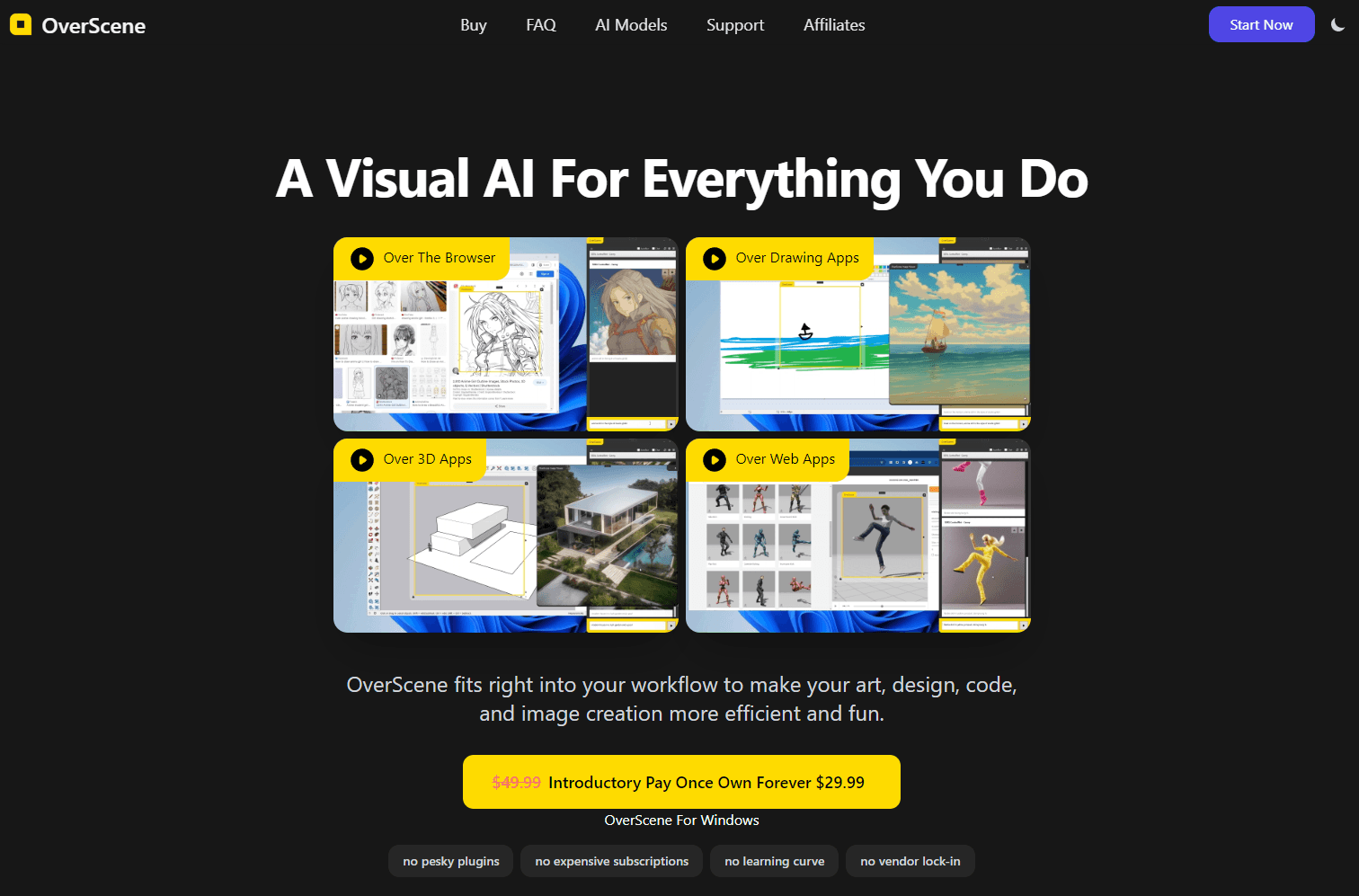
OverScene is a unique AI overlay designed to integrate generative AI magic directly into any desktop application. It functions as a visual AI copilot, enhancing workflows for art, design, code, and image creation. Users can transform sketches into masterpieces within software like Photoshop or Blender, generate moodboards, and even convert screenshots into code without writing a single line. The tool offers features like image-to-image, image-to-text, text-to-image, depth-to-image, pose-to-image, text summarization, code generation, and 3D rendering. It boasts a one-click installation, a floating frame for easy interaction, and access to various AI models from platforms like OpenAI and Replicate.com, all while being optimized for lightweight efficiency.
BrainGrid
BrainGrid is an AI Product Planner designed to streamline the software development process from idea to deployment. It helps users conceptualize ideas, refine them into detailed specifications, and break down large features into manageable tasks for AI coding agents. The tool clarifies requirements by asking smart questions to uncover edge cases and constraints, generating comprehensive specs including goals, context, architecture, and acceptance criteria. BrainGrid integrates seamlessly with various AI coding tools like Claude Code and Cursor via MCP, CLI, or simple copy-paste, ensuring no vendor lock-in. It aims to reduce back-and-forth, accelerate feature delivery, and minimize regressions, enabling builders to ship production-ready software faster and more reliably.
miyagi
Miyagi is a comprehensive sample project designed to help developers envision and build intelligent applications using Microsoft's Copilot stack. It offers an experiential approach to developing AI-infused product experiences, covering both generative and traditional machine learning use cases. The project introduces traditional software engineers to emerging design patterns in prompt engineering, such as chain-of-thought and retrieval-augmentation, alongside techniques like vectorization for long-term memory, fine-tuning of open-source models, agent-like orchestration, and plugins for augmenting and grounding LLMs. It includes examples utilizing Semantic Kernel, Promptflow, LlamaIndex, LangChain, and various vector stores, making it ideal for modernizing applications with AI.
octocode-mcp
Octocode-mcp serves as an MCP server for semantic code research and real-time context generation, leveraging LLM patterns. It enables users to search naturally across both public and private repositories based on their permissions. The tool is designed to transform any accessible codebase into AI-optimized knowledge, facilitating understanding of simple and complex code flows. It helps users find real implementations and live documentation from various sources. Octocode-mcp also offers agent skills for tasks like code search, multi-phase research, code analysis, planning, RFC generation, PR review, prompt optimization, and documentation writing, empowering AI assistants with advanced engineering capabilities.
Paper2Code
Paper2Code is an innovative tool designed to automate the generation of code from scientific papers, specifically in the field of machine learning. At its core is PaperCoder, a sophisticated multi-agent LLM system that streamlines the process of converting research papers into functional code repositories. This system operates through a meticulously structured three-stage pipeline: planning, analysis, and code generation, with each stage handled by specialized AI agents. Paper2Code aims to significantly reduce the manual effort and time typically required to implement research findings, offering a robust solution for developers and researchers. It supports both OpenAI API and open-source models like DeepSeek-Coder-V2-Lite-Instruct, providing flexibility in deployment and cost management. The tool also includes comprehensive benchmark datasets and a model-based evaluation system for assessing the quality of generated repositories.
spacy-transformers
spacy-transformers is a powerful open-source package designed to bridge the gap between spaCy's natural language processing framework and state-of-the-art transformer models from Hugging Face. It allows users to seamlessly incorporate pretrained transformers such as BERT, GPT-2, and XLNet into their spaCy pipelines, enabling advanced NLP capabilities. The package supports easy multi-task learning, allowing backpropagation to a single transformer model from multiple pipeline components. It also features automatic alignment of transformer output to spaCy's tokenization, customizable handling of transformer data in the Doc object, and out-of-the-box serialization for model packaging. This integration is crucial for developers and researchers looking to leverage the power of modern transformer architectures within a familiar and extensible NLP framework.