
Coding & Development
Browsing page 18 of AI tools for Code Assistants in Coding & Development. Sorted by confidence score — our independent quality rating.

SolnetInfo
SolnetInfo is a premier remote-first AI and IT services company with a track record of over 65 successful projects. They offer a comprehensive suite of services including custom AI solutions, intelligent chatbot development, web development, mobile app development, UI/UX design, and SaaS platform development. SolnetInfo caters to businesses seeking bespoke software solutions and digital transformation, leveraging their expertise in various programming languages and frameworks. They serve clients across Pakistan and globally, focusing on delivering tailored IT services to meet specific client requirements.

Alibaba Cloud AI Coding Assistant
Alibaba Cloud AI Coding Assistant, also known as Lingma, is an AI-powered tool designed to significantly enhance the coding experience for developers within IntelliJ IDEs. It provides intelligent code suggestions through its Code Completion feature, helping developers write code more efficiently and accurately. Beyond basic completion, Lingma offers an 'Ask' function, allowing developers to query the AI for assistance, and supports multi-file context, enabling the AI to understand and provide suggestions based on a broader scope of the project. This assistant aims to streamline development workflows and improve productivity for coders.

Devies Digital Core
Devies Digital Core offers specialized AI, UX, and engineering teams to help companies design, build, and scale their digital products. Their services encompass a wide range of expertise, from machine learning (ML) and large language models (LLM) to secure and scalable software solutions. Devies focuses on bridging the gap between technology, culture, and business to deliver high-performance teams and complete software solutions. They emphasize a product mindset in a consulting world, aiming to provide clarity and momentum to businesses by finishing what they start. Their offerings include R&D, cybersecurity, and data, AI & ML services, catering to clients seeking robust digital product development.
Mysti
Mysti is an open-source VS Code extension designed to enhance coding productivity by integrating multiple AI coding agents. It allows developers to leverage the collective intelligence of up to 12 AI providers, including Claude Code, Codex, Gemini, and GitHub Copilot, either individually or in collaborative teams. Key features include a 'Brainstorm Mode' where two AIs debate solutions using various strategies, an '@-Mention System' for routing tasks to specific agents, and 'Autonomous Mode' with configurable safety controls. Mysti also offers 16 developer personas to shape AI thinking, intelligent plan detection, and context compaction to prevent token overflow. It works with existing AI subscriptions, requiring only the installation of relevant CLI tools.
ChatGPT Can Use Your Computer Now. Here's What That Actually Means.
This comprehensive article delves into the groundbreaking capability of AI models, such as OpenAI's GPT-5.4 and Anthropic's Claude, to natively interact with and operate computer environments. It explains the fundamental 'screenshot loop' mechanism that allows AI to analyze screens and execute actions like mouse movements and keyboard inputs. The piece provides an in-depth look at different implementations, including OpenAI's agent mode and Codex, Anthropic's three-track approach with Computer Use API, Claude Code, and Cowork, Perplexity Computer's multi-model orchestration, Google's Gemini Agent, and Microsoft's Copilot Studio. It compares their benchmarks, architectural differences, pricing, and target applications, from general computer use to specialized coding and enterprise solutions. The article emphasizes the rapid advancements and the implications for productivity and automation across various sectors.
Smol Developer
Smol Developer, powered by E2B, offers isolated sandboxes that enable AI agents to securely execute code, process data, and utilize various tools. The platform provides SDKs for easy management of these environments, supporting both JavaScript/TypeScript and Python. Users can define custom templates for their sandboxes, controlling the base image, build commands, and environment variables. It features flexible pricing with a free Hobby tier and paid Pro and Enterprise options, allowing customization of CPU, RAM, and session length. E2B is designed for building and running AI agents with confidence, ensuring data protection through enterprise-grade security.
ruby-openai
ruby-openai is a comprehensive Ruby gem designed to simplify interaction with the OpenAI API. It allows developers to easily integrate advanced AI capabilities into their Ruby applications, supporting a wide range of OpenAI features such as chat completions, streaming responses, vision models, embeddings, and image generation with DALL·E 2 and DALL·E 3. The gem also offers compatibility with other AI services like Azure OpenAI, Deepseek, Ollama, Groq, and Gemini, providing flexibility for various deployment scenarios. Key functionalities include token counting, file management for fine-tuning and assistants, and real-time WebRTC conversations. It's highly configurable, allowing for custom timeouts, base URIs, and error logging, making it suitable for both quick tests and robust production environments.
GPT Prompt Engineer
GPT Prompt Engineer is a powerful tool designed to streamline the prompt engineering process for large language models. It takes a description of your task and a set of test cases, then automatically generates a variety of potential prompts. The system rigorously tests each generated prompt against the provided test cases, comparing their performance and ranking them using an ELO rating system. This allows users to quickly identify the most effective prompts for their specific needs. It supports models like GPT-4, GPT-3.5-Turbo, and Claude 3 Opus, and includes specialized versions for classification tasks and for converting Claude 3 Opus prompts to Claude 3 Haiku for cost and speed optimization. Optional logging to Weights & Biases and Portkey is also available for tracking prompt chains and responses.

Cognitive Latam
Cognitive Latam is a Deep Tech company specializing in Artificial Intelligence, Computer Vision, Intelligent Automation, and Blockchain. They partner with governments and visionary businesses to convert complex challenges into high-impact, scalable, and AI-driven solutions. Their services include strategic AI implementation, advanced computer vision for security, retail, and agriculture, and intelligent automation agents for complex processes. They also develop conversational AI and avatars for marketing and support, and design AI-Blockchain architectures for traceability and security. Additionally, Cognitive Latam conducts R&D in quantum AI and emerging technologies through their CGN Labs.
Arcten
Arcten specializes in developing long-horizon autonomous research and coding agents, designed to handle complex tasks over extended periods. The company is backed by Y Combinator and draws its foundational expertise from AI research conducted at Caltech. Based in San Francisco, Arcten focuses on creating advanced AI agents that can perform in-depth research and generate code autonomously. This technology aims to streamline development processes and accelerate innovation by empowering AI to manage and execute multi-step, intricate projects without constant human intervention. Their work is geared towards pushing the boundaries of AI-native product development.

Helm.ai
Helm.ai delivers comprehensive AI-first software and simulation solutions tailored for advanced driver-assistance systems (ADAS) up to Level 4 autonomous driving. The platform specializes in perception, planning, and simulation models designed for both real-time deployment and scalable offline training and validation. Utilizing proprietary Deep Teaching™ and generative AI, Helm.ai builds models that enable faster, more cost-effective development for production-bound projects. Key offerings include Helm.ai Vision for Level 3 autonomy perception, Helm.ai Driver for Level 2+ autonomy, and generative AI foundation models like GenSim-2, VidGen-2, and WorldGen-1 for data modification, synthetic video generation, and multi-sensor simulation. These technologies adapt to diverse driving conditions and support a unified approach from Level 2 to Level 4 autonomous driving.
micro-agent
Micro-agent is an AI agent developed by BuilderIO that automates the process of writing and fixing code. Users provide a prompt, and the agent generates a test case, then iteratively refines the code until all tests pass. This tool addresses the common issue of LLMs producing broken code, handling the generation, iteration, and fixing automatically. It's designed as a "micro" agent, focusing on creating a definitive test case and iterating on code until it passes, rather than attempting to be an end-to-end developer. It supports various LLM providers like Claude, OpenAI, and Ollama, and offers features like unit test matching and experimental visual matching for design fidelity.
nobodywho
NobodyWho is an inference engine designed to run Large Language Models (LLMs) locally and efficiently across multiple platforms, including Python, Flutter, React Native, and Godot. It offers fast and simple tool calling, automatically deriving grammars from function signatures to ensure perfect tool execution. The engine features conversation-aware preemptive context shifting, enabling long, lobotomy-free conversations. It supports optimized native code for Windows, Linux, macOS, Android, and iOS, with super-fast inference powered by Vulkan or Metal. NobodyWho is compatible with thousands of pre-trained LLMs in the GGUF format, leveraging llama.cpp, and includes vision and hearing capabilities for rich multimodal interactions. Models can be downloaded directly from Hugging Face or any URL.
AI Chrome Extension Builder
Shipper is an innovative AI tool designed to empower users to build a variety of applications, including web apps, mobile apps, and Chrome extensions, simply by conversing with an AI assistant. This platform eliminates the need for traditional coding, making app development accessible to non-technical users and experienced builders alike. Key features include an AI Advisor that guides the building process, pre-built templates for quick starts, and the ability to integrate functionalities like authentication, Stripe payments, map views, and host dashboards. Shipper aims to significantly accelerate the development cycle, allowing users to launch MVPs and bring ideas to life rapidly, with options for both free and paid plans that scale with usage and advanced features.
Doclific
Doclific is an open-source internal documentation tool designed to help developers and teams create beautiful, maintainable technical documentation directly within their codebase. It provides a Notion-like rich text editor supporting headings, lists, and code blocks, alongside powerful features like ERD diagramming and interactive whiteboarding for architecture designs. A key differentiator is its AI integration, which automatically adds documentation skills to Cursor and Claude AI assistants, enabling AI-powered documentation creation and editing. Doclific runs entirely on your machine, ensuring speed and data privacy, and allows for smart code snippets that automatically update with git changes, preventing scattered and outdated documentation.

STAT.AI
STAT.AI is an AI-powered tool designed to significantly enhance the Stata workflow for data analysis. It enables users to perform comprehensive data analysis with greater speed and accuracy, streamlining processes that typically consume hours. A key feature is Stata GPT, which provides instant answers to complex queries, reducing the need to search through extensive documentation or forums. Additionally, STAT.AI includes converters for Python and R scripts, allowing seamless integration and conversion of code into Stata format. This makes the tool suitable for a wide range of users, from beginners seeking simplified data handling to experts looking to optimize their analytical pipelines.
aisearch-openai-rag-audio
aisearch-openai-rag-audio is an open-source sample implementation of the VoiceRAG pattern, designed to create interactive voice generative AI experiences. This tool leverages Azure AI Search for retrieval-augmented generation (RAG) and Azure OpenAI's gpt-4o-realtime-preview model for real-time audio processing and response generation. It enables developers to build applications with voice interfaces that capture audio input, process it through a RAG system, and generate audio output. Key features include voice input/output, RAG capabilities for answering questions from a knowledge base, and citations for search results. The project provides infrastructure as code and a Dockerfile for deployment to Azure Container Apps, and can also be run locally, making it a flexible solution for developers looking to integrate advanced voice AI into their applications.
airflow-ai-sdk
airflow-ai-sdk is a Python SDK designed to seamlessly integrate Large Language Models (LLMs) and AI Agents into Apache Airflow workflows. It empowers users to define tasks that call LLMs, orchestrate multi-step AI reasoning with custom tools, and automatically parse and validate LLM outputs using type hints. The SDK supports all models available in the Pydantic AI library, including OpenAI, Anthropic, and Gemini. Key features include `@task.llm` for general LLM calls, `@task.agent` for orchestrating AI agents, `@task.llm_branch` for dynamic DAG control flow based on LLM output, and `@task.embed` for creating vector embeddings. This SDK is ideal for developers looking to leverage mature orchestration tooling like Airflow for robust, production-ready LLM and agent-based pipelines.
Ask Robi
Ask Robi functions as an AI companion accessible directly via WhatsApp, offering a versatile suite of AI capabilities. Users can leverage Robi for various tasks, including generating creative images, composing textual content, translating between different languages, and receiving assistance with mathematical problems and coding challenges. The tool is designed to combine advanced AI functionalities with its own creative algorithms, aiming to provide comprehensive support with minimal setup required from the user. Its integration with WhatsApp makes it a convenient and readily available personal assistant for a wide range of daily tasks.
vly.ai (YC F24)
vly.ai is an AI-powered web development platform designed to transform user ideas into fully functional web applications. Users simply describe their project idea, and the AI agent generates, iterates, and deploys the project using React, Vite, and Convex. The platform boasts a custom real-time architecture optimized for AI compatibility, offering superior performance and cost savings, claiming to be 7x cheaper than competitors. Key features include backend visualizations that demystify AI-generated software, over 1000 integrations with popular services like Stripe, OpenAI, and GitHub, and advanced coding agents. It supports building a wide range of applications, from 3D multiplayer games and e-commerce sites to real-time collaboration tools, making it suitable for developers looking for rapid web software iteration.
rust-genai
rust-genai is a comprehensive Rust library designed to simplify interaction with multiple generative AI providers through a single, ergonomic API. It natively supports a wide array of services including OpenAI, Anthropic, Gemini, xAI, Ollama, Groq, DeepSeek, Cohere, Together, Fireworks, Nebius, Mimo, Zai (Zhipu AI), BigModel, and GitHub Copilot. The library focuses on standardizing chat completion APIs, offering features like image analysis, custom authentication, model aliases, and custom endpoint resolution. It prioritizes ergonomics and commonality across services, providing native protocol support for advanced features like Gemini Thinking and Anthropic Reasoning Effort. This makes it an excellent choice for developers looking to integrate diverse AI capabilities into their Rust applications without managing multiple SDKs.
ChatGPT-CodeReview
ChatGPT-CodeReview is an AI-powered bot designed to automate and enhance the code review process within GitHub. Leveraging ChatGPT, it provides automated code reviews for pull requests, identifying potential issues and suggesting improvements. The bot can be integrated into GitHub repositories as an app or used via GitHub Actions, offering flexibility in deployment. It supports various OpenAI models, including GPT-4o, and allows for custom prompts, language settings, and API endpoints. Users can configure parameters such as `top_p`, `temperature`, `max_tokens`, and define ignore/include patterns for files, making it a highly customizable solution for developers looking to streamline their code quality checks.
CloudAEye
CloudAEye is an AI-powered platform designed to significantly accelerate software development by automating key post-coding tasks. It offers intelligent code review capabilities that understand the full context of pull requests, identifying critical issues, logic flaws, and security vulnerabilities before merging. The tool also provides instant root cause analysis for CI/CD test failures, including flaky tests, and streamlines test triaging. Furthermore, CloudAEye automates the generation and updating of unit tests, covering edge and negative cases to help achieve comprehensive test coverage. With features like a developer companion for chatting with codebases and an issue explainer for step-by-step implementation guidance, CloudAEye aims to boost developer productivity and ensure high-quality software delivery.
LaunchFlow
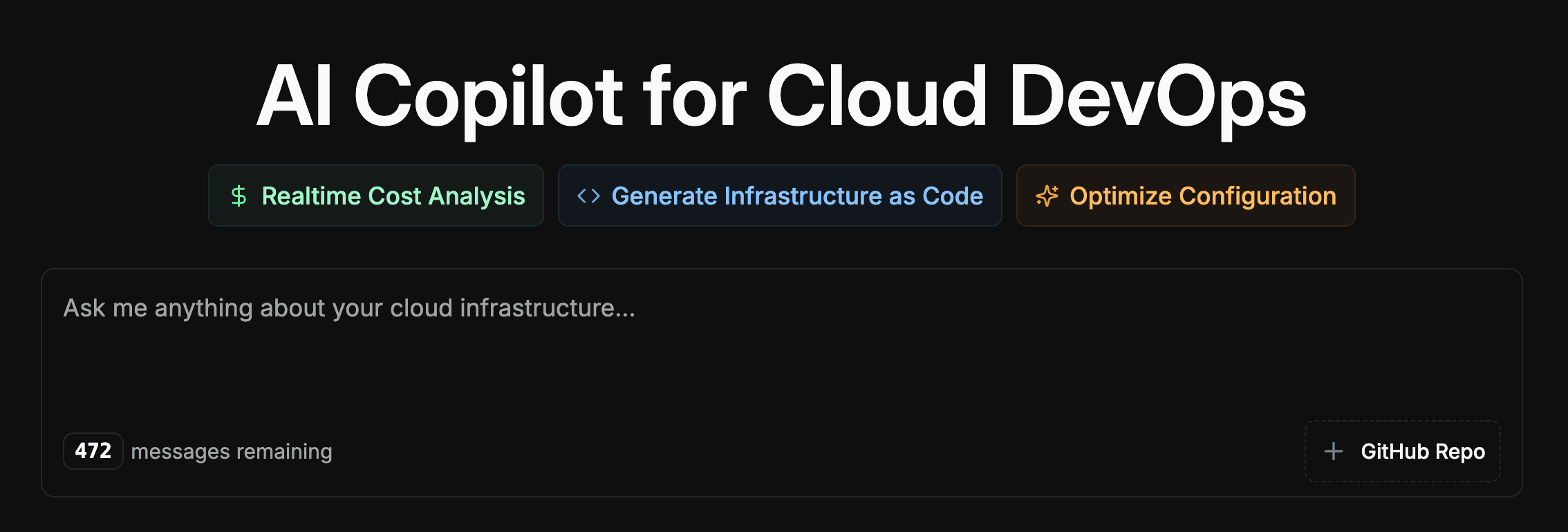
LaunchFlow is an AI-powered platform designed to streamline cloud infrastructure management across AWS, GCP, and Azure. It features an AI Copilot, infra.new, which assists teams in optimizing costs and accelerating deployment cycles. The core of LaunchFlow's offering is its Infrastructure as Code Generator, which utilizes AI-powered blueprints to produce production-ready Terraform configurations and CI/CD pipelines in minutes. This approach ensures consistent and reliable results, moving beyond generic AI prompts to deliver expert-designed patterns. Users retain full ownership and modification rights over the generated code, allowing for seamless integration with existing workflows and tools. LaunchFlow aims to eliminate the research phase, enabling developers to build directly without extensive documentation review or trial and error.