
Coding & Development
Browsing page 25 of AI tools for Code Assistants in Coding & Development. Sorted by confidence score — our independent quality rating.

code-index-mcp
Code Index MCP is an open-source Model Context Protocol (MCP) server designed to enhance how AI models interact with and understand complex codebases. It offers intelligent indexing, advanced search capabilities, and detailed code analysis, making it ideal for tasks like code review, refactoring, documentation generation, debugging assistance, and architectural analysis. The tool supports 10 core languages with specialized tree-sitter parsing and over 50 additional file types with a fallback strategy, ensuring comprehensive coverage. Key features include real-time monitoring with automatic index updates, persistent caching for performance, and memory-efficient processing optimized for large codebases. It integrates seamlessly with MCP-compatible applications like Claude Desktop and Anthropic's Codex CLI, providing a robust solution for developers looking to leverage AI for code understanding.
Command-G
Command-G is an evolving suite of AI tools specifically tailored for iOS, macOS, and visionOS developers, acting as a copilot within Xcode. It features free code autocompletion, powered by Codeium, which provides code suggestions during typing, proving particularly useful for repetitive tasks and generating inspiration. Additionally, Command-G integrates GPT-4 for chat functionalities, allowing developers to easily insert their code as context into conversations with ChatGPT directly within Xcode. This integration helps maintain developer flow and enhances productivity. The tool emphasizes privacy and security, stating that Command-G servers never access user code or messages, and there is no telemetry for app usage. It performs direct requests against API providers, with privacy policies governed by the respective providers like OpenAI and Codeium.
langfun
Langfun is a PyGlove-powered library designed to simplify working with large language models (LLMs) by treating natural language as functions. This approach enables seamless integration between natural language and programming, enhancing control and streamlining agent development. A key feature is Object-Oriented Prompting, which allows users to interact with LLMs using objects and types. Langfun is compatible with popular LLMs like Gemini, GPT, and Claude without requiring additional fine-tuning. It offers a powerful and scalable solution with modular prompts, efficient workflows for both request-based and batch jobs, and a robust evaluation framework. The library is designed for agile development, providing an intuitive programming model, easy integration into Python codebases, and comprehensive LLM support under a unified API.
Mindlytic AI
Mindlytic AI is a boutique AI-native development studio based in Jersey City, NJ, with a delivery team in Surat, India. They focus on shipping production-ready AI systems, including advanced agents, Retrieval-Augmented Generation (RAG) systems, and voice AI solutions. Their expertise lies in transforming business operations through custom AI development. The studio emphasizes delivering practical, deployable AI solutions tailored to client needs, moving beyond theoretical concepts to tangible, impactful applications.
TextRL
TextRL is an open-source Python library designed for improving text generation models through reinforcement learning with human feedback (RLHF). It builds upon HuggingFace's TRL library, offering a streamlined approach to modern text-generation RL. Key features include a single dataclass for configuration, dedicated trainer classes for various algorithm families like GRPO, RLOO, DPO, and KTO, and support for callable reward functions. The tool also integrates with PEFT, accelerate, and vLLM for efficient training and deployment. TextRL enables developers to fine-tune models like Bloom, GPT, BART, and T5, making it a versatile solution for advanced text generation tasks.
toolkit-ai
toolkit-ai is an open-source project designed to streamline the creation and utilization of AI plugins. It empowers developers to generate code for Langchain Tools and ChatGPT plugins simply by providing a description of their intended function. This capability simplifies the process of building AI agents that can automatically leverage these tools. The platform offers both an npm package for programmatic tool generation and a CLI-based usage for longer-running, self-evaluating agent processes. It supports the generation of complex tools, such as a temperature converter, complete with input and output schema validation. toolkit-ai is brought to you by the team behind Pal, an AI assistant platform, indicating a focus on practical, tool-enhanced AI solutions.
vectordb-recipes
vectordb-recipes is a comprehensive open-source repository designed to help developers build GenAI applications. It offers a rich collection of examples, ready-to-use applications, starter code, and tutorials. The resource leverages LanceDB, a free, open-source, and serverless vector database that requires no complex setup. LanceDB seamlessly integrates into the Python data ecosystem, supporting popular libraries like pandas, arrow, and pydantic. Additionally, it provides a native TypeScript SDK for serverless vector search. The repository is structured into sections covering various aspects of GenAI, including building applications from scratch, multimodal AI, RAG (Retrieval Augmented Generation), vector search, chatbots, evaluation, AI agents, recommender systems, and core AI concepts. It's an excellent starting point for anyone looking to kickstart their GenAI projects with practical, hands-on guidance.
TypeChat
TypeChat is a library developed by Microsoft that streamlines the creation of natural language interfaces by leveraging types. Traditionally, building these interfaces involved complex decision trees, but TypeChat simplifies this by using Large Language Models (LLMs) to match natural language input to intent. It addresses common challenges in LLM integration, such as constraining model replies for safety, structuring responses for further processing, and ensuring output validity. Instead of complex prompt engineering, TypeChat utilizes 'schema engineering,' where developers define types representing application intents. The library then handles prompt construction, response validation, and even repairs non-conforming outputs through further LLM interaction, ensuring alignment with user intent. It supports TypeScript/JavaScript, Python, and C#/.NET.
liteai.me
LiteAI is an AI-powered coding playground designed for building real web applications directly in the browser using PyScript, HTML, CSS, and JavaScript. It eliminates the need for complex setups or backend environments, offering a seamless experience for students, educators, and developers. Users can leverage AI to generate starter code for web apps, then edit, test, and publish them instantly to a shareable URL. The platform supports both JavaScript-based and PyScript-based browser apps, acting as an online IDE where Python code runs natively in the browser. LiteAI is particularly beneficial for educational settings, providing an interactive and visual way for beginners to learn coding by building functional tools.
Amber Innovations Limited
Amber Innovations Limited delivers enterprise software, cybersecurity, and cloud solutions tailored for businesses in the Caribbean and beyond. They offer custom software development, including mobile and web applications, UI/UX design, and cloud computing services. The company specializes in AI and Machine Learning, providing custom AI applications, machine learning algorithms, and natural language processing tools to drive efficiency and productivity. Additionally, Amber Innovations offers next-gen cybersecurity consulting with AI-powered protection that monitors networks, identifies threats in real-time, and ensures data compliance. They also provide analytics and big data solutions, DevOps implementation, and offer on-demand certified programmers and developers as resources for digital transformation.
MCPJam Inspector
MCPJam Inspector is a comprehensive tool designed for developers to test, debug, and evaluate MCP servers and ChatGPT applications locally. It enables inspection of how servers and apps perform across various modern MCP clients, including ChatGPT, Claude, and Cursor. Key features include an Apps Inspector for direct tool execution and model-in-the-loop interactions, an OAuth Debugger to visualize and verify authorization flows, and a Chat Playground for interacting with MCP apps using frontier models. Developers can inspect traces, tool calls, inputs, outputs, app-to-host messages, and rendered UI, accelerating the iteration loop without needing external services like ngrok or a ChatGPT subscription.
GitGuessr
GitGuessr is an engaging game designed to enhance your code reading and comprehension skills. Players are immersed in random locations within real GitHub repositories, where certain lines of code are masked. The objective is to quickly understand the surrounding codebase and accurately fill in the missing code. This tool supports various programming languages including Python, TypeScript, JavaScript, and Java, offering different difficulty levels from easy Python one-liners to challenging intermediate Python scenarios. Beyond being a fun challenge, GitGuessr serves a practical purpose by training a crucial programming skill in the AI era: the ability to rapidly orient oneself within unfamiliar code, such as that generated by large language models (LLMs). The game features curated 'Code Maps' with varying difficulty and language focus, and allows players to create their own maps. Scoring is based on speed and accuracy, with penalties for incorrect guesses.
MagicAI
MagicAI is a comprehensive AI platform designed for creative content generation, offering a suite of tools for both image and video creation. Users can generate AI art from text prompts or existing images, and also create AI-powered videos. Beyond visual content, MagicAI includes an AI chat feature and various other AI tools like Ghibli AI, ControlNet, InPainting, OutPainting, and Upscale Image. The platform aims to unleash imagination with its AI capabilities, providing a free tier for users to explore its features before committing to a paid plan, which is currently listed as 'Coming Soon'.
GPU Memory Calculator LLMTraining
GPU Memory Calculator LLMTraining is a specialized tool designed to assist AI developers and machine learning engineers in optimizing their Large Language Model (LLM) training processes. This application calculates the GPU memory requirements based on user-defined parameters such as model size, various parallelism settings, and training configurations. By providing detailed memory estimates, the tool helps users understand the resource demands of their LLM projects, enabling more efficient hardware allocation and preventing out-of-memory errors during training. It serves as a crucial aid for planning and scaling LLM development.
apidash
Apidash is a beautiful AI-powered open-source cross-platform API client built using Flutter, available for desktop and mobile. It enables developers to easily create and customize HTTP and GraphQL API requests, visually inspect responses, and generate API integration code. Apidash supports various API types including HTTP, GraphQL, and SSE/Streaming, with planned support for WebSocket and MQTT. It offers advanced features like visual preview and download of data and multimedia API responses, which is a differentiator from other API clients. The tool also provides code generation for multiple languages and libraries such as JavaScript, Python, Kotlin, and Dart. Data is persisted locally, and collections can be exported as HAR files for version control or import into other API clients. Apidash includes DashBot, an AI assistant powered by local or cloud LLMs, to help debug requests, generate code, and create documentation.
attention-is-all-you-need-pytorch
attention-is-all-you-need-pytorch offers a PyTorch implementation of the Transformer model, as detailed in the influential "Attention is All You Need" paper. This open-source project focuses on a novel sequence-to-sequence framework that leverages the self-attention mechanism, moving away from traditional Convolution or Recurrent Neural Network structures. It has demonstrated state-of-the-art performance on tasks like WMT 2014 English-to-German translation. The project supports both training and translation with trained models, making it a valuable resource for researchers and developers in natural language processing. While still a work in progress, particularly concerning BPE-related parts, it provides a robust foundation for experimenting with and building upon the Transformer architecture.
awesome-ai-coding
Awesome-AI-Coding is a comprehensive, curated list of resources dedicated to AI coding topics. It features a wide array of projects, including open scientific collaborations like BigCode, code completion servers such as Fauxpilot, and AI integrations for popular IDEs like CodeGPT.nvim for Neovim and ChatIDE for VSCode. The list also highlights various open-source alternatives to GitHub Copilot, such as Tabby and Twinny, and tools for specific tasks like generating codebase documentation with Autodoc or operating on codebases using GPT with promptr. Additionally, it provides information on datasets, LLM models specifically trained for code, relevant research papers, and a directory of AI coding products and startups. This makes it an invaluable resource for developers, researchers, and anyone interested in the rapidly evolving field of AI-assisted software development.
Vitrin9
Vitrin9 specializes in developing AI-driven applications designed to future-proof enterprise businesses. Their services encompass a comprehensive suite of solutions including enterprise AI, robust cloud infrastructure, insightful business intelligence, and expert product development. By leveraging artificial intelligence and data science, Vitrin9 helps organizations craft innovative, data-driven products that enhance operational efficiency and strategic decision-making. Their approach focuses on delivering tailored AI solutions that integrate seamlessly into existing business processes, ensuring long-term growth and competitive advantage.
context-engineering-intro
Context-engineering-intro offers a comprehensive template for implementing context engineering, a method that significantly enhances the performance of AI coding assistants. Unlike traditional prompt engineering, which focuses on clever wording, context engineering provides a complete system including documentation, examples, rules, patterns, and validation. This approach reduces AI failures, ensures consistency with project patterns, enables complex feature implementation, and allows AI to self-correct through validation loops. While centered around Claude Code, the strategy is applicable to any AI coding assistant, providing a structured way to guide AI through multi-step implementations and ensure high-quality, consistent code generation.
claude-code-skill-factory
Claude Code Skill Factory is a powerful open-source toolkit designed for building and deploying production-ready Claude Skills, Code Agents, custom Slash Commands, and LLM Prompts at scale. It offers an interactive builder and pre-built commands to streamline the development process. Key capabilities include generating complete Claude Skills with proper formatting and documentation, creating specialized Claude Code Agents with enhanced YAML frontmatter, and generating mega-prompts for various roles with 69 professional presets. The toolkit also supports building Claude Code hooks for workflow automation with safety validation and language-specific templates, and creating custom slash commands with comprehensive validation. It further enables interoperability between Claude Code and OpenAI Codex CLI, making it a versatile solution for AI agent development.
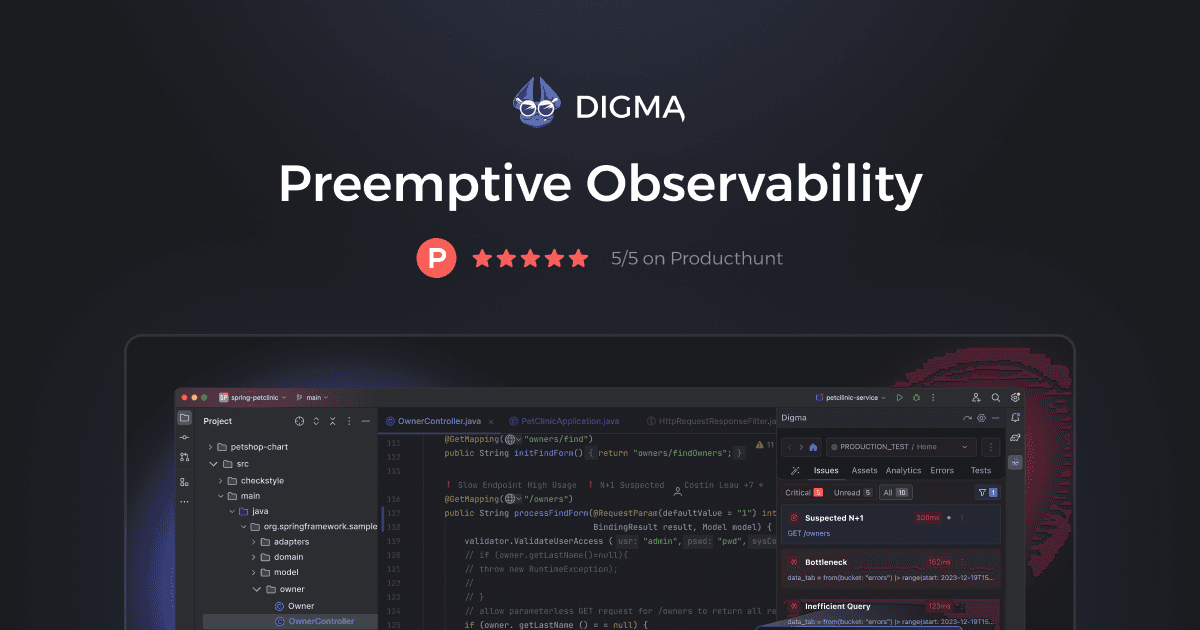
Digma AI
Digma AI operates as a fully autonomous AI SRE, designed to streamline the identification, root cause analysis, and remediation of issues across both code and infrastructure. Leveraging its Dynamic Code Analysis (DCA) engine, Digma identifies code-level problems in pre-production environments, preventing issues before they impact production. It integrates with existing observability stacks and data sources like PostgreSQL, GitHub, and Kubernetes to provide accurate and reliable resolutions. The tool also enhances code reviews by highlighting critical performance problems, bottlenecks, and slow database queries, and can suggest production-aware fixes directly into pull requests. Digma is OpenTelemetry compliant and works without requiring code changes, offering a free-forever plan for individual developers.
TangoCode Inc
TangoCode Inc offers AI-powered Martech Solutions, focusing on the design, deployment, and optimization of operational AI. Their services are geared towards driving measurable performance across a client's entire marketing stack. The company emphasizes accelerating the speed to market for new technologies, leveraging artificial intelligence and machine learning. TangoCode works with customers from development through to marketing, providing comprehensive support for integrating AI into their operations. Their expertise helps businesses enhance their marketing efforts through advanced AI capabilities, ensuring efficient and effective technological implementation.
grepai
grepai is a privacy-first command-line interface (CLI) tool designed for semantic code search and call graph generation, specifically tailored for AI agents. Unlike traditional `grep` which relies on exact text matching, grepai uses vector embeddings to understand the meaning of code, allowing users to perform natural language queries like "authentication logic" to find relevant code, even if naming conventions vary. It drastically reduces AI agent input tokens by providing relevant context instead of raw search results. Key features include searching by intent, tracing call graphs to understand function dependencies, 100% local operation ensuring code never leaves the machine, and an automatic file watcher to keep the index fresh. It's ready for AI agents, working out-of-the-box with tools like Claude Code, Cursor, and Windsurf, and can be called directly as an MCP server tool.
keras-transformer
Keras-transformer is a Python library designed to facilitate the construction of (Universal) Transformer models within the Keras framework. It offers essential building blocks such as positional encoding, embeddings, attention masking, and memory-compressed attention. The library also supports Adaptive Computation Time (ACT) and provides a general implementation for BERT models, making it highly relevant for Natural Language Processing (NLP) tasks. Developers can flexibly piece together multi-step Transformer models using its Keras layers, or customize existing components like self-attention and activation functions. The repository includes practical examples demonstrating its application in language modeling with BERT and GPT on datasets like WikiText-2.