
Coding & Development
Browsing page 68 of AI tools for Code Assistants in Coding & Development. Sorted by confidence score — our independent quality rating.

Bolt.new
Bolt.new is an AI-powered web development agent designed to simplify the creation of full-stack web applications. Users can build and scale high-performing websites and apps by interacting with AI using natural language prompts. The platform integrates advanced coding agents into a familiar visual interface, eliminating the need for complex local setups and reducing errors by automatically testing, refactoring, and iterating code. Bolt.new supports the import and use of design systems like Figma, Material UI, and Chakra UI, allowing users to build on-brand applications. It also offers Bolt Cloud for enterprise-grade backend infrastructure, including hosting, databases, user management, and SEO optimization, providing a comprehensive solution for product managers, entrepreneurs, marketers, agencies, and students.
Devin AI
Devin AI is an autonomous AI software engineer designed to streamline software development for engineering teams. It acts as an AI coding agent, capable of planning and executing complex engineering tasks, including code migrations, refactoring, documentation generation, and on-call incident resolution. Devin AI leverages parallel cloud agents to achieve significant efficiency gains, as demonstrated by its use in large-scale code migrations. It integrates seamlessly into existing workflows, working with tools like GitHub, Linear, Slack, and various cloud platforms, allowing engineers to delegate repetitive or time-consuming tasks and focus on higher-value work. Devin learns from past interactions, improving its speed and reliability over time.

reinforcejs
reinforcejs is a comprehensive Reinforcement Learning library implemented in Javascript, offering a suite of common RL algorithms for developers. It features Dynamic Programming methods for tabular environments, Temporal Difference Learning (SARSA/Q-Learning) for finite state/action spaces, and Deep Q-Learning for continuous state features with discrete actions, leveraging neural networks. The library also supports Stochastic and Deterministic Policy Gradients, along with Actor Critic architectures, specifically designed for handling continuous action spaces. While these advanced methods are noted as being in alpha, potentially buggy or finicky, the library provides web demos and detailed documentation to guide users through its functionalities. It integrates with recurrentjs for building expression graphs and automatic backpropagation.
Interview Solver
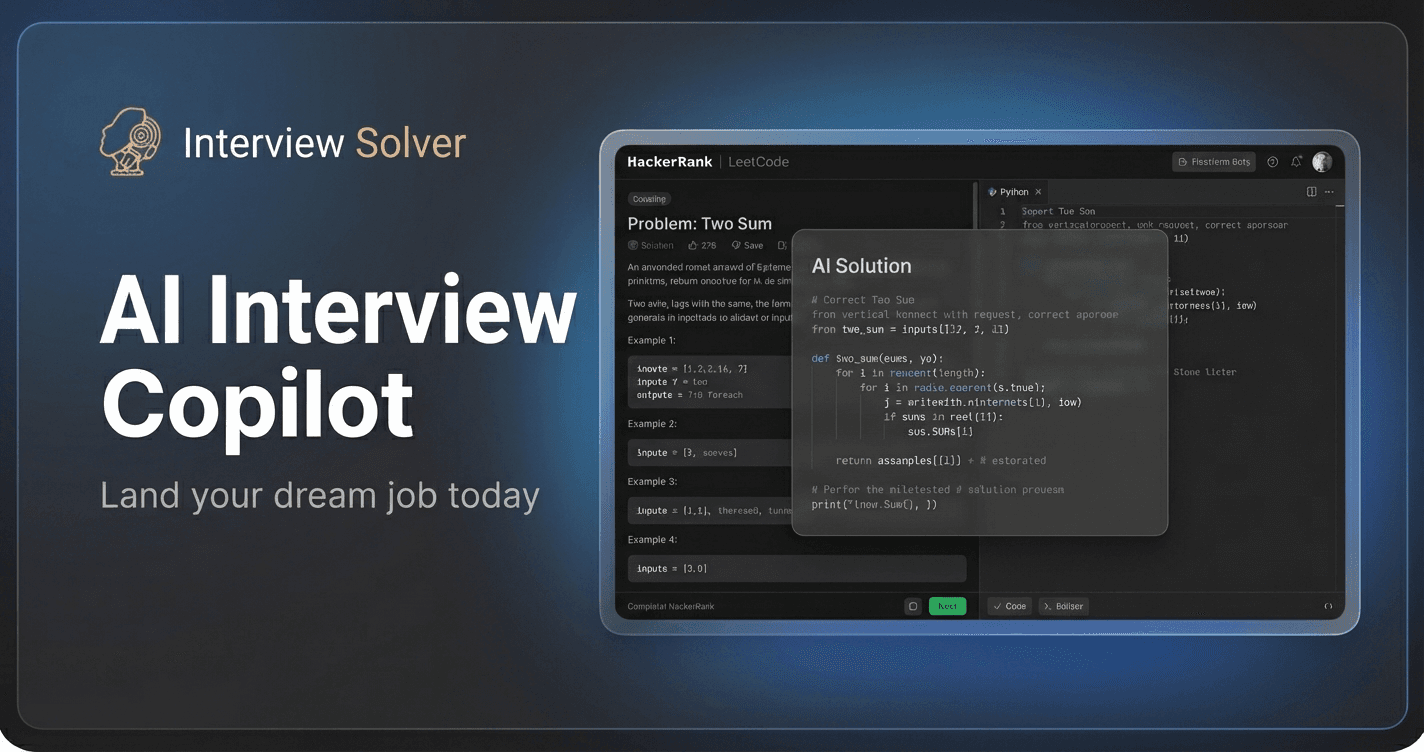
Interview Solver is an AI-powered desktop application designed as an "AI Interview Copilot" to assist software engineers during live coding and system design interviews. It provides real-time solutions for all LeetCode problems and system design questions, making it easier to pass FAANG interviews. A key differentiator is its "invisible mode," which ensures the application is undetectable during screen sharing on platforms like Zoom (up to version 6.16), Microsoft Teams, and Google Meet. It uses global hotkeys that bypass browser detection and can process audio input from interviews to provide contextually relevant answers. The tool also features syntax highlighting, flowchart generation, and a companion mode, making it a comprehensive solution for interview preparation and execution.
Imagimob
Imagimob is a leading provider of Edge AI and tinyML solutions, focusing on enabling customers to put Edge AI applications into production. Their flagship product, DEEPCRAFT™ Studio, is an end-to-end platform designed for developing AI/Machine Learning models specifically for embedded devices. It covers the entire ML workflow, from data collection and annotation to model building, evaluation, and deployment on target hardware. Imagimob also offers DEEPCRAFT™ Ready Models, which are pre-trained, production-ready ML models that allow for rapid deployment without the need for extensive data collection, validation, or training. These ready models are ideal for users seeking quick integration and reduced development effort, making advanced machine learning accessible for edge devices.
Vals AI
Vals AI offers independent and unbiased benchmarks for evaluating the performance of leading AI models across rigorous, domain-specific tasks. It focuses on real-world applications in finance, law, software, healthcare, and other industries. The platform conducts its own evaluations and creates many benchmarks in-house, providing a comprehensive Vals Index score for various models. Users can view performance metrics, compare models, and track improvements over time. Vals AI also provides updates on new model releases and their performance across different benchmarks, including open-weight and closed-weight systems. Proprietary benchmarks are available upon request, catering to specific industry needs.
Vebholic
Vebholic specializes in delivering smart and agile digital solutions, focusing on creative and innovative answers for challenging business issues. The company integrates strategic designers, experienced software developers, and advanced AI engineers into businesses to foster growth and connectivity. Their services span from UX strategy to product execution, covering innovation strategies, design thinking, systems design, digital product strategy, and technology architecture. Vebholic also offers comprehensive software development, including website, app, mobile, AI/Machine Learning, enterprise systems, AR/VR, robotics, and manufacturing automation. Their process emphasizes understanding client needs, user research, ideation, and meticulous design and coding to build high-quality products and experiences.
RepoToText
RepoToText is a specialized web application designed to streamline the process of preparing GitHub repository content for use with Large Language Models (LLMs). It efficiently scrapes a given GitHub repository, consolidating all its files into a single, organized .txt file. A key feature is the ability to optionally include external documentation by providing a URL, ensuring that all relevant information is captured. This tool is particularly useful for developers, researchers, and AI practitioners who need to feed structured code and documentation into LLMs for tasks such as code analysis, generation, or understanding. By simplifying the data preparation step, RepoToText helps in accelerating AI-driven development workflows.
Lisan
Lisan offers an X-Suite of enterprise AI productivity products designed to enhance efficiency and streamline operations for governments and large organizations. The platform provides advanced AI solutions across various domains, including writing assistance, intelligent meeting management, accurate translation services, and comprehensive document automation. Lisan aims to deliver ultra-effective AI capabilities to meet the complex demands of enterprise-level users, focusing on robust performance and secure integration within existing workflows. Its suite is tailored to improve productivity and operational effectiveness in demanding environments.
scrapeghost
scrapeghost was an experimental Python library designed for web scraping using OpenAI's GPT API. While the project is no longer maintained or recommended by its author, it offered a unique approach to data extraction. Key features included Python-based schema definition for specifying data shapes, HTML cleaning to reduce API request costs, and the ability to pre-filter HTML using CSS and XPath selectors. It also supported auto-splitting for larger pages, JSON and schema validation for postprocessing, and a hallucination check to ensure data accuracy. The library incorporated cost controls, allowing users to track token usage, set budgets, and implement automatic fallbacks between GPT models to manage expenses.
reverser_ai
ReverserAI is a research project designed to automate and enhance reverse engineering tasks by leveraging locally-hosted large language models (LLMs). Operating entirely offline, it ensures data privacy and security, making it suitable for sensitive analysis. The tool's initial release focuses on automatically suggesting high-level, semantically meaningful function names derived from decompiler output. While currently integrated as a Binary Ninja plugin, its modular architecture is designed for easy extension to other reverse engineering platforms like IDA and Ghidra. ReverserAI balances performance with confidentiality requirements, showcasing the potential of local LLMs on consumer-grade hardware and exploring the benefits of combining static analysis with modern AI capabilities for improved accuracy.
repo2txt
repo2txt is a web-based tool designed to convert the contents of GitHub repositories into a single, formatted text file. This is particularly useful for AI-assisted development and preparing prompts for Large Language Models (LLMs). The tool offers multiple sources including public and private GitHub repositories with token support, local file directory selection, and zip file uploads. It features smart filtering options like extension filters, .gitignore support, custom patterns, and directory selection, all previewed with a visual file tree. Performance is optimized with virtual scrolling, code splitting, web workers, progressive loading, and smart caching. It also boasts a modern UX with dark mode, responsive design, real-time GPT token counting, and privacy-first processing that is 100% browser-based with no server uploads or tracking.
Formula Generator
Formula Generator leverages AI to streamline the process of building Excel and Google Sheets documents, formulas, and tables. It significantly reduces the time and effort typically required for spreadsheet tasks, making it accessible even for users without coding experience. The tool emphasizes prompt engineering, allowing users to craft precise instructions for AI models to generate tailored formulas and organize data effectively. It also supports system instructions to guide AI behavior consistently across tasks, enhancing long-term productivity for data analysis, documentation, and reporting. Beyond generation, Formula Generator can explain, debug, and optimize existing formulas, identify errors, and even write custom automation scripts in VBA, SQL, or Apps Script, transforming spreadsheet work into a highly efficient and low-effort process.
sherpa-ncnn
sherpa-ncnn offers real-time speech recognition and voice activity detection, operating entirely offline without requiring an internet connection. Built with next-gen Kaldi and ncnn, this tool provides robust performance across a wide array of platforms, including iOS, Android, Linux, macOS, and Windows. Developers can integrate sherpa-ncnn into their projects using multiple programming languages such as C++, C, Python, and JavaScript. Its offline capability makes it ideal for applications requiring privacy, low latency, or operation in environments with limited connectivity, ensuring efficient and reliable audio processing.
TensorFlow.NET
TensorFlow.NET (TF.NET) offers .NET Standard bindings for Google's TensorFlow, allowing C# and F# developers to build, train, and deploy Machine Learning models within the cross-platform .NET Standard framework. It aims to implement the complete TensorFlow API in C# and includes a built-in Keras high-level interface, released as an independent package TensorFlow.Keras. This project facilitates the migration of Python-based machine learning code to .NET, providing access to a vast ecosystem of TensorFlow resources. Unlike other projects that only expose low-level C++ APIs, TensorFlow.NET enables the entire training and inference pipeline to be constructed using pure C# and F#. It also serves as a backend for ML.NET, offering better integration within the .NET environment.
Pieces for Developers
Pieces for Developers is an AI companion designed to enhance the workflow of developers by acting as an infinite artificial memory. It captures live context from various digital environments, including browsers, IDEs, and collaboration tools, automatically forming memories of code, documents, and chats. The tool manages snippets with auto-capture and versioning, and supports multiple LLMs, allowing users to choose between leading cloud and local providers. Pieces operates on-device, ensuring privacy and control over data, with cloud functionality being optional. It helps developers remember everything without conscious effort, providing context that can be returned to, and enabling natural language searches for past work.
Anthropic Healthcare
Anthropic Healthcare provides a marketplace of Claude Code Skills specifically designed for healthcare workflows. This includes tools for generating FDA/NIH-compliant clinical trial protocols, performing initial checks and summarizing arguments for medical necessity in prior authorization reviews, and accelerating healthcare system integration with specialized knowledge of HL7 FHIR R4. It supports healthcare data exchange, including resource structures, coding systems like LOINC, SNOMED CT, and RxNorm, and validation patterns. The platform also offers access to remote MCP servers for CMS Coverage, NPI Registry, and PubMed, enabling comprehensive data access for healthcare professionals.
torch-light
torch-light is an open-source deep learning resource built on PyTorch, designed to help users learn and implement deep learning concepts. It provides fundamental neural network implementations, including Logistic, CNN, and RNN models, making it accessible for those starting in the field. Beyond basic examples, torch-light also includes advanced implementations using more complex models, catering to users looking to deepen their understanding and practical skills. This tool is ideal for developers and students who want to explore deep learning with a hands-on approach, offering a practical way to understand how various neural network architectures function and can be applied.
CodeGuide
CodeGuide is an AI-powered browser extension designed to assist users in mastering algorithms. It offers personalized guidance and solutions, making the process of learning and implementing algorithms more efficient. The tool aims to provide comprehensive support for understanding complex algorithmic concepts and applying them in practical scenarios. While the current website content is minimal, the core functionality revolves around enhancing algorithmic proficiency through AI-driven assistance, catering to individuals looking to improve their coding skills and problem-solving abilities in the realm of algorithms.
alan-sdk-cordova
The Alan AI SDK for Cordova provides a self-coding system for integrating AI into Cordova applications. This platform allows developers to embed an intelligent AI assistant into their apps, facilitating human-like conversations and actions via voice commands. Alan AI transforms enterprise software by introducing Application-Level AI, which embeds an intelligent layer into applications to build features on demand. Powered by a proprietary Three-Layer AI (3LAI) architecture, the system generates both business logic and UI in real-time without manual development. It works across the entire app stack, including the user interface, business logic, and data management, enabling companies to integrate AI-driven interfaces into existing apps quickly.
CodeAir
CodeAir is a mobile application designed to empower developers by providing remote control capabilities for VS Code. This innovative tool enables users to manage and work on their coding projects directly from their mobile devices, offering significant flexibility and convenience. Beyond basic remote access, CodeAir integrates AI support to assist with various coding tasks, enhancing productivity and streamlining development workflows. It also facilitates seamless file transfers, ensuring that developers can easily move necessary project files between their mobile device and the VS Code environment. This makes CodeAir an ideal solution for developers who need to maintain continuity in their work, whether they are away from their primary workstation or simply prefer the mobility of a handheld device for certain coding activities.
codeassist
CodeAssist, developed by Gensyn, is a unique AI coding assistant designed for privacy and local operation. Unlike typical code assistants, CodeAssist integrates directly into your editor, learning from every keystroke, edit, and deletion. This continuous interaction allows it to adapt to your personal coding habits and style, acting as an apprentice. Users can practice programming problems and train their own AI model, which updates based on their interactions. The tool records all interactions as training feedback, comparing user edits to the assistant's actions to calculate rewards and penalties, thereby refining the local model. It supports installation via Docker and Python, requiring a HuggingFace token for operation, and offers a web UI for problem selection and interaction.
claude-sub-agent
claude-sub-agent is a comprehensive AI-driven development workflow system built on Claude Code's Sub-Agents feature. It automates the entire software development lifecycle, from requirements analysis to final validation, by employing specialized AI agents. Each agent, such as `spec-analyst`, `spec-architect`, and `spec-developer`, handles specific aspects of the process, ensuring specialized expertise. The system incorporates quality gates at various phases to maintain high standards and provides comprehensive documentation for every step. It offers flexible integration, allowing it to work with existing specialized agents, and supports quick starts with slash commands for initiating workflows and customizing parameters like quality thresholds or skipping agents.
wevi
wevi, the Word Embedding Visual Inspector, is an open-source tool designed for visualizing and exploring word embeddings directly within a web browser. This tool is invaluable for data scientists and developers working with natural language processing, as it provides a clear visual representation of the relationships between words. By offering an intuitive interface, wevi aids in debugging NLP models and gaining deeper insights into how word embeddings capture semantic similarities. It is compatible with popular browsers like Chrome and Firefox, making it easily accessible for a wide range of users. The project encourages community contributions to further enhance its features and capabilities.