
Coding & Development
Browsing page 78 of AI tools for Code Assistants in Coding & Development. Sorted by confidence score — our independent quality rating.

Lightning Assist
Lightning Assist is a powerful AI-powered text expander designed for Windows, macOS, and Linux, enabling users to streamline their typing workflow across all desktop applications. It allows for the expansion of keyboard shortcuts into full messages, code, or templates, and integrates built-in AI commands to rewrite, enhance, or summarize text in place. A standout feature is its push-to-talk voice typing, which works globally without needing to switch applications. Unlike browser extensions, Lightning Assist functions in any app, including terminals and IDEs, making it a versatile productivity tool. It offers a 14-day free trial to experience its full capabilities, including hotkey-triggered text expansion, AI Speech for voice-to-text, and cross-platform compatibility.
codmate
CodMate is a macOS SwiftUI application designed to streamline the management of command-line interface (CLI) AI sessions. It enables users to efficiently browse, search, organize, resume, and review work generated by popular AI coding assistants like Codex, Claude Code, and Gemini CLI. The tool prioritizes speed through incremental indexing and caching, offering a compact three-column user interface. Key workflows include Project Review for Git changes, with optional AI commit message generation, and one-click Resume/New functionalities. Although the project is being archived, it provided valuable insights into integrating and managing AI agent interactions within a desktop environment, focusing on human usability interfaces (HUI) for AI systems.
d1-manager
D1 Manager is a comprehensive web UI and API designed for managing Cloudflare D1, a serverless SQL database. It offers a user-friendly interface that simplifies the management of databases, tables, and records. A key feature is its integrated AI assistant, which helps users write SQL queries using natural language, significantly streamlining the query creation process. The tool also supports semantic queries through OpenAI API or Cloudflare AI Worker, translating natural language into executable SQL. With features like listing tables, showing schema, running SQL queries, and editing table data via the UI, D1 Manager aims to simplify database operations, allowing developers to focus more on data utilization rather than complex management tasks. It also includes I18n support for multiple languages and an API for programmatic operations.
deep-learning-frameworks
deep-learning-frameworks offers installation support for a broad collection of deep learning and machine learning components, such as PyTorch, transformers, Fast.ai, and scikit-learn, specifically tailored for the ArcGIS System. This includes ArcGIS Pro, Server, and the ArcGIS API for Python. The tool facilitates AI and deep learning applications for geospatial problems like feature extraction, pixel classification, and feature categorization. It simplifies the setup process by installing 254 packages into the default arcgispro-py3 Python environment. While most tools work on any machine, common deep learning workflows benefit significantly from an NVIDIA GPU with CUDA Compute Capability 5.0+ and 8GB+ dedicated graphics memory. The project provides installers for various ArcGIS versions and detailed instructions for both Windows and Linux environments, including manual installation options and support for disconnected environments.
GitStart
GitStart is a platform designed to accelerate software development by providing elastic engineering capacity through a hybrid model of AI and human developers. It features Ticket Studio, which transforms vague tickets into quality specifications with clear context, integrating with tools like Figma, Jira, Linear, and GitHub. The Accelerate component then delivers merge-ready pull requests, combining coding agents with human developer oversight through a five-stage quality process. GitStart supports over 15 languages and frameworks, including React, Node.js, and Python, and can be used for frontend development, testing, bug fixes, and new feature development. It aims to make software development more accessible globally, offering a dedicated team of developers that learns your codebase over time.
Keras-Project-Template
Keras-Project-Template is an open-source project template designed to streamline the development and training of deep learning models with Keras. It offers a clear, structured architecture, including predefined folders for models, trainers, data loaders, and configurations, simplifying project organization. The template supports checkpointing and TensorBoard visualization for monitoring training progress. A key feature is its integration with Comet.ml, enabling comprehensive experiment tracking, including hyper-parameters, metrics, and graphs, with real-time updates. This allows developers to easily manage and compare different model iterations and configurations, enhancing the efficiency of deep learning research and development.
reloadium
Reloadium is an open-source tool designed to significantly enhance the Python development experience through advanced hot reloading and profiling capabilities. It allows developers to see code changes reflected instantly without restarting the application, providing immediate feedback on functionality. Reloadium also integrates seamlessly with IDEs such as PyCharm, with plugins for other IDEs coming soon. Beyond hot reloading, it offers profiling features and AI integration with ChatGPT to provide additional context for conversations, leading to more effective replies. It supports various Python frameworks and libraries including Django, Flask, SQLAlchemy, and Pandas, ensuring broad applicability across different project types.
segmentation_models.pytorch
segmentation_models.pytorch is an Open Source Python library designed for semantic image segmentation using PyTorch. It provides a high-level API that allows users to create neural networks with minimal code, supporting 12 encoder-decoder model architectures such as Unet, Unet++, Segformer, and DPT. The library boasts an extensive collection of over 800 pretrained convolutional and transformer-based encoders, including timm support, which helps achieve faster and more stable convergence during training. It also includes popular metrics and losses for training routines, such as Dice and Jaccard, and is compatible with ONNX export and torch script/trace/compile. This makes it a versatile tool for researchers and practitioners in computer vision.
TensorLayer
TensorLayer is a powerful, open-source deep learning and reinforcement learning library built for scientists and engineers. It offers an extensive collection of customizable neural layers, enabling rapid development of advanced AI models. Inspired by PyTorch, TensorLayer provides transparent and flexible APIs, making it easier to build and train complex AI models compared to other TensorFlow wrappers. It supports multiple backends including TensorFlow, PyTorch, MindSpore, PaddlePaddle, OneFlow, and Jittor, allowing deployment on various hardware like Nvidia-GPU and Huawei-Ascend. The library is recognized for its simplicity, flexibility, and high performance, with comprehensive documentation and a large community.
BigCode - Playground
BigCode - Playground is an AI tool designed for code experimentation and model testing, hosted on Hugging Face Spaces. It serves as a platform for developers and AI enthusiasts to interact with and test various code models. While the live website currently indicates a runtime error, suggesting it may not be fully operational at this moment, its intended purpose is to provide a space for exploring and validating code-related AI functionalities. The tool is part of the BigCode initiative, aiming to foster community engagement in the development and application of large language models for code.
aidermacs
Aidermacs brings AI-powered development directly into Emacs, integrating with Aider, a powerful open-source AI pair programming tool. It offers similar AI capabilities to tools like Cursor but is tailored for Emacs workflows. Key features include intelligent model selection with multiple backends, built-in Ediff integration for AI-generated changes, and enhanced file management directly from Emacs. Users can customize model selection, including an experimental Architect mode that uses separate models for reasoning and code generation, which has shown state-of-the-art results. Aidermacs also provides a minor mode for working with prompt files and flexible configuration options for API keys and environment variables.
amazon-q-developer-cli
Amazon Q Developer CLI, now known as Kiro CLI, offered an agentic chat experience directly within the terminal, enabling developers to build applications using natural language. While the open-source Amazon Q Developer CLI project is no longer actively maintained and will only receive critical security fixes, its successor, Kiro CLI, continues to provide these capabilities as a closed-source product. The tool allowed for natural language interaction to streamline development workflows, offering features like code generation, debugging assistance, and general development support directly from the command line. It was designed to enhance developer productivity by integrating AI-powered assistance into the terminal environment.
chatblade
Chatblade is a versatile command-line interface (CLI) tool designed to interact with OpenAI's ChatGPT. It accepts piped input, arguments, or both, enabling flexible query submission. Users can save common prompt preambles for quick usage and manage distinct conversations through named sessions. The tool also provides utility methods to extract JSON or Markdown from ChatGPT responses, with options for raw output or formatted syntax highlighting. It supports both gpt-3.5 and gpt-4 models, interactive chat sessions, and streaming responses. Chatblade can also be configured for Azure OpenAI endpoints. Note: This project is archived and no longer under active development, with the developer recommending alternatives like llm or Fabric for modern CLI needs.
Claude-Code-Usage-Monitor
Claude-Code-Usage-Monitor is an open-source, real-time terminal monitoring tool designed for Claude AI token usage. It offers advanced analytics, machine learning-based predictions, and a rich, color-coded UI to track token consumption, burn rate, and cost analysis. Key features include configurable refresh rates, smart auto-detection of usage plans, and an advanced warning system with cost and time predictions. The tool supports various Claude plans (Pro, Max5, Max20) and includes a default 'Custom' plan that intelligently adapts to usage patterns by analyzing past sessions to calculate personalized limits. It also provides model-specific pricing with cache token calculations and comprehensive logging options, making it an essential utility for developers managing their Claude AI expenses and usage efficiently.

ChatPRD
ChatPRD is the #1 AI platform designed specifically for product managers, transforming ideas into clear requirements and coaching teams to ship better products. It enables users to write great product documents like PRDs, user stories, and technical specs in minutes, not days, by leveraging AI to generate content from prompts, meeting notes, or rough ideas. The platform offers CPO-level reviews with actionable feedback, identifying strategic gaps and coaching users to think deeply about product problems. ChatPRD integrates seamlessly with tools like Linear, Notion, Slack, and GitHub, allowing for one-click exports and prototype generation. It also provides agentic capabilities for engineers and designers, shared project spaces, and custom AI personas, making it a comprehensive solution for product teams of all sizes.

OmniScience
OmniScience introduces Vivo, an AI-native control tower designed to transform clinical trial operations. Vivo unifies disparate data sources across trials, sites, and participants, providing real-time insights and continuous monitoring. It acts as a cognitive partner for clinical teams, interpreting signals, surfacing critical information, and identifying risks early to accelerate decision-making. Vivo is built to improve outcomes at scale, reducing manual effort and helping teams deliver therapies to patients faster. Key features include 'Ask Vivo' for instant, explainable insights from trial data, portfolio intelligence for cross-trial oversight, dynamic participant profiles, on-demand lab insights, and continuous monitoring with alerts. The platform is designed for various roles within clinical development, operations, research, data management, safety monitoring, and CROs, and supports multiple therapeutic areas including Oncology, CNS, Immunology & Inflammation, Rare Disease, and Obesity. Vivo is a validated system engineered to comply with global clinical trial and AI regulations, ensuring data security, privacy, and quality.
pytorch_tabular
PyTorch Tabular offers a unified and accessible framework for applying deep learning models to tabular data. Designed with principles of low resistance usability, easy customization, and scalability, it simplifies the development and deployment of advanced models. The library integrates with PyTorch and PyTorch Lightning, enabling efficient training on both GPUs and CPUs, alongside automatic logging for experiment tracking. It supports a variety of state-of-the-art models including FeedForward Networks, NODE, TabNet, Mixture Density Networks, AutoInt, TabTransformer, GATE, GANDALF, and DANETs, as well as semi-supervised Denoising AutoEncoders. Users can also implement custom models, making it suitable for both real-world applications and research.
PyTorch-BYOL
PyTorch-BYOL offers a robust PyTorch implementation of the Bootstrap Your Own Latent (BYOL) self-supervised learning approach. This tool is designed for researchers and developers to experiment with and apply BYOL algorithms for representation learning. It includes configurable parameters for network architecture (ResNet-18 or ResNet-50), projection and prediction heads, data transformations, and trainer settings such as batch size, momentum update, and epochs. The repository provides clear installation instructions and configuration options, making it accessible for those looking to delve into self-supervised learning without starting from scratch. It also details feature evaluation methods, including linear separability using logistic regression and KNN on datasets like STL10.
pytorch-cnn-finetune
pytorch-cnn-finetune is an open-source Python library designed to simplify the process of fine-tuning pre-trained Convolutional Neural Networks (CNNs) within the PyTorch framework. It offers a streamlined approach for adapting powerful, pre-trained models, such as those from ImageNet, to new, custom image recognition challenges. The tool automatically handles the replacement of the network's top-level classifier, allowing users to focus on training the model for their specific datasets. This makes it particularly useful for researchers and developers looking to leverage state-of-the-art CNN architectures without extensive manual configuration, accelerating the development of specialized image classification solutions.
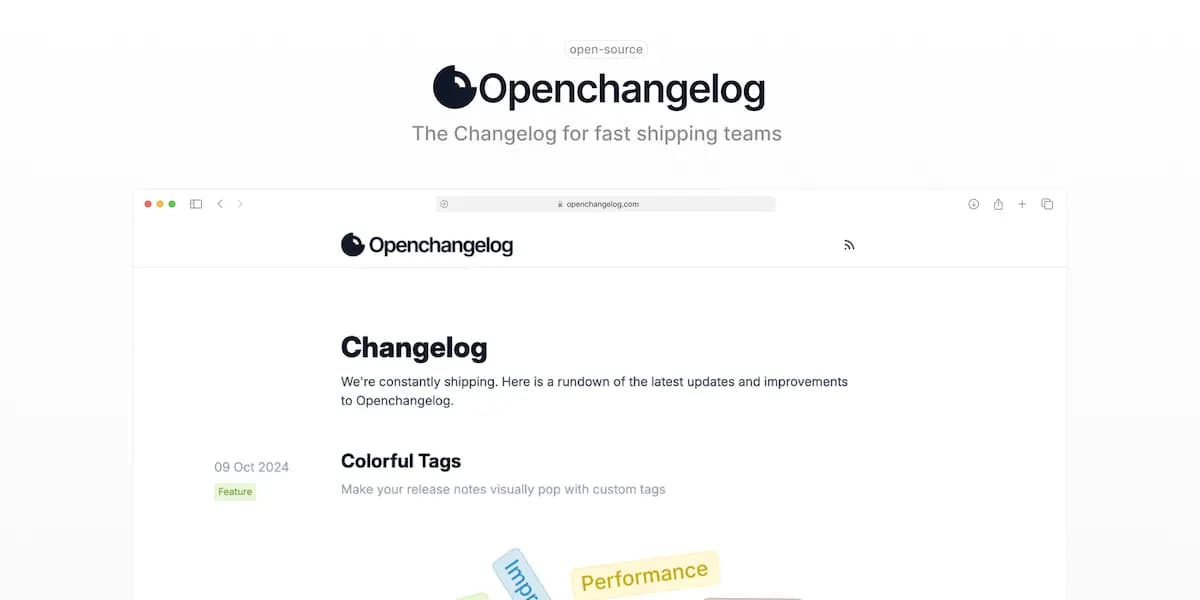
Openchangelog
Openchangelog allows development teams to easily integrate release notes into their workflow, ensuring users are always updated on product changes. It offers a customizable changelog with light and dark themes, custom domain support, and password protection for sensitive communications. Key features include an automatic RSS feed for updates, full-text search for release notes, and direct synchronization with GitHub repositories. The platform supports self-hosting and provides SDKs for easy integration, such as with Next.js. Openchangelog aims to simplify the process of publishing and managing product updates, making it an essential tool for maintaining transparent communication with users.
SpeedTorch
SpeedTorch is a Python library designed to optimize data transfer between CPU and GPU in PyTorch, particularly for deep learning applications. It achieves faster transfer speeds for pinned CPU to GPU tensors and GPU to CPU tensors, in some cases up to 410x faster for GPU to CPU transfers. The library is especially beneficial for training large numbers of embeddings by allowing them to be hosted on CPU RAM when idle, thereby sparing GPU RAM. It also enables the use of non-sparse optimizers like Adamax for sparse training, which is typically not supported. SpeedTorch leverages Cupy tensors and custom memory allocators to achieve its performance gains, making it a valuable tool for developers working with memory-intensive PyTorch models.
text_renderer
text_renderer is an open-source tool designed to generate synthetic text line images, primarily for training deep learning Optical Character Recognition (OCR) models like CRNN. It features a modular design, allowing users to easily add different components such as Corpus, Effect, and Layout. A key capability is its integration with Albumentations, providing a wide range of image augmentation effects to enhance dataset diversity. The tool supports rendering multiple corpora on a single image with varying effects, generating vertical text, and creating LMDB datasets compatible with PaddleOCR. It also includes a web-based font viewer and corpus sampler for character balance.
UCR_Time_Series_Classification_Deep_Learning_Baseline
UCR_Time_Series_Classification_Deep_Learning_Baseline is an open-source repository designed to provide a foundational deep learning model for time series classification. It specifically utilizes fully convolutional neural networks (FCNs) to establish a robust baseline for research and application. The tool is tailored for univariate time series data, making it suitable for a wide array of domains including finance, industrial applications, and healthcare, where time-dependent data analysis is crucial. It supports both representation learning and classification tasks, offering a valuable resource for data scientists and researchers looking to explore or implement deep learning solutions for time series analysis.
UER-py
UER-py (Universal Encoder Representations) is an open-source framework designed for pre-training on general-domain corpora and fine-tuning on downstream NLP tasks using PyTorch. It emphasizes model modularity, allowing users to combine various embedding, encoder, decoder, and target modules to construct custom pre-training models. The toolkit supports CPU, single GPU, and distributed training modes, making it versatile for different computational environments. UER-py also provides a comprehensive model zoo with pre-trained models of diverse properties, facilitating their direct use in various applications. It has been tested for reproducibility against original implementations of models like BERT, GPT-2, ELMo, and T5, and offers solutions for numerous NLP competitions.