
Coding & Development
Browsing page 79 of AI tools for Code Assistants in Coding & Development. Sorted by confidence score — our independent quality rating.

web-codegen-scorer
Web Codegen Scorer is a robust tool designed for evaluating the quality of web code generated by Large Language Models (LLMs). It enables developers to make evidence-based decisions regarding AI-generated code, offering features to iterate on system prompts, compare code quality across various models, and monitor generated code quality over time. The tool focuses specifically on web code and utilizes well-established measures of code quality, including built-in checks for build success, runtime errors, accessibility, security, LLM rating, and coding best practices. It also supports automatic repair attempts for detected issues and provides an intuitive report viewer UI to compare results.
WPeChatGPT
WPeChatGPT is an IDA plugin designed to assist reverse engineers and security analysts in understanding binary files more efficiently. Leveraging advanced AI models such as OpenAI's gpt-3.5-turbo and DeepSeek, it provides capabilities like analyzing function usage environments, intended purposes, and renaming variables for clarity. The plugin can also attempt to restore functions using Python, particularly for smaller code blocks, and identify potential vulnerabilities within functions. Furthermore, it can generate corresponding exploits for identified vulnerable functions and offers an automatic binary file analysis feature through Auto-WPeGPT. This tool significantly streamlines the binary analysis workflow by integrating AI-powered insights directly into the IDA environment.
XcodeLLMEligible
XcodeLLMEligible is an open-source project designed to enable Xcode LLM, Apple Intelligence, and iPhone Mirroring functionalities on macOS versions and hardware configurations that are not officially supported by Apple. The tool achieves this by overriding Darwin eligibility checks, offering two primary methods: a 'util tool' method that requires a one-time SIP disable and boot-arg modification, and an 'override file' method that does not require SIP to be disabled at all. It supports macOS 15.0 - 15.3.1 and has been tested with XcodeLLM, Apple Intelligence, and ChatGPT integration on Mac mini (M4 Pro, 2024) running macOS 15.2. The project is intended for learning and research purposes, allowing users to permanently access these features on their Macs.

Metaflow.org
Metaflow.org is an open-source framework designed to simplify the development, management, and deployment of real-life ML, AI, and data science projects. It allows users to build robust workflows using any Python libraries for models and business logic, managing dependencies locally and in the cloud. Key features include automatic versioning of variables for experiment tracking and debugging, and seamless orchestration of workflows in plain Python, enabling local development and debugging before deployment to production without code changes. Metaflow facilitates scaling to the cloud, leveraging GPUs, multiple cores, and large memory, and integrates with major cloud providers like AWS, Azure, and Google Cloud, or custom Kubernetes clusters. It was originally developed at Netflix to address the demanding needs of ML/AI engineers and data scientists.
Lovable
Lovable is an AI-powered full-stack development platform designed to accelerate the creation of web applications and websites. Users can describe their desired app or website through natural language chat or by providing screenshots and documents, and the AI will build a working prototype in real-time. The platform supports iterative refinement with simple feedback and one-click deployment. Lovable builds front-end applications using React, Tailwind, and Vite, and can connect to OpenAPI backends, with Supabase support for data persistence and authentication in alpha. It integrates with GitHub for source control and allows users to own their projects and code. The platform offers features like real-time execution visualization, error detection with an auto-repair option, and version history for tracking changes.
Moderne
Moderne is an AI-driven platform that builds knowledge, discovery, and execution tools for coding agents. It enables agents to operate faster, more accurately, and at significantly lower cost across real-world software systems. Powered by the OpenRewrite Lossless Semantic Tree (LST), Moderne offers a comprehensive context model for understanding and transforming code at scale. The platform provides tools for deterministic framework and language upgrades, bulk vulnerability remediation, multi-repository change coordination, precomputed context registries, and high-performance organization-wide search. Moderne aims to improve agent performance, reduce token costs, accelerate change velocity, and ensure multi-agent enterprise readiness.

Tessl
Tessl is an agent enablement platform designed to help teams build reliable AI-native software. It functions as a package manager for agent skills and context, allowing developers to find, install, version, and evaluate the skills their coding agents rely on. This ensures agents behave consistently across various tools and projects. Tessl enables organizations to turn internal APIs, libraries, and conventions into agent-usable skills, documentation, and rules, reducing retries and review cycles. The platform also provides evaluation capabilities to test skills against structured best practices and real-world scenarios, preventing regressions as systems evolve. By offering a single source of truth for skills and context, Tessl promotes reusability across agents, models, and development environments, avoiding lock-in and ensuring consistent behavior.
tflite_gles_app
tflite_gles_app offers GPU-accelerated deep learning inference applications, leveraging TensorFlow Lite GPU Delegate and TensorRT for enhanced performance. This open-source project is designed for platforms such as Raspberry Pi, NVIDIA Jetson, and Linux PCs. It includes a variety of applications covering tasks like lightweight and high-accuracy face detection (Blazeface, DBFace), age and gender estimation, image classification, object detection, 3D facial surface geometry estimation (Facemesh), hair segmentation, 3D handpose estimation, iris detection, 3D object detection, various pose estimations (Blazepose, Posenet), 3D human pose estimation, depth estimation, semantic segmentation, face segmentation, selfie-to-anime transformation, artistic style transfer, and text detection. The repository provides detailed instructions for building and running applications on different target environments, supporting both live camera and recorded video file inputs.

Wizerr AI
Wizerr AI is a hardware intelligence platform designed for electronics companies, offering an AI-native infrastructure that transforms component and supply data into real-time, engineer-grade decisions. It leverages a continuously evolving Component Intelligence Graph built from millions of electronic component datasheets and supply signals. Key features include a BOM Optimizer for streamlining component selection, identifying functional equivalents beyond part numbers, and finding compatible second sources with defensible comparisons. The platform provides real-time commercial insights, including pricing, stock, lead times, and risk information, enabling informed choices for engineering and procurement teams. Wizerr AI also offers a deep matching engine for pin-to-pin, package, and electrical matches, datasheet chat and comparison, and collaboration tools for sharing results and persistent workspaces. It's built for deep component intelligence with a patent-pending ELX engine and domain-tuned AI, providing explainable intelligence with confidence scores.

Aspen
Aspen is a free, native API testing application designed for macOS, focusing specifically on REST APIs. It operates with a zero-trust policy, meaning all operations are performed locally on your machine without requiring a login, ensuring high data security and privacy. The tool integrates an AI assistant, named Alfred, to significantly speed up API integrations and development by generating data models, OpenAPI Specifications, and integration code. Aspen also features Collections, allowing users to organize, import, export, and share API requests, facilitating teamwork and reuse. It supports importing from tools like Postman, making it a versatile option for developers seeking an efficient and secure API testing solution.
EEG-DL
EEG-DL is a comprehensive Deep Learning library specifically designed for Electroencephalography (EEG) signal classification, implemented using TensorFlow. This open-source library offers a wide array of state-of-the-art deep learning algorithms, including various CNN, ResNet, DenseNet, FCN, Siamese Networks, GCN, Bayesian CNNs, RNN, LSTM, GRU, and Transformer models. It supports EEG Motor Imagery (MI) benchmark datasets and provides evaluation criteria such as Confusion Matrix, Accuracy, Precision, Recall, F1 Score, Kappa Coefficient, and ROC/AUC. The library is continuously updated with the latest advancements in deep learning for EEG tasks, making it a valuable resource for researchers and developers in the field.
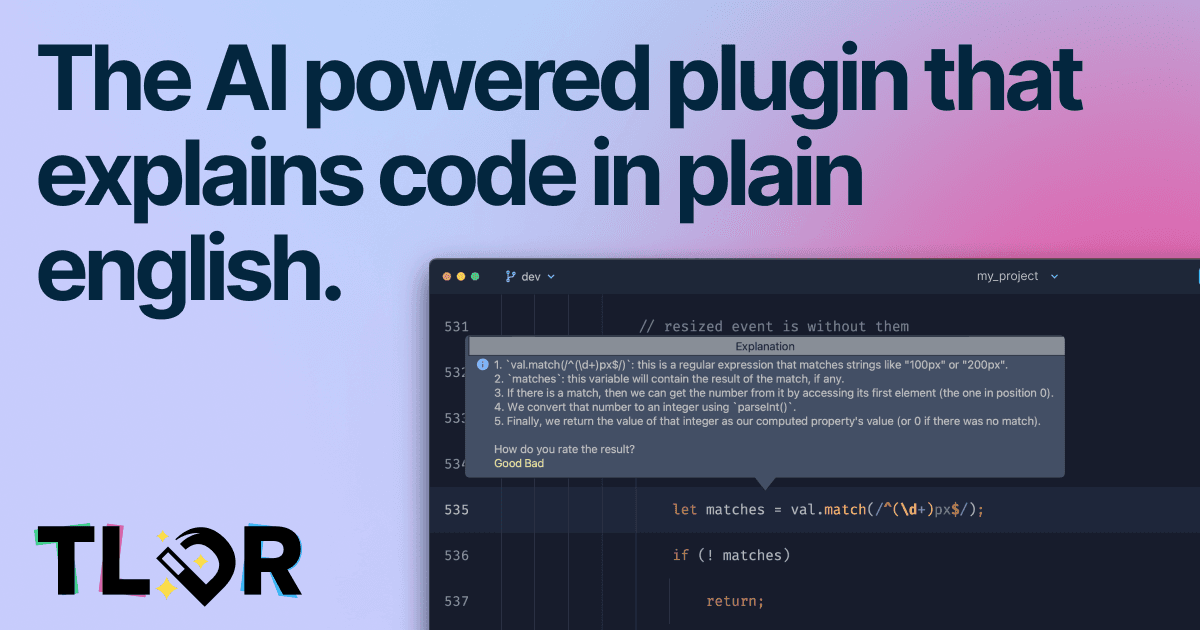
TLDR
TLDR is an AI-powered IDE plugin designed to help developers quickly understand code by explaining it in plain English. It supports nearly all programming languages, making it a versatile tool for various development environments. The plugin is particularly useful for deciphering complex elements like regular expressions and SQL queries, as well as for gaining a rapid understanding of new codebases. TLDR aims to save developers time by providing instant summaries of code, allowing them to build mental context efficiently. It offers a free version with limited credits and paid tiers for individual and organizational use, all accessible via the JetBrains plugin marketplace.
Aigility AI
Aigility AI is designed to help enterprises build and ship production-grade, privacy-first AI applications in minutes, not months. The platform aims to be a universal layer for fast, private, and domain-specific AI, eliminating trade-offs, data leaks, and brittle workflows. It focuses on uniting speed, privacy, domain intelligence, reliability, and reusability within a single platform. Aigility AI is currently in early access, with a focus on delivering enterprise-level AI solutions that are both efficient and secure, catering to the needs of businesses looking to integrate advanced AI capabilities without compromising data integrity or development timelines.
OnsetLab
OnsetLab is an open-source framework designed for developers to run tool-calling AI agents locally. This platform empowers users to transform small language models into powerful agents capable of interacting with real tools and operating within their local environments. A key advantage of OnsetLab is its flexibility, offering no cloud lock-in, which ensures data privacy and control. Developers can deploy their agents using various methods, including Python, Docker, or vLLM, providing versatility in integration and deployment strategies. This framework is ideal for those who require robust, locally-run AI solutions without relying on external cloud infrastructure.
dev-gpt
Dev-GPT is an open-source AI tool designed to automate the microservice development process, acting as a virtual development team. Users provide a description of the microservice they want to build, and Dev-GPT, comprising a Product Manager, Developer, and DevOps AI, handles the entire lifecycle from concept to deployment. It iteratively builds and tests the microservice, generating code, tests, and Dockerfiles. The tool supports both gpt-3.5-turbo and gpt-4 models, allowing for cost-effective or more complex microservice generation. It can run microservices locally in Docker or deploy them to the cloud via Jina AI, and even generates a Streamlit playground for testing.
DeepSite v4
DeepSite v4 is an AI-powered web development tool designed to help users build, design, and deploy stunning websites quickly and without requiring code. It features multi-page capabilities for creating complex websites with dynamic routing and navigation, suitable for everything from simple landing pages to full web applications. The platform offers instant auto-deployment and free hosting with a global CDN for fast performance. DeepSite leverages cutting-edge open-source AI models like DeepSeek, MiniMax, and Kimi, ensuring transparency and customization. Its intuitive interface caters to both developers and non-developers, and it integrates seamlessly with Hugging Face models and datasets for advanced AI capabilities. Optimized for speed, DeepSite utilizes edge computing and smart caching.
DeepLearnToolbox
DeepLearnToolbox is a Matlab/Octave toolbox designed for deep learning research and development. It includes various deep learning models such as Deep Belief Nets (DBN), Stacked Autoencoders (SAE), Convolutional Neural Nets (CNN), Convolutional Autoencoders (CAE), and vanilla Neural Nets (NN). Each model comes with practical examples to guide users through implementation and experimentation. While the toolbox was a valuable resource, it is no longer maintained and is considered outdated. The creator recommends using more modern and actively developed deep learning frameworks like Theano, Torch, or TensorFlow for current projects.
dllm
dLLM is an open-source library designed to bring transparency and reproducibility to the development pipeline of diffusion language models. It offers scalable training pipelines, supporting advanced features like LoRA, DeepSpeed, and FSDP, based on the transformers Trainer. The library also provides unified evaluation pipelines built on lm-evaluation-harness, simplifying inference and customization. dLLM includes minimal training, inference, and evaluation recipes for open-weight models such as LLaDA and Dream, and implements various training algorithms like MDLM (masked diffusion) and BD3LM (block diffusion). It also supports accelerated inference and evaluation with Fast-dLLM, offering cache and confidence-threshold decoding.
Microservices-Based-Algorithmic-Trading-System
MBATS is an open-source, Docker-based platform designed for quantitative analysts and algorithmic traders to develop, test, and deploy trading strategies, with a strong emphasis on machine learning. It simplifies the process of bringing trading ideas to production by integrating various open-source tools like Backtrader for strategy development, MLflow for managing machine learning models, and PostgreSQL for market data storage. The platform also includes Apache Airflow for orchestrating jobs and Apache Superset for visualizing backtested and live strategy performance. MBATS offers a modular architecture, making it easy to scale and migrate components to cloud environments like GCP, and supports multiple symbol and strategy types for both backtesting and live trading.

Alfred AI
Alfred AI is an intelligent API assistant designed to transform developer portals by automating workflows and accelerating API operations. It can generate integration code and data models in any language and framework, simplifying the integration process for customers and speeding up onboarding. Users can ask Alfred anything about their API using natural language, and it will instantly provide answers, discover endpoints, and understand API structures. This tool aims to reduce integration support requests by 15x and accelerate API integrations, discovery, and adoption by 10x. Alfred AI can be easily embedded into any developer portal with a single line of code and an OpenAPI Specification, making it a powerful addition for enhancing developer experience and boosting revenue.
Open-Claude-Cowork
Open-Claude-Cowork is an open-source desktop AI assistant designed to streamline programming, file management, and a wide array of other tasks. It serves as a genuine AI collaboration partner, moving beyond simple GUIs to offer a more interactive experience. Unlike terminal-only solutions, Agent Cowork runs as a native desktop application, providing visual feedback and convenient session management across projects. It reuses existing Claude settings, eliminating the need for a separate development environment or Claude Code installation. This tool is particularly beneficial for users seeking a persistent desktop AI assistant with visual insights into AI operations and efficient project organization.
opcode
opcode is a robust desktop application built with Tauri 2, designed to enhance interaction with Claude Code. It offers a visual interface for managing Claude Code sessions, creating custom AI agents with specific system prompts and behaviors, and tracking usage analytics including API costs and token breakdowns. The tool features a visual project browser, session history, smart search, and a timeline with checkpoints for session versioning and instant restore. Additionally, opcode includes an MCP Server Manager for configuring Model Context Protocol servers and a built-in editor for CLAUDE.md files with live preview and syntax highlighting, making AI-assisted development more intuitive and productive.
self-attention-cv
Self-attention-cv is an open-source repository offering implementations of diverse self-attention mechanisms specifically tailored for computer vision applications. Built in PyTorch, it leverages `einsum` and `einops` for efficient and flexible module creation. The repository serves as an ongoing collection of building blocks, enabling developers to integrate advanced attention models into their projects. It supports a range of computer vision tasks, including image recognition and segmentation, with examples for Multi-head attention, Axial attention, Vision Transformers (ViT), and TransUnet. It also includes various positional embedding implementations.

On-Call Health
On-Call Health is an open-source tool designed to proactively identify early warning signs of overload in on-call engineers, aiming to prevent burnout. It integrates with popular incident management and project tracking tools like Rootly, PagerDuty, GitHub, Linear, and Jira to gather relevant data. The tool combines this data with self-reported check-ins from engineers and tracks various metrics against both personal and team baselines. By providing insights into potential overwork, On-Call Health helps organizations maintain a sustainable on-call rotation and improve engineer well-being. Its open-source nature allows for transparency and community contributions.