
Coding & Development
Browsing page 83 of AI tools for Code Assistants in Coding & Development. Sorted by confidence score — our independent quality rating.

Agent Bar
Agent Bar is a menu bar application designed to streamline the coding workflow for developers using Claude Code. It provides a clean, native user interface that keeps Claude Code sessions readily accessible, allowing users to launch sessions in any project folder and monitor their status in real time. Developers can review messages, approve or deny tool actions, and organize multiple sessions efficiently. The tool also includes optional voice dictation for quick prompt capture, minimizing context switching and enabling faster responses. By integrating Claude Code directly into the macOS menu bar, Agent Bar helps developers stay focused and productive without leaving their desktop environment.
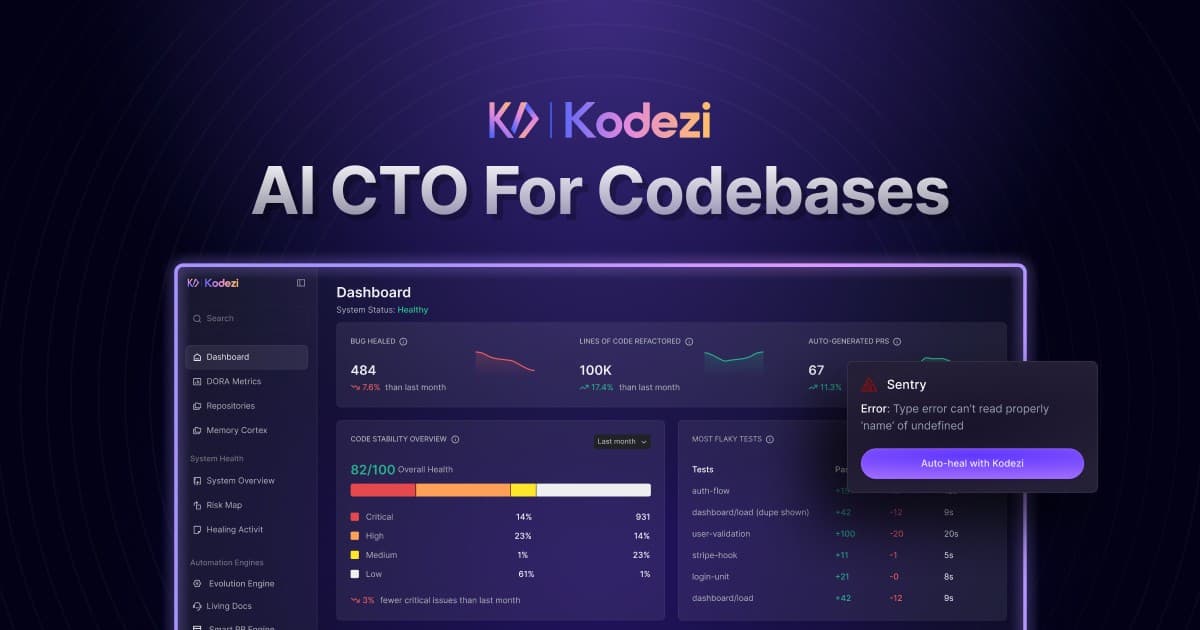
Kodezi
Kodezi functions as an AI CTO, providing an autonomous operating system for modern codebases. It is designed to maintain, evolve, and govern software, ensuring it remains healthy, scalable, and always ready to ship. The platform seamlessly integrates across your development stack, offering features like autonomous bug fixing, real-time code refinement, and automatic enforcement of best practices. Kodezi also includes vulnerability detection and error recovery, proactively identifying and healing security risks before code reaches production. Additionally, it intelligently generates code, API definitions, and test coverage, ensuring every update is complete and reliable. This comprehensive approach helps developers streamline their workflow and improve code quality.
sshx
sshx offers a secure, web-based platform for sharing and collaborating on terminals. Users can invite others by sharing a unique browser link, enabling real-time collaboration with remote cursors and chat on a multiplayer infinite canvas. The tool is designed for speed and security, featuring end-to-end encryption to ensure data privacy, as the server never sees what is being typed. It supports cross-platform use with a command-line tool available for macOS, Linux, and Windows. sshx is ideal for teaching, debugging, or cloud access, allowing users to move and resize multiple terminals in any arrangement and see live presence of other participants. Its ultra-fast mesh networking connects users to the nearest distributed peer in a global network.

Zenvault
Zenvault is a CLI-first project control plane designed to streamline developer experience by centralizing repositories, environment variables, and resources. It allows for one-command onboarding to any project, eliminating the need for manual setup documentation and fragile .env files. Zenvault ensures that code runs correctly and consistently across all environments and machines, improving team productivity and reducing setup friction. Key features include secure secrets management with AES-256 encryption, environment variables per service, and audit logging. It integrates seamlessly into existing workflows, providing a single source of truth for project configuration and enabling secure team collaboration with granular access control.
Cursor.sh
Cursor is an advanced AI-powered coding environment designed to significantly boost developer productivity. It offers real-time code suggestions, intelligent code generation, and debugging assistance, integrating seamlessly into the development workflow. Key features include autonomous agents that can build, test, and demo features, a specialized Tab model for accurate autocomplete, and comprehensive codebase understanding. Cursor supports various cutting-edge models from OpenAI, Anthropic, Gemini, xAI, and its own, allowing users to choose the best AI for each task. It runs across multiple platforms, including desktop, CLI, and integrates with tools like Slack and GitHub for collaborative development and PR reviews. Trusted by major enterprises, Cursor aims to accelerate software creation securely and at scale.
deepC
deepC is a vendor-independent deep learning library, compiler, and inference framework specifically engineered for small form-factor devices such as microcontrollers, IoT, and edge devices. It allows for the deployment of deep learning models in resource-constrained environments, boosting the intelligence of billions of devices without relying on expensive hardware or constant internet connections. The framework includes an ahead-of-time compiler that produces optimized executables based on the LLVM compiler toolchain, specialized for deep neural networks with ONNX as the front end. deepC supports various architectures like Arm, Armv7, Arm64, AMD64, and ppc64le, and is compatible with operating systems including Ubuntu, CentOS, Arch Linux, Manjaro, Windows, and Mac OS.
Code Companion
Code Companion is an AI-powered programming tutor designed to assist users with various programming problems. Leveraging the advanced capabilities of GPT-4, it provides real-time help and feedback, making it a valuable resource for improving coding skills and efficiency. The tool offers guidance and suggestions, acting as a virtual mentor for developers. It aims to streamline the learning and development process by offering immediate support and insights into coding challenges. This makes it suitable for individuals looking to enhance their programming proficiency and tackle complex problems with AI-driven assistance.
CodeCompanion
CodeCompanion is an AI coding assistant that aims to enhance developer productivity by automating various coding tasks. It is designed to integrate seamlessly with both new and existing projects, offering features like semantic code search and the ability to follow custom instructions. The tool focuses on handling mundane programming chores, such as project setup and deployment, to free up developers for more complex work. A key differentiator highlighted in its previous description is its commitment to data security, ensuring that code remains local. However, the official website for CodeCompanion is currently inaccessible, indicating a potential change in its status or availability.
AIShader
AIShader is a proof-of-concept tool designed to generate shaders for Unity using natural language prompts, powered by ChatGPT. This innovative solution allows developers to describe the desired shader effect in plain English, and the AI translates it into functional Unity shader code. To utilize AIShader, users must obtain an API key from OpenAI and configure it within the Unity Project Settings. A crucial consideration for users is that the API key is stored in `UserSettings/AIShaderSettings.asset`, necessitating its exclusion when sharing projects to maintain security and prevent unauthorized access to the OpenAI API. This tool streamlines the shader creation process, making it more accessible for developers who may not be deeply familiar with shader programming languages.
hasktorch
Hasktorch is an open-source library designed for tensors and neural networks, specifically tailored for the Haskell programming language. It leverages the core C++ libraries that power PyTorch, enabling Haskell developers to engage in AI and deep learning tasks. The project is under active development, with its second major release (0.2) available on Hackage and Nixpkgs. Hasktorch provides comprehensive documentation, including introductory videos and detailed getting started guides for various environments like Linux, macOS, and Docker, supporting both CPU and CUDA configurations. It also addresses known issues such as MPS support on macOS and tensor movement to CUDA, offering solutions and workarounds for common challenges.
hebel
Hebel is an open-source Python library for deep learning, leveraging GPU acceleration through CUDA via PyCUDA. It provides functionalities for implementing neural network models, specifically feed-forward networks for classification and regression. The library offers a range of activation functions and advanced training methods, including momentum, Nesterov momentum, dropout, and early stopping, along with L1 and L2 weight decay for regularization. While no longer actively developed, it served as a foundational tool for researchers and developers working with deep learning models on Linux, Windows, and potentially Mac OS X. Hebel is available on PyPi for easy installation.
hands-on-train-and-deploy-ml
Hands-on-train-and-deploy-ml is a comprehensive GitHub repository offering a step-by-step tutorial for building and deploying a machine learning REST API. The project focuses on predicting crypto prices, providing a practical guide for ML engineers to move beyond notebooks. It covers essential MLOps frameworks and tools, including CometML for experiment tracking and model registry, Cerebrium for serverless deployment, and GitHub Actions for automating safe deployments. The tutorial is structured into three main parts: model training, model deployment as a REST API, and automation with GitHub Actions and Model Registry. It emphasizes a 100% serverless stack, making it accessible without complex infrastructure setup.
keras-cv
KerasCV is a comprehensive open-source library offering modular computer vision components designed for seamless integration with Keras 3, supporting TensorFlow, JAX, and PyTorch backends. It provides a rich collection of models, layers, metrics, and callbacks for common computer vision tasks such as data augmentation, classification, object detection, segmentation, and image generation. Developers can leverage KerasCV to quickly assemble production-grade, state-of-the-art training and inference pipelines. The library ensures the same level of polish and backward compatibility as the core Keras API, maintained by the Keras team. While KerasCV is transitioning to KerasHub for new vision model development, existing functionalities remain robust and supported.
nilearn
Nilearn is an open-source Python library designed for machine learning in neuroimaging, offering approachable and versatile analyses of brain volumes and surfaces. It provides a comprehensive suite of statistical and machine-learning tools, accompanied by instructive documentation and a supportive community. The library facilitates general linear model (GLM) based analysis and integrates with the scikit-learn Python toolbox for advanced multivariate statistics. This enables applications such as predictive modeling, classification, decoding, and connectivity analysis within neuroimaging research. Nilearn is ideal for researchers and data scientists working with brain imaging data, providing the necessary tools to implement complex analytical workflows.
mahout
Apache Mahout is an open-source project designed to facilitate the rapid creation of scalable and performant machine learning applications. While historically known for classical machine learning algorithms like collaborative filtering, clustering, and classification, the project has evolved significantly. The current focus includes Qumat, a high-level Python library for quantum computing, enabling users to build quantum circuits with standard gates and run them on various backends like Qiskit, Cirq, or Amazon Braket. Additionally, it features QDP (Quantum Data Plane) for GPU-accelerated encoding of classical data into quantum states, supporting zero-copy tensor transfer with PyTorch, NumPy, and TensorFlow. This makes Mahout a versatile tool for both traditional and emerging quantum machine learning applications.
Stately
Stately is a visual software modeling platform designed to help developers and teams build and deploy application logic using state machines and statecharts. It provides a drag-and-drop editor that allows users to design complex systems, generate code, and create documentation. The platform integrates with XState, an open-source library for managing state in JavaScript and TypeScript applications, ensuring no vendor lock-in. Stately supports bidirectional updates between code and visualization, allowing users to work in their preferred environment. It can also visualize existing Redux or Zustand code and offers an IDE extension for VS Code. Key features include AI-assisted flow generation, test generation, and the ability to export code in JavaScript or TypeScript, making it a comprehensive solution for robust logic development.
AI SEO Tools: Rank & Grow
AI SEO Tools: Rank & Grow is an AI-powered mobile application designed to assist content creators, bloggers, YouTubers, marketers, and small business owners in enhancing their digital growth. The app simplifies content optimization by providing instant, AI-driven suggestions for keywords, titles, content, and tags. It features a user-friendly interface that combines powerful SEO tools like Keyword Generator, Title Generator, Content Generator, Viral Video Ideas, Description Generator, and Tag Generator. This eliminates the need for complex tools or lengthy research, allowing users to save time and grow their online presence faster. It's ideal for generating optimized ideas for blog posts, videos, and social media captions.
Coding AI
Welcome to Coding AI, the ultimate coding companion and learning platform designed for both beginners and professionals. This mobile application allows users to dive into the world of programming and artificial intelligence, exploring various coding languages such as Python, Java, JavaScript, C++, and more. It offers comprehensive tutorials and resources, making complex coding concepts accessible. A key feature is the real-time AI assistance, which enhances coding efficiency, minimizes errors, and helps create flawless projects. Users can also collaborate with fellow developers and share their projects within the app's vibrant community, fostering feedback, idea exchange, and continuous skill improvement.

Appforcestudio
AppForceStudio is a comprehensive AI-powered platform designed to streamline the creation, testing, and deployment of mobile and web applications. It allows users to build apps from prompts, screenshots, or existing code, offering instant preview and deployment capabilities. The platform features an intuitive visual canvas for mapping out screens and user flows, similar to a design whiteboard but optimized for apps. Key functionalities include AI-driven code generation with intelligent suggestions, advanced code editing with live previews, and a unified design system tool for consistent branding. AppForceStudio supports multi-language native code export for iOS, Android, and web platforms, making it ideal for turning app ideas into reality quickly without extensive coding knowledge.
open-swe
Open-SWE is an open-source framework designed for building internal coding agents within organizations, mirroring the sophisticated systems used by elite engineering teams. Built upon LangGraph and Deep Agents, it offers a robust architecture that includes isolated cloud sandboxes for task execution, curated toolsets for focused operations, and advanced context engineering via AGENTS.md files and source context. The platform supports subagent orchestration and middleware for flexible workflow customization. It integrates seamlessly with communication platforms like Slack and Linear, allowing engineers to invoke agents directly from their existing workflows and receive real-time updates. Open-SWE also features built-in GitHub OAuth and automatic pull request creation, streamlining the development process.
ptan
Ptan, or PyTorch Agent Net, is an open-source reinforcement learning toolkit designed for PyTorch. It serves as a reimplementation of the AgentNet library, providing a robust framework for developing and experimenting with AI agents. The library was notably used in the "Deep Reinforcement Learning Hands-On" book, with sample sources available for reference. Ptan supports various PyTorch versions through different code branches, ensuring compatibility and up-to-date dependencies. It includes features like experience sources and integrates with essential libraries such as PyTorch Ignite, OpenAI Gym, Python OpenCV, and TensorBoardX, making it a comprehensive solution for researchers and developers in the reinforcement learning domain.
python_autocomplete
python_autocomplete is an open-source project that leverages a simple LSTM (Long Short-Term Memory) neural network to provide autocompletion for Python code. The tool is designed to predict and suggest code completions, potentially saving a significant number of keystrokes—up to 30% in most files and nearly 50% in some. It performs beam search to find predictions up to approximately 10 characters ahead. The model is trained on tokenized Python code, after cleaning comments, strings, and blank lines, and a pre-trained model checkpoint is included. While currently inefficient for direct editor integration, it demonstrates the potential of neural networks for code assistance. A simpler, maintained version is available at lab-ml/source_code_modelling.
SolidGPT
SolidGPT is an AI searching assistant specifically designed for developers, facilitating efficient code and workspace semantic search. It helps developers quickly find relevant information within their codebase and Notion documents, eliminating the need for constant context switching. The tool is available as a VSCode Extension, offering a seamless integration into the development workflow. Users can onboard their codebase and Notion pages, then ask questions to get instant answers, saving time on hunting for code or documentation. SolidGPT emphasizes data safety, stating it does not collect user data and uses OpenAI series models, requiring users to agree to OpenAI's terms of use.
Cosine AI
Cosine AI is an advanced AI software engineering agent designed to streamline complex coding tasks without compromising maintainability or visibility. It operates across desktop, cloud, and terminal environments, integrating seamlessly into existing workflows. Cosine AI utilizes its proprietary Lumen models, optimized for production-first coding, focusing on maintainable, readable, and production-quality outputs rather than bloated code. It excels at reasoning across intricate architectures, legacy infrastructure, and diverse codebases, including enterprise and niche languages like COBOL, Fortran, Verilog, Rust, and complex SQL. The platform supports the entire SDLC, from work scoping and development to testing and deployment, offering flexible deployment options including public cloud, dedicated tenant, and fully air-gapped solutions for stringent security requirements.