
Coding & Development
Browsing page 87 of AI tools for Code Assistants in Coding & Development. Sorted by confidence score — our independent quality rating.

OpenChem
OpenChem is a deep learning toolkit specifically designed for computational chemistry and drug design research, built with a PyTorch backend. Its primary goal is to simplify the application of deep learning models for researchers in these fields. Key features include a modular design with a unified API, allowing for easy combination of different modules, and the ability to build new models using only a configuration file. The toolkit supports fast training with multi-GPU capabilities and provides utilities for data preprocessing. It also integrates with Tensorboard for visualization. OpenChem handles various tasks such as classification, regression, multi-task learning, and generative models, supporting data types like character sequences (SMILES, amino acids) and molecular graphs, with automatic conversion of SMILES to graphs.

Agili8
Agili8 offers XRAI® Vision, an in-house developed software that leverages extended reality glasses and remote software to connect specialists with operators. The platform aims to enhance real-time insights, streamline workflows, and improve health, safety, and workforce capabilities. Key features include XR visualization for real-time insights, AI assistance for optimizing stock, logistics, and asset management, and computer vision for 3D "live hands-on" virtual guidance. Agili8's patented custom solutions are purpose-built for various sectors including Health, Industrial, Education, and Safety, providing AI assistance and expert guidance to frontline and remote workers for critical decision-making. The software has been rigorously tested in harsh conditions and has a proven track record of reducing human errors, decreasing downtime, increasing profit, and improving customer satisfaction.

PseudoEditor
PseudoEditor offers a free online integrated development environment (IDE) specifically designed for writing and compiling pseudocode. It aims to simplify the process of writing pseudocode by providing features such as dynamic syntax highlighting for keywords, functions, and data types, as well as autocomplete functionality. The platform includes an advanced pseudocode compiler that allows users to test and verify their pseudocode with instant execution. Users can save their projects to the cloud by creating a free account, enabling access and editing from any device. PseudoEditor supports various pseudocode variations and styles, including major exam board specifications like AQA, OCR, CIE, Edexcel, and IB, with toggleable syntax rules. A Pro version is available, offering an AI Tutor, intelligent code generators, and code converters to languages like Python and C++, along with an ad-free experience.
qlib
Qlib is an AI-oriented quantitative investment platform developed by Microsoft, designed to empower quantitative research using AI technology. It supports diverse machine learning modeling paradigms, including supervised learning and reinforcement learning, making it suitable for various financial analysis tasks. The platform is equipped with tools to automate the research and development process, streamlining the creation and testing of investment strategies. As an open-source project available on GitHub, Qlib provides a robust framework for developers and data scientists to build and experiment with advanced AI models in the finance domain, fostering innovation in quantitative investment.
rulesync
rulesync is an open-source Node.js CLI tool designed to automate the generation of configuration files for AI coding agents. This tool is particularly useful for developers and teams working on AI development projects, as it streamlines workflows and simplifies the management of agent configurations. By automating these tasks, rulesync helps to ensure consistency and reduce manual effort, fostering better collaboration within development teams. Its command-line interface makes it accessible for integration into existing development pipelines, providing a flexible solution for managing the underlying settings that drive AI coding agents.
Release.ai
Release.ai provides a platform for developers to easily deploy and integrate AI models into their applications and development workflows. It focuses on private and secure integration, allowing users to leverage AI capabilities without compromising data integrity. The tool is designed to streamline the deployment process, enabling production-ready AI models to be operational in minutes. This accelerates the development cycle and allows teams to quickly incorporate advanced AI functionalities into their projects, enhancing productivity and decision-making within their development environments.

driveblocks
driveblocks specializes in developing advanced perception and autonomy software and AI models for off-road vehicles across agriculture, construction, and defense sectors. Unlike systems designed for highways, driveblocks' technology is purpose-built to operate reliably under harsh conditions, including dust, snow, fog, dense vegetation, and complex hilly terrain. The platform processes multi-modal sensor data through AI algorithms, applies sensor-fusion strategies to generate real-time 3D world models, and enables local behavior decisions like evasion and terrain-aware navigation. Its Physical AI models are trained and validated in challenging environments, ensuring efficient operation on production hardware with industrial-grade sensors and various AI accelerators. driveblocks integrates seamlessly with existing system architectures, supporting different sensor choices and compute units.
Sherlock
Sherlock is an open-source JavaScript library designed to parse natural language event descriptions into structured data. It excels at interpreting plain English phrases like "The party is tomorrow from 3pm to 5pm" and returning an object with properties such as `eventTitle`, `startDate`, `endDate`, and `isAllDay`. This tool supports a wide variety of input formats common in US English, handling times, days, date ranges, and event titles. For enhanced customization, Sherlock can be paired with Watson, which provides preprocessor and postprocessor layers to manipulate input strings or modify returned data, making it adaptable for specific application logic or data validation needs. Installation is straightforward via npm.
StateSmith
StateSmith is a cross-platform, free/open-source tool designed for generating state machines in various programming languages. It creates human-readable code with zero dependencies, making it highly suitable for diverse applications ranging from tiny bare metal microcontrollers to video games, apps, and web platforms. A key differentiator is its avoidance of dynamic memory allocations, which is crucial for safety and performance-critical embedded systems. StateSmith ensures the diagram is always accurate by generating fully working code directly from the documentation, eliminating the common problem of manual synchronization between code and diagrams. The tool boasts a strong suite of over 730 integration tests that verify behavior across all supported languages, providing confidence in its reliability and allowing for refactoring without breaking specified behavior.
sqlchat
sqlchat is an innovative chat-based SQL client designed to simplify database interactions through natural language. This tool enables users to perform a wide range of SQL operations, including querying, modifying, adding, and deleting data, all within an intuitive chat interface. By leveraging natural language processing, sqlchat aims to make database management more accessible and efficient, moving away from traditional SQL client complexities. It's particularly useful for those who prefer a conversational approach to data manipulation, streamlining workflows and reducing the need for extensive SQL syntax knowledge.
vonage-php-sdk-core
The vonage-php-sdk-core is a robust PHP client library designed to facilitate seamless integration with the Vonage API. It provides comprehensive support for a wide range of communication services, including SMS, Voice, and Text-to-Speech. Developers can leverage this library to implement features such as number verification (2FA), sending messages across various platforms like WhatsApp, MMS, and Viber, and managing inbound messages via webhooks. The library requires a minimum PHP version of 8.1 and is easily installable via Composer. It offers flexible authentication options, including basic API key/secret and signature-based credentials, and allows for custom API endpoint configurations. The SDK also includes functionalities for verifying incoming message signatures, ensuring secure communication within applications.

Codejet
Codejet is a no-code platform designed to empower users to build websites, applications, and backends without writing a single line of code. It utilizes a proprietary puzzle block logic, simplifying the development process and making it accessible to a wider audience. The platform aims to accelerate the design-to-code transformation, allowing users to create functional and responsive digital products efficiently. Codejet focuses on providing a streamlined experience for building and deploying web solutions.
JDoodle
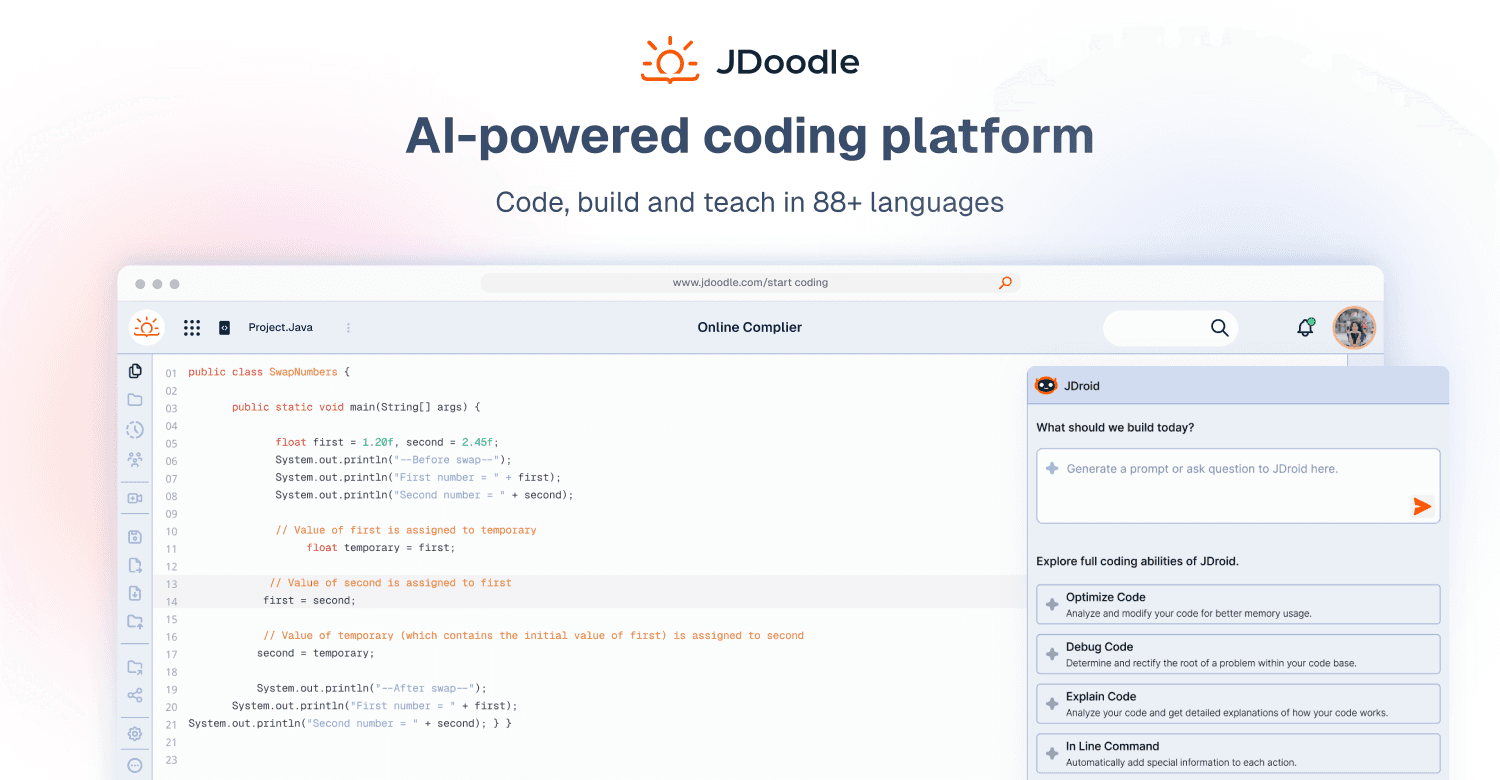
JDoodle is a comprehensive online compiler, editor, and Integrated Development Environment (IDE) designed to support over 110 programming languages. It offers a convenient platform for developers and students to write, compile, and execute code directly in their web browser without needing local installations. Users can run programs on the fly, save their code for future reference, and easily share their projects with others. The platform aims to provide a quick and easy way to compile and run programs online, making it an accessible tool for learning, testing, and collaborating on various coding tasks. It supports popular languages like Java, C, C++, PHP, Perl, Python, and Ruby, among many others.

alwaysAI
alwaysAI is a computer vision solutions company focused on activating Vision AI in the real world for meaningful impact. The platform provides software for the development, deployment, and management of computer vision applications, catering to enterprise needs. They also offer industry-specific SaaS solutions and engineering support to help businesses integrate and leverage Vision AI. The company's mission is to drive impact through Vision AI, improving efficiency, safety, and automation across various sectors. While specific features and pricing are not detailed on the provided pages, the overarching goal is to empower organizations to utilize computer vision effectively.
Bragi
Bragi is an AI audio software platform designed to help brands build next-generation intelligent audio products. Powered by OpenAI, it integrates into a wide range of audio devices, including TWS, headphones, glasses, and speakers, in under four months. The platform supports all major audio chipsets, allowing for seamless integration without disrupting existing hardware roadmaps. Key features include an all-in-one platform for screenless access to services like Chat AI and Apple Music, a companion app ecosystem available as a branded version or SDK, and an Audio App Store for post-sale revenue. Bragi also offers advanced user interfaces with customizable shortcuts via wake words, buttons, or display widgets, providing instant access to AI and product settings. It provides on-ground support in China for fast response times and coordination.
RepoAgent
RepoAgent is an LLM-powered open-source framework designed to assist developers and teams in generating comprehensive documentation for their code repositories. It automates the process of creating and maintaining project documentation, providing detailed explanations for each Python file and making it easier for developers to understand, maintain, and enhance codebases. The tool automatically detects changes in Git repositories, analyzes code structure through AST to generate documents for individual objects, and identifies inter-object bidirectional invocation relationships to enrich documentation content. It seamlessly replaces Markdown content based on changes, ensuring consistency, and executes multi-threaded concurrent operations for efficient document generation. RepoAgent also supports automated documentation updates for team collaboration and offers a way to display code documentation, with future plans for multi-programming language support and local model integration.
Cloudnonic Corp.
Cloudnonic Corp. is a technology company that provides innovative software and AI solutions for businesses. With a focus on German quality and Latino heart, they offer services including app and web application development, specializing in AI development and cloud-native systems. Cloudnonic aims to give clients a competitive advantage through digital innovation and customized solutions. They serve diverse industries across Europe, North America, and South America, helping businesses leverage cutting-edge technology to achieve their goals. Their expertise spans various aspects of software and AI, ensuring comprehensive and tailored solutions for their clients.
Zist
Zist is a code snippet manager designed to help developers organize and manage their code effectively. It integrates seamlessly with GitHub Gists, allowing users to store, retrieve, and share code snippets within the GitHub ecosystem. The tool aims to streamline development workflows by providing a centralized location for frequently used code, making it easier to access and reuse. This integration with GitHub Gists ensures that snippets are version-controlled and accessible across different environments, enhancing productivity for individual developers and teams alike. Zist focuses on simplifying the process of managing code snippets, ensuring developers can quickly find and utilize the code they need without interruption.
Agentless
Agentless is an open-source AI tool designed to automatically solve software development problems without relying on traditional agents. It operates through a structured three-phase process: localization, repair, and patch validation. The localization phase identifies faults down to specific files, classes, functions, and fine-grained edit locations. During the repair phase, Agentless generates multiple candidate patches for each bug in a simple diff format. Finally, the patch validation phase selects and runs regression tests, generates additional reproduction tests, and re-ranks patches based on test results to submit the most effective fix. Agentless has demonstrated strong performance, achieving solve rates of 40.7% and 50.8% on SWE-bench lite and verified benchmarks, respectively, when integrated with Claude 3.5 Sonnet.
nib
nib is an open-source Stylus library designed to streamline frontend development by offering a comprehensive collection of mixins, utilities, and components. It also includes advanced features like gradient image generation, which can be enabled by installing node-canvas. Developers can integrate nib into their projects using npm and leverage its functionalities either by importing the entire library or by selectively choosing specific modules like gradients or normalize. This tool is particularly useful for those working with Stylus to create efficient and maintainable stylesheets.
AICommand
AICommand is a proof-of-concept tool that integrates ChatGPT directly into the Unity Editor, enabling developers to control various aspects of their Unity projects using natural language prompts. This innovative approach aims to streamline game development workflows by allowing users to issue commands in plain English rather than traditional coding or manual interface interactions. While the creator notes it's not yet practical for production due to inconsistencies, it serves as a valuable exploration into the potential of AI in game development, offering insights into both its successes and failures. Developers can experiment with this integration by generating an API key and setting it within Unity's Project Settings, then accessing the AI Command window to input prompts.

EnlivenAI Solutions LLC
EnlivenAI Solutions LLC is a leading AI and software development company focused on crafting innovative AI solutions deeply aligned with specific business needs. They provide a comprehensive suite of services including AI development and integration, custom software development, web and mobile application development, AR/VR solutions, and embedded systems development. With a proven track record of over 155 projects delivered and 4+ years of experience, EnlivenAI serves various industries such as FinTech, Healthcare, Retail, and Media. They emphasize a collaborative development journey from insight discovery and strategic blueprinting to agile engineering and continuous quality validation, ensuring scalable and high-impact solutions.
ml-design-docs
ml-design-docs offers a comprehensive template for creating design documents specifically tailored for machine learning systems. Based on a detailed post, this guideline helps users think critically about problem definition, solution design, and feedback integration. It covers essential sections such as overview, motivation, success metrics, requirements & constraints, methodology (including problem statement, data, techniques, experimentation, and human-in-the-loop), and implementation details (high-level design, infra, performance, security, data privacy, monitoring, cost, integration points, risks & uncertainties). The template is designed to be adaptable, allowing users to select and add sections to best meet their project's needs, ensuring thorough planning and clear communication.
agent-trace
Agent Trace is an open specification designed for tracing AI-generated code, offering a vendor-neutral format to record AI contributions alongside human authorship within version-controlled codebases. The specification defines a `Trace Record` schema, which is the fundamental unit for capturing attribution data, including details like version, unique ID, timestamp, VCS information, the tool that generated the trace, and an array of files with attributed ranges. It supports granular attribution at file and line levels, allowing for the identification of models used and related agent conversations. The specification emphasizes interoperability, extensibility through custom metadata, and human/agent readability. It also addresses line tracking, content hashes for position-independent tracking, and model identification following the models.dev convention. While it defines the data structure, it remains unopinionated about storage mechanisms, allowing for flexible implementation.