
Coding & Development
Browsing page 138 of AI tools for Open Source & Models in Coding & Development. Sorted by confidence score — our independent quality rating.

swin2sr
swin2sr is an open-source AI tool leveraging the SwinV2 Transformer for advanced image super-resolution and restoration. It excels at reducing JPEG compression artifacts and upscaling images, offering state-of-the-art performance in classical, lightweight, and real-world image super-resolution. The tool is particularly effective for compressed input scenarios, addressing common issues like training instability and resolution gaps in transformer vision models. It provides code, pre-trained models, and demos, making it suitable for both research and practical applications in image processing and low-level vision. Demos are available on platforms like Kaggle, Google Colab, and Huggingface Spaces.
Deep-RL-Notes
Deep-RL-Notes offers a comprehensive collection of notes on Deep Reinforcement Learning, specifically tailored for UC Berkeley's CS 285 (formerly CS 294-112) course, taught by Professor Sergey Levine. This resource serves as a textbook, covering foundational concepts like Markov decision processes and value functions, as well as advanced techniques such as Deep Q-Networks (DQN) and Proximal Policy Optimization (PPO). It integrates deep learning with reinforcement learning, discussing function approximation and representation learning. Users can compile the LaTeX source code into a PDF locally or edit it online via Overleaf, as the repository is regularly updated. The notes aim to balance theoretical clarity with practical relevance, providing examples, case studies, and programming exercises for hands-on experience.
sonata
Sonata is the official project repository for "Sonata: Self-Supervised Learning of Reliable Point Representations," a CVPR'25 Highlight paper. This open-source tool provides self-supervised pre-trained Point Transformer V3 models specifically designed for various 3D point cloud downstream tasks. Users can leverage Sonata for quick inference and visualization, with easy-to-use installation options for both standalone and package modes. The repository includes pre-trained models, inference code, and visualization demos, making it accessible for researchers and developers. It supports custom data integration and offers a flexible data transformation pipeline, along with options for loading models from Huggingface or local paths, even accommodating environments without FlashAttention.
streaming
Streaming is a data streaming library built by MosaicML designed to make training on large datasets from cloud storage as fast, cheap, and scalable as possible. It is specifically optimized for multi-node, distributed training for large models, ensuring correctness, performance, and ease of use. The library supports various data types including images, text, video, and multimodal data, and is compatible with major cloud storage providers like AWS, OCI, GCS, Azure, and any S3 compatible object store. It integrates seamlessly into existing training workflows as a drop-in replacement for PyTorch IterableDataset. Key features include seamless data mixing, true determinism for reproducible training runs, instant mid-epoch resumption, high throughput, and equal convergence compared to local disk solutions.
StableGen
StableGen is an open-source Blender addon that integrates generative AI into the 3D texturing workflow. It enables users to create fully textured 3D meshes from a single image or text prompt using TRELLIS.2, and then texture and refine them with models like SDXL, FLUX.1-dev, or Qwen Image Edit through a flexible ComfyUI backend. Key features include scene-wide multi-mesh texturing, multi-view consistency, advanced camera placement strategies, and precise geometric control with ControlNet. It also offers local editing, style guidance with IPAdapter, and integrated workflow tools like camera setup and texture baking, making it a comprehensive solution for 3D artists.
synaptic
Synaptic is an open-source JavaScript neural network library designed for both Node.js environments and web browsers. Its core strength lies in its architecture-free algorithm, which allows developers to construct and train virtually any type of first-order or second-order neural network. The library comes equipped with several built-in architectures, including multilayer perceptrons, multilayer long-short term memory networks (LSTM), liquid state machines, and Hopfield networks. Additionally, it features a versatile trainer capable of training any given network, complete with built-in tasks for testing and comparing architectural performance, such as solving XOR problems or completing Distracted Sequence Recall tasks. This makes Synaptic a powerful tool for developers looking to implement and experiment with neural networks in their JavaScript projects.
Texygen
Texygen is an open-source benchmarking platform designed to support research in open-domain text generation models. It offers a comprehensive suite of implemented text generation models, alongside a diverse set of metrics for evaluating the diversity, quality, and consistency of generated texts. The platform aims to standardize research in the field of text generation, fostering reproducibility and reliability in future work. By facilitating the sharing of fine-tuned open-source implementations among researchers, Texygen helps advance the development and understanding of text generation technologies. It supports Python 3.6+ and popular libraries like TensorFlow, Numpy, Scipy, and NLTK.
tiny-cuda-nn
tiny-cuda-nn is a high-performance C++/CUDA neural network framework designed for speed and efficiency in training and querying neural networks. It incorporates a lightning-fast "fully fused" multi-layer perceptron and a versatile multiresolution hash encoding, as detailed in its technical papers. The framework supports various input encodings, losses, and optimizers, making it adaptable for diverse neural network applications. It also offers JIT fusion for significant performance boosts, particularly on newer NVIDIA GPUs, and provides PyTorch bindings for integration into Python workflows, though native CUDA performance remains superior for large batch sizes. The framework is ideal for developers and researchers working on demanding AI tasks requiring optimized computational performance.
Transformer-SSL
Transformer-SSL is an open-source project offering the official implementation for "Self-Supervised Learning with Swin Transformers." This codebase is notable for including Swin Transformer as one of its backbones, enabling the evaluation of learned representations' transferring performance on downstream tasks like object detection and semantic segmentation. It features MoBY, a self-supervised learning approach combining MoCo v2 and BYOL, achieving high accuracy on ImageNet-1K linear evaluation with significantly fewer tricks than previous works. The project provides models and code for self-supervised learning, linear evaluation, and demonstrates strong performance when transferring to object detection and semantic segmentation tasks.
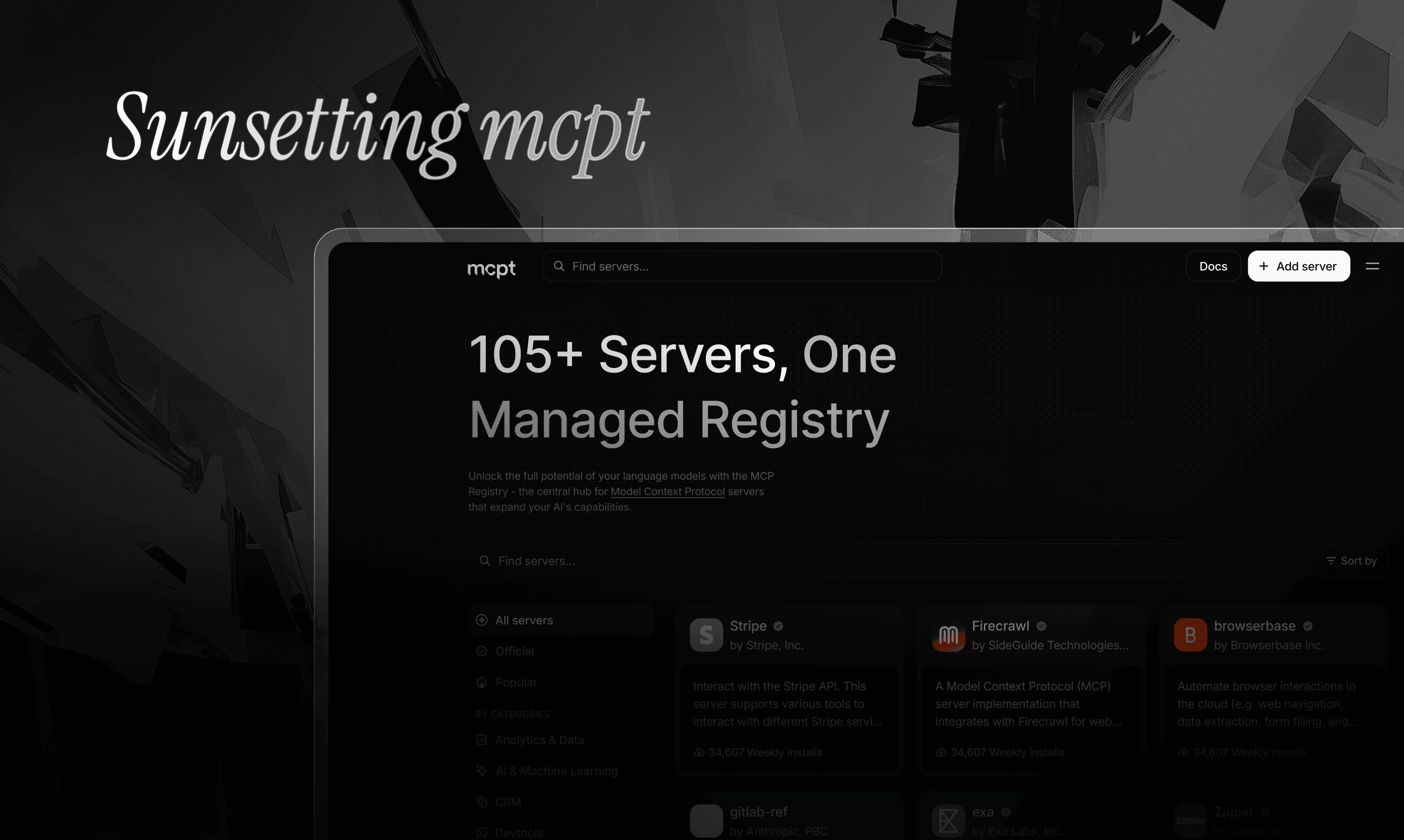
MCP Registry
MCP Registry was a server registry developed by Mintlify, intended to provide a central platform for discovering and showcasing MCP (Model Context Protocol) servers. Launched after the success of Mintlify's MCP server generator, the registry aimed to solve the discoverability problem within the MCP ecosystem. Despite attracting over 3,000 unique visitors within 24 hours of its launch and receiving significant interest from developers, the project was sunsetted just five days later. The decision was made because building and supporting a marketplace would have diverted critical operational resources from Mintlify's core developer tools product, and marketplace building was not considered their core strength. This case highlights the importance of strategic focus for companies, especially during periods of rapid growth.
Uformer
Uformer is an open-source implementation of a general U-shaped Transformer designed for various image restoration tasks. Based on research presented at CVPR 2022, this tool employs a hierarchical encoder-decoder network with a local-enhanced window Transformer block to efficiently capture both local context and global dependencies. Its core designs include non-overlapping window-based self-attention to reduce computational requirements and depth-wise convolution in the feed-forward network. Uformer also explores three skip-connection schemes to optimize information flow from the encoder to the decoder. It has been extensively tested and proven superior in tasks such as image denoising (SIDD, DND), motion deblurring (GoPro, HIDE, RealBlur-J/-R), defocus deblurring (DPDD), deraining, and demoireing. The project is built with PyTorch 1.9.0, Python3.7, and CUDA11.1, making it accessible for researchers and developers.
VLM-R1
VLM-R1 is an open-source project from om-ai-lab that introduces a stable and generalizable R1-style Large Vision-Language Model. It is designed to solve complex visual understanding tasks, demonstrating state-of-the-art performance in areas such as Open-Vocabulary Detection (OVD) and multimodal math reasoning. The project supports various fine-tuning methods, including full fine-tuning for GRPO, LoRA fine-tuning, and multi-node training. VLM-R1 also offers multi-image input capabilities and supports different VLMs like QwenVL and InternVL. Recent updates have optimized its performance on Huawei Ascend Atlas series hardware, significantly reducing Time to First Token (TTFT) and increasing throughput. The repository provides comprehensive scripts for training, evaluation, and deployment, making it a valuable resource for researchers and developers working with advanced vision-language models.
transfuser
TransFuser is an open-source project that focuses on advancing autonomous driving technology through transformer-based sensor fusion. This tool implements imitation learning for the control of autonomous vehicles, leveraging multi-modal fusion transformers for end-to-end autonomous driving. The project is a journal extension of previous work, offering researchers and developers a robust codebase for experimentation and development in the field. It includes detailed setup instructions for CARLA, dataset generation scripts, and training and evaluation procedures. The repository also provides pre-trained agents and tools for submitting to the CARLA leaderboard, making it a comprehensive resource for those working on autonomous driving systems.
VM-UNet
VM-UNet is an open-source code repository for 'Vision Mamba UNet for Medical Image Segmentation,' a novel U-shape architecture model designed for medical image segmentation. It addresses the limitations of CNNs in long-range modeling and the quadratic computational complexity of Transformers by utilizing State Space Models (SSMs), specifically Mamba. The tool introduces the Visual State Space (VSS) block as its foundation to capture extensive contextual information and employs an asymmetrical encoder-decoder structure. VM-UNet has demonstrated competitive performance on datasets like ISIC17, ISIC18, and Synapse, aiming to establish a baseline for efficient and effective SSM-based segmentation systems in medical imaging.
W2NER
W2NER offers the source code for a novel approach to Unified Named Entity Recognition (NER), as presented in an AAAI 2022 paper. Unlike traditional methods that study flat, overlapped, and discontinuous NER individually, W2NER unifies these tasks by modeling them as word-word relation classification. The architecture effectively captures neighboring relations between entity words using Next-Neighboring-Word (NNW) and Tail-Head-Word-* (THW-*) relations. It employs a neural framework that treats unified NER as a 2D grid of word pairs, enhanced by multi-granularity 2D convolutions for refining grid representations. A co-predictor then reasons about word-word relations. The model has demonstrated state-of-the-art performance across 14 benchmark datasets, including both English and Chinese, for all three types of NER.
xplique
Xplique is a comprehensive Python toolkit designed to bring clarity to complex neural network models through state-of-the-art Explainable AI (XAI) techniques. Originally developed for TensorFlow models, it also offers partial compatibility with PyTorch. The library features modules for Attribution Methods, allowing users to compute explanations like Grad-CAM and Integrated Gradients across various tasks such as classification, regression, object detection, and semantic segmentation. It also includes Feature Visualization to understand how networks build their understanding, Concept Extraction to identify human concepts, and Metrics to evaluate the faithfulness and robustness of explanations. Xplique supports diverse data types including images, time series, and tabular data, making it a versatile tool for AI model analysis and debugging.
wer_are_we
wer_are_we is an open-source project dedicated to tracking the state-of-the-art and recent research results in speech recognition. It functions as a dynamic bibliography, compiling and presenting performance metrics (such as Word Error Rate or WER) for various models across different datasets like LibriSpeech, WSJ, Hub5'00, TED-LIUM, and CHiME. The project details the architectures, training methodologies, and published papers associated with each result, offering a valuable resource for researchers and practitioners to compare and understand advancements in the field. Users are encouraged to contribute corrections and updates, fostering a collaborative environment for maintaining an accurate and up-to-date overview of speech recognition progress.
ydata-synthetic
ydata-synthetic is an open-source Python package designed for generating synthetic tabular and time-series data. It incorporates state-of-the-art generative models, including various GAN architectures like CTGAN, WGAN, and TimeGAN, as well as Gaussian Mixture models. The tool provides a low-code experience for quick data generation and features a Streamlit-based UI for an intuitive workflow, from training models to generating and profiling synthetic data samples. It supports diverse applications such as privacy compliance, bias removal, dataset balancing, and augmentation, making it a versatile solution for data scientists and developers working with sensitive or limited datasets.
ZenCtrl
ZenCtrl is a powerful framework designed for generating multi-view images without the need for specialized training or LoRA models. Users can upload an initial image and provide a text prompt to produce diverse perspectives and scenes of the subject. The tool offers customizable parameters such as generation steps, strength, and output size, giving users control over the final image quality and style. Developed by Fotographer.ai, ZenCtrl aims to simplify the process of creating complex visual assets, making it accessible for various creative applications. Although currently paused on Hugging Face Spaces, its core capability lies in transforming a single input into a rich set of multi-angle visuals.
agentlabs
AgentLabs offers an open-source universal frontend solution for AI Agents, enabling developers to quickly deploy their AI agents to public users. The platform provides essential features such as an authentication portal for user management, a clean chat frontend interface for user interaction, and integrated analytics and payment functionalities. Developers can control their AI agents with a real-time bidirectional streaming SDK from their backend, available in Python and TypeScript. AgentLabs aims to simplify the deployment process for AI agents, allowing developers to concentrate on the core AI logic while it handles the user-facing aspects. It supports both cloud hosting and self-hosting via Docker Compose, with an active alpha release and ongoing development.
Agently-Daily-News-Collector
Agently-Daily-News-Collector is an open-source project designed to showcase an automated daily news collecting workflow. Powered by the Agently AI application development framework, this tool allows users to input a topic and automatically generate a multi-column news briefing. The workflow includes searching, shortlisting, browsing, summarizing, and assembling stories into a final report, which is saved as Markdown. It features structured output contracts for clearer interfaces, built-in search and browse tools, and environment-aware settings for easy model configuration. The project emphasizes a clean app/workflow/tools/prompts split, enabling true concurrency in processing columns and summaries through TriggerFlow for efficient news collection.
ai-dial-core
AI DIAL Core is an open-source project designed to provide a unified API for various chat completion and embedding models, assistants, and applications. Built on Java 21 and Eclipse Vert.x, it offers a robust and scalable solution for integrating diverse AI functionalities. The tool supports HTTP proxy functionality and provides comprehensive configuration options for static and dynamic settings, identity providers, toolsets, security, and storage. Developers can deploy DIAL Core on Kubernetes using Helm charts, making it suitable for complex enterprise environments. Its modular design allows for flexible integration and management of AI resources, ensuring a consistent interface across different AI services.
AutoDL-Projects
AutoDL-Projects is an open-source, lightweight project offering automated deep learning algorithms implemented in PyTorch. It provides various neural architecture search (NAS) and hyper-parameter optimization (HPO) algorithms, making it suitable for beginners, engineers, and researchers. The project features simple library dependencies, a unified codebase for all algorithms, and active maintenance. Key capabilities include implementations of NAS algorithms like TAS, DARTS, GDAS, SETN, NAS-Bench-201, and NATS-Bench, as well as HPO-CG. It requires Python >= 3.6 and PyTorch >= 1.5.0, with options for knowledge distillation and pre-trained models.

vectranetworks.com
Vectra AI is a leading cybersecurity AI platform designed to protect modern networks from sophisticated attacks. It leverages Attack Signal Intelligence to analyze real-time data and identify compromised areas, providing preemptive protection, observability, and proactive detection and response across network, cloud, and identity environments. The platform helps enterprises reduce cyber risk, detect and contain active threats, and strengthen resilience in hybrid and multi-cloud settings. Vectra AI offers solutions for SOC modernization, SIEM optimization, IDS replacement, EDR extension, and critical infrastructure risk management, arming security analysts with crucial intel to stop attacks fast.