
Coding & Development
Browsing page 134 of AI tools for Open Source & Models in Coding & Development. Sorted by confidence score — our independent quality rating.

super-gradients
Super-gradients is an open-source training library designed to simplify the process of building, training, and fine-tuning state-of-the-art computer vision models. It provides ready-to-deploy pre-trained models, including the high-performance YOLO-NAS and YOLO-NAS-POSE architectures, which outperform other YOLO versions in accuracy and speed. The library supports various computer vision tasks such as classification, semantic segmentation, object detection, and pose estimation. Users can easily load and fine-tune models with validated hyper-parameters, and all models are production-ready, compatible with deployment tools like TensorRT and OpenVINO. Super-gradients also offers advanced features like Quantization Aware Training (QAT) and Knowledge Distillation, along with support for Distributed Data Parallel (DDP) for efficient multi-GPU training.
deeppy
deeppy is an open-source deep learning framework designed for Python, leveraging NumPy for its core operations and offering CUDA acceleration to enhance computational performance. This makes it suitable for researchers and developers working on deep learning projects that require efficient processing. The framework aims to provide a Pythonic interface, allowing users to build and experiment with deep learning models using familiar Python constructs. Its foundation on NumPy ensures compatibility and ease of integration with the broader Python scientific computing ecosystem, while CUDA support addresses the need for high-speed parallel processing in deep learning tasks.
DQN-based-UAV-3D_path_planer
DQN-based-UAV-3D_path_planer, also known as RLGF, is a comprehensive open-source training framework designed for Unmanned Aerial Vehicle (UAV) deep reinforcement learning tasks. It provides a versatile environment for developing and testing UAV path planning solutions, supporting both continuous and discrete flight actions. The framework integrates a variety of mainstream deep reinforcement learning algorithms, including SAC, DQN, DDQN, PPO, Dueling DQN, and DDPG. Users can customize task environment models and UAV parameters via XML configuration files, enabling rapid development of specific UAV missions. It also offers training log support and multi-dimensional visualization of UAV trajectories, including static HTML outputs and dynamic visualization via a Java backend with MySQL integration.
ZenteiQ.ai
ZenteiQ.ai is an advanced AI platform designed to revolutionize engineering design by integrating physics-native AI with Scientific Foundation Models. It specializes in transforming complex simulation and experimental data into actionable intelligence, accelerating discovery, design, and industrial innovation across various sectors. The platform's capabilities are highlighted by its ability to handle intricate equations like the Heat Equation, Wave Equation, Navier-Stokes, and Schrödinger, indicating its application in highly technical and scientific domains. ZenteiQ.ai aims to provide intelligent surrogates for engineering design, enabling more efficient and accurate development processes.
MaiBot
MaiBot, also known as MaiSaka, is an interactive AI agent built on large language models, designed to understand users and interact in a genuinely human style. Unlike typical bots, MaiSaka prioritizes warmth, authenticity, and connection, rather than just efficiency or perfection. It employs a natural conversational style, avoiding long-winded or markdown-heavy replies, and intelligently adapts its speech to the conversation's atmosphere. MaiSaka evolves by imitating speaking styles in group chats and learning new slang. Inspired by psychological personality theories, it continuously builds an understanding of user preferences and behaviors. The tool also boasts a powerful plugin system, offering virtually unlimited extension possibilities through its APIs and event system.
nerd-dictation
nerd-dictation is a simple, hackable, and offline speech-to-text utility designed for Desktop Linux. It leverages the VOSK-API for accurate transcription without requiring an internet connection. The tool is a single-file Python script with minimal dependencies, making it easy to set up and use. Key features include optional conversion of numbers to digits, a timeout function for automatic speech ending, and configurable output types (simulating keystrokes or printing to standard output). Users can customize text manipulation through Python scripts and bind begin/end/cancel commands to shortcut keys for efficient workflow. It also supports suspend/resume functionality to manage resource usage, especially with larger language models.
ppq
PPL Quantization Tool (PPQ) is a powerful, open-source offline neural network quantization tool designed for industrial applications. It focuses on optimizing neural networks by converting floating-point operations to fixed-point operations, which significantly reduces computational costs and memory usage. This makes PPQ particularly suitable for deployment on edge devices where chip area and power consumption are limited. The tool offers a highly flexible and extensible framework, allowing users to customize quantization bit-width, granularity, and calibration algorithms for individual operators and tensors. PPQ's execution engine is specifically designed for quantization, supporting 99 common Onnx operator execution logics and native quantization simulation. It integrates with various inference frameworks like TensorRT, OpenVINO, and Onnxruntime, providing pre-built quantizers and export logic.
QiZhenGPT
QiZhenGPT is an open-source Chinese medical large language model developed by CMKRG. It leverages a Chinese medical instruction dataset built from the QiZhen Medical Knowledge Base to significantly improve performance in Chinese medical contexts. The model has been fine-tuned on Chinese-LLaMA-Plus-7B, CaMA-13B, and ChatGLM-6B models. Initially, it focuses on drug knowledge Q&A with a dedicated evaluation dataset, with plans to expand to diseases, surgeries, and examinations. QiZhenGPT also underpins MedCopilot, a smart medical assistant integrated with HIS and electronic medical record systems, offering features like functional assistant, auxiliary diagnosis, medical quality assurance, and medical record documentation. MedCopilot is already in use at Zhejiang University Second Affiliated Hospital.
qwen600
qwen600 is a static, suckless single batch CUDA-only mini inference engine specifically designed for the QWEN3-0.6B instruct model. Developed for educational purposes, it allows users to learn about Large Language Models (LLMs) and transformers while practicing CUDA programming. The engine boasts significant performance improvements, claiming to be approximately 8.5% faster than llama.cpp and 292% faster than Hugging Face with flash-attn in tokens/sec. It features compile-time optimization, minimal dependencies (CUDA, cuBLAS, CUB, std IO), efficient memory management, and zero-cost pointer-based weight management on GPU, making it suitable for systems with limited VRAM like an RTX 3050 8GB.

NetNewsWire 7
NetNewsWire 7 is a free and open-source RSS reader designed for Mac, iPhone, and iPad, offering a streamlined way to consume news and blog content. It allows users to subscribe to their favorite blogs and news sites via RSS feeds, consolidating articles into a single, easy-to-manage interface. The application tracks read articles, ensuring users don't miss new content and can easily pick up where they left off. Key features include a Safari extension for adding feeds, syncing capabilities with various services like iCloud, Feedbin, and Feedly, customizable article themes, and a reader view. It also supports easy keyboard navigation, dark mode, starred articles, smart feeds, and background refreshing, providing a fast, stable, and accessible reading experience.
Cute Magick
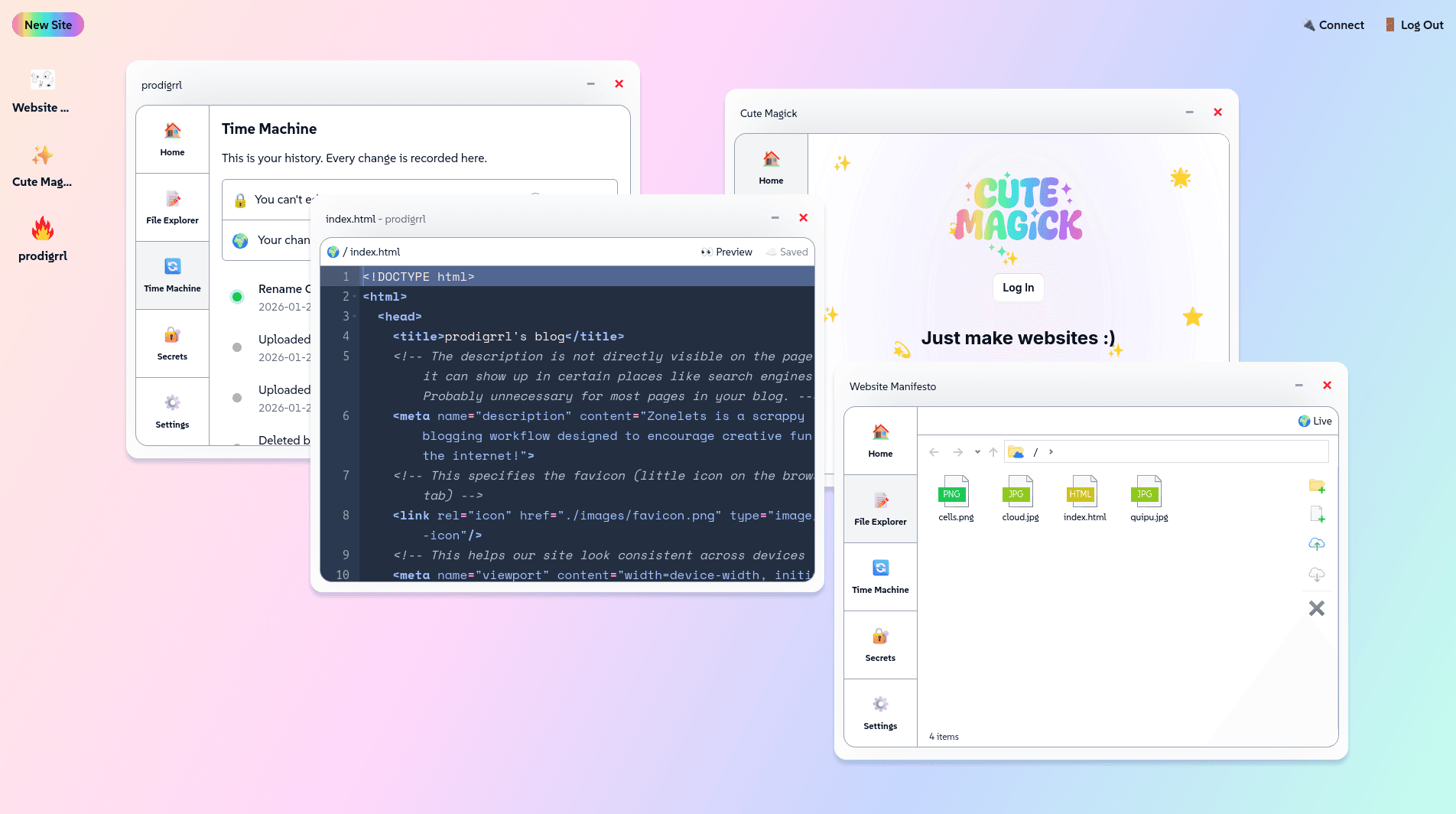
Cute Magick offers a simple yet powerful open-source web hosting solution designed for developers and creative coders. It provides an interactive workspace where users can build, preview, and publish websites using various languages like HTML, CSS, PHP, Python, Lua, and Node.js. A key differentiator is its "Time Machine" feature, which saves every file change as a snapshot, allowing users to rewind to any previous version, preview past states, and restore earlier configurations. The platform emphasizes ownership and portability, with sites stored as plain files and standard Git history, enabling easy export and self-hosting options. It caters to those who want to build real, server-powered websites without the complexities of traditional infrastructure.
aios-core
aios-core is an open-source framework designed for AI-orchestrated full-stack development, empowering users to build AI-powered applications with greater control. It emphasizes a "CLI First" architectural premise, ensuring that all execution, decisions, and automation happen directly within the command-line interface. The framework introduces two key innovations: agentic planning, where specialized agents collaborate to create detailed PRD and architecture documents, and contextualized development, where a Scrum Master agent transforms these plans into hyper-detailed development stories for the `dev` agent. This approach aims to eliminate planning inconsistency and context loss, providing a comprehensive understanding for the development process. It supports various IDEs and CLIs, offering different levels of integration and automation.
Dreambooth Diffusion Hokusai
Dreambooth Diffusion Hokusai is an AI tool hosted on Hugging Face, leveraging the Keras-Dreambooth framework for image generation. While the specific functionalities are not detailed, it is designed to enable users to create images through AI. The tool is tagged for consentful use and is intended for the US region. The current status of the tool indicates a runtime error, suggesting it may not be fully operational or accessible at this time. Users interested in AI image creation might find this tool relevant, though its current availability is impacted by technical issues.
Bender
Bender is an open-source abstraction layer built over MetalPerformanceShaders, designed to simplify the development and execution of neural networks on iOS devices. It addresses the growing need to run AI models directly on mobile devices, even if the training was done elsewhere. Bender provides an intuitive way to define and run neural networks using common layers like Convolution, Pooling, and FullyConnected. A key feature is its ability to load models trained in other frameworks, such as TensorFlow, by translating them into Bender layers. This eliminates the need to include TensorFlow's static library or rely solely on CPU execution, enabling GPU-accelerated inference on iOS. It aims to make on-device AI more accessible and performant for developers.
DeepSeekSelfTool
DeepSeekSelfTool is an open-source AI cybersecurity toolkit developed by DeepSeek, designed to assist security professionals and developers with various tasks. Its capabilities include traffic analysis to identify malicious network activity, JavaScript code auditing to pinpoint vulnerabilities and risks, and process analysis for both Windows and Linux/macOS systems to detect suspicious processes. The tool also features HTTP to Python conversion for generating POC/EXP code, text processing for data reformatting, and regular expression generation. A standout feature is its robust WebShell detection, capable of identifying both traditional WebShells and memory-resident ones. Additionally, it offers AI-powered translation and code auditing, making it a comprehensive solution for cybersecurity operations and reporting.
RetNet
RetNet offers a minimal, pure PyTorch implementation of the Retentive Network, designed as a successor to the Transformer architecture for large language models. This repository focuses on aiding scientific and technological understanding and advancement, with code prioritizing correctness and readability over optimization. Key features include single-scale and multi-scale retention across parallel, recurrent, and chunkwise paradigms, as well as a multi-layer retentive network with FFN and LayerNorm. It also supports a causal language model built on top of the retentive network. The implementation utilizes Microsoft's xPos for positional encoding, with an alternative complex value encoding available for specific use cases, though it requires higher precision and memory.
rcnn
R-CNN (Regions with Convolutional Neural Network Features) is an open-source visual object detection system developed by Ross Girshick, Jeff Donahue, Trevor Darrell, and Jitendra Malik at UC Berkeley EECS. It integrates bottom-up region proposals with rich features extracted by a convolutional neural network. At the time of its release, R-CNN achieved a 30% relative improvement in detection performance on PASCAL VOC 2012, reaching 53.3% mean average precision. While no longer maintained and considered a historical artifact, it serves as a foundational work for more recent and advanced object detection methods like Fast R-CNN and Faster R-CNN. The codebase is available on GitHub and requires MATLAB and Caffe for installation and use.
solo-learn
solo-learn is an open-source library dedicated to self-supervised methods for unsupervised visual representation learning, built on PyTorch Lightning. It aims to offer state-of-the-art techniques within a consistent and comparable framework, while also incorporating various training optimizations. The library is self-contained, allowing for flexible integration of its models into other projects. Key features include a wide array of self-supervised methods like Barlow Twins, BYOL, DINO, MAE, MoCo V2+, SimCLR, and VICReg, alongside support for various backbones such as ResNet, ViT, and ConvNeXt. It also boasts increased data processing speed with Nvidia Dali, flexible augmentations, and comprehensive evaluation methods including online/offline linear evaluation and K-NN evaluation. The tool is ideal for machine learning researchers and developers working on visual representation learning tasks.
YiIotCloud
YiIotCloud is a comprehensive cloud video surveillance and AI video analytics platform designed for robust security and monitoring. It provides both motion-activated and continuous recording options, allowing users to configure cloud storage according to their needs. The platform integrates advanced AI detection features, including face, person, vehicle, and animal detection, enhancing its ability to identify and alert users to specific events. YiIotCloud ensures convenient remote access through dedicated mobile and web applications, making it easy to monitor premises from anywhere. This tool is ideal for those seeking a scalable and intelligent solution for video monitoring and security.
MistoLine ControlNet Demo
MistoLine ControlNet Demo is an AI tool designed for image generation, specifically focusing on the ControlNet architecture. It provides a platform for users to explore and experiment with ControlNet, a neural network that offers precise control over image synthesis. Hosted on Hugging Face, this demo allows individuals to interact with the technology and understand its capabilities in generating controlled images. While the live website currently indicates a runtime error, the tool's purpose is to showcase the potential of ControlNet in AI-driven image creation.
kickstartDS
kickstartDS is an Open Source starter kit and next-gen UI toolkit for Design Systems, providing a comprehensive component and pattern library. It empowers web development teams to create consistent and brand-compliant web frontends with high efficiency. The platform offers a low-code framework and a UI development toolkit, allowing users to own a Design System without extensive investment. It features 26 components, 250 properties, and 500 design tokens, ensuring a solid foundation for customization. kickstartDS supports rich integrations with modern web stacks, including React, Storybook, Gatsby, and Next.js, and offers CMS starters for platforms like Storyblok and WordPress. It emphasizes quality user experience, maximum performance, and accessibility by default, supporting W3C’s WCAG 2.1 spec.
WenetSpeech Yue
WenetSpeech Yue is a text-to-speech application developed by ASLP-lab, hosted on Hugging Face Spaces, specifically designed for generating Cantonese audio. Users can input any text and then select from available models and speaker prompts to customize the generated speech. While the tool's primary function is to convert text into粤语 audio, the live website currently indicates a runtime error, suggesting it may not be fully operational at this moment. Despite the current technical issues, its intended purpose is to provide a platform for Cantonese speech synthesis, likely leveraging a large-scale Cantonese speech corpus as described in its metadata.
AI Chat One
AI Chat One offers a unified interface for users to access and compare responses from multiple prominent AI chatbots, including models like ChatGPT, Claude, and Gemini. This platform aims to streamline the process of leveraging diverse AI capabilities for a wide range of tasks, eliminating the need to switch between different applications. It provides various licensing options, from basic individual use to team licenses supporting multiple devices, catering to different user needs. The tool is designed to simplify AI interaction for developers and other professionals working with multiple AI models.
Open SaaS
Open SaaS offers a free, open-source starter kit designed to accelerate the development and launch of SaaS applications. Built with React and Node.js, it provides a comprehensive boilerplate that includes essential features such as user authentication, payment processing integrations, and an administrative dashboard for managing the application. The kit also features an AI example application, demonstrating how to integrate artificial intelligence functionalities. By handling common boilerplate tasks, Open SaaS allows developers to focus on core product innovation, significantly reducing development time and effort for new SaaS ventures.