
Coding & Development
Browsing page 131 of AI tools for Open Source & Models in Coding & Development. Sorted by confidence score — our independent quality rating.

TTS
TTS is a comprehensive open-source library developed by Mozilla for advanced Text-to-Speech generation. It leverages the latest research to provide a balance of ease-of-training, speed, and quality, making it suitable for various applications. The library includes pretrained models and tools for measuring dataset quality, supporting over 20 languages. It features high-performance deep learning models for Text2Spec tasks like Tacotron and Glow-TTS, as well as various vocoder models such as MelGAN and WaveRNN. TTS supports multi-speaker TTS, efficient multi-GPU training, and the ability to convert PyTorch models to Tensorflow 2.0 and TFLite for inference. It also provides a demo server for model testing and notebooks for extensive benchmarking.
UniPic
UniPic is an open-source multi-image editing model developed by SkyworkAI, focusing on image editing, generation, and understanding tasks. The tool is built around three distinct modeling paradigms, offering flexibility and advanced capabilities for manipulating and interpreting images. It is particularly well-suited for AI researchers and developers who are actively working on or interested in multimodal models, providing a robust platform for experimentation and application development in the field of artificial intelligence and computer vision.
automagica
Automagica is an open-source project that began in 2018, aiming to make Robotic Process Automation (RPA) technologies accessible. It provides a comprehensive suite of tools for building and managing automated tasks, including Automagica Bot for runtime execution, Automagica Flow for visual automation design with Python support, and Automagica Wand for AI-powered UI element picking. The platform also features Automagica Lab, a Jupyter Notebook-based environment for automation development, and Automagica Portal for managing bots, credentials, and logs. While initially open-source, the project was acquired by Netcall plc in 2020, with existing services transitioning to commercial offerings. It supports a wide range of activities from cryptography and random data generation to browser automation, credential management, keyboard/mouse control, image processing, file operations, and integrations with applications like Word, Excel, and Outlook.
Haechi AI
Haechi AI offers free, AI-powered fraud protection specifically designed for elderly Americans and their families. The platform screens incoming phone calls in real-time, detecting spoofed numbers, impersonation attempts, and high-pressure tactics before a user answers. It also allows users to photograph suspicious physical mail for instant analysis, identifying lottery scams, fake government notices, and fraudulent checks. Haechi AI provides ongoing fraud education through weekly briefings and real-time alerts, empowering users to recognize new scam techniques. A family dashboard feature enables adult children to monitor a parent's protection status, review flagged threats, and receive notifications, offering peace of mind. The service emphasizes data privacy with 256-bit encryption and a strict no-data-selling policy.
catalyst
Catalyst is a high-performance C# Natural Language Processing (NLP) library inspired by spaCy's design, offering a robust solution for developers working with .NET. It provides pre-trained models, out-of-the-box support for training word and document embeddings, and flexible entity recognition models. Key features include non-destructive tokenization, efficient RegEx-free processing at over 1M tokens/s, and cross-platform compatibility across Windows, Linux, macOS, and ARM. Catalyst also supports part-of-speech tagging, language detection, and efficient binary serialization. Developers can leverage pre-built models for various language packages and easily integrate them via NuGet, with lazy loading from disk or an online repository.
BMInf
BMInf (Big Model Inference) is an open-source toolkit designed to facilitate efficient inference for large-scale pretrained language models (PLMs). It enables the execution of models with over 10 billion parameters, even on low-resource hardware like a single NVIDIA GTX 1060 GPU. The tool offers significant performance improvements over existing PyTorch implementations, particularly for GPUs like V100 or A100. BMInf 2.0.0 introduced compatibility with any transformer-based model, making it a versatile solution for researchers and developers working with big AI models. It provides methods for automatic model conversion using `bminf.wrapper` or manual replacement of modules like `torch.nn.ModuleList` and `torch.nn.Linear` for optimized performance.
ViZDoom
ViZDoom is an open-source platform designed for developing AI bots that play the classic 1993 game Doom using only visual information from the screen buffer. It is primarily intended for research in machine visual learning and deep reinforcement learning. The tool offers a robust API for Python (including Gymnasium/Gym wrappers) and C++, supporting multi-platform deployment on Linux, macOS, and Windows. Key features include high performance (up to 7000 frames/steps per second), lightweight footprint, and easy creation of custom scenarios with visual editors and a powerful scripting language. Researchers can leverage its async and sync single-player/multiplayer modes, customizable rendering, access to depth and audio buffers, object labeling, and in-game data for advanced AI experimentation. ViZDoom is reinforcement learning friendly, suitable for learning from demonstration, apprenticeship learning, and inverse reinforcement learning.
xlstm
xlstm is the official GitHub repository for the xLSTM, a new Recurrent Neural Network architecture based on the original LSTM. This tool provides the necessary code and resources for researchers and practitioners to implement and experiment with this novel LSTM variant. xLSTM utilizes Exponential Gating with appropriate normalization and stabilization techniques, along with a new Matrix Memory, to overcome the limitations of traditional LSTMs. It demonstrates promising performance in Language Modeling compared to Transformers or State Space Models. The repository includes a 7B parameter xLSTM Language Model trained on 2.3T tokens, optimized for fast and efficient inference, and offers detailed instructions for installation and usage.
Trinity-RFT
Trinity-RFT is a comprehensive, open-source framework designed for the reinforcement fine-tuning (RFT) of large language models (LLM). It offers a general-purpose, flexible, and scalable solution by decoupling the RFT process into three core components: Explorer for generating experience data, Trainer for updating model weights, and Buffer for managing data pipelines. This architecture supports various RFT modes, including synchronous/asynchronous, on-policy/off-policy, and online/offline RL, allowing for independent scaling of rollout and training. Trinity-RFT also provides robust support for agentic RL workflows, full-lifecycle data pipelines with active data management, and a user-friendly design with plug-and-play modules and graphical interfaces. It supports a wide array of algorithms like PPO, GRPO, DPO, and CHORD.
responsible-ai-toolbox
Responsible AI Toolbox is an open-source suite of tools designed to help developers and stakeholders assess, develop, and deploy AI systems responsibly. It offers a collection of model and data exploration and assessment user interfaces and libraries for a holistic understanding of AI systems. Key components include the Responsible AI dashboard for comprehensive model assessment, an Error Analysis dashboard to identify model errors, an Interpretability dashboard for understanding predictions, and a Fairness dashboard to assess group fairness issues. The toolbox also includes mitigation libraries for improving model performance and a tracker for managing and comparing machine learning experiments, ensuring AI systems are safe, trustworthy, and ethical.
Swif
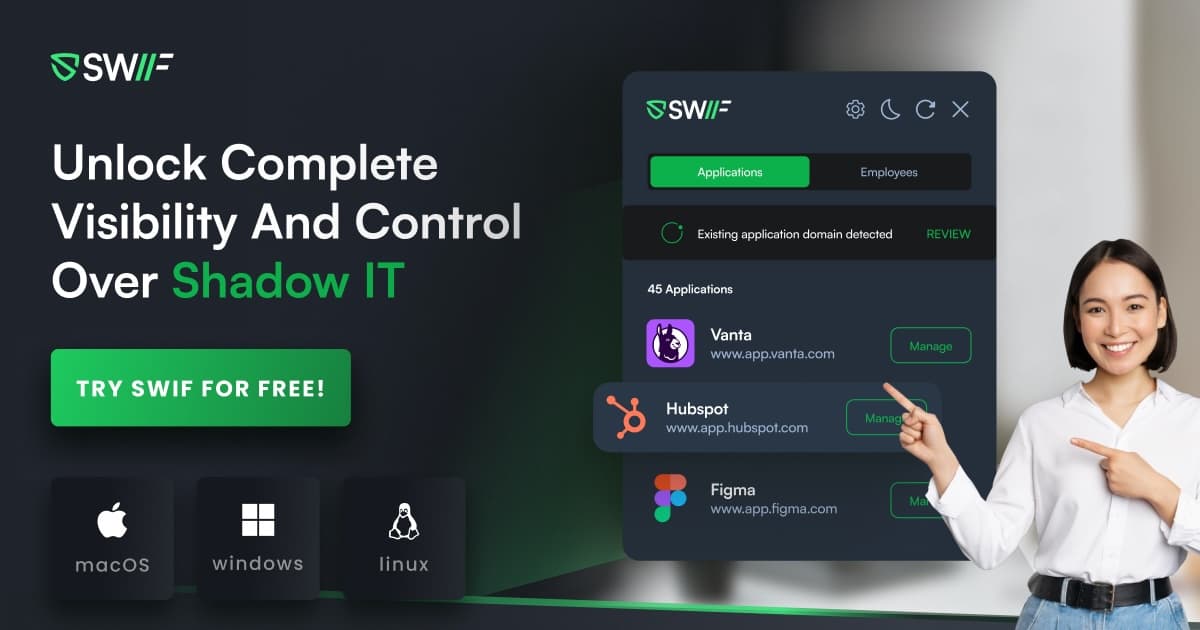
Swif is a comprehensive MDM (Mobile Device Management) software designed to help companies automate compliance and gain full visibility into Shadow IT across a wide range of operating systems, including Linux, macOS, Windows, iOS, iPadOS, and Android. The platform offers unified device management, enabling IT teams to roll out policies, commands, custom software, and app access efficiently. Key features include real-time Shadow IT detection, compliance benchmarking, and automated compliance management, which helps minimize cyber attacks and streamline employee provisioning and offboarding. Swif integrates with various identity providers and compliance tools, ensuring quick setup and audit-ready device compliance for frameworks like SOC 2, ISO 27001, and HIPAA.

EchoMark
EchoMark protects private information by embedding invisible forensic watermarks into documents, images, and email, personalized for each recipient. This allows organizations to immediately identify the source of information leaks, whether through email, printout, or photo. The solution is enterprise-proven, requires no client software, and is imperceptible to the recipient. EchoMark offers dynamic image watermarking with Chroma and Luma marks for different leak scenarios, and secure communication features with AI-rephrasing for email privacy. It also provides SecureView links to replace attachments, augmenting Data Loss Prevention (DLP) strategies, and offers detailed analytics on file viewing. The platform simplifies the process of watermarking, uploading leaked content, and tracing the source using computer vision, providing a report within minutes.
airllm
AirLLM is an open-source framework designed to optimize inference memory usage for large language models, enabling 70B models to run on a single 4GB GPU without requiring quantization, distillation, or pruning. It also supports running 405B Llama3.1 models on 8GB VRAM. The tool offers features like model compression for up to 3x inference speed improvement, support for various LLMs including Llama, Qwen, ChatGLM, Baichuan, Mistral, and InternLM, and compatibility with MacOS. AirLLM simplifies the inference process with an AutoModel feature that automatically detects model types and provides prefetching to overlap model loading and computation for enhanced speed.
DeepLiveCam
DeepLiveCam is an open-source AI tool designed for transforming digital identities, making it ideal for VTubers, streamers, and content creators. This powerful offline software facilitates real-time face swapping and avatar creation, allowing users to seamlessly change their appearance during live streams and video content. DeepLiveCam emphasizes privacy and data security by operating entirely offline, ensuring no uploads or online dependencies. It supports both Nvidia and AMD GPUs, as well as Mac/Apple Silicon, offering broad accessibility. Key features include real-time video playback without rendering, advanced face mapping, and an ethical approach to AI-assisted video transformation, empowering users with unlimited creativity while maintaining full control over their data.
alibi
Alibi is a source-available Python library designed for machine learning model inspection and interpretation. It offers high-quality implementations of black-box, white-box, local, and global explanation methods for both classification and regression models. The library supports diverse explanation techniques such as Anchor explanations, Integrated Gradients, Counterfactual examples, Accumulated Local Effects, Kernel SHAP, and Tree SHAP. It also includes algorithms for model confidence and prototype generation. Alibi can be installed via PyPI, GitHub source, or Anaconda, with options for distributed computation and SHAP support. Its API is inspired by scikit-learn, featuring distinct initialize, fit, and explain steps, making it a valuable tool for developers and data scientists seeking to understand and debug their machine learning models.
audiocraft
AudioCraft is a comprehensive PyTorch library designed for deep learning research in audio generation. It provides both inference and training code for advanced AI generative models, including MusicGen for controllable text-to-music generation and AudioGen for text-to-sound. The library also integrates the state-of-the-art EnCodec audio compressor/tokenizer, Multi Band Diffusion for EnCodec-compatible decoding, and MAGNeT for non-autoregressive text-to-music/sound. Additionally, it offers AudioSeal for audio watermarking and JASCO for high-quality text-to-music conditioned on chords, melodies, and drum tracks, making it a powerful toolkit for researchers and developers in the audio AI domain.
OmAgent
OmAgent is a Python library designed to simplify the development of multimodal language agents. It abstracts away complex engineering challenges such as worker orchestration, task queues, and node optimization, providing a straightforward interface for defining agents. The library supports various multimodal interactions, including native integration with VLM models, real-time APIs, computer vision models, and mobile device connections. This enables developers and researchers to build agents that can process and reason over diverse inputs like text, images, video, and audio. OmAgent also offers a flexible agent architecture with a graph-based workflow orchestration engine and multiple memory types for contextual reasoning. It includes state-of-the-art unimodal and multimodal agent algorithms like ReAct, CoT, and SC-CoT, and supports local model deployment via Ollama or LocalAI, alongside a fully distributed architecture with custom scaling options.
Waveye
Waveye specializes in AI-driven imaging radars, delivering ultra high-resolution Lightweight Imaging Radar (LIR) technology with deeply-integrated radar AI. This advanced perception system is designed to enable robust autonomy at scale across multiple industries. Key performance indicators include a native angular resolution of 0.5 / 0.9 in azimuth and elevation, a wide 160-degree field of view in azimuth and 40 degrees in elevation, and an operating range exceeding 200 meters. The technology is capable of over 5000 detections in typical urban scenes, making it suitable for demanding applications. Waveye's solutions are particularly relevant for off-road autonomy, robotics, and automotive sectors, providing enhanced object detection and environmental understanding.
Zelim
Zelim develops AI-powered maritime safety and security systems designed to protect lives, vessels, and offshore assets at sea. Their core offerings include ZOE, an intelligent AI lookout system for automatic man overboard detection that meets ISO 21195:2020 standards, providing continuous vigilance and real-time tracking. Swift is a rapid overboard recovery system engineered for quick and safe casualty retrieval, even in rough conditions. Guardian is an unmanned rescue vessel for life-saving missions in dangerous or inaccessible areas. Zelim's technology extends human capabilities, eliminating uncertainty in critical maritime moments across sectors like Cruise Ferry, Offshore Energy, Defence, and Commercial Shipping.
whisper-vits-svc
whisper-vits-svc is an open-source core engine for singing voice conversion and singing voice cloning, built upon the VITS framework. It leverages variational inference with adversarial learning for end-to-end voice transformation. Designed for deep learning beginners, the project requires basic knowledge of Python and PyTorch. Key features include support for multiple speakers, the ability to create unique speakers through mixing, and conversion of voices even with light accompaniment. Users can also edit F0 using Excel and benefit from various model properties like strong noise immunity and improved conversion stability. The tool does not support real-time voice converting and focuses on practical application for learning deep learning concepts.

Project Numina
Project Numina is a non-profit initiative dedicated to advancing mathematics through open collaboration between humans and AI. It focuses on building open-source AI tools, models, and datasets specifically designed for mathematical collaboration and research. The platform aims to deepen how humans and machines engage with mathematics by providing accessible resources and fostering a community of shared exploration. Users can discover flagship projects, current research directions, and access all models and datasets which are open and available. The initiative encourages community involvement through contributions, resource exploration, and donations to support its mission of open, collaborative mathematics.

Go2
Go2 is an edge-native link platform designed for speed and comprehensive analytics, built on Cloudflare's global network for sub-10ms redirects. It offers a developer-first approach with robust APIs and SDKs, alongside features like custom domains, dynamic QR codes, and real-time tracking of clicks, locations, and devices. The platform supports advanced functionalities such as geo-targeting, device-based routing, and retargeting pixels for major ad platforms. Go2 is open-source, emphasizing transparency and auditable operations, and provides enterprise-grade security with SOC 2 Type II compliance and GDPR adherence. It caters to a wide range of users from solo creators to large enterprises, enabling efficient link management, campaign performance tracking, and scalable growth.
labml
labml is an open-source tool designed to monitor deep learning model training and hardware usage, accessible from both mobile phones and laptops. It offers easy integration with just two lines of code, allowing users to track experiments, including git commits, configurations, and hyperparameters. The tool also provides real-time monitoring of hardware usage on any computer. Key features include an API for custom visualizations, pretty logs of training progress, and compatibility with frameworks like PyTorch and TensorFlow. Users can host their own experiment server and access the user interface locally or on a separate machine, making it a flexible solution for deep learning practitioners.

Prime Intellect
Prime Intellect offers an open superintelligence stack, providing a comprehensive compute and infrastructure platform for developing and deploying agentic AI models. The platform supports hosted reinforcement learning (RL) training, allowing users to run end-to-end RL jobs with managed infrastructure and integrated environments. It also facilitates hosted evaluations for benchmarking model performance and offers flexible deployment options including dedicated or serverless inference with support for custom LoRA adapters. Prime Intellect provides access to a rich Environments Hub with hundreds of open-source RL environments and offers robust compute solutions, from single-node to large-scale clusters, across various providers with features like multi-node on-demand access, SLURM/K8s orchestration, and Infiniband networking.