
Coding & Development
Browsing page 130 of AI tools for Open Source & Models in Coding & Development. Sorted by confidence score — our independent quality rating.

eli5
eli5 is a Python package designed to help debug and inspect machine learning classifiers, providing explanations for their predictions. It supports a wide range of machine learning frameworks, including scikit-learn, Keras (for Grad-CAM visualizations), xgboost, LightGBM, CatBoost, and lightning. The library can explain weights and predictions of linear classifiers, print decision trees, show feature importances, and debug scikit-learn pipelines. Additionally, eli5 implements algorithms for inspecting black-box models, such as TextExplainer for LIME-based explanations and permutation importance for feature importances. Explanations can be formatted for console display, HTML embedding, pandas DataFrames, or JSON for custom rendering.
Aeteos
Aeteos, recognized as Europe's 2025 Cognitive Computing Leader, offers Percipion, a sovereign and secured symbolic cognitive platform. Developed over eight years of research, Percipion faithfully reproduces human information processing mechanisms to turn sensitive textual data into actionable intelligence. It empowers organizations in critical sectors like law enforcement, defense, and forensics to achieve full autonomy, deploy their own platforms, and strengthen resilience against various threats. Percipion is trustworthy, knowledge-based, zero data capture, poison-proof, fully explainable, ethical, and EU AI Act compliant. It uncovers weak semantics, psychological inferences, transcribes algospeak and emojis, analyzes grammar, and foresees risks in real-time without hallucinations, all while operating offline with quantum-resistant encryption.
char-rnn
char-rnn is an open-source implementation of multi-layer Recurrent Neural Networks (RNN, LSTM, and GRU) designed for character-level language models. This Torch-based tool allows users to train a neural network on a text file, enabling it to learn to predict the next character in a sequence. Once trained, the RNN can generate new text that mimics the style and content of the original training data. It offers features like multi-layer support, model checkpointing, and GPU acceleration for efficiency. While this specific codebase is older, it laid the groundwork for more optimized versions like torch-rnn, making it a foundational resource for understanding character-level language modeling.
micronet
Micronet is an open-source library designed for AI model compression and efficient deployment on various hardware platforms. It provides a comprehensive suite of techniques including quantization-aware training (QAT) and post-training quantization (PTQ) for both high-bit and low-bit scenarios, as well as pruning methods like normal, regular, and group convolutional channel pruning. The library also supports batch-normalization fusion for quantization, enhancing model efficiency. For deployment, Micronet integrates with TensorRT, enabling optimized inference in fp32, fp16, and int8 formats with features like op-adapt and dynamic shape support. This makes it an invaluable tool for developers looking to reduce model size and accelerate inference speed.
md
md is a highly streamlined and elegant WeChat Markdown editor designed to simplify content creation for the platform. It supports a comprehensive range of Markdown syntax, including mathematical formulas, Mermaid charts, GFM warning blocks, and PlantUML diagrams. Users can customize themes and CSS styles, and the editor features built-in local content management with automatic draft saving. For advanced functionality, md offers integration with various image hosting services like GitHub, Alibaba Cloud OSS, Tencent Cloud COS, and more, making image management effortless. Additionally, it incorporates AI assistants from leading models such as DeepSeek, OpenAI, and Tongyi Qianwen to intelligently aid in content generation, making it an ideal tool for anyone looking to produce polished WeChat articles efficiently.
dask-ml
Dask-ML is an open-source Python library designed for scalable machine learning, leveraging the power of Dask for parallel computing. It allows data scientists and machine learning engineers to efficiently process large datasets and execute complex ML tasks across distributed environments. The library seamlessly integrates with established machine learning frameworks such as Scikit-Learn and XGBoost, extending their capabilities to handle larger-than-memory datasets and distributed computations. This makes Dask-ML an invaluable tool for developing and deploying machine learning models in scenarios requiring high scalability and performance, facilitating robust and efficient data science workflows.
skorch
skorch is an open-source neural network library designed to bridge the gap between PyTorch and scikit-learn, offering a compatible API for building and training neural networks. It enables developers to leverage the power of PyTorch within the familiar scikit-learn ecosystem, simplifying model development and integration. Key features include support for learning rate schedulers, scoring with scikit-learn functions, early stopping, checkpointing, and parameter freezing/unfreezing. skorch also provides a progress bar for both CLI and Jupyter environments, automatic inference of CLI parameters, and integrations with GPyTorch for Gaussian Processes and Hugging Face. This makes it an ideal tool for data scientists and developers who want to combine the flexibility of PyTorch with the structured workflow of scikit-learn.

CloudSoul
CloudSoul is a comprehensive full-stack platform designed to help European mid-market companies achieve NIS2 security and compliance without needing to build a dedicated security team. It integrates security operations and compliance automation into a single, turn-key solution. Key features include automated vulnerability management with prioritised risks and remediation tracking mapped to NIS2 Article 21, and SIEM with real-time alerting and built-in NIS2 incident reporting. The platform ensures EU-sovereign infrastructure, aligning with GDPR, Schrems II, and NIS2 data residency requirements. CloudSoul also offers continuous compliance evidence mapping to NIS2 and ISO 27001, providing audit-ready reports and dashboards for boards and regulators. It supports integrations with major cloud providers like Amazon, Google, and Microsoft.
serverless-ml-course
The serverless-ml-course is an open-source educational resource designed to simplify the development and operation of AI-enabled prediction services. It teaches how to build batch and real-time prediction services using Python, focusing on serverless infrastructure. The course covers essential MLOps fundamentals such as versioning, testing, data validation, and operations, enabling users to deploy features and models, train models, and run inference pipelines. A key differentiator is its emphasis on building a prediction service around a model without needing extensive operations experience, making it accessible for those who can program in Python but are not cloud computing experts. It also guides users on building serverless UIs for their prediction services.
pyannote-audio
pyannote-audio is an open-source Python toolkit designed for speaker diarization, a process that identifies 'who spoke when' in an audio recording. Built on the PyTorch machine learning framework, it offers robust capabilities for speech activity detection, speaker change detection, and speaker embedding. The toolkit includes pretrained models and pipelines, allowing users to quickly implement and experiment with audio analysis tasks. Furthermore, it supports fine-tuning of these models, enabling users to optimize performance on their specific custom datasets. This makes pyannote-audio a versatile tool for researchers and developers working with audio data.
BunkerWeb
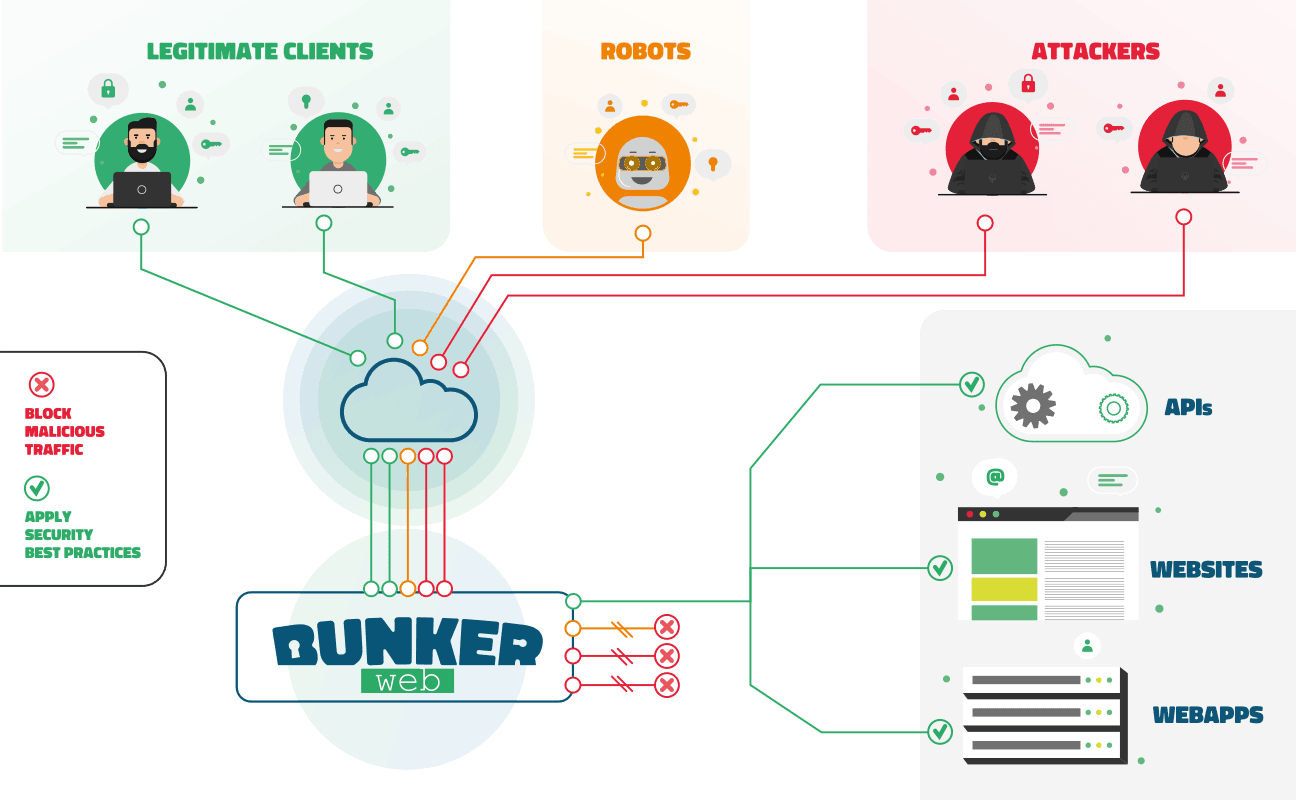
BunkerWeb is a next-generation, open-source Web Application Firewall (WAF) designed to make web services secure by default. It acts as a reverse proxy, shielding web applications from a wide range of threats including those listed in the OWASP Top 10, malicious bots, and DDoS attacks. BunkerWeb integrates seamlessly into various environments such as Linux, Docker, and Kubernetes, providing comprehensive protection for applications and APIs. The solution is highly configurable, offering both a command-line interface and an intuitive web UI for easy management. Its modular architecture allows for easy extension with additional security features via a plugin system, ensuring adaptability to evolving threats and specific security needs. BunkerWeb also offers a fully managed SaaS solution, BunkerWeb CLOUD, for those seeking instant, reliable cloud-based web security without deployment hassle.
pyttsx3
pyttsx3 is a text-to-speech (TTS) conversion library specifically designed for Python, offering the unique advantage of offline operation. Unlike many other TTS solutions that require an internet connection, pyttsx3 enables developers to integrate speech synthesis directly into their Python applications, making it ideal for environments with limited or no connectivity. The library supports a variety of voices and languages, providing flexibility for different project requirements. Its offline capability makes it a robust choice for applications where real-time, independent speech generation is crucial, such as embedded systems, local desktop applications, or projects requiring enhanced privacy.
DataCrunch
Verda, formerly DataCrunch, is a European ISO-certified cloud provider specializing in AI infrastructure. It offers instant access to powerful production-grade GPUs through self-service instances and multi-node clusters, including bare-metal options with NVIDIA B200, H200, and H100 GPUs. Verda also provides serverless inference for containerized models, allowing auto-scaling and pay-per-usage, and managed endpoints for popular AI models. The platform is designed to remove infrastructure barriers for AI teams, focusing on optimizing performance, reliability, and costs, with all infrastructure powered by 100% renewable energy and hosted in GDPR-regulated European countries.
Scikit Learn
Scikit Learn is a comprehensive, open-source machine learning library for Python, designed to be simple and efficient for predictive data analysis. Built upon NumPy, SciPy, and matplotlib, it offers a wide array of algorithms for classification, regression, clustering, and dimensionality reduction. The library also includes robust tools for model selection and data preprocessing, such as feature extraction and normalization. Its accessibility and reusability across various contexts make it a valuable resource for both beginners and experienced practitioners in the field of machine learning. Scikit Learn is commercially usable under a BSD license, fostering a vibrant open-source community.
robustmq
RobustMQ is a unified messaging engine built with Rust, designed as a communication infrastructure for the AI era. It operates as a single binary, one broker, and one storage layer, eliminating external dependencies and allowing deployment from edge devices to cloud clusters. It natively supports MQTT, Kafka, NATS, AMQP, and its own mq9 protocol on a shared storage layer, meaning a message written once can be consumed by any protocol. The mq9 protocol is specifically designed for AI Agent asynchronous communication, offering features like agent mailboxes with persistent store-first delivery, priority levels, and public mailbox discovery. RobustMQ emphasizes minimal operations, multi-tenancy, and ultra-low-latency dispatch, making it suitable for diverse messaging needs from IoT to streaming data pipelines.
spacy-models
spacy-models offers a collection of pre-trained models specifically designed for use with the spaCy Natural Language Processing (NLP) library. These models are essential for data scientists and machine learning engineers who are building applications that require advanced text processing capabilities. The models support a wide range of NLP tasks, including efficient text analysis, named entity recognition, and dependency parsing. By leveraging these pre-trained models, users can significantly accelerate their NLP development workflows, reducing the need for extensive custom training. The integration with spaCy ensures high performance and ease of use for various linguistic tasks.
SlowFast
PySlowFast is an open-source video understanding codebase developed by FAIR, designed to provide high-performance, lightweight PyTorch implementations of state-of-the-art video backbones. It supports various video understanding research tasks, including classification and detection, and is built for rapid implementation and evaluation of novel video research ideas. The repository features implementations of methods like SlowFast Networks, Non-local Neural Networks, X3D, Multiscale Vision Transformers (MViTv1 and MViTv2), Reversible Vision Transformers (Rev-ViT and Rev-MViT), and supports advanced techniques such as Multigrid Training, MAE for Video, and MaskFeat. It also includes a comprehensive model zoo with pre-trained models and baselines, along with visualization tools for analysis and inference.
sherpa
sherpa is an open-source speech-to-text inference framework built with PyTorch, designed for deploying pre-trained models to transcribe speech. It specializes in end-to-end models, particularly transducer- and CTC-based architectures, offering high-performance speech recognition capabilities. Developers can integrate sherpa into their projects using either C++ or Python APIs, making it versatile for various development environments. The framework is ideal for those looking to implement custom speech-to-text solutions, leverage advanced AI models for audio processing, or contribute to the open-source AI community. Its focus on inference means it's optimized for efficient deployment of trained models.
swift-video-generator
swift-video-generator is an open-source library designed for developers and video creators to programmatically generate videos. It offers core functionalities such as combining individual images with audio tracks to create video segments, and the ability to merge multiple video files into a single output. This tool is particularly useful for automating video production workflows, allowing for efficient creation of video content from various media assets. Its open-source nature provides flexibility for customization and integration into existing development environments, catering to users who need a programmatic approach to video generation and editing.
tlm
tlm functions as a local command-line interface (CLI) copilot, leveraging the power of Ollama to provide AI-driven code assistance. It is designed to be a workstation companion, allowing developers to utilize various open-source models such as Llama 3, Phi4, DeepSeek-R1, and Qwen within their local environment. This setup ensures that code assistance is available directly from the command line, offering a private and secure way to enhance coding workflows without relying on external cloud services. The tool is particularly beneficial for those who prioritize data privacy and wish to keep their code and AI interactions within their local infrastructure.
TensorFlow-VAE-GAN-DRAW
TensorFlow-VAE-GAN-DRAW is an open-source collection of generative methods implemented using TensorFlow. This repository offers implementations of Deep Convolutional Generative Adversarial Networks (DCGAN), Variational Autoencoders (VAE), and DRAW: A Recurrent Neural Network For Image Generation. It allows users to experiment with and run these different generative models, providing a foundation for research and development in image generation. The project highlights that DCGANs produce decent results after 10 epochs with default parameters and outlines future enhancements like more complex data integration and replacing the current attention mechanism with a Spatial Transformer Layer.
tensorflow_template_application
tensorflow_template_application offers a versatile and generic template for deep learning projects built with TensorFlow. It is designed to streamline the development process by providing a structured foundation. The tool supports multiple data formats, including CSV, LIBSVM, and TFRecords, ensuring flexibility in data handling. Key features extend to prediction servers, leveraging TensorFlow Serving and a Python HTTP server, as well as prediction clients available in various programming languages. This comprehensive setup makes it suitable for developers looking to quickly deploy and manage deep learning models.
TextyMcSpeechy
TextyMcSpeechy is an open-source tool designed for creating custom Piper text-to-speech (TTS) models. It enables users to generate unique voice models from their own voice samples or by utilizing existing voice datasets. The tool facilitates rapid dataset recording and provides a dedicated training environment, allowing users to monitor and listen to the voice as the training process progresses. A key advantage is its offline functionality, making it accessible without an internet connection. Furthermore, TextyMcSpeechy is lightweight enough to be deployed and used on low-power devices like a Raspberry Pi, offering flexibility and accessibility for various projects and users.
Time-MoE
Time-MoE is an open-source project offering a family of decoder-only time series foundation models, utilizing a Mixture of Experts architecture. These models are designed for auto-regressive operation, enabling universal forecasting with arbitrary prediction horizons and context lengths up to 4096. It scales up to 2.4 billion parameters and is trained from scratch. A key component is the Time-300B dataset, the largest open-access time series data collection, comprising over 300 billion time points across more than nine domains. Time-MoE supports making forecasts, fine-tuning with custom datasets in jsonl format, and evaluation on benchmark datasets, making it suitable for advanced time series analysis.