
Coding & Development
Browsing page 30 of AI tools for Open Source & Models in Coding & Development. Sorted by confidence score — our independent quality rating.

Cryptomage
Cryptomage offers Cyber Eye, a Network Detection and Response (NDR) probe that leverages advanced AI and Machine Learning algorithms for real-time anomaly and attack detection. Unlike many security solutions that focus on user and device behavior, Cyber Eye performs low-level, deep analysis of network traffic, protocol states, and behaviors. It identifies threats such as hidden network communication, botnets, malware, 0-day attacks, and DDoS attacks. The system includes modules for threat detection, event handling, network monitoring, forensics, and GDPR compliance, including detecting personal data leaks. Cryptomage Cyber Eye integrates seamlessly with other security solutions to enhance threat detection capabilities.

Myst AI (acquired by Snowflake)
Myst AI was acquired by Snowflake to integrate advanced machine learning capabilities directly into the Snowflake Data Cloud. This strategic acquisition is designed to empower Snowflake users with enhanced tools for data analysis, predictive modeling, and AI-driven insights within their existing data infrastructure. The integration is expected to provide a seamless experience for leveraging machine learning models on large datasets stored in Snowflake, enabling more sophisticated data-driven decision-making. Further details regarding the specific functionalities and rollout of these integrations are anticipated to be announced in the coming months, as Snowflake continues to expand its machine learning ecosystem.
pgvector
pgvector is an open-source extension designed for PostgreSQL databases, providing robust capabilities for vector similarity search. It allows users to efficiently store high-dimensional vectors alongside other data within their Postgres database. The extension supports both exact and approximate nearest neighbor searches, making it suitable for a wide range of AI and machine learning applications that rely on vector embeddings. By integrating vector search directly into Postgres, pgvector simplifies data management and retrieval workflows, eliminating the need for separate vector databases. It supports various distance metrics, offering flexibility for different use cases and data types, and is ideal for developers looking to enhance their applications with semantic search, recommendation systems, or RAG capabilities.
Awesome-LLMOps
Awesome-LLMOps is a comprehensive, curated, and open-source list of the best LLMOps tools available for developers. This repository categorizes tools across various critical areas of LLM operations, including large language models, computer vision and audio foundation models, model serving frameworks, security, and observability. It also covers LLMOps specific tools, vector search, code AI, training IDEs, foundation model fine-tuning, experiment tracking, data management, large-scale deployment, ML platforms, and performance optimization. The resource is designed to help developers navigate the complex landscape of LLM development and deployment, offering a centralized hub for discovering relevant tools and frameworks.
Qwen3-TTS
Qwen3-TTS is an open-source text-to-speech (TTS) model series developed by the Qwen team at Alibaba Cloud. It offers capabilities for stable, expressive, and streaming speech generation, making it suitable for various audio content creation needs. The model also supports advanced features such as free-form voice design, allowing users to customize and create unique vocal styles, and voice cloning, which enables the replication of existing voices. This makes Qwen3-TTS a versatile tool for developers and content creators looking to integrate high-quality, customizable speech into their applications or projects.
RAG-Retrieval
RAG-Retrieval is a specialized AI tool designed for the efficient fine-tuning of Retrieval Augmented Generation (RAG) retrieval models. It provides comprehensive support for the entire lifecycle of RAG retrieval models, encompassing training, inference, and distillation processes. The tool is versatile, accommodating a range of model types such as embedding models, ColBERT models, and re-ranker models. A key feature is its ability to facilitate the fine-tuning of any open-source RAG retrieval models, offering flexibility and extensibility for developers working with various RAG architectures. This makes it a valuable asset for those looking to optimize and customize their RAG systems for specific applications and datasets.
QA-deep-learning
QA-deep-learning is a GitHub repository that provides TensorFlow and Theano code specifically designed for insurance question answering (QA) matching. The project incorporates various deep learning models, including Convolutional Neural Networks (CNN) and Recurrent Neural Networks (RNN), to facilitate effective question and answer matching. This tool is particularly useful for researchers and developers engaged in Natural Language Processing (NLP) projects, offering a foundational codebase for building and experimenting with advanced QA systems in the insurance domain. It serves as a valuable resource for understanding and implementing deep learning approaches to complex text-based matching problems.
RWKV-LM
RWKV-LM, pronounced RwaKuv, is an innovative RNN architecture designed to achieve Large Language Model (LLM) performance. It uniquely combines the strengths of both RNNs and transformers, allowing it to be directly trained like a GPT transformer while maintaining linear time complexity and constant space usage (without a KV-cache). This results in fast training, infinite context length capabilities, and free sentence embedding. The project is currently at RWKV-7 "Goose" and is a Linux Foundation AI project, making it completely free to use. It offers efficient inference and training, with specific instructions and reference implementations available for various versions, including RWKV-7 and RWKV-6.
ROS-LLM
ROS-LLM is an open-source framework designed for embodied intelligence applications within the Robot Operating System (ROS). It facilitates natural language interactions, allowing users to control robots through conversational engagement. The framework leverages powerful Large Language Models (LLMs) like GPT-4 and ChatGPT for advanced decision-making, motion control, and navigation. With a focus on ease of use and extensibility, ROS-LLM enables quick integration of custom robot functionalities, often within ten minutes. Key features include seamless ROS integration, support for major LLMs, flexible control based on language interpretation, and simplified extensibility for various robot functions. It also provides instructional examples and retains local chat histories for convenience.
ros-mcp-server
ROS-MCP-Server is an open-source tool designed to bridge the gap between advanced AI models, such as Claude, GPT, and Gemini, and robotic systems. It facilitates bidirectional communication, allowing AI models to both command robots and receive real-time feedback on their status and sensor data. A key advantage is its ability to integrate with existing ROS setups by simply adding a rosbridge node, eliminating the need for changes to the robot's source code. The server offers full context to LLMs, guiding them to discover available topics, services, actions, and their types, ensuring correct syntax usage without manual configuration. It supports various MCP clients like Claude Code, Codex CLI, Gemini CLI, Claude Desktop, ChatGPT, and Cursor, and is compatible with both ROS 1 and ROS 2 versions.
ReplaceAnything Using SAM + SDXL Inpainting
ReplaceAnything Using SAM + SDXL Inpainting is a sophisticated tool designed for precise image editing, specifically focusing on object replacement. It integrates the Segment Anything Model (SAM) for accurate object segmentation and SDXL Inpainting for high-quality, context-aware image generation to seamlessly replace selected elements. This combination makes it a powerful solution for creative content generation, photo retouching, and various other image manipulation tasks. The tool aims to provide users with advanced capabilities for modifying images with ease and precision, making it suitable for both professional and casual use cases in photo editing.
shotgun_code
Shotgun Code is a desktop power-tool designed to connect local codebases with powerful Large Language Models. It goes beyond simple file copying by intelligently packaging project context and executing prompts directly against various LLMs, including OpenAI (GPT-4o/GPT-5), Google Gemini (2.5/3 Pro & Flash), and OpenRouter. Key features include AI-powered Auto-Context for relevant file selection, direct API integrations, built-in prompt templates for different roles, and a comprehensive history and audit log. It aims to solve common issues like context cutoff and missing files, enabling developers to blast massive context payloads instantly and streamline their LLM-driven coding workflows.
tgpt
tgpt is a cross-platform Command-Line Interface (CLI) tool designed to bring AI chatbot capabilities directly into your terminal. It offers a free and efficient way to interact with various AI providers without needing a graphical user interface. Users can easily install tgpt on GNU/Linux, MacOS, and Windows systems using package managers like pacman, Homebrew, Go, Scoop, or Chocolatey, as well as direct installation scripts. The tool supports proxy configurations and allows for easy updates. tgpt is ideal for developers and technical users who prefer to leverage AI functionalities within their command-line environment for tasks like code generation, quick queries, or automating workflows.
tokencost
tokencost is an open-source Python library designed to provide easy token price estimates for over 400 Large Language Models (LLMs). It helps developers accurately calculate the USD cost of using major LLM APIs by estimating the cost of both prompts and completions. The tool tracks the latest price changes from LLM providers and offers token counting functionality using Tiktoken for OpenAI models and Anthropic's beta API for newer Claude models. It integrates seamlessly into AI agent development workflows, allowing for cost calculation with a single function call, making it an essential tool for budget management and cost optimization in AI applications.
KeyU
KeyU Tech specializes in a comprehensive suite of IT services and solutions, including web development, product design, and SaaS solutions. Their expertise extends to advanced AI and machine learning, offering custom models for process automation and data-driven insights. KeyU also provides data analysis services to uncover trends and optimize business strategies. They emphasize a collaborative approach, starting with understanding a client's long-term vision, focusing on achievable milestones, and delivering rapid prototypes for quick feedback and adjustments. Their services are designed to enhance user experience, streamline operations, and scale effortlessly as businesses grow, ensuring efficient implementation and swift market entry.
Mithril Security
Mithril Security is a deep tech cybersecurity startup focused on making AI more privacy-friendly through secure software solutions. Their products include BlindLlama for confidential AI with GPU support, AICert for verifiable training of AI models, and AIGovTool for trusted monitoring of AI. They emphasize end-to-end data protection, using secure hardware like TPMs to provide cryptographic proof that data remains confidential and models are untampered. Mithril Security's solutions are open-source and have been audited by independent security labs, promoting transparency and trust in AI deployment, particularly for sensitive data and intellectual property protection.
uqlm
UQLM (Uncertainty Quantification for Language Models) is an open-source Python package designed to detect hallucinations in large language models (LLMs). It offers a comprehensive suite of response-level scorers for quantifying the uncertainty of LLM outputs, with higher scores indicating a lower likelihood of errors. The package categorizes scorers into Black-Box (consistency-based, universal compatibility), White-Box (token-probability-based, faster/cheaper but requires internal access), LLM-as-a-Judge (customizable via prompt engineering), Ensemble (combines multiple scorers for robust estimates), and Long-Text (claim-level scoring for factual precision). UQLM supports various LangChain Chat Models and provides extensive documentation and example notebooks for different uncertainty quantification approaches.
Beagle Security
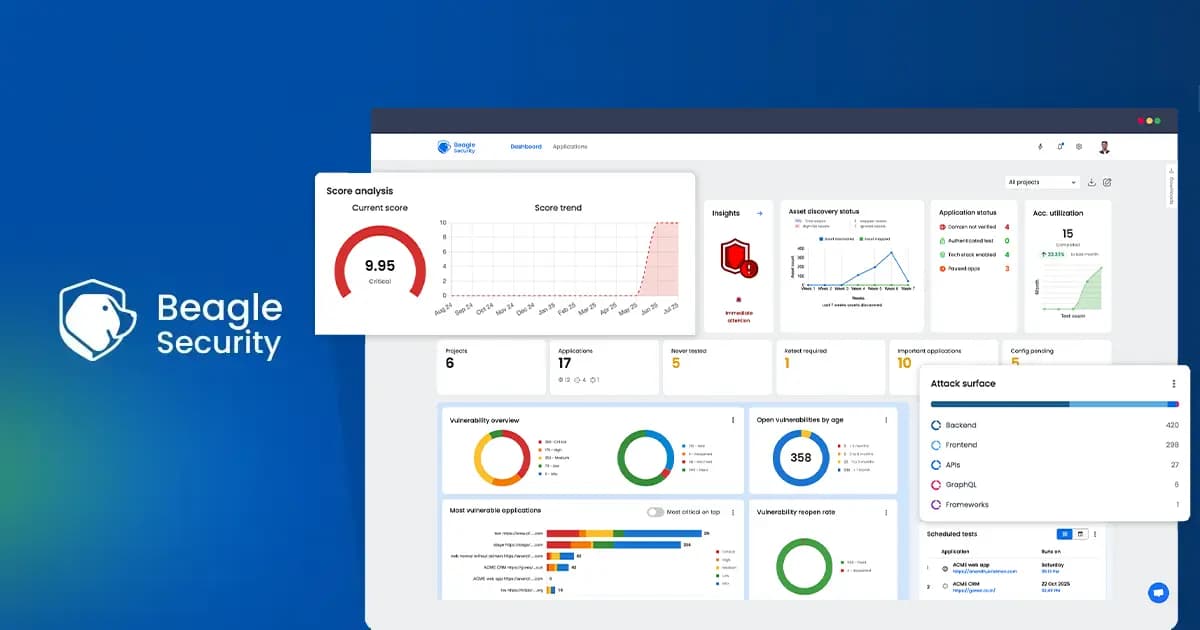
Beagle Security is an AI-powered AppSec platform designed for automated web application and API penetration testing. It leverages AI, trained on over 350,000 penetration test workflows, to conduct comprehensive tests and identify vulnerabilities with the same level of detail as a human. The platform provides actionable remediation insights, helping organizations meet compliance requirements, prove security to customers, and integrate security testing into their CI/CD pipelines. Key features include end-to-end penetration tests on complex applications, the ability to teach the AI business logic through recorded scenarios, and integrations with project management tools like Jira and Azure Boards for easy vulnerability reporting. It offers flexible, usage-based pricing, allowing users to pay only for the tests they run, with no limits on the number of applications or targets.
OpenGPT-X
OpenGPT-X is a collaborative project focused on developing and training large-scale AI language models (LLMs) specifically tailored for European requirements. The project emphasizes versatility, trustworthiness, multilingual capabilities, and an open-source approach, making its models, such as "Teuken 7B," publicly available. Funded by the German Federal Ministry for Economic Affairs and Climate Action (BMWK), OpenGPT-X brings together expertise from science, industry, and media to cover the entire generative AI value chain. Its primary goal is to accelerate the adoption of generative AI in the German economy by fostering cutting-edge research with a strong application focus. The initiative also provides resources like the LLM Workbook to help users understand and utilize these advanced language models.
VoxCPM
VoxCPM2 is a cutting-edge, tokenizer-free Text-to-Speech (TTS) system developed by OpenBMB, designed for highly natural and expressive speech synthesis. It bypasses discrete tokenization by directly generating continuous speech representations via an end-to-end diffusion autoregressive architecture. The latest version, VoxCPM2, is a 2B parameter model trained on over 2 million hours of multilingual speech data, supporting 30 languages. Key features include Voice Design, allowing users to create new voices from natural-language descriptions, and Controllable Voice Cloning, which enables cloning a voice from a short reference clip with optional style guidance. It also offers Ultimate Cloning for reproducing every vocal nuance and outputs 48kHz studio-quality audio. VoxCPM2 is fully open-source under the Apache-2.0 license, making it free for commercial use, and supports real-time streaming with low RTF.
VITA
VITA is an open-source project focused on achieving GPT-4o level real-time vision and speech interaction. The latest version, VITA-1.5, introduces significant advancements, including a reduction in end-to-end speech interaction latency from approximately 4 seconds to 1.5 seconds, enabling near-instant user experience. It also boasts enhanced multimodal performance, with average scores on benchmarks like MME, MMBench, and MathVista increasing from 59.8 to 70.8. VITA-1.5 refines speech processing capabilities, reducing ASR Word Error Rate from 18.4 to 7.5, and integrates an end-to-end TTS module. The tool supports both English and Chinese and provides instructions for setting up basic and real-time interactive demos, making it accessible for developers and researchers.
Safe Pro Group Inc.
Safe Pro Group (NASDAQ: SPAI) provides AI-enabled security and defense solutions, with a core focus on protecting personnel. Their primary offering involves AI-powered computer vision technologies for rapid analysis of drone-based imagery, utilizing proprietary machine learning and deep learning software. This technology is specifically designed for landmine and unexploded ordnance (UXO) detection. Beyond AI, the company also offers drone services for critical infrastructure inspection and aerial data capture, as well as manufacturing advanced ballistic protection products like body armor, plates, helmets, and EOD suits. Their solutions are geared towards enhancing safety and efficiency in high-risk environments.
yousan.ai
yousan.ai is an open-source project dedicated to providing a wealth of resources for individuals studying deep learning. It encompasses a wide array of materials, including practical projects, comprehensive ebooks, and structured courses. The platform is designed to support various popular deep learning frameworks such as Caffe, TensorFlow, PyTorch, MXNet, PaddlePaddle, Darknet, Deeplearning4j, MatConvNet, Keras, Chainer, and CNTK. It covers key deep learning tasks like computer vision (image classification, segmentation, object detection), speech processing (recognition, synthesis), and natural language processing (knowledge graphs, automatic question answering). The project also offers specific resources on topics like GANs, Transformer models, and ChatGPT, making it a valuable hub for deep learning enthusiasts and professionals.
TinySwallow-1.5B-Instruct-WebGPU
TinySwallow-1.5B-Instruct-WebGPU is a compact Japanese Large Language Model (LLM) designed to run directly within your web browser, leveraging WebGPU technology for local processing. This application, hosted on Hugging Face Spaces, allows users to view and interact with 3D models. You can upload your own 3D models or utilize preloaded ones, providing a detailed and immersive environment for exploration. The tool is particularly focused on Japanese language processing and AI experimentation, making it a valuable resource for developers and researchers interested in local LLM deployment and 3D model interaction within a browser-based setting.