
Coding & Development
Browsing page 41 of AI tools for Open Source & Models in Coding & Development. Sorted by confidence score — our independent quality rating.

Mavenai Technologies
Mavenai Technologies is an insurtech startup leveraging Artificial Intelligence and Machine Learning to automate motor insurance claims. Beyond insurance, they provide AI as a service across multiple industries, offering solutions like smart claim processing, drone imagery analysis, satellite imagery analysis, and AI chatbots for automating manual tasks. Mavenai also specializes in industrial inspection for defect detection using AI. A key focus for the company is assisting clients in transitioning from Web 2.0 to Web 3.0, including services related to NFT-based solutions, DeFi, and blockchain consulting, advising, and education. They work with a diverse clientele including insurance providers, government agencies, AI companies, space agencies, and drone companies.
prompt-tutorial
Prompt-tutorial is a GitHub-based open-source resource dedicated to teaching prompt engineering for large language models (LLMs). It offers a structured series of lessons covering fundamental principles, advanced strategies, and common limitations in prompt creation. The tutorial emphasizes clear and explicit instructions, structured output requirements, and iterative prompt optimization. It includes practical examples for tasks like text summarization, inference, language translation, and content generation, making it suitable for individuals looking to enhance their skills in interacting with LLMs without requiring a technical background.
PyTorch-Tutorial-2nd
PyTorch-Tutorial-2nd is a comprehensive, open-source tutorial designed for individuals ranging from beginners to experienced deep learning engineers. It systematically covers PyTorch fundamentals, including environment setup, data handling, model building, optimization, and visualization. The tutorial delves into practical applications across computer vision (image classification, segmentation, object detection, GANs, Diffusion models), natural language processing (RNN, LSTM, Transformer, BERT, GPT models for text classification, machine translation), and large language models (Qwen, ChatGLM, Baichuan, Yi, GPT Academic). Furthermore, it provides in-depth guidance on industrial deployment, covering ONNX and TensorRT principles, model quantization (PTQ, QAT), and acceleration techniques, enabling users to master PyTorch for real-world project implementation.
Tutorial
Tutorial, developed by InternLM, is an open-source learning platform designed for developers to master large language models (LLMs) and vision-language models (VLMs). It offers a structured curriculum through 'camps' with challenges, documentation, and video tutorials covering foundational topics like Linux, Python, and Git, as well as advanced concepts such as prompt engineering, RAG implementation, model fine-tuning with XTuner, and deployment with LMDeploy. The platform also includes practical applications like building intelligent agents with Lagent and multi-modal model deployment. Participants can earn computational resources and certificates upon completing advanced challenges, fostering a community-driven learning environment.
build-your-ai-coding-assistant
Build-your-ai-coding-assistant is an open-source project and comprehensive guide detailing how to construct a custom AI-assisted coding tool, similar to GitHub Copilot or JetBrains AI Assistant. It provides a step-by-step approach for developers, covering the entire lifecycle from designing IDE plugins and selecting appropriate AI models to building high-quality datasets and fine-tuning models. The guide emphasizes practical application, using examples like DeepSeek Coder and Intellij IDEA, and discusses various AI coding scenarios such as code completion, explanation, generation, and review. It also delves into architectural considerations for balancing model speed and quality, and different contextual engineering approaches to enhance AI assistance.
sentiment-analysis
sentiment-analysis is an open-source project offering multiple approaches to sentiment analysis and text classification, core tasks within Natural Language Processing (NLP). It provides implementations ranging from dictionary-based methods and traditional machine learning algorithms like Bayes, to advanced deep learning models such as TextCNN and BERT. The tool also features a unique approach for handling unknown tokens, including emojis, by learning their semantic vectors during fine-tuning. This makes it a versatile resource for developers and researchers working on NLP tasks, particularly those focused on understanding and categorizing textual sentiment.
zero_nlp
zero_nlp is a robust Chinese NLP solution built on PyTorch and Transformers, designed to be an out-of-the-box training framework. It offers a complete solution for training and fine-tuning various models, including large language models, text-to-vector, text generation, and multi-modal models. The platform provides extensive training data from the open-source community, along with templates for processing vertical domain data efficiently, even for hundreds of gigabytes. It supports a full workflow from data cleaning and processing to model building, training, deployment, and visualization. Key features include support for models like GPT2, CLIP, GPT-Neox, Dolly, Llama, ChatGLM-6b, and VisionEncoderDecoderModel, alongside multi-card parallelization for training and inference of large models.
VCPToolBox
VCPToolBox acts as a revolutionary middleware deployed between AI model APIs and frontend applications, fundamentally transforming large language models (LLMs) from stateless entities into complete intelligent agent systems. It achieves this through a unified instruction protocol, multi-level persistent memory, a distributed plugin engine, and a multi-agent collaboration framework. The tool addresses critical limitations of traditional AI systems, such as disconnected frontends and backends, mechanical tool invocation, and lack of persistent memory. VCPToolBox enables AI to operate across distributed systems using natural language, maintain a unified identity across multiple interfaces, possess a continuous sense of time, and utilize a neuron-simulated memory system that mimics human recall processes.
geniusaihub
geniusaihub is an all-in-one AI platform that aims to simplify problem-solving, automate various tasks, and enhance media through features like photo restoration. The platform integrates a diverse set of AI tools, providing users with a centralized hub for their AI-related needs. While specific features are not detailed on the provided pages, the overarching goal is to offer comprehensive AI capabilities for a wide range of applications, from creative endeavors to practical work automation. Its design suggests a focus on accessibility, bringing advanced AI functionalities into a single, manageable interface for users looking to leverage artificial intelligence without needing to navigate multiple specialized tools.
FindTheChatGPTer
FindTheChatGPTer is a valuable resource for anyone interested in exploring open-source alternatives to ChatGPT and GPT-4. This project compiles a continuously updated list of text-based and multi-modal large language models, offering insights into their technical details, capabilities, and GitHub links. It covers a range of models, from those developed independently to those based on existing architectures like LLAMA, and includes discussions on their training methodologies such as supervised fine-tuning and reinforcement learning from human feedback (RLHF). The project also highlights models supporting various languages, multi-modal functionalities, and different parameter scales, making it a comprehensive guide for developers, researchers, and enthusiasts looking to understand and utilize the evolving landscape of open-source AI.
prolificdreamer
ProlificDreamer is an open-source tool for high-fidelity and diverse text-to-3D generation, leveraging Variational Score Distillation. Published in NeurIPS 2023, this tool provides a robust framework for converting text prompts into detailed 3D models. The generation process is structured into three distinct stages: initial NeRF (Neural Radiance Fields) generation with VSD guidance, followed by geometry refinement, and finally, texturing, also with VSD guidance. This multi-stage approach allows for fine-tuning and optimization at each step, ensuring high-quality and diverse outputs. While powerful, the current implementation, built on Stable Diffusion without 3D data, may exhibit the multi-face Janus problem, a common limitation in text-to-image diffusion models. The developers suggest that finetuning on multi-view images could alleviate this issue in future iterations. ProlificDreamer is integrated into the Threestudio library, making it accessible for developers and researchers.
LLMAPI.ai
LLMAPI.ai offers a free unified API interface for developers to access over 200 large language models from various providers. Compatible with the OpenAI API format, it allows for seamless migration and integration. The platform includes features like multi-provider support, performance monitoring to compare model effectiveness and cost, and secure API key management. It also provides one-click team synchronization, cost-aware analytics for tracking requests, tokens, and spend, and per-model/provider breakdowns. Additionally, users can monitor error rates, cache hit rates, and reliability trends directly from the dashboard, helping teams save up to 30% on subscription waste and infrastructure fees through intelligent routing and semantic caching.
pgvecto.rs
pgvecto.rs is a Postgres extension designed for scalable, low-latency, and hybrid-enabled vector search directly within PostgreSQL databases. Built with Rust and based on pgrx, it allows users to integrate vector similarity search functions without revolutionizing their existing database infrastructure. Key features include support for up to 65535 vector dimensions, dynamic SIMD instruction dispatching for optimized performance, and additional data types like binary vectors, FP16, and INT8. It offers filtering capabilities with its VBASE method for combined vector search and relational queries, and provides Write-Ahead Logging (WAL) support for data. The tool supports squared Euclidean distance, negative dot product, and cosine distance operators for vector comparisons, making it a robust solution for integrating advanced vector search into PostgreSQL.
rag-stack
rag-stack is an open-source solution designed to deploy a private ChatGPT alternative securely within your Virtual Private Cloud (VPC). It functions as a corporate oracle by connecting to your organization's knowledge base, enabling Retrieval Augmented Generation (RAG). This technique augments LLM capabilities by retrieving information from external systems, providing context beyond their training data. rag-stack supports open-source LLMs such as Llama 2, Falcon, and GPT4All, offering a more reliable, faster, and cost-effective alternative to fine-tuning models. It includes a server and UI for PDF upload, allowing users to chat over their documents using Qdrant as a vector database. Deployment options are available for Google Cloud, AWS, and Azure.
hqq
hqq provides an official implementation of Half-Quadratic Quantization (HQQ) and HQQ+, designed to efficiently quantize large machine learning models. It supports various bit-widths (8, 4, 3, 2, 1 bits) and can be applied to different model types, including LLMs and Vision models. A key differentiator is its ability to quantize models quickly without the need for calibration data, making it a fast and accurate solution. The tool is compatible with optimized CUDA/Triton kernels for faster inference and supports PEFT training. Users can customize quantization settings for different layers and integrate with popular frameworks like Hugging Face Transformers and vLLM, offering flexibility for both research and deployment.
pragmatic_segmenter
Pragmatic Segmenter is a rule-based sentence boundary detection gem designed to segment text into sentences across multiple languages without requiring machine learning or training data. It aims to provide a "real-world" segmenter that performs well even when the format and domain of the input text are unknown. The tool focuses on robust language support, going beyond English-centric solutions, and includes text cleaning and preprocessing capabilities. It is opinionated, specifically developed for segmenting texts to create translation memories, and handles ambiguous sentence boundaries conservatively to maintain coherence. The project also features "Golden Rules," a set of tests for evaluating segmenter accuracy on edge cases, which are available for download.
raglite
RAGLite is a comprehensive Python toolkit designed for Retrieval-Augmented Generation (RAG), offering flexible integration with DuckDB or PostgreSQL databases. It allows users to choose any LLM provider via LiteLLM, including local llama-cpp-python models, and supports various rerankers like FlashRank. The toolkit emphasizes lightweight, permissive open-source dependencies and includes features like PDF to Markdown conversion, multi-vector chunk embedding, and optimal semantic chunking. RAGLite also provides adaptive and programmable RAG pipelines, self-query capabilities, and optional integrations for a ChatGPT-like frontend, Pandoc for document conversion, Mistral OCR for high-quality document processing, and Ragas for evaluation.
Meta Segment Anything Model 2
Meta Segment Anything Model 2 (SAM 2) is the first unified model designed for segmenting objects across both images and videos with high precision. Users can select objects in any image or video frame by providing a click, box, or mask as input, and the model segments the object based on this prompt. SAM 2 is engineered for fast and precise object selection, delivering state-of-the-art performance for object segmentation in both images and videos. The models are open source under an Apache 2.0 license, making them accessible for various applications and research. It also supports refining predictions with additional prompts, especially useful in video frames.
Adaptive ML
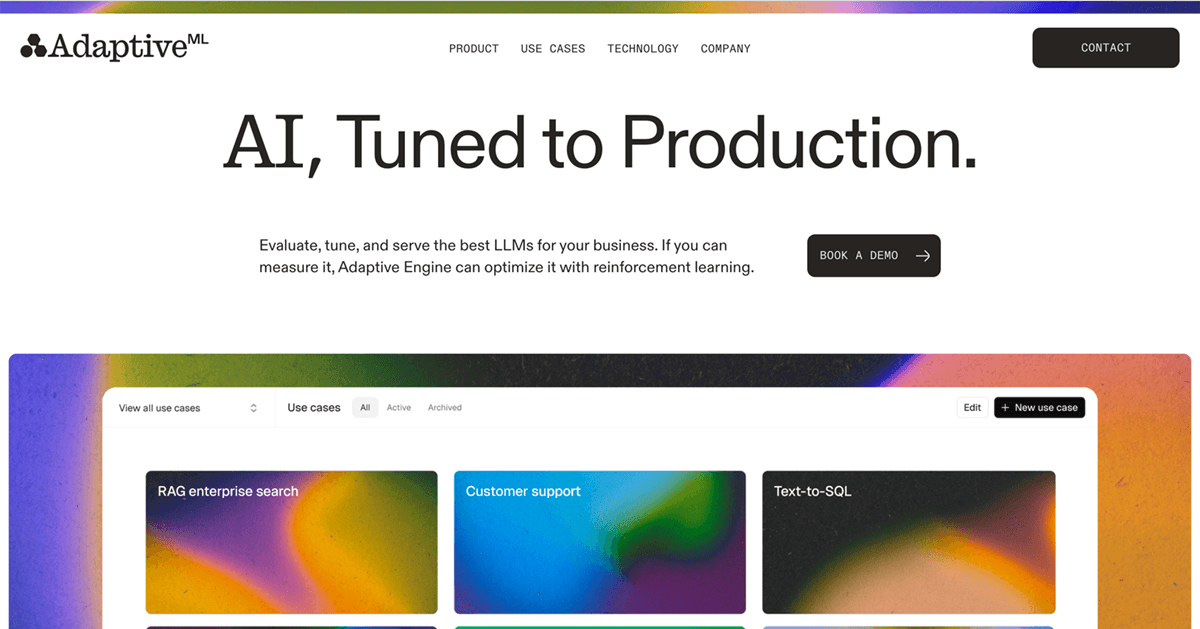
Adaptive ML provides a platform, Adaptive Engine, for businesses to build, own, and deploy specialized Large Language Models (LLMs) by leveraging reinforcement learning. The tool focuses on evaluating, tuning, and serving LLMs to drive business value. Key capabilities include generating synthetic data, fine-tuning models with reinforcement learning to outperform frontier APIs, and evaluating performance with bespoke AI judges tailored to business outcomes. It also guarantees performance through A/B testing and optimizes models with real-time production feedback, ensuring continuous improvement and knowledge retention. Adaptive ML is designed to help enterprises bridge the gap from prototype to autonomous production for their AI initiatives.
python-genai
python-genai is Google's official Python SDK for integrating generative AI models into applications. It provides developers with the tools to leverage Google's powerful Gemini Developer API and Vertex AI APIs directly within their Python projects. This SDK simplifies the process of incorporating advanced AI capabilities, such as code generation, into various applications. It is designed to help developers build intelligent features and automate tasks by providing a robust and easy-to-use interface to Google's generative AI services, making it a valuable resource for enhancing Python-based solutions with cutting-edge AI.
AI-Resources-Central
AI-Resources-Central is a comprehensive GitHub repository dedicated to bringing together outstanding artificial intelligence (AI) open-source projects from around the world. It aims to be a go-to resource for anyone looking for inspiration, learning new AI techniques, or contributing to the AI community. The repository covers a wide range of AI domains, including machine learning, deep learning, and natural language processing. It promotes the open-source spirit by showcasing high-quality projects, fostering innovation by providing practical examples, and supporting learning and development by offering hands-on opportunities with the latest AI tools and technologies. The project is available in both Simplified Chinese and English, making it accessible to a global audience.
GPT4o.so
GPT4o.so offers free online access to OpenAI's GPT-4o, a groundbreaking multimodal AI platform. This tool allows users to explore and utilize GPT-4o's capabilities for interpreting and generating text, visuals, and audio. It is engineered for speed, cost-efficiency, and universal accessibility, revolutionizing interaction with AI technology. Key features include multimodal integration across text, imagery, and audio, instant voice dialogue with emotional context understanding, and advanced visual recognition for diverse applications. The platform also provides access to over 50,000 other AI tools, making it a comprehensive resource for AI enthusiasts, developers, and businesses aiming to enhance operational efficiency and engagement.
qxresearch AI
qxresearch AI is a dedicated research lab specializing in Machine Learning, Deep Learning, and Computer Vision. The team is committed to making impactful discoveries and openly sharing their findings through academic journals and open-source contributions on GitHub. Beyond theoretical research, qxresearch AI actively implements these advancements into tangible AI applications within the healthcare and education sectors. The organization manages a diverse portfolio of research projects and papers, driven by fundamental research, real-world applications, and infrastructure development goals. Their primary research focus areas include Generative AI, Computer Vision, and Reinforcement Learning, fostering an environment where individuals and teams can pursue specific research interests.
Commissioned
Commissioned provides a fine-tuning as a service platform, enabling individuals and teams to customize AI models quickly and efficiently. It addresses the complexities of fine-tuning, such as vendor-specific data formats and custom evaluations, by handling data cleaning, formatting, and deduping. Users can upload various data types like conversations, documents, or codebases and choose from popular model providers including OpenAI, Gemini, or open-source options. The platform supports fine-tuning for a range of models, including Gemini 2.5, Gemini 2.5 Flash, GPT-4.1, GPT-4.1 mini, and Qwen3-8B. It offers a free tier, making it accessible for individuals exploring fine-tuning, and scales up to enterprise solutions with features like centralized billing, team member management, and dedicated hardware.