
Coding & Development
Browsing page 43 of AI tools for Open Source & Models in Coding & Development. Sorted by confidence score — our independent quality rating.

awesome-llms-fine-tuning
awesome-llms-fine-tuning is a meticulously curated collection of resources designed to aid in the fine-tuning of Large Language Models (LLMs) such as GPT, BERT, and RoBERTa. This repository is an indispensable resource for machine learning practitioners and researchers looking to adapt pre-trained models to specific tasks and domains. It encompasses a wide range of materials including tutorials, academic papers, practical tools, robust frameworks, and established best practices. The collection helps users enhance model performance and ensure alignment with particular contexts, terminology, and application requirements. Whether expanding expertise or just starting in the LLM field, this repository offers valuable insights and guidelines to streamline the fine-tuning process.
verl-agent
verl-agent is an extension of veRL specifically designed for training large language model (LLM) and vision-language model (VLM) agents using reinforcement learning (RL). It is the official code for the paper "Group-in-Group Policy Optimization for LLM Agent Training." A key differentiator is its step-independent multi-turn rollout mechanism, which allows for fully customizable per-step input structures, flexible history management, and modular memory. This design makes verl-agent highly scalable for very long-horizon, multi-turn RL training, such as tasks requiring up to 50 steps. The framework provides a diverse set of RL algorithms, including GiGPO, GRPO, and PPO, along with a rich suite of agent environments for both visual and text-based tasks, supporting models like Qwen3, LLaMA3.2, and LoRA fine-tuning.

Outtake
Outtake leverages agentic AI to secure modern attack surfaces, offering advanced search capabilities, real-time threat classification, and automated response. The platform is designed to protect the digital presence of brands by continuously scanning the open information environment for threats. It transforms noise into insights through Open Source Intelligence, monitoring emerging narratives, detecting threats from open sources, and protecting against location-based risks. For Digital Risk Protection, Outtake's AI agents automatically identify, prioritize, and dismantle impersonation attacks across various digital surfaces like social media, apps, and advertisements. Additionally, Outtake Verify is a browser extension that cryptographically signs emails and enables employees to report brand impersonations, helping to authenticate executive communications and prevent account takeovers.
transformer
This repository offers PyTorch implementations of two significant transformer network architectures: "Attention is All You Need" by Vaswani et al. (NIPS 2017) and "Weighted Transformer Network for Machine Translation" by Ahmed et al. (Arxiv 2017). It serves as a valuable resource for researchers and developers interested in understanding, experimenting with, and applying transformer models in machine translation and other natural language processing tasks. The project is open-source, providing the full code for these implementations, making it accessible for academic study, practical development, and benchmarking against established models.
MindSpore
MindSpore is an open-source, self-developed AI framework by Huawei, designed to support full-scenario deep learning training and inference across device, edge, and cloud environments. It aims to provide a new AI programming paradigm, enabling developers to create efficient and flexible AI software and hardware applications. Key features include automatic differentiation based on source code transformation, automatic distributed parallel training, robust data processing capabilities, and a high-performance graph execution engine. MindSpore is primarily applied in AI fields such as computer vision and natural language processing, catering to data scientists and algorithm engineers. The framework fosters an AI development ecosystem through its open-source nature and community support, offering various toolkits for scientific computing, large models, and specific domains like CV and NLP.
unilm
unilm is an open-source project by Microsoft focused on large-scale self-supervised pre-training, encompassing a wide range of tasks, languages, and modalities. It provides foundational architectures like TorchScale, DeepNet, and Magneto, alongside a diverse collection of pre-trained models such as Kosmos, MetaLM, BEiT, WavLM, and LayoutLM. The project supports advancements in natural language processing, machine translation, speech recognition, document AI, and multimodal AI. It is designed for researchers and developers interested in building and experimenting with cutting-edge foundation models, offering resources for language, vision, and speech tasks, as well as multimodal applications.
Okareo
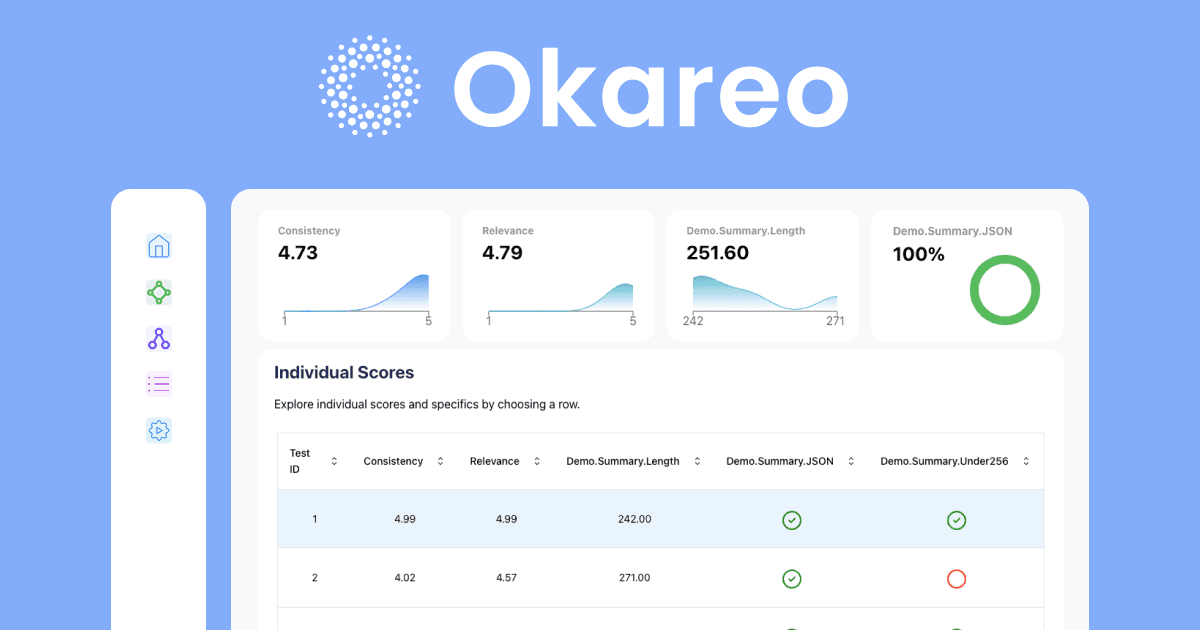
Okareo offers a comprehensive platform for AI application developers to build and deploy high-quality LLM-powered applications. It enables users to simulate real users and automate agent behaviors with 'Drivers' to expose unexpected behaviors and edge cases. The platform allows for automated agent evaluation in CI/CD pipelines, catching failures early and ensuring reliable agents. Okareo also helps close the loop from production to development by pairing simulation with error tracking and synthetic data, generating new test cases and data for retraining or fine-tuning. This leads to faster fixes, stronger guardrails, and safer agents, providing full visibility and increasing accuracy for AI products.

Datalytica
Datalytica is a leading AI consulting and development firm dedicated to accelerating the adoption of artificial intelligence and emerging technologies across various sectors. They offer expertise in AI assurance and reverse engineering, as evidenced by their award from the AFRL Regional Network for groundbreaking work in these areas. Datalytica provides strategic and technical advisory support, helping organizations like ARPA-H shape research portfolios, refine program strategies, and strengthen execution to achieve measurable impact. Their work spans diverse applications, from operationalizing Large Language Models for the Department of Defense to digital modernization of industrial operations and advising on trusted AI for coalition-ready space superiority for NATO. Datalytica's insights are valuable for both government entities and the private sector, driving innovation and ensuring the effective deployment of AI solutions.
Freeport Metrics
Freeport Metrics is an American-owned and managed offshore software development partner specializing in generative AI integrations. They help startups and enterprises shorten the path to results with AI, offering services from product design and solution patterns to coding assistance and team training. Freeport Metrics builds and maintains AI systems for various operational problems, including voice agents, document intelligence, automation, and custom integrations. They also offer AI accelerators to ramp up product teams for the Gen AI age and provide solutions for leveraging existing applications with tools like Form2agent AI. Their expertise spans industries such as FinTech, InsureTech, HealthTech, Logistics, and FoodTech.
Wan 2.6 AI
Wan 2.6 AI is an open-source video generation model developed by Alibaba, offering powerful capabilities to create professional-grade videos. Users can generate videos from text prompts (Text-to-Video), animate static images (Image-to-Video), or transform existing videos with new styles or enhanced quality (Video-to-Video). The tool supports high-resolution output at 720p and 1080p, with flexible video durations ranging from 5 to 15 seconds. It features smooth motion, realistic textures, and cinematic visual quality, along with strong prompt understanding. Wan 2.6 AI is ideal for various applications, including short films, marketing product showcases, social media content, character animation, creative art, and visual effects, providing free credits to start and an affordable, usage-based pricing model.
ELITE Research Lab LLC
ELITE Research Lab LLC is dedicated to advancing artificial intelligence through focused research in key areas such as explainable AI, natural language processing, computer vision, and human-AI interaction. The lab's core mission is to deepen the understanding and practical application of AI technologies to address complex, real-world challenges ethically. They strive to develop AI systems that are not only powerful but also transparent and easily understandable, promoting trust and broader adoption. Their work aims to bridge the gap between theoretical AI advancements and their tangible impact on society, ensuring that AI solutions are both innovative and responsible.

Corelight
Corelight is an industry-leading Network Detection & Response (NDR) platform designed to uncover hidden threats with network evidence. It transforms raw network data into definitive evidence, powering AI-driven detection and expert-authored workflows, and enabling the AI SOC ecosystem. The platform offers complete network visibility, reducing risk and providing situational awareness by proactively eliminating visibility gaps. It accelerates investigations with Agentic Triage, which automatically consolidates alerts, correlates evidence, and executes expert playbooks, leading to 10x faster triage. Corelight also significantly reduces false positives and improves detection accuracy through a multi-layered detection engine that fuses threat intelligence, machine learning, behavioral analytics, and expert-tuned signatures, delivering risk-prioritized alerts with AI-driven summaries.
Archeron Group
Archeron Group positions itself as an innovation-first organization dedicated to machine learning and artificial intelligence. While specific product offerings are not detailed on its current website, the company's focus suggests it likely provides advanced AI development, consulting, and implementation services to clients. Its emphasis on being innovation-first indicates a commitment to cutting-edge solutions and staying at the forefront of AI advancements. The company's online presence currently shows a redirecting status, implying a potential website overhaul or a private client-focused operation.
auto-cot
auto-cot is an open-source tool that provides an official implementation for "Automatic Chain of Thought Prompting in Large Language Models." Developed by Amazon Science, this tool significantly reduces the manual effort typically required for designing effective chain of thought prompts. By automating the generation of diverse prompts, auto-cot helps large language models (LLMs) like GPT-3 achieve or even exceed the performance of manually designed prompts. It is particularly useful for researchers and developers working with LLMs, offering a method to enhance reasoning capabilities through automated prompt engineering. The project is available on GitHub and includes requirements, datasets, and quick start instructions for easy implementation.
pollinations
Pollinations is an open-source generative AI platform based in Berlin, designed for creators and developers. It offers accessible APIs for generating text, images, video, and audio, powering over 500 community projects. The platform features a new unified API at gen.pollinations.ai, consolidating all generation needs into a single endpoint. Users can access models like Flux, GPT-5, Claude, Gemini, and Seedream. Pollinations emphasizes open-source development, community contributions, and a pay-as-you-go system with 'Pollen credits'. It provides various tools including a web interface, API access, and an SDK for Node.js, browser, and React integration, making it suitable for a wide range of AI-driven content creation.
aKin
aKin is a public benefit AI company dedicated to building frontier AI models for life, emphasizing a responsible co-evolution of AI and humanity. The company designs and builds flexible, AI-powered solutions that are currently in use by public and private organizations. These solutions span various critical domains, including AI for daily living to manage tasks and free up time, AI for healthcare to support wellbeing, AI for government to aid policy decisions, and AI for space exploration. aKin's approach integrates neuroscience, chaos theory, and AI to develop enterprise-grade AI and personal AI co-pilots, aiming to make advanced AI accessible to everyone.
Safety-Prompts
Safety-Prompts is an open-source GitHub repository offering a comprehensive collection of Chinese safety prompts designed to evaluate and enhance the safety of Large Language Models (LLMs). This resource includes over 100,000 prompts and corresponding ChatGPT responses, covering a wide array of typical safety scenarios such as insult, unfairness, discrimination, crimes, physical harm, mental health, privacy, property, ethics, and morality. Additionally, it features instruction attack scenarios like goal hijacking, prompt leaking, role play instruction, unsafe instruction topics, inquiry with unsafe opinion, and reverse exposure. The dataset is intended for training and fine-tuning safer models, aligning model outputs with human values, and conducting safety assessments. While most responses are safe, the repository notes some limitations, including potential prompt imperfections and occasional unsafe responses from ChatGPT, particularly in goal hijacking scenarios.
awesome-dl4nlp
awesome-dl4nlp is a comprehensive, curated list of resources for Deep Learning (DL) in Natural Language Processing (NLP). It offers a wide array of materials including courses from institutions like Stanford and Carnegie Mellon, various books on DL with text and NLP, and practical tutorials for frameworks like PyTorch. The resource also compiles talks and lectures from leading experts, lists popular DL frameworks such as TensorFlow, PyTorch, and SpaCy, and highlights significant papers and blog posts in the field. Additionally, it provides access to diverse datasets for NLP tasks and information on word embeddings. This makes it an invaluable hub for anyone looking to explore or deepen their understanding of DL for NLP.
Awesome-Graph-LLM
Awesome-Graph-LLM is an Open Source repository dedicated to curating research papers and resources at the intersection of Graph-Related Large Language Models (LLMs). It aims to bridge the gap between the remarkable progress of LLMs in natural language processing and the prevalence of graph structures in real-world applications. The collection covers various aspects including datasets, benchmarks, surveys, prompting techniques, general graph models, large multimodal models, and diverse applications such as basic graph reasoning, node classification, knowledge graphs, and graph retrieval augmented generation (GraphRAG). This resource is invaluable for researchers and developers looking to explore or contribute to this rapidly evolving field.
Walaris
Walaris offers the AirScout platform, a signal processing and sensor fusion software that leverages hardened artificial intelligence to process real-time data from sensor arrays. Designed for edge processing, AirScout locally fuses data and performs billions of computations to identify patterns or objects. The software is hardware-agnostic, allowing for rapid upgrades or downgrades with different sensors or optics, and integrates seamlessly with third-party sensors and command-and-control systems via an easy-to-use API. Key offerings include AirScout Sentry, an end-to-end optical system for unparalleled optical monitoring, and AirScout Verify, a slew-to-cue EO/IR solution supporting third-party systems for autonomous optical acquisition, classification, and tracking of unwanted UAS in airspace.
Awesome-LLMs-Datasets
Awesome-LLMs-Datasets is a comprehensive, open-source repository that curates and summarizes representative Large Language Model (LLM) text datasets. It categorizes datasets across five key dimensions: Pre-training Corpora, Fine-tuning Instruction Datasets, Preference Datasets, Evaluation Datasets, and Traditional NLP Datasets. The resource also includes sections for Multi-modal Large Language Models (MLLMs) Datasets and Retrieval Augmented Generation (RAG) Datasets, with gradual updates. It provides essential details such as dataset name, paper link, size, license, language, and construction method, serving as a valuable reference for researchers and developers in the LLM field.
Codag
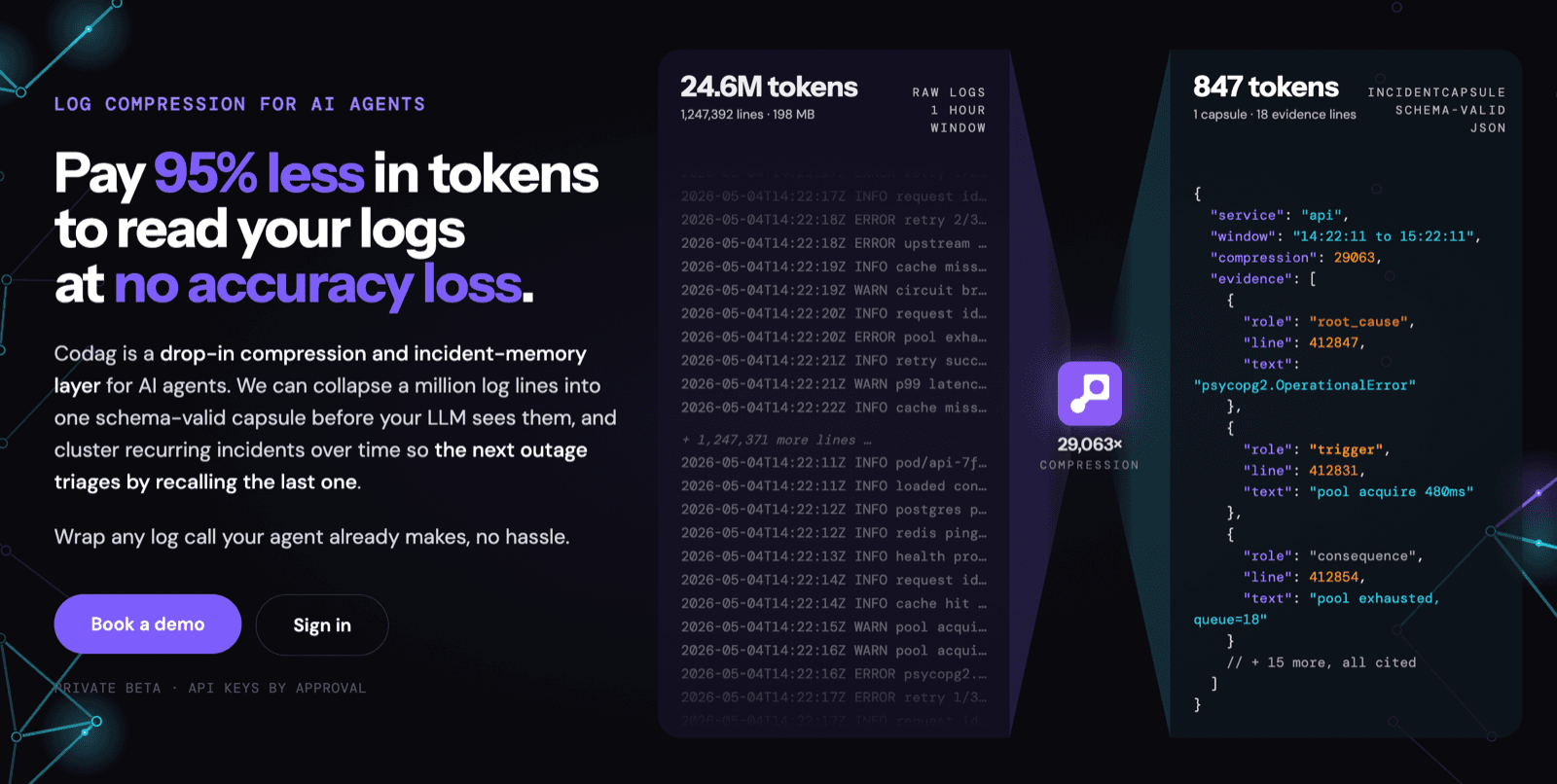
Codag is the first AI talent agency, offering AI employees that operate with shared organizational memory. Unlike other AI agents, Codag's employees retain context, learn from corrections, and avoid starting from scratch with each task. They operate through real browsers, mice, and keyboards, enabling them to perform any computer task a human can. Managers can delegate tasks conversationally via Slack, and the AI employees draw from a unified organizational context including team structure, conventions, and decision history. This approach aims to eliminate the $2 trillion lost annually to misalignment in U.S. businesses, providing a workforce that continuously learns and adapts to specific company workflows.
awesome-llm-and-aigc
awesome-llm-and-aigc is a comprehensive GitHub repository serving as a curated list of public projects focused on Large Language Models (LLM), Vision Language Models (VLM), Vision Language Action (VLA), and AI Generated Content (AIGC). This resource is designed for researchers and developers seeking to explore the latest advancements, datasets, and applications in these rapidly evolving AI domains. It covers a wide range of topics including reinforcement learning, CUDA, YOLO, Triton, Llama, GPT, and various AI for science initiatives. The repository acts as a central hub for discovering relevant projects and staying updated on the AI landscape.
awesome-llm-powered-agent
awesome-llm-powered-agent is a comprehensive GitHub repository dedicated to curating resources related to LLM-powered agents. It serves as an exhaustive collection of papers, repositories, and blogs, covering various aspects such as autonomous task solvers, multi-agent cooperation, frameworks, open-source projects, and applications in web agents, robotics, and gaming. The project aims to provide a continuously updated resource for researchers and developers interested in the impressive planning, reasoning, and tool-calling capabilities of Large Language Models. While the repository is not under active maintenance, it contains a wealth of information, primarily focusing on papers published before October 2023, with some newer additions. Contributions via pull requests are welcomed to expand its collection.