
Coding & Development
Browsing page 127 of AI tools for Coding & Development. Sorted by confidence score — our independent quality rating.

Bild
Bild is an AI-powered engineering co-pilot specifically designed for medical device development, built by engineers from Apple and Tesla. It addresses the bottleneck between CAD and manufacturing by automating the review of inspection data, lot records, and batch documentation. Bild's AI agents can instantly identify impacted documents with every regulatory or design change, performing impact analysis. The Review Wizard, grounded in engineering and regulatory context, allows AI agents to review documents in seconds, significantly reducing the time from weeks to moments. This tool is developed and trusted by engineers at leading hardware teams, aiming to streamline complex workflows and improve overall productivity.
BootLoop
BootLoop is an AI agent designed to revolutionize firmware and embedded software development. It automates the process of writing, testing, and debugging firmware directly on real hardware, significantly accelerating the development workflow. The platform intelligently extracts information from datasheets, schematics, and Altium projects to generate production-ready embedded code. BootLoop supports various toolchains like Zephyr, VxWorks, and ESP-IDF, and languages including C, C++, and Rust. It performs automated hardware-in-the-loop testing using oscilloscopes and logic analyzers, ensuring full-coverage test pipelines. The tool also features AI-powered debugging, static analysis for security flaws, and the ability to learn project-specific conventions for continuous improvement.
deep-learning-illustrated
The deep-learning-illustrated repository on GitHub offers the complete code and Jupyter notebooks that complement the 'Deep Learning Illustrated' book by Jon Krohn, Grant Beyleveld, and Aglaé Bassens. This resource provides a visual and interactive approach to understanding artificial neural networks and deep learning. It covers a wide range of topics from biological and machine vision to natural language processing, generative adversarial networks, and deep reinforcement learning. Users can find step-by-step installation guides and all code examples, making it suitable for those seeking a practical introduction to AI and deep learning implementation. The notebooks are primarily in TensorFlow, with notes on converting to TensorFlow 2.x.
MusicGPT
MusicGPT is an innovative application designed for generating music from natural language prompts. It leverages Large Language Models (LLMs) that run locally, ensuring performant music creation across different platforms without the need for extensive dependencies like Python or complex machine learning frameworks. Currently, it supports MusicGen by Meta, with plans to integrate more music generation models. Users can interact with MusicGPT through a chat-like UI mode, which stores chat history, allows playing generated samples, and generates music in the background. Alternatively, a CLI mode enables direct music generation and playback in the terminal, with configurable sample lengths. It offers flexibility in model selection and GPU usage, though powerful hardware is recommended for larger models.
Intelligine Technologies
Intelligine Technologies offers a private AI operating system and infrastructure layer designed to run within an organization's existing cloud environment. It integrates over 40 leading AI models, proprietary enterprise data, and internal tools into a single, secure AI ecosystem. The platform provides private AI orchestration, multi-model reasoning, secure collaboration, and a persistent memory layer, all governed by the user's policies and data controls. Unlike public chatbots, Intelligine is deployed in your VPC or on-prem, anonymizes every request, and enforces enterprise-grade governance, auditability, and data sovereignty. Users retain full ownership of all data, embeddings, custom models, configurations, and outputs, ensuring data privacy and compliance.
free-ai-coding
free-ai-coding serves as a comprehensive directory for AI coding tools that provide free access to advanced, pro-grade AI models. Many tools claim to be free, but often downgrade users after initial limits are reached. This resource meticulously compares various AI coding tools, detailing their pro-grade model access, free tier limits (such as requests per day, tokens, or credits), and whether a credit card is required for signup. It highlights models verified to achieve over 60% on SWE-bench, ensuring users can identify truly capable AI assistants for real-world coding tasks. The list is ordered by generosity of free tiers, making it easy for developers to find the most beneficial options.
multi-agent-coding-system
The multi-agent-coding-system is an open-source AI coding system that leverages an orchestrator agent to manage explorer and coder agents. This system is designed for intelligent context sharing, allowing agents to build meaningfully on previous discoveries and eliminate redundant work. It achieved a notable #13 ranking on Stanford's TerminalBench leaderboard, outperforming Claude Code. The orchestrator analyzes tasks, dispatches subagents, verifies changes, and maintains a context store. Explorer agents perform read-only investigations and verifications, while coder agents handle implementation with full system access. The system's smart context sharing and task management ensure efficient and strategic problem-solving, even for complex tasks, by providing agents with precise, relevant information.

InfinityFlow
InfinityFlow is an AI-native database specifically designed for large language model (LLM) applications, offering incredibly fast hybrid search capabilities. It supports a wide range of search types including dense embedding, sparse embedding, tensor, and full-text search, alongside filtering and various rerankers like RRF, weighted sum, and ColBERT. The database boasts impressive performance, achieving 0.1 milliseconds query latency and up to 15K QPS on million-scale vector datasets. It supports rich data types such as strings, numerics, and vectors. InfinityFlow is built for ease-of-use with an intuitive Python API and a single-binary architecture, eliminating dependencies and simplifying deployment. It is available for Linux, Windows (via WSL/WSL2), and MacOS.
funNLP
funNLP is a comprehensive open-source repository dedicated to Chinese Natural Language Processing (NLP). It provides a vast collection of tools, datasets, and resources for various NLP tasks, including sensitive word detection, language identification, phone number and ID extraction, and sentiment analysis. The repository also features extensive linguistic databases such as Chinese and Japanese name libraries, synonym/antonym dictionaries, and various Chinese word vectors. Developers and researchers can leverage funNLP for tasks like text generation, summarization, named entity recognition, and building conversational AI systems. Its diverse offerings make it a valuable resource for advancing NLP research and developing applications in the Chinese language domain.
Mistral 7B Instruct GGUF Run On CPU Basic
Mistral 7B Instruct GGUF Run On CPU Basic is a Hugging Face Space that provides a user-friendly interface to interact with the Mistral 7B Instruct model. This tool is designed for basic text generation on a CPU, making it accessible for experimentation and personal projects without requiring high-end GPUs. Users can input messages and receive AI-generated responses, with options to fine-tune the output's randomness (temperature) and focus (top_p) using intuitive sliders. It functions as a general assistant, capable of various conversational tasks.
Meku
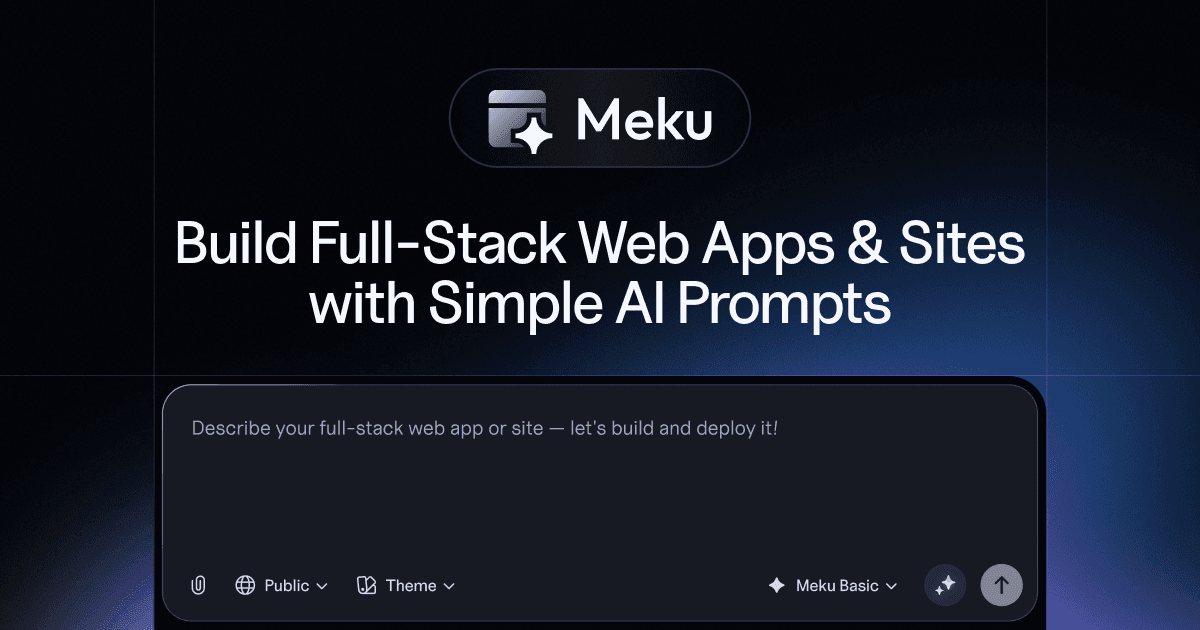
Meku is an AI-powered platform designed for developers to build and deploy full-stack web applications and websites rapidly. Users can describe their ideas using simple AI prompts, and Meku generates a functional, production-ready project in minutes. The platform supports extensive customization through conversational AI, allowing users to refine and perfect their applications directly in chat. Key features include one-click deployment with SSL and custom domains, the ability to launch full-stack apps with authentication, databases, and APIs, and seamless integrations with tools like GitHub and Supabase. Meku emphasizes developer-friendly features such as live previews, real-time conversational refinements, and full code ownership with export options to GitHub or ZIP files, ensuring no vendor lock-in.
ner-lstm
ner-lstm is an open-source project that provides an implementation of Named Entity Recognition (NER) using multilayered bidirectional Long Short-Term Memory (LSTM) networks. This tool is based on the approach described in a research paper published at the ICON-16 conference. It leverages TensorFlow for its deep learning architecture and supports classification tasks for named entities in text corpora. The project includes functionalities for generating embedding models (Word2Vec, GloVe, RnnVec), preparing input data by resizing datasets and converting sentences to embeddings, and running the deep neural network. It has been tested on CoNNL 2003 NER Shared Task and the ICON-2013 Hindi NER dataset, demonstrating its applicability to both English and Hindi languages. The code is available on GitHub, making it accessible for developers and researchers interested in natural language processing.
AquilaX
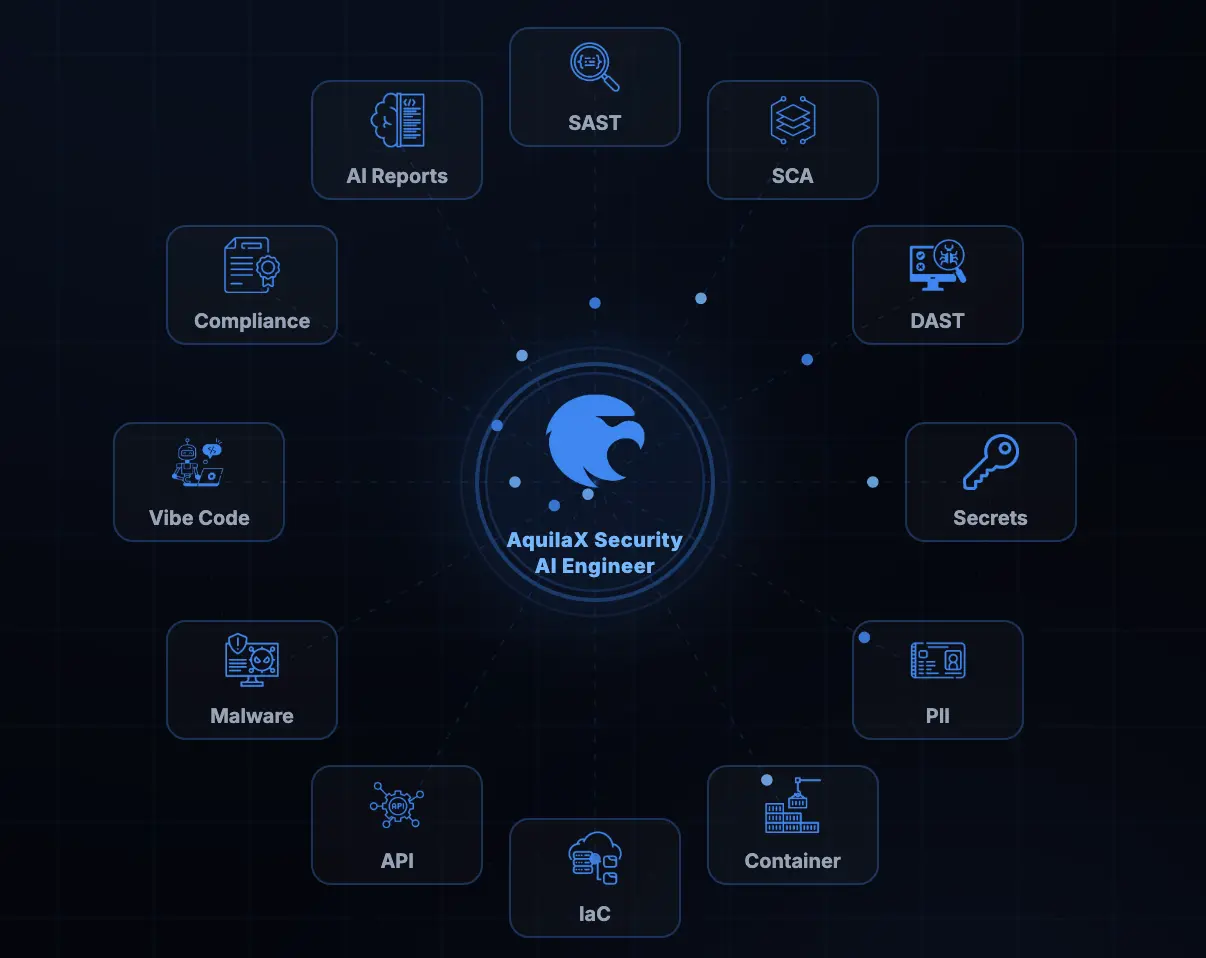
AquilaX is an AI-powered application security platform designed to streamline DevSecOps workflows by providing a comprehensive suite of 32 parallel scanners. These include Static Application Security Testing (SAST), Software Composition Analysis (SCA), Dynamic Application Security Testing (DAST), secrets scanning, PII detection, container security, Infrastructure as Code (IaC) scanning, API security, and malware detection. A key differentiator is its Securitron AI engine, which is trained on over 300 million projects to eliminate 93.54% of false positives, generate contextual fix patches, and open automated pull requests for remediation. AquilaX integrates natively with popular CI/CD pipelines like GitHub Actions, GitLab CI, Bitbucket Pipelines, Jenkins, and CircleCI, and supports various compliance frameworks such as ISO 27001, SOC 2, PCI DSS, NIST 800-53, DORA, NIS2, and OWASP Top 10 with automated reporting. Scans are designed to complete in under 60 seconds.

Planby Now
Planby Now is an AI-powered, no-code scheduling software designed to simplify event planning and agenda creation. Users can build and publish conference programs, event agendas, and weekly planners without writing any code. The platform supports data import from CSV, Airtable, and Calendly, and offers ready-to-use templates for various needs. A key feature is Planby Greyce, an AI co-pilot that suggests schedule structures, fills in session details, and helps users go live faster. Schedules can be customized with themes and branding, and are embeddable on any website using a single line of code. The drag-and-drop editor and all-in-one dashboard ensure ease of use and efficient management across devices.
LLM-Jailbreaks
LLM-Jailbreaks is a comprehensive GitHub repository dedicated to compiling and sharing various jailbreak prompts and techniques for large language models such as ChatGPT, Claude, and Llama. This resource is invaluable for developers, researchers, and security professionals looking to test the robustness and security of LLMs against adversarial inputs and prompt leaking. The repository includes detailed examples and methods like DeepSeek R1, Grok3, Gemini2.0, and different versions of DAN prompts, offering practical insights into bypassing typical AI safety measures. It serves as a community-driven platform for understanding and mitigating potential vulnerabilities in AI systems.
ParetoLabs
ParetoLabs offers a modular AI platform designed to optimize business processes with tailored AI applications. It addresses challenges like data silos and complex IT landscapes through its flexible architecture and pre-configured agents, such as an E-Mail Assistant and Customer Chatbot. The platform features AI Guardrails for secure and compliant operation, especially in highly regulated industries like finance in Switzerland. It also includes a Knowledge Management Framework and an Integration Framework to boost AI application performance and streamline system integration. ParetoLabs emphasizes a rapid time-to-value, delivering practical results and a clear ROI within weeks, supported by end-to-end expert guidance from conception to operation.
Robotictech
Robotictech is a technology company that provides advanced solutions for monitoring and analyzing urban and environmental data, with a strong focus on the energy sector. Leveraging artificial intelligence and computer vision, they tackle complex challenges in electrical generation, transmission, and distribution. Their offerings include the IRT3D software for automated mapping, environmental control, and analysis of transmission lines, featuring distance calculations, automatic pruning reports, and tree fall projections. The Street Census solution automates the monitoring of lighting parks, mutual use, and arborization, providing over 10,000 points per day at low cost. Additionally, Flight Census uses AI to classify lighting points from drone images, recognizing lamp types and power, and offering georeferencing of components. Robotictech emphasizes continuous improvement, a highly qualified team, and dedicated technical support.
Supercharge Lab
Supercharge Lab is an AI development platform designed to deliver enterprise-quality AI projects. The platform leverages artificial intelligence, deep learning, and data to create and manage intelligent workflows. It aims to provide comprehensive solutions for businesses looking to accelerate their transformation through functional AI applications. While specific features and pricing details are not available from the current website content, the platform's focus is on enabling organizations to build and deploy robust AI solutions, suggesting a technical and business-oriented approach to AI development.
Nexosis
DataRobot provides an industry-leading AI agent workforce platform designed for enterprise use, focusing on maximizing impact and minimizing risk. The platform allows teams to build, operate, and govern AI agents across their lifecycle, integrating into core business processes. It supports the creation of foundational, business, and purpose-built agents, with specific co-development for SAP and co-engineering with NVIDIA. DataRobot aims to unify complex enterprise environments, enabling rapid deployment of agents in days, not quarters, and supporting deployment across on-premise, hybrid, and cross-cloud infrastructures. It also provides tools for monitoring agent quality, mitigating issues, and ensuring compliance through robust governance features.
FormGenie
FormGenie is an AI-powered platform designed to streamline the creation of forms and the analysis of collected responses. Leveraging natural language processing, it simplifies the entire process of building surveys and questionnaires, making it accessible even for users without extensive technical knowledge. The tool goes beyond mere form creation by providing intelligent insights from the gathered data, helping users to quickly understand trends and make informed decisions. It aims to enhance efficiency in data collection and feedback gathering, offering a user-friendly interface for a seamless experience.
Pai-Megatron-Patch
Pai-Megatron-Patch is an official deep learning training toolkit developed by Alibaba Cloud, designed for the large-scale training and prediction of Large Language Models (LLMs) and Vision-Language Models (VLMs) using the Megatron framework. It addresses the challenge of low training efficiency for models exceeding 10 billion parameters, effectively utilizing GPU computational power. The toolkit supports a wide range of commonly used LLMs, including Llama, Qwen, and DeepSeek, and incorporates accelerating techniques from Megatron-LM. Its design philosophy avoids invasive modifications to Megatron-LM's source code, instead providing expansions and improvements as patches. Key features include support for multiple LLMs, model weight conversion between Huggingface, Megatron, and Transformer Engine, FP8 training acceleration, and rich usage examples for pre-training, fine-tuning, evaluation, inference, and reinforcement learning.
PatrickStar
PatrickStar is an open-source framework developed by Tencent that facilitates the parallel training of large language models (LLMs), particularly for Natural Language Processing (NLP) applications. It addresses the challenge of high hardware resource requirements for training PTMs by optimizing memory usage. Utilizing a chunk-based memory management system and heterogeneous training, PatrickStar efficiently leverages both CPU and GPU memory, allowing users to train significantly larger models with fewer GPUs. It has demonstrated the ability to train models like GPT3-175B on a relatively small GPU cluster, making advanced AI model training more accessible and cost-effective for a broader community.
nlp_overview
nlp_overview is an open-source project dedicated to providing an up-to-date learning resource on modern deep learning techniques in natural language processing (NLP). It delves into the theoretical foundations and implementation specifics of deep learning models such as recurrent neural networks (RNNs), convolutional neural networks (CNNs), and reinforcement learning. The resource covers a wide array of NLP tasks and applications, including machine translation, question answering, and dialogue systems, and summarizes state-of-the-art results. The project aims to be a collaborative and open resource, guiding researchers and enthusiasts through emerging concepts, benchmark datasets, and code releases in the NLP field.
PnP.ai
PnP.ai is an AI-as-a-Service platform designed to provide plug-and-play, industry-specific AI solutions for small and medium-sized enterprises (SMEs). The platform focuses on making AI accessible and easy to integrate, allowing businesses to leverage artificial intelligence without extensive technical expertise. It offers tailored AI solutions across various industries, aiming to streamline operations, enhance decision-making, and drive growth for its users. PnP.ai positions itself as a practical tool for SMEs looking to adopt AI technologies efficiently and effectively.