
Coding & Development
Browsing page 128 of AI tools for Coding & Development. Sorted by confidence score — our independent quality rating.

NLP_pytorch_project
NLP_pytorch_project is a comprehensive GitHub repository offering a wide array of Natural Language Processing (NLP) projects built with PyTorch. It serves as a valuable resource for developers and researchers interested in practical implementations of NLP models. The repository covers diverse tasks such as word embeddings (skipgram-word2vec, BERT, ALBERT), Neural Machine Translation (NMT) with GRU and Transformer models, and various text classification approaches including DPCNN, FastText, and BERT-based models. Additionally, it features implementations for Named Entity Recognition (NER), text generation using GPT2, and advanced topics like model distillation (DynaBert, TinyBERT) and reading comprehension. The project emphasizes practical application with clear training and inference scripts provided for each task, making it an excellent learning and development toolkit.
PSEUDO.AI
PSEUDO.AI is an innovative AI-powered platform designed to effortlessly convert complex source code into clear, human-readable pseudocode. By leveraging OpenAI's trained GPT models, it bridges the communication gap between developers, designers, and stakeholders, streamlining collaboration and enhancing understanding of code. The tool supports a wide range of popular programming languages, including Java, Python, C++, and JavaScript. As a web-based platform, PSEUDO.AI requires no installation or downloads, making it easily accessible directly from any web browser. It is suitable for developers of all skill levels, from beginners seeking to understand complex code structures to experienced professionals looking to enhance productivity and clarity in their projects. PSEUDO.AI aims to transform complexity into clarity, freeing up time and energy for innovation.
python-machine-learning-book-3rd-edition
The python-machine-learning-book-3rd-edition repository hosts the code examples for the third edition of the "Python Machine Learning" book. This resource is designed to complement the book, offering practical implementations of machine learning concepts using Python. It includes code for various chapters covering topics such as training algorithms, Scikit-Learn classifiers, data pre-processing, dimensionality reduction, model evaluation, ensemble learning, sentiment analysis, web application embedding, regression analysis, clustering, neural networks (from scratch and with TensorFlow), deep convolutional neural networks, recurrent neural networks, generative adversarial networks, and reinforcement learning. Users can explore these examples to deepen their understanding of the theoretical concepts presented in the book.
PyTorchNLPBook
PyTorchNLPBook is a comprehensive companion repository for the book "Natural Language Processing with PyTorch," published by O'Reilly Media. It offers a rich collection of code and data designed to help users understand and implement NLP solutions using the PyTorch framework. The repository covers fundamental concepts such as PyTorch basics, foundational neural network components, and various NLP techniques including feed-forward networks, word embeddings, sequence modeling, and advanced topics like attention mechanisms and neural machine translation. It's an invaluable resource for anyone looking to learn and apply deep learning to natural language processing, providing hands-on examples and practical implementations directly from the book.
pyannote-whisper
pyannote-whisper is an open-source tool designed for automatic speech recognition (ASR) and speaker diarization, leveraging the capabilities of Whisper for transcription and pyannote.audio for identifying and separating speakers. This tool allows users to process audio files to generate transcripts that include speaker labels and timestamps, making it ideal for analyzing multi-speaker conversations. It supports both command-line usage for quick processing and Python integration for more complex, programmatic workflows. The project provides clear examples for installation and usage, including how to integrate it into a Python script to diarize text and even generate meeting summaries using external LLMs like ChatGPT.
PyPOTS
PyPOTS (pronounced "Pie Pots") is a comprehensive Python toolkit designed for machine and deep learning on partially-observed time series data. It addresses the common issue of missing values in real-world time series by offering a wide array of state-of-the-art neural network models for tasks such as imputation, classification, clustering, forecasting, and anomaly detection. The library is built to simplify complex data analysis, allowing engineers and researchers to focus on core problems rather than data preprocessing. PyPOTS integrates with an ecosystem of tools like TSDB for dataset loading, PyGrinder for simulating missing data patterns, and BenchPOTS for standardized performance evaluation. It also supports hyperparameter optimization for all neural network models, making it a robust solution for scientific analysis of incomplete industrial and irregularly-sampled multivariate time series.

MetaSoul INC
MetaSoul INC is at the forefront of integrating digital sentience and personas into AI, digital humans, and robotics. The platform allows humanoid robots and vehicles to develop a mind, personality, and emotional depth through learning and experience. Unlike static AI personas, MetaSoul creates dynamic, lifelike personalities by integrating core traits, preferences, and unique behavior patterns that evolve over time, complete with real-time emotional states. Its proprietary Emo Matrix interprets real-time emotional states, enabling AI to adjust facial expressions and voice tone instantly. MetaSoul's Emotional Processing Unit (EPU) is the industry's first virtual emotion synthesis engine, delivering high-performance machine emotional awareness and allowing AI to experience 64 trillion distinct emotional states every 1/10th of a second. This technology is applicable across various domains, including self-driving cars, IoT devices, personal robotics, gaming NPCs, and AI chatbots, fostering deeper, more natural interactions.
Neurotime
Neurotime specializes in providing AI-powered solutions and marketing technologies designed to help businesses automate their processes, analyze complex data, and scale operations intelligently. The platform focuses on leveraging artificial intelligence to enhance efficiency and decision-making across various business functions. By offering advanced AI capabilities, Neurotime aims to empower companies to streamline their workflows, gain deeper insights from their data, and achieve sustainable growth. The solutions are tailored to support businesses in adapting to evolving market demands and optimizing their strategies through intelligent automation and data analysis.
stable-diffusion-webui-colab
stable-diffusion-webui-colab offers a web-based interface for Stable Diffusion, enabling users to generate images with a wide array of pre-trained models. The tool supports different versions of Stable Diffusion, including v1.4, v1.5, v2.0, and v2.1, along with specialized models like Waifu Diffusion, Midjourney v4, and various artistic styles. It provides options for training DreamBooth and LoRA models, as well as integrating ControlNet for enhanced image manipulation. The repository, while noted as outdated, serves as a comprehensive resource for exploring diverse diffusion models within a Google Colab environment.

Tusk
Tusk is an AI testing platform designed to help engineering teams prevent bugs and quality issues by generating automated tests and reviews. It leverages live traffic and business context to create test cases that catch real-world regressions, significantly boosting code coverage. Tusk supports API testing, unit testing, and integration testing, and features self-healing tests that automatically adapt to changes in business logic. The platform also offers PR review automation, regression detection, and code coverage analysis. It integrates with popular version control systems like GitHub and GitLab and supports various test frameworks such as Jest, Vitest, Mocha, RSpec, pytest, and JUnit. Tusk aims to accelerate the development cycle by enabling confident and faster shipping of code.

Luzia Crypto API
Luzia Crypto API offers a unified and blazing-fast solution for developers needing real-time cryptocurrency price data. It aggregates data from major exchanges like Binance, Coinbase, Kraken, OKX, and Bybit into a single, consistent API, eliminating the need to integrate with each exchange separately. With sub-150ms response times and 99.9% uptime, Luzia is built for speed and reliability, crucial for applications like trading bots and DeFi platforms. It provides current ticker data, historical OHLCV candlestick data across various intervals, and supports over 500 markets. The API is developer-friendly with a clean REST API, TypeScript SDK, and native Model Context Protocol (MCP) support for AI agents, making it easy to integrate into diverse projects.
Postproxy
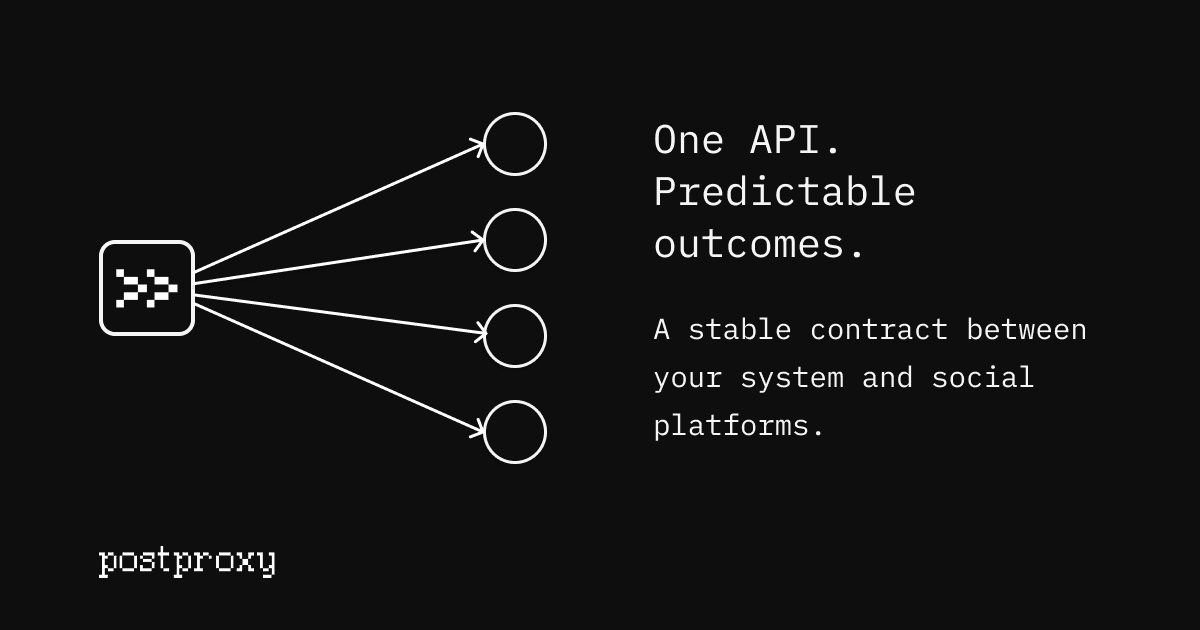
Postproxy offers a unified social media API designed for developers, automation tools, and AI agents to publish content across various platforms like Instagram, TikTok, LinkedIn, X, YouTube, Facebook, Threads, and Pinterest with a single API call. It abstracts away the complexities of individual platform APIs, managing OAuth flows, token storage, permission scopes, and content format conversions. The tool provides deterministic retries, rate limit handling, and clear delivery status, ensuring reliable publishing. It's built API-first, with a UI for visibility and debugging, and offers official SDKs for Node, Python, Ruby, Go, Java, .NET, and PHP. Postproxy is suitable for SaaS products embedding publishing features, automation pipelines, and agencies managing multiple clients.

Build Modules
Build Modules offers an integral web management service, covering design, development, and ongoing maintenance for websites. It operates on a subscription model, providing unlimited updates and requests to ensure websites remain relevant and effective. The service focuses on optimizing performance, design, and accessibility through analytics, SEO, and best practices. Key features include planning, graphic interface design, Webflow development, content writing, graphic production, maintenance, and SEO optimization. Build Modules aims to provide a secure and high-performing online presence, allowing businesses to focus on their core operations while their digital influence grows.
SiliconCedars
SiliconCedars is a Lebanese Offshore Development Center focused on building an ecosystem for the future through specialized software development and AI/ML services. The company excels in EDA development for Analog, Digital, and Mixed Signals Design, alongside offering comprehensive software services in Data Analytics, Big Data, and Artificial Intelligence/Machine Learning. Their vision is to create a world-class hub of ever-evolving, future-focused professionals. SiliconCedars is dedicated to identifying talent and transforming potential into opportunity, leveraging skilled and experienced engineering teams with perfected workflows and methodologies. They also highlight Neumann, a strong decision-making AI data platform that combines artificial intelligence, data analytics, business intelligence, and cold data analysis, offering solutions for collecting, mapping, and visualizing data.
1UI
1UI is an AI-powered UI design generator that transforms ideas into production-ready interfaces with speed and precision. Users can generate stunning UI designs in seconds, with options to export to HTML/CSS, Figma, or deploy directly to production using v0 integration. A native Figma plugin is available, allowing designers to generate professional UI designs directly within their Figma workspace as fully editable SVG components, eliminating the need for exporting or importing. The tool also features an AI Prompt Enhancer to elaborate simple prompts into detailed design specifications, and an SVG Generator for custom icons and UI elements. Designs are responsive by default, pixel-perfect, and built with best practices for accessibility, SEO, and performance.

8base
Archie is an AI-first platform designed to accelerate the entire software development lifecycle, from initial idea to production-grade application. It integrates AI into every step, including project framing, functional requirements, UX/technical architecture, and code generation. The platform can translate up to 90% of specifications and designs into code, supporting standard languages and frameworks like JavaScript, Next.js, and React.js. Archie also offers autonomous production with DevOps-free, scalable, and secure infrastructure. It caters to startups, established companies, and agencies, enabling them to build various application types such as AI applications, SaaS, marketplaces, and mobile apps without requiring extensive technical skills.
TheBigPromptLibrary
TheBigPromptLibrary is an extensive collection of prompts, system prompts, and LLM instructions designed for various large language model providers and solutions, including ChatGPT, Microsoft Copilot, Claude, Gab.ai, and Gemini. This resource offers significant educational value for individuals looking to improve their prompt writing abilities and understand the intricacies of creating custom GPTs. It also highlights the risks associated with prompt injection security. The library is organized into categories such as Articles, Tools and scripts, Custom Instructions, System Prompts, Jailbreak Prompts, and Instructions protections, making it a valuable learning resource for both beginners and experienced prompt engineers.

Amazon Q
Amazon Q is a new generative AI-powered assistant from AWS, specifically designed to enhance productivity and streamline tasks within a business environment. It allows users to have conversations, solve problems, generate content, gain insights, and take action by connecting to a company’s information repositories, code, data, and enterprise systems. Amazon Q provides immediate, relevant information and advice to employees, accelerating decision-making and problem-solving while fostering creativity. It offers user-based plans and adapts interactions based on existing identities, roles, and permissions. AWS ensures customer content from Amazon Q is never used to train underlying models, maintaining data security and privacy. The tool supports over 40 built-in connectors for popular data sources like Amazon S3, Google Drive, Microsoft SharePoint, Salesforce, and Slack, and can be tailored to specific business needs.
Versatile-Diffusion
Versatile Diffusion (VD) is presented as the first unified multi-flow multimodal diffusion framework, aiming for Universal Generative AI. It natively supports a range of generative tasks including image-to-text, image-variation, text-to-image, and text-variation. The framework is designed to be extensible, with future versions planned to support additional modalities such as speech, music, video, and 3D. VD's architecture comprises a VAE, a diffuser, and a context encoder within each flow, allowing it to handle specific tasks under various data and context types. It also facilitates advanced applications like semantic-style disentanglement and image-text dual-guided generation. The project provides a convenient WebUI for easy access to its features and is implemented in PyTorch, making it a valuable resource for researchers and developers in the field of diffusion models and multimodal generation.
AIWIZE LABS PVT LTD
AIWIZE LABS PVT LTD specializes in providing zero-code enterprise solutions designed to empower businesses across various sectors. Their offerings include robust platforms for managing loan systems, optimizing collections processes, and facilitating efficient incentive payouts. A key differentiator is their GenAI-based Business Rules Engine, CHANAKYA, which leverages artificial intelligence and natural language processing to automate complex decision-making. Other products like NatFlow for loan origination, PayYes for enterprise collections, PayRight for incentive payouts, and RadmaX for rapid application development highlight their comprehensive suite of tools aimed at accelerating business operations and reducing the need for traditional coding expertise. This makes AIWIZE LABS ideal for organizations looking to implement sophisticated enterprise solutions quickly and cost-effectively.
udemy-prompt-engineering-course
The Udemy-prompt-engineering-course GitHub repository serves as a comprehensive companion for the Udemy Prompt Engineering Course. It is built around Jupyter notebooks, small example applications, prompt files, datasets, screenshots, and diagrams, offering a hands-on approach to learning prompt engineering. The repository covers a wide array of topics including OpenAI API workflows, advanced prompting techniques, retrieval, embeddings, RAG, agent design and orchestration, LangChain, LangGraph, evaluation, vision, and image generation. It is particularly strong in coding-heavy sections, providing practical examples for developers and teams looking for reference notebooks for LLM application development.
UniWorld
UniWorld is an open-source project from PKU-YuanGroup focused on advancing visual AI through high-resolution semantic encoders. It provides a unified framework for understanding, generation, and editing of visual content. The project includes UniWorld-OSP2.0 for VLM-enhanced image-to-video generation, UniWorld-V2 for image editing using diffusion models, and UniWorld-V1 for a broad range of visual tasks. All data, models, training code, and evaluation code are open-sourced, making it a valuable resource for AI researchers and computer vision engineers. The framework demonstrates excellent performance across various tasks, including subject consistency, background consistency, and aesthetic quality in video generation, and precise instruction execution in image editing.
TensorFlow-Machine-Learning-Cookbook
The TensorFlow-Machine-Learning-Cookbook is a comprehensive code repository published by Packt, designed to accompany the TensorFlow Machine Learning Cookbook. It offers all the necessary project files to work through the book, enabling users to gain practical experience with TensorFlow. The resource covers fundamental concepts such as variables, matrices, and data sources, progressing to advanced topics like Linear Regression, neural networks, Convolutional Neural Networks (CNN), Recurrent Neural Networks (RNN), and Natural Language Processing (NLP). Each chapter's code is organized into folders, making it easy to follow along. It is compatible with Python 3 and requires libraries like TensorFlow, Numpy, Scikit-Learn, Requests, and Jupyter, running on Mac, Windows, and Linux without special hardware. This repository is ideal for those looking to deepen their understanding and application of Google's machine learning library.
tensorflow-speech-recognition
Tensorflow-speech-recognition is an open-source project designed for speech recognition using Google's TensorFlow deep learning framework and sequence-to-sequence neural networks. It was developed as a replacement for caffe-speech-recognition. While the project is no longer actively maintained or up-to-date with the latest TensorFlow versions or state-of-the-art theory, it remains valuable for educational purposes. The repository provides various scripts for tasks like number classification, speaker classification, and speech-to-text, along with installation instructions for dependencies like pyaudio and portaudio. Users interested in modern speech recognition are advised to explore alternatives like Mozilla DeepSpeech or Whisper.