
Coding & Development
Browsing page 366 of AI tools for Coding & Development. Sorted by confidence score — our independent quality rating.

neural-network-genetic-algorithm
neural-network-genetic-algorithm is an open-source project designed to evolve neural networks using a genetic algorithm. This tool focuses on identifying optimal network parameters for various classification tasks. It is currently limited to Multi-Layer Perceptrons (MLPs) and leverages the Keras library for building, training, and validating networks. The project demonstrates its effectiveness by quickly achieving over 98% accuracy on the MNIST dataset and 56% on the CIFAR10 dataset after 10 generations. The repository includes Python scripts for both brute-force and genetic algorithm approaches, allowing users to customize network parameters and choose between MNIST or CIFAR10 datasets. It serves as a practical example for those interested in applying genetic algorithms to neural network optimization.
f24tech
F24Tech is a leading technology solutions provider based in India, offering a wide range of services including custom software development, mobile app development, and comprehensive CRM implementations. Their expertise spans various programming languages and frameworks such as Java (Spring Boot, Hibernate), Python (Django, Flask), PHP (Laravel, Symfony), and JavaScript (React, Angular, Vue.js). They also provide specialized CRM services including Zoho implementation, NetSuite consulting, custom CRM development, Salesforce solutions, HubSpot integration, and Microsoft Dynamics 365. F24Tech focuses on delivering scalable, secure, and efficient solutions tailored to meet unique business requirements, serving clients from startups to enterprise-level organizations worldwide.

Towards AI, Inc.
Towards AI, Inc. offers comprehensive AI education, training, and custom AI system development for both individuals and organizations. Their platform is designed to guide users from initial AI curiosity to achieving tangible AI capabilities. They provide a range of resources including courses, community engagement, enterprise training programs, and bespoke AI development services. Since 2019, Towards AI has educated over 400,000 individuals, focusing on practical AI engineering courses and corporate AI bootcamps. The company aims to empower users to effectively utilize and build with AI tools and models, bridging the gap between theoretical knowledge and real-world application.
skrub
skrub (formerly dirty_cat) is a powerful open-source Python library designed to streamline machine learning tasks when working with dataframes. It offers a comprehensive suite of functionalities for data cleaning, preprocessing, and wrangling, making it easier to prepare tabular data for machine learning models. The library is built to handle common challenges associated with dirty or inconsistent data, ensuring that data scientists and developers can focus on model building rather than tedious data preparation. skrub integrates seamlessly into existing Python-based machine learning pipelines, providing efficient and robust solutions for data preparation.
NNfSiX
NNfSiX is a GitHub repository dedicated to providing neural network implementations from scratch across a variety of programming languages. This open-source project aims to serve as a valuable educational resource for developers interested in understanding the foundational concepts of neural networks by seeing them implemented in different linguistic contexts beyond just Python. Users are encouraged to contribute their own implementations or improvements via pull requests, fostering a collaborative learning environment. The repository allows for easy comparison of how neural network components are built and function in languages such as C++, C, Assembly, Swift, Java, and C#, among others, making it a comprehensive reference for multi-language development.
FranzKafka.xyz
FranzKafka.xyz is an open-source writing platform designed for a distraction-free writing experience. It eliminates common distractions like feeds and metrics, allowing users to focus solely on their content. A unique feature is the option to connect your own database via Supabase, offering flexibility and control over your data. The platform aims to evoke the feeling of filing a document into history, emphasizing permanence and thoughtful composition. It's ideal for those seeking a minimalist approach to writing and knowledge management.
LaunchPadQuick
LaunchPadQuick offers a comprehensive NextJS boilerplate designed to accelerate the development and launch of SaaS applications. It comes pre-loaded with critical features such as authentication (NextAuth.js, Magic Link), various database options (Supabase, MongoDB, Prisma ORM), and payment processing with Stripe (checkout sessions, webhooks, customer portal). The boilerplate also includes AI integration with OpenAI and Claude3 APIs, transactional email setup via Mailgun, and contact forms. Additional features like SEO, ShadCN UI, light/dark mode, and an admin dashboard are included, making it an all-in-one solution for startup founders looking to go live quickly and efficiently.
Plug-and-Play Bias Detection
Plug-and-Play Bias Detection is an open-source AI tool available as a Hugging Face Space, developed by avid-ml. It is designed to help users identify and mitigate bias within their machine learning models. This tool is crucial for ensuring fairness and upholding ethical considerations in the development and deployment of AI applications. While the current live website indicates a runtime error, suggesting it may not be fully operational at this moment, its core purpose is to provide a accessible platform for bias detection. As an open-source project, it promotes transparency and community contribution in addressing AI fairness challenges.
tf_unet
tf_unet is an open-source project offering a generic U-Net implementation developed with TensorFlow, specifically designed for image segmentation tasks. Originally used for Radio Frequency Interference mitigation, this tool is highly adaptable and can be applied to diverse imaging data, from detecting circles in noisy images to identifying galaxies and stars in wide-field imaging. The project provides Jupyter notebooks for toy problems and RFI mitigation, making it accessible for both learning and practical applications. While the project is discontinued in favor of a TensorFlow 2 compatible version, it remains a valuable resource for understanding and implementing U-Net architectures.
Now4FreeGPT Prompting Machine
Now4FreeGPT Prompting Machine is an AI prompt generator hosted on Hugging Face Spaces. It is designed to help users create effective prompts for various AI models. While the tool aims to provide a platform for prompt generation, the current live website indicates a runtime error, suggesting it is not fully operational at this time. The project is open-source under the Apache-2.0 license, indicating a community-driven approach to its development. Despite the current technical issue, its intent is to facilitate prompt engineering for those working with AI.
QwenSite
QwenSite is an innovative AI-powered tool designed to simplify website creation, enabling users to generate professional websites without writing a single line of code. By simply providing content and design preferences, users can leverage QwenSite to quickly build their online presence. The tool is hosted on Hugging Face Spaces, indicating its accessibility and potential for community-driven development. It aims to democratize web development, making it accessible to individuals and small businesses who may lack technical skills or resources for traditional web design. QwenSite focuses on ease of use and efficiency, allowing for rapid prototyping and deployment of web applications.
awesome-chatgpt-api
awesome-chatgpt-api is a comprehensive, curated list of applications and tools that leverage the new ChatGPT API. This resource is particularly valuable as it highlights tools that enable users to configure and use their own API keys, facilitating free and on-demand access to their personal quota. Beyond just a list of tools, it includes a dedicated development section, offering a collection of projects and articles designed to assist developers in building better applications. The list covers a wide range of categories, including plugins, extensions, web apps, desktop and mobile applications, and command-line interface (CLI) tools, making it a versatile resource for anyone looking to integrate or develop with the ChatGPT API.
picoGPT
picoGPT offers an exceptionally small and minimal implementation of the GPT-2 model, built entirely in plain NumPy. Designed primarily for educational purposes, it distills the core functionality of GPT-2 into a highly concise codebase, with the entire forward pass implemented in approximately 40 lines of code. While it prioritizes readability and minimalism over performance, it serves as an excellent resource for developers and students looking to understand the fundamental architecture of GPT-2 without the complexity of larger frameworks. It includes OpenAI's BPE Tokenizer and utilities to download and load GPT-2 model weights, allowing users to experiment with different model sizes.
asm-dude
asm-dude is a Visual Studio extension designed to enhance the assembly programming experience by offering syntax highlighting and code completion. The latest iteration, AsmDude2, is built around a Language Server Protocol (LSP) and a lightweight Visual Studio extension specifically for VS2022. It supports a wide range of architectures including x86, x64, SSE, AVX, AVX2, Xeon-Phi (Knights Corner), and AVX-512 instructions, along with Masm and Nasm directives. Key features include code descriptions on hover, signature help, and syntax highlighting within the disassembly window. While some features from the older AsmDude are still being ported, it aims to provide a robust environment for assembly developers.
Awesome-World-Models
Awesome-World-Models is an open-source repository that serves as a curated list of academic papers focused on world models. This resource is invaluable for researchers and academics interested in general video generation, embodied AI, and autonomous driving. The repository not only lists relevant papers but also includes links to associated code implementations and related websites, making it a comprehensive hub for staying updated on the latest advancements in these fields. Its open-source nature encourages community contributions, ensuring the list remains current and extensive. This tool is particularly useful for those looking to quickly find and organize research materials, facilitating literature reviews and project development in complex AI domains.
pymilvus
Pymilvus serves as the official Python SDK for the Milvus vector database, offering a robust interface for developers to interact with Milvus. It supports essential functionalities such as vector similarity searches and data storage, which are crucial for building AI applications that leverage vector embeddings. The SDK is designed to be compatible with various Milvus versions, providing clear installation instructions via pip for Python 3.8+. It also includes features for managing submodules, generating Python files from Milvus-proto, and ensuring code quality through linting and formatting tools. Pymilvus is an open-source project, encouraging community contributions and providing resources for development and testing.
PyCNN
PyCNN is an open-source Python library designed for image processing using Cellular Neural Networks (CNN). Unlike traditional neural networks, CNNs allow communication only between neighboring units, making them particularly efficient for real-time image processing tasks. This library provides a framework for implementing and experimenting with CNN-based image processing algorithms, including edge detection, grayscale edge detection, corner detection, diagonal line detection, inversion, and optimal edge detection. It supports Python 2.7 and 3.3+ and relies on common scientific computing libraries like Pillow, Scipy, and Numpy. PyCNN is a valuable resource for researchers and developers interested in exploring the application of Cellular Neural Networks in image processing.
Chat with Tess
Chat with Tess provides an interactive platform for engaging with advanced AI assistants, specifically showcasing the capabilities of Tess-R1 models. These models are designed to produce Chain-of-Thought (CoT) reasoning, enabling them to process complex queries and deliver detailed, structured responses. Users can customize various settings, including the AI model itself and the system message, to tailor their conversational experience. The platform highlights models such as migtissera/Tess-R1-Limerick-Llama-3.1-70B and migtissera/Tess-v2.5.2-Qwen2-72B, offering a hands-on opportunity to explore the Tess-R1 series' advanced reasoning abilities. This tool is ideal for those interested in experimenting with and understanding the nuances of sophisticated AI conversational agents.
CoAdapter
CoAdapter is an AI tool hosted on Hugging Face Spaces, focusing on model adaptation and transfer learning. It is built using Gradio, making it accessible for users to interact with. The tool operates under the OpenRAIL license, indicating its open-source nature and community-driven development. While the live website currently shows a runtime error during model downloading, suggesting it may be under maintenance or experiencing issues, its core purpose is to facilitate advanced AI model manipulation. Users interested in experimenting with or developing upon existing AI models for specific applications would find CoAdapter relevant.
EcoLogits Calculator
EcoLogits Calculator is a web-based tool designed to help users understand the environmental impact of their AI model usage. By providing information such as the specific AI model, the number of tokens processed, and other usage details, the application calculates the estimated CO₂ emissions associated with that workload. This tool promotes awareness and encourages more responsible AI practices by making the carbon footprint of generative AI models transparent. It is hosted on Hugging Face Spaces, making it easily accessible for anyone interested in assessing the ecological impact of their AI projects.
EdgeTAM
EdgeTAM is an on-device executable variant of the SAM (Segment Anything Model) designed for promptable segmentation and tracking within videos. This open-source tool allows users to upload a video, select a specific object, and then generates a masked video that highlights and tracks the chosen object throughout the footage. Optimized for efficiency, EdgeTAM achieves real-time performance on mobile devices like iPhones, making it highly suitable for mobile AI applications where immediate processing is crucial. Its core capability lies in providing precise object tracking and segmentation directly on the device, reducing latency and reliance on cloud infrastructure.
DigestDiff
DigestDiff is an AI-driven tool designed to help developers understand and communicate their codebase's evolution through its commit history. It offers three core functionalities: generating detailed codebase overviews, summarizing recent work for standups and reports, and creating streamlined release notes. The tool emphasizes privacy, requesting only read-only access to GitHub repositories and never storing generated content or accessing actual code. Users can also manually input commit history, ensuring flexibility and security. DigestDiff aims to accelerate developer onboarding, improve team communication, and automate documentation processes.
robe
Robe is a comprehensive code assistance tool specifically designed for Ruby development within Emacs. It leverages a Ruby REPL subprocess, loading your application or gem code to provide detailed insights into loaded classes, modules, and method definitions. Key functionalities include jumping to method definitions, superclass methods, or constant definitions, displaying method documentation, and offering method and constant name completion. It also supports completion for instance and local variable names within the current file. Robe integrates with `inf-ruby` for managing the Ruby console and offers features like reloading the current file or the entire Rails environment. It's compatible with `company-mode` for enhanced completion and supports built-in Emacs completion. The tool is tested with various Ruby versions and Emacs 27.1+, primarily on GNU/Linux, with some functionality on JRuby and MS Windows.
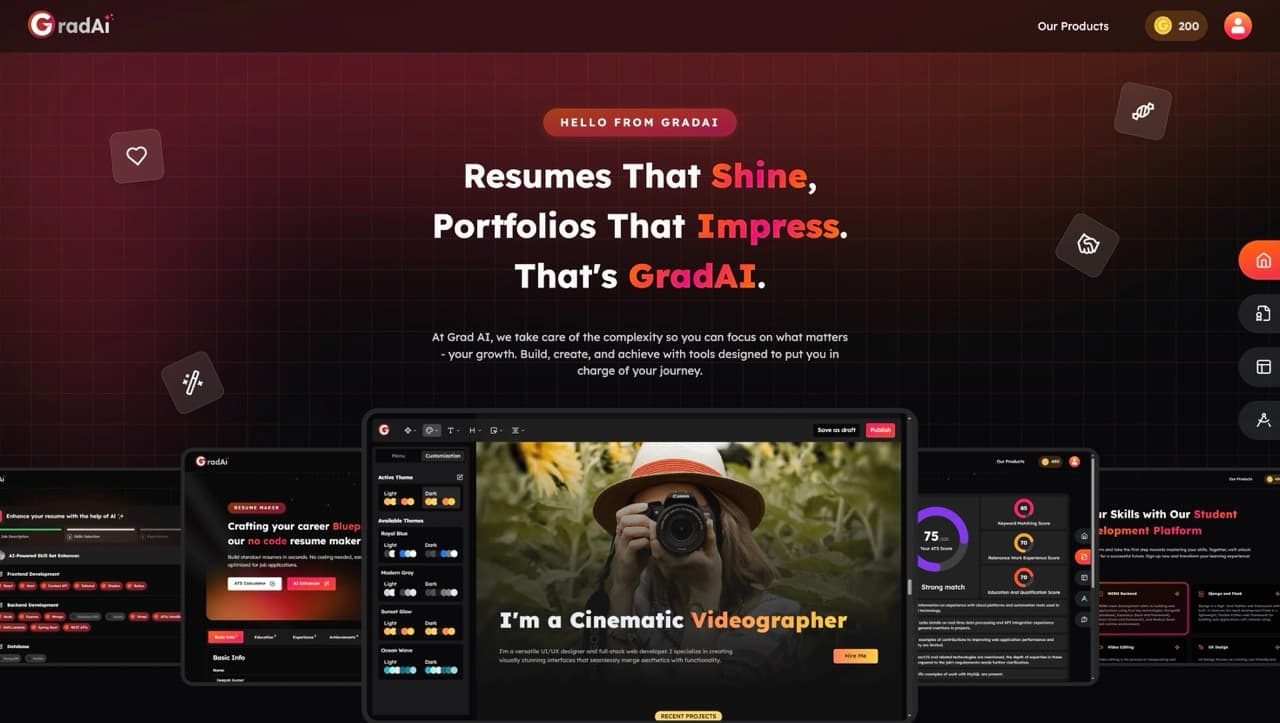
GradAI
GradAI is a powerful AI-driven platform designed to enhance job seekers' resumes and portfolios, helping them land their dream jobs. It offers an intuitive drag-and-drop no-code portfolio creator, allowing users to showcase projects, skills, and testimonials effectively. The platform also includes an AI Resume Enhancer to optimize resumes with relevant keywords, ensuring they pass Applicant Tracking System (ATS) screenings. Users can analyze their resume's ATS compatibility with the ATS Calculator and receive personalized improvement tips. GradAI provides new resume templates and allows for seamless export and sharing across platforms like LinkedIn. It aims to simplify the job search process by providing tools to build, create, and achieve career goals.