
Coding & Development
Browsing page 371 of AI tools for Coding & Development. Sorted by confidence score — our independent quality rating.

machine-learning-engineering-for-production-public
Machine-learning-engineering-for-production-public serves as the official public repository for DeepLearning.AI's Machine Learning Engineering for Production Specialization. This resource is designed to support students and professionals in understanding the intricacies of deploying machine learning models into real-world production environments. The repository contains various materials, including course content, labs, and other public resources relevant to the specialization's curriculum. While it provides valuable learning assets, the repository is currently not accepting pull requests for contributions. It is an essential companion for anyone undertaking the DeepLearning.AI MLEP Specialization, offering practical insights and foundational knowledge for machine learning engineering.

ShieldForce
ShieldForce offers AI-driven cybersecurity protection specifically tailored for home healthcare agencies, community health centers, and regulated small to mid-sized businesses. The platform provides HIPAA-ready managed cybersecurity solutions, including 24/7 threat monitoring, advanced email security, and automated disaster recovery to protect against cyber breaches. It helps organizations achieve compliance with regulations like HIPAA and SHIN-NY, offering services such as endpoint protection, encrypted backup, access controls, and security awareness training. ShieldForce is designed for organizations without dedicated IT staff, providing full onboarding and ongoing management, allowing staff to focus on patient care. The service aims to stop attacks, restore operations quickly, and reduce cyber insurance costs.
Chat2Build
Chat2Build revolutionizes website creation by enabling users to chat their site into existence with an AI. This platform simplifies the entire process, from design to deployment, eliminating the need for complex coding or manual hosting setup. Users can effortlessly create stunning website layouts, organize content, and integrate various tools and services. Chat2Build handles domain and hosting complexities by automatically deploying sites to Netlify. It offers customizable options with themes and layouts, making it a one-stop solution for individuals and businesses looking to build and launch their online presence efficiently.
dreamtalk
DreamTalk is an open-source framework designed for generating expressive talking head videos. It utilizes diffusion probabilistic models to create high-quality videos that capture diverse speaking styles. The tool is robust, handling a wide array of inputs including songs, speech in multiple languages, and even noisy audio, and can work with out-of-domain portraits. Users can specify audio paths, style clips, head poses, and input images to generate videos. While the primary focus is on accurate lip-sync and vivid expressions, the resolution can be improved using external solutions like CodeFormer or MetaPortrait's Temporal Super-Resolution Model. The project provides inference code and pretrained checkpoints, though access to checkpoints requires an email request for academic research purposes.
AttentionDeepMIL
AttentionDeepMIL offers a PyTorch implementation of Attention-based Deep Multiple Instance Learning, a technique detailed in the paper "Attention-based Deep Multiple Instance Learning" by Ilse, Tomczak, and Welling. This open-source tool is designed for researchers and developers to explore and apply attention mechanisms within deep learning models, particularly in the context of multiple instance learning. It includes code for running MNIST-BAGS experiments and provides guidance for adapting the model to histopathology datasets like Breast Cancer and Colon Cancer. The implementation features a modified LeNet-5 model with Attention-based MIL pooling and uses the negative log-likelihood of the Bernoulli distribution as its objective function. It's a valuable resource for those looking to replicate or extend research in this specialized area of deep learning.
deep-motion-editing
Deep-motion-editing is an open-source library built with PyTorch, designed for editing and rendering 3D character animations using deep learning. It offers fundamental and advanced functions, covering everything from reading and editing animation files to visualizing and rendering them, including integration with Blender. The library's core deep editing operations include motion retargeting and motion style transfer, based on research published at SIGGRAPH 2020. It supports both intra-structural and cross-structural retargeting, and allows for style transfer from video to animation. The library provides pretrained models and instructions for training models from scratch, making it a comprehensive tool for developers working with 3D character animation.
tidybot2
tidybot2 is an open-source project providing a holonomic mobile manipulator designed for robot learning. It includes comprehensive hardware designs and software components for building and operating the robot. The platform supports various tasks, from phone teleoperation and data collection to policy training and inference. Its holonomic base allows for independent and simultaneous control of planar degrees of freedom, simplifying complex mobile manipulation tasks. The project offers a simulation environment for testing the codebase without physical hardware and detailed guides for assembly, usage, and software setup, making it accessible for researchers and developers in the field of robotics.
SegFormer (ADE20k) in TensorFlow
SegFormer (ADE20k) in TensorFlow is an AI tool specifically designed for semantic image segmentation. Built with TensorFlow, it enables detailed image analysis and object recognition, making it suitable for tasks that require precise pixel-level classification. This tool is particularly useful for researchers and developers working in computer vision who need to accurately identify and delineate different objects or regions within an image. Its implementation within the TensorFlow framework ensures compatibility with a wide range of machine learning workflows and environments, facilitating integration into existing projects.

hava havai
Hava Havai offers the world's first web check-in API, specifically designed for travel agents and Online Travel Agencies (OTAs). This powerful tool enables seamless integration with over 500 airlines globally, allowing for automated web check-ins, seat selection, baggage management, and payment components. With a rapid 2-day integration time, businesses can quickly unlock new revenue streams and enhance customer experience. Key features include built-in UI widgets for mobile and desktop, instant digital boarding pass delivery via WhatsApp, email, and SMS, and a robust API with 99.9% uptime and SOC 2 compliant security. The platform uses transparent, volume-based pricing that scales with usage, making it a cost-effective solution for automating airline check-in processes.

Sureel AI
Sureel is a platform designed for creators, media rights owners, and AI companies to navigate the AI revolution. It offers solutions to protect, control, and monetize media by allowing owners to define how their content can be used for AI training. Key features include showing AI companies what content they can and cannot train on, setting granular rules for media usage and alteration, and dynamically licensing media based on its impact on AI outputs. Sureel also provides attribution tools, enabling creators to opt-in to share approved media for protection and monetization, or opt-out to prevent specific content from being used as training data. Real-time attribution reporting and analysis of media influence on AI creations are also core functionalities.
JTP 3 Hydra Demo
JTP 3 Hydra Demo is a Hugging Face Space by RedRocket designed to analyze images. Users can upload an image or provide a URL, and the application will process it to identify and highlight key features. The tool offers adjustable sensitivity and depth of analysis, allowing users to customize the results to their specific needs. This makes it suitable for detailed image examination and feature extraction. It operates within the Hugging Face ecosystem, leveraging its infrastructure for deployment and compute resources.
aiToolHub
aiToolHub serves as a comprehensive platform dedicated to the discovery and adoption of artificial intelligence tools. It enables users to efficiently search, compare, and select from a wide array of AI solutions available in the market. The platform is designed to assist both businesses and individual professionals in quickly identifying the most suitable AI tools to meet their specific requirements, streamlining the process of integrating AI into their workflows. By providing a centralized hub for AI tool exploration, aiToolHub aims to simplify decision-making and accelerate the adoption of innovative AI technologies.
Chatgpt Detector
Chatgpt Detector is a web-based application hosted on Hugging Face Spaces, designed to determine the likelihood of a text being generated by ChatGPT. Users can input a question and an answer, and the tool will analyze the provided text to assess if it exhibits characteristics commonly found in AI-generated content. This tool is particularly useful for educators, content managers, and anyone needing to verify the originality of written material. It provides a straightforward interface for quick analysis, making it accessible for identifying potential AI plagiarism.
Time-Series-Forecasting-and-Deep-Learning
Time-Series-Forecasting-and-Deep-Learning is a comprehensive, open-source GitHub repository dedicated to curating resources for time series forecasting and deep learning. It serves as a valuable hub for researchers, data scientists, and students seeking to explore the latest advancements in the field. The repository meticulously organizes research papers, including those from 2017 up to 2026, alongside benchmarks, applications like TimeGPT, and various datasets. Additionally, it provides links to relevant courses, blogs, and code libraries, making it an all-in-one reference for anyone involved in time series analysis and model development. The structured content, including a table of contents, allows for easy navigation through a vast collection of academic and practical materials.
tf2_course
tf2_course is a comprehensive collection of Jupyter notebooks designed to accompany the "Deep Learning with TensorFlow 2 and Keras" training. This open-source project, available on GitHub, provides practical exercises and their corresponding solutions, making it an invaluable resource for individuals looking to deepen their understanding and skills in deep learning using TensorFlow 2 and Keras. Users can access these notebooks online via services like Colaboratory, Binder, or Deepnote for temporary environments, or install them locally for a persistent setup. The project also includes detailed installation instructions and addresses common issues like Python version compatibility and SSL errors, ensuring a smooth learning experience for students and professionals alike.
NapkinML
NapkinML is a lightweight, open-source library offering concise implementations of various machine learning models using NumPy. Designed for simplicity and educational purposes, many of its model implementations are compact enough to fit into a single tweet. The library includes essential algorithms such as K-Means, K-Nearest Neighbors, Linear Regression, Linear Discriminant Analysis, Logistic Regression, Multilayer Perceptron, and Principal Component Analysis. It serves as an excellent resource for developers and students looking to understand the core mechanics of these models without the overhead of larger frameworks. Its focus on minimal code makes it perfect for quick experimentation and learning the mathematical foundations of machine learning.

StreamDeploy
StreamDeploy is a specialized deployment platform designed for robotics and edge AI fleets, offering containerized over-the-air (OTA) updates. It streamlines the deployment process for devices like NVIDIA Jetson Orin, Google Coral TPU, ROC-RK3588, and ROS2-based robots. The platform provides features such as safe rollouts with canary deployments, hardware compatibility checks, and instant rollback capabilities to ensure reliability and minimize downtime. Unlike generic IoT platforms, StreamDeploy is optimized for the unique demands of edge AI workloads and robotics workflows, offering curated, production-ready containers and version-controlled configurations for scalable fleet management.
SwarmOne
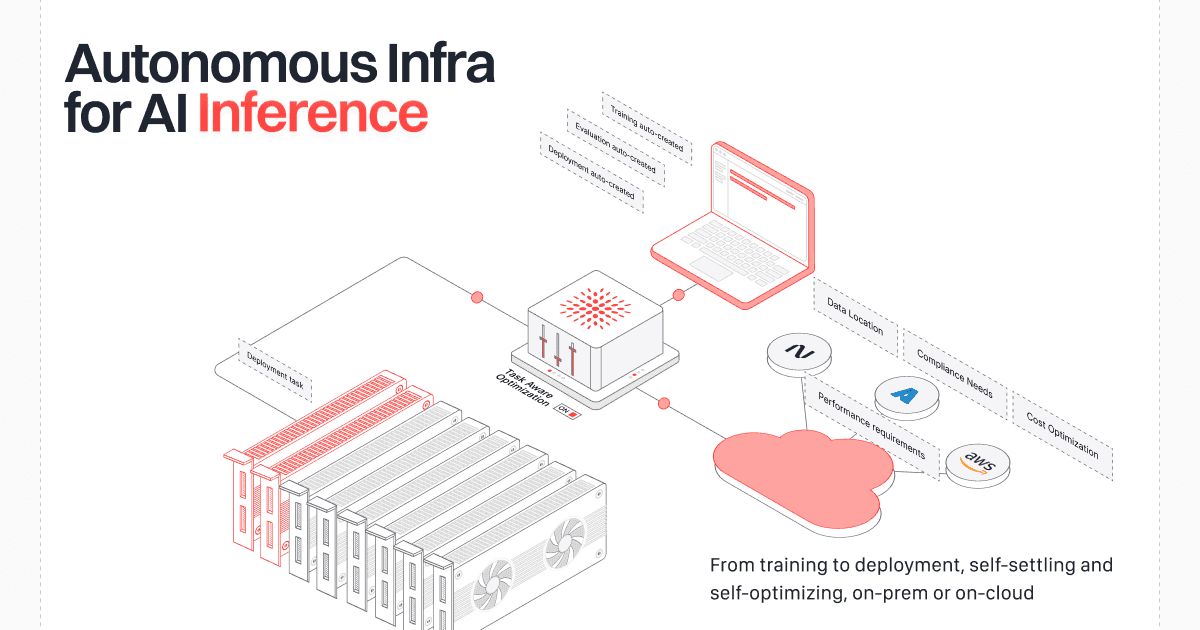
SwarmOne is an autonomous infrastructure platform designed for AI inference, training, and evaluation workloads. It offers a unique scheduler that dynamically disaggregates prefill and decode, orchestrates heterogeneous GPU clusters (NVIDIA, AMD, Intel, Groq, and more), and rebalances in real time to achieve over 90% utilization. The platform features SLO-driven autoscaling, enforcing defined latency, throughput, or cost targets by instantly provisioning GPUs when latency drifts and scaling compute to zero when traffic drops. SwarmOne aims to reduce costs by up to 80% through dynamic disaggregation, multi-node orchestration, and multi-cloud arbitrage, routing to the cheapest capable hardware. It supports a full AI lifecycle from training to deployment with zero DevOps/MLOps required, making it ideal for engineering teams at global enterprises.
ml-system-design-pattern
ml-system-design-pattern is an open-source GitHub repository dedicated to providing system design patterns for machine learning. It focuses on the practical aspects of deploying and managing ML systems in production, covering crucial areas such as training, serving, and operational patterns. The repository aims to explain these system patterns for designing robust machine learning infrastructures, rather than focusing on model development for accuracy. It is designed to be platform-agnostic, though most patterns can be implemented using Python, and assumes deployment on public clouds or Kubernetes clusters. The resource includes detailed patterns for various stages, including synchronous, asynchronous, and batch serving, as well as QA, training, and operation patterns, making it a valuable resource for ML engineers and architects.
Satellite-Imagery-Datasets-Containing-Ships
Satellite-Imagery-Datasets-Containing-Ships is a comprehensive GitHub repository that curates radar and optical satellite datasets specifically designed for ship detection, classification, semantic segmentation, and instance segmentation tasks. These datasets are invaluable for researchers and developers working in computer vision, machine learning, remote sensing, and maritime analysis. The repository details various datasets, including SSDD, OpenSARship, SAR-Ship-Dataset, AIR-SARShip, HRSID, LS-SSDD, and FUSAR-Ship, providing information on their authors, year, tasks supported, and direct access links. Each dataset entry includes specifics like image dimensions, spatial resolutions, polarization types, and annotation formats, making it a crucial resource for developing and evaluating algorithms for maritime surveillance and naval operations.

Unicsoft
Unicsoft is a Web3 development company with extensive experience in blockchain networks like Hedera and Solana. They provide a comprehensive suite of Web3 solutions, including the creation of tokenization platforms, DeFi software, and various blockchain-based applications. Their services encompass blockchain development, consulting, asset tokenization, enterprise blockchain solutions, crypto solutions, blockchain game development, and DeFi development. Unicsoft aims to help businesses reduce reliance on intermediaries, enhance security, and tap into new revenue streams through decentralized technologies. They also offer custom software development and technical consulting, catering to a diverse range of industries from FinTech to Healthcare and Automotive.
Awesome-AutoML-and-Lightweight-Models
Awesome-AutoML-and-Lightweight-Models is a comprehensive GitHub repository that curates high-quality and recent works in the field of Automated Machine Learning (AutoML) and lightweight models. It serves as a valuable resource for researchers and practitioners, categorizing information into key areas such as Neural Architecture Search, Lightweight Structures, Model Compression, Quantization and Acceleration, Hyperparameter Optimization, and Automated Feature Engineering. The repository includes links to papers and associated code repositories (often in PyTorch or TensorFlow), making it easy to explore and implement the discussed techniques. It is continuously updated, welcoming contributions to ensure it remains a current and relevant resource for the AutoML research community.
trading-bot
This project implements a Stock Trading Bot utilizing Deep Reinforcement Learning, specifically Deep Q-learning. It's designed for learning and experimentation, keeping the implementation simple and close to the algorithm discussed in research papers. The bot allows users to create intelligent agents that learn from market data, making decisions to buy, sell, or hold based on observed states. It incorporates several improvements to the Q-learning algorithm, including Vanilla DQN, DQN with fixed target distribution, Double DQN, Prioritized Experience Replay, and Dueling Network Architectures. Users can train the agent on historical data and evaluate its performance, with visualizations available for model evaluations. It's a valuable resource for those interested in applying reinforcement learning to financial trading.
Wallaroo.AI
Wallaroo.AI is a comprehensive AI inference platform designed for deploying, serving, observing, and optimizing AI models in production at scale. It supports any model and hardware, from CPUs to GPUs, across various environments including cloud, multi-cloud, on-premise, and edge locations. The platform offers features like automated resource orchestration, scaling, load balancing, and centralized monitoring for AI inference pipelines. It aims to significantly reduce engineering time, infrastructure costs, and accelerate time-to-value by providing up to 12X faster inferencing and 80% lower costs. Wallaroo.AI integrates seamlessly with existing AI toolchains via Python SDK and API, supporting complex workflows and enabling continuous optimization of live models.