
Coding & Development
Browsing page 361 of AI tools for Coding & Development. Sorted by confidence score — our independent quality rating.

simpleai
simpleai is an open-source Python library designed to implement various artificial intelligence algorithms, drawing inspiration from the book "Artificial Intelligence, a Modern Approach" by Stuart Russel and Peter Norvig. It offers a more "pythonic" and maintainable approach compared to other implementations. The library includes traditional and local search algorithms, Constraint Satisfaction Problems (CSPs), and statistical classification. It also provides interactive execution viewers for search algorithms, available via web or terminal. simpleai emphasizes readability, stability, and adherence to PEP8 guidelines, making it suitable for both educational purposes and developing AI applications. Installation is straightforward via pip.
dreamtalk
DreamTalk is an open-source framework designed for generating expressive talking head videos. It utilizes diffusion probabilistic models to create high-quality videos that capture diverse speaking styles. The tool is robust, handling a wide array of inputs including songs, speech in multiple languages, and even noisy audio, and can work with out-of-domain portraits. Users can specify audio paths, style clips, head poses, and input images to generate videos. While the primary focus is on accurate lip-sync and vivid expressions, the resolution can be improved using external solutions like CodeFormer or MetaPortrait's Temporal Super-Resolution Model. The project provides inference code and pretrained checkpoints, though access to checkpoints requires an email request for academic research purposes.

Prompt.Cafe
Prompt.Cafe is a prompt generator designed to help users rapidly create app ideas. By allowing users to mix various 'ingredients' into prompts, the tool streamlines the ideation process for application development. It aims to eliminate the initial blank-cursor problem, enabling faster iteration and exploration of app concepts. The platform focuses on providing a quick and efficient way to generate prompts, making it easier for developers and creators to kickstart their projects without getting stuck on the initial brainstorming phase. The intuitive interface encourages experimentation with different combinations to discover unique app ideas.
Shopless
Shopless Business Solutions is a digital agency with over 5 years of experience, specializing in a comprehensive range of digital services. These include web design, mobile development, branding services, social media marketing, and management. They focus on building bright brands, unique visual systems, and digital experiences, offering future-ready solutions from branding and customer experiences to e-commerce and emerging technologies. Shopless also provides AI-integrated products such as e-commerce platforms, e-learning platforms, ERP systems, healthcare systems, and virtual tour builders, designed to unlock efficiency, innovation, and growth. Their services aim to optimize workflows, enhance efficiency, and foster collaboration for businesses.
seq2seq-signal-prediction
seq2seq-signal-prediction is an open-source project designed to teach users how to implement Sequence-to-Sequence (seq2seq) Recurrent Neural Networks (RNNs) for time series forecasting using TensorFlow. The project includes a series of four exercises of increasing difficulty, starting with deterministic signal prediction and progressing to more complex tasks like denoising and Bitcoin price forecasting. It provides a Jupyter notebook and a Python script version, with instructions for running the code locally or on Google Colab with GPU support. The exercises guide users through adjusting hyperparameters and modifying network architectures to achieve accurate predictions, making it a practical learning resource for those with some prior knowledge of RNNs.
shapash
Shapash is a Python library designed to make machine learning models interpretable and comprehensible for everyone. It offers various visualizations with clear and explicit labels, simplifying the understanding of interactions between a model's features. A key feature is its ability to generate a Webapp, allowing users to easily navigate between local and global explainability. This Webapp helps Data Scientists understand their models and share results with non-data experts. Shapash also contributes to data science auditing by providing comprehensive reports about models and data. It supports Regression, Binary Classification, and Multiclass problems and is compatible with numerous models like Catboost, Xgboost, LightGBM, Sklearn Ensemble, Linear models, and SVM, with options to integrate other models.
Streamlit Image Comparison
Streamlit Image Comparison is a web-based tool designed for visually comparing two images. Users can upload images directly or provide URLs, and the application will display them side-by-side with an interactive slider. This feature is particularly useful for identifying subtle differences between images, making it suitable for tasks such as quality control, A/B testing of visual assets, or analyzing the effects of image processing algorithms. The tool offers customization options, including the ability to adjust the slider's initial position, its width, and to add labels for the left and right images, enhancing the clarity and precision of the comparison process. It operates within a Streamlit application environment, providing a straightforward and accessible interface.
Safeguard Applied Innovation LTD
Safeguard Applied Innovation LTD provides an advanced AI safety platform designed to prevent workplace accidents. The platform simplifies safety management, making it smart and user-friendly. It offers tools and insights for real-time risk identification and reduction, leveraging advanced sensing and monitoring technologies. Safeguard's unique approach breaks down safety management into individual tasks with control mechanisms, while also aggregating real-time data to create a comprehensive safety status through its 'Compass' metric. Key features include personnel competency control, subcontractor competency control, equipment competency control, and proactive safety management, ensuring a data-driven approach to loss prevention.

KeyMatch Pro
KeyMatch Pro is an innovative mobile application designed to help users identify and organize their physical keys efficiently. It utilizes precise key matching technology, comparing key profiles rather than just labels, to provide reliable results. The app operates on an offline-first principle, meaning there is no backend storage and scans are processed externally, ensuring privacy and security. KeyMatch Pro is built for scalability, capable of organizing collections ranging from a few keys to large inventories. Developed by Rudi Brouwers with his family, the app is available on both iOS and Android platforms, offering a practical solution for managing various types of keys, from home to work and storage.

American Dream Jobs
American Dream Jobs is an online platform designed to assist individuals in finding high-paying, AI-resilient careers. Users can answer a few questions and upload their resume to receive tailored career matches and real job openings. The tool allows exploration of hundreds of careers, filtering by pay, training time, category, and AI resilience. It also offers a 'Compare Futures' feature to evaluate lifetime earnings, education costs, and ROI for up to three careers, and a 'Calculate Earnings' tool to project net worth over time. Additionally, users can find local job opportunities and explore popular career paths with clear training routes and strong job markets, such as Healthcare (Non-Clinical), Skilled Trades, and Tech (No Degree Required).

Moonlite AI
Moonlite AI delivers high-performance AI infrastructure designed for enterprise-grade performance and compliance, specifically targeting demanding AI workloads such as computational research, distributed model training, and large-scale data processing. The platform offers the flexibility to deploy infrastructure within existing data center facilities or in Moonlite's own facilities, combining bare-metal performance with cloud-native simplicity. Key features include purpose-built compute infrastructure optimized for parallel processing and distributed workloads, high-performance networking with RDMA and InfiniBand, and tiered storage solutions. Moonlite also emphasizes compliance by design, with built-in network isolation, enterprise controls, and certifications like SOC 2, ISO 27001, and ISO 42001, ensuring regulatory requirements are met.
Streamlit Docker Template
Streamlit Docker Template provides a streamlined solution for deploying Streamlit applications within Docker containers. This tool is designed to help users create reproducible and portable environments, ensuring consistency across different deployment stages. By containerizing Streamlit apps, it simplifies the process of packaging and running web applications built with Streamlit. This template is particularly useful for developers and data scientists who want to share their interactive data analysis and machine learning models as web applications, offering a robust and isolated execution environment. It abstracts away much of the complexity associated with environment setup, allowing users to focus on their application logic.
nexent
Nexent is a zero-code platform designed for auto-generating production-grade AI agents, leveraging Harness Engineering principles. It provides a unified approach to tools, skills, memory, and orchestration, incorporating built-in constraints, feedback loops, and control planes. The platform eliminates the need for complex orchestration or drag-and-drop interfaces, allowing users to develop any agent using pure language. Key features include smart agent prompt generation, scalable data processing for over 20 data formats, personal-grade and internet knowledge search with traceability, and multimodal understanding. It also boasts an MCP tool ecosystem for flexible integration of Python plug-ins, models, and chains without core code modification.
schnetpack
schnetpack is an open-source toolbox designed for researchers and developers working with atomistic systems. It provides a robust framework for developing and applying deep neural networks to predict various properties of molecules and materials, such as potential energy surfaces and quantum-chemical characteristics. The tool includes fundamental building blocks for atomistic neural networks, simplifying the process of conducting simulations and making accurate property predictions. Its open-source nature, hosted on GitHub, encourages community contributions and provides transparent access to its codebase, making it a valuable resource for academic and industrial research in computational chemistry and materials science.

Talesmyth
Talesmyth is a comprehensive worldbuilding platform designed for storytellers, writers, and game masters. It enables users to build and organize rich narrative worlds by tracking characters, locations, and lore across various creative projects, including novels, RPG campaigns, and general world lore. The platform offers genre templates like Fantasy, Mystery, and Sci-Fi, as well as templates for popular game systems such as Dungeons & Dragons. Users can also create custom entities and link them throughout their world. Talesmyth includes AI-assisted worldbuilding features to generate summaries and starting points, enhancing creativity without replacing imagination. Recent updates include relationship tracking and visual boards for organizing ideas.
LaminarFlow
Kursaha Tech specializes in providing innovative custom software solutions tailored to individual business needs. Their services encompass comprehensive app development, cutting-edge AI solutions, and robust cloud infrastructure. They also offer data services to help businesses leverage their information effectively. Kursaha Tech aims to transform businesses by building bespoke technology solutions that drive efficiency and growth, focusing on delivering high-quality, customized software to meet specific client requirements.
RL-Factory
RL-Factory is an open-source framework designed for efficient reinforcement learning (RL) post-training in Agentic Learning. It significantly simplifies the process by decoupling the environment from RL post-training, allowing users to train agents with only a tool configuration and a reward function. A key differentiator is its support for asynchronous tool-calling, which makes RL post-training up to 2x faster than existing frameworks. The platform natively supports one-click DeepSearch training, multi-turn tool-calling, model judge reward mechanisms, and training for various models, including Qwen3. Future updates aim to introduce a WebUI for data processing, environment definition, and project management, alongside support for more models and multimodal agentic learning.
SmolVLM 256M Instruct WebGPU
SmolVLM 256M Instruct WebGPU is an AI model developed by Hugging Face Smol Models Research, designed to provide instant visual descriptions. Users can upload a photo, and the application will generate a short text caption summarizing the image in clear, natural language. This tool operates entirely within a web browser, eliminating the need for any special setup or installations. It is particularly useful for quickly understanding the content of an image through an AI-generated description, making it accessible for a wide range of users who need immediate visual interpretation without complex configurations. The model is available as a Hugging Face Space, emphasizing its accessibility and ease of use.
TensorFlowASR
TensorFlowASR is an open-source toolkit for automatic speech recognition (ASR) built on TensorFlow 2. It provides implementations of various advanced ASR architectures, including DeepSpeech2, Jasper, RNN Transducer, ContextNet, and Conformer. A key feature is the ability to convert these models to TFLite, which significantly reduces memory and computation requirements, making them suitable for deployment on devices with limited resources. The framework supports multiple languages, including English and Vietnamese, and offers functionalities for feature extraction and augmentations. It's designed for developers and researchers looking to build, train, and deploy high-performance speech recognition systems.

Phala Cloud
Phala Cloud offers a hardware-secured compute platform designed for confidential AI, ensuring verifiable AI with enterprise-grade privacy. It allows users to deploy confidential AI models with Trusted Execution Environment (TEE) protection quickly. The platform supports various pre-configured confidential AI models from providers like MoonshotAI, Qwen, and DeepSeek, ready for deployment on hardware-secured GPU servers. Phala Cloud provides an all-in-one confidential compute platform for AI workloads, offering nearly native performance with 100% privacy. It is built for enterprise security and regulatory requirements, being SOC 2 Type I certified and HIPAA compliant, with ISO 27001 in progress. The platform supports popular AI frameworks like TensorFlow, PyTorch, and Hugging Face, and offers per-minute billing with no minimums or hidden fees.
SapientML
SapientML is an open-source AutoML technology designed to accelerate and enhance AI model creation. It learns from a corpus of existing datasets and human-written pipelines to efficiently generate high-quality machine learning pipelines for new predictive tasks. Key features include high speed, as it evaluates only the most plausible pipelines, and transparency, providing an easy-to-understand generated machine learning program with explanations. It also boasts high accuracy, leveraging past knowledge from programs that built highly accurate AI models. Users can install SapientML via pip and utilize its APIs to generate machine learning pipelines, making it accessible for developers and data scientists looking to streamline their AI development workflow.
driveblocks
driveblocks specializes in developing advanced perception and autonomy software and AI models for off-road vehicles across agriculture, construction, and defense sectors. Unlike systems designed for highways, driveblocks' technology is purpose-built to operate reliably under harsh conditions, including dust, snow, fog, dense vegetation, and complex hilly terrain. The platform processes multi-modal sensor data through AI algorithms, applies sensor-fusion strategies to generate real-time 3D world models, and enables local behavior decisions like evasion and terrain-aware navigation. Its Physical AI models are trained and validated in challenging environments, ensuring efficient operation on production hardware with industrial-grade sensors and various AI accelerators. driveblocks integrates seamlessly with existing system architectures, supporting different sensor choices and compute units.
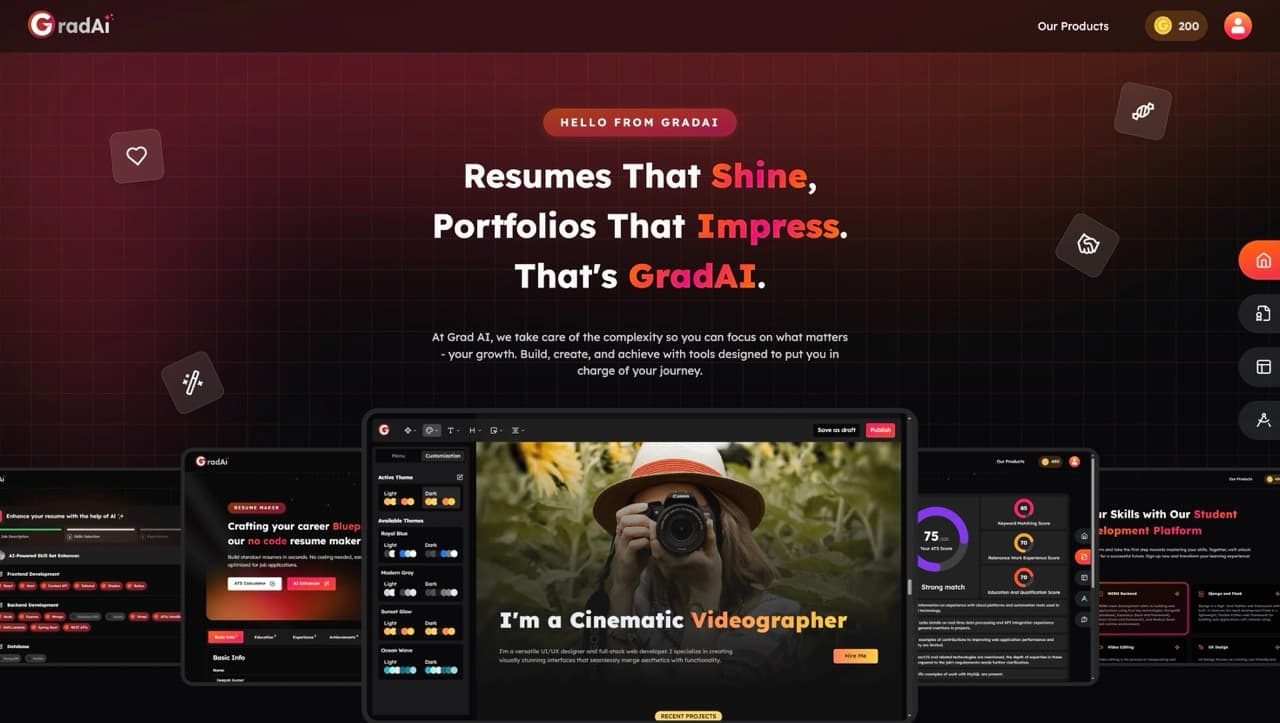
GradAI
GradAI is a powerful AI-driven platform designed to enhance job seekers' resumes and portfolios, helping them land their dream jobs. It offers an intuitive drag-and-drop no-code portfolio creator, allowing users to showcase projects, skills, and testimonials effectively. The platform also includes an AI Resume Enhancer to optimize resumes with relevant keywords, ensuring they pass Applicant Tracking System (ATS) screenings. Users can analyze their resume's ATS compatibility with the ATS Calculator and receive personalized improvement tips. GradAI provides new resume templates and allows for seamless export and sharing across platforms like LinkedIn. It aims to simplify the job search process by providing tools to build, create, and achieve career goals.

MyGameDB
MyGameDB is a comprehensive tool designed for managing personal video game collections. Users can add games, platforms, and accessories, specifying details like content, region, number of copies, and purchase price. The platform supports a vast database of over 200,000 games across more than 2,000 platforms. Key features include a wishlist to track desired games and receive notifications when other members have them, and the ability to export collections in various formats such as PDF, CSV, and TXT, which is ideal for flea markets. Users can also add friends to view their collections, scan barcodes to quickly add games, and follow games, platforms, and accessories for sale or trade. The tool provides access to statistics, including top 10 games and platforms, and is available on Android for on-the-go management.