
Coding & Development
Browsing page 381 of AI tools for Coding & Development. Sorted by confidence score — our independent quality rating.

Reproducible-Deep-Compressive-Sensing
Reproducible-Deep-Compressive-Sensing is a comprehensive collection of source code dedicated to deep learning-based compressive sensing (DCS). This repository categorizes and provides access to numerous research works, offering links to their respective source code, PDF papers, and DOIs. The collection is organized based on key characteristics such as sampling matrix type (frame-based/block-based), sampling scale (single scale, multi-scale), and the deep learning platform used. It also includes code for image and video reconstruction, as well as other related applications. This resource is invaluable for researchers and developers looking to explore, reproduce, or build upon existing deep learning models in compressive sensing.
deep-learning-models
deep-learning-models is a GitHub repository offering Keras code and pre-trained weights for several widely used deep learning models. This resource includes implementations for VGG16, VGG19, ResNet50, Inception v3, and a CRNN for music tagging. The architectures are designed to be compatible with both TensorFlow and Theano backends, automatically adapting to the image dimension ordering specified in your Keras configuration. Users can easily load pre-trained weights, such as 'imagenet' for image models or 'msd' for the music tagging model, which are automatically downloaded and cached locally. While this repository is deprecated in favor of `keras.applications`, it remains a valuable reference for understanding and utilizing these foundational models.
Deep-Learning-TensorFlow
Deep-Learning-TensorFlow is a GitHub repository offering a collection of pre-built Deep Learning algorithms implemented with the TensorFlow library. This package is designed as a command-line utility, enabling users to quickly train and evaluate popular Deep Learning models. It can also serve as a benchmark or baseline for comparing custom models and datasets. The repository includes implementations for Convolutional Networks, Restricted Boltzmann Machines, Deep Belief Networks, Deep Autoencoders, Denoising Autoencoders, Stacked Denoising Autoencoders, and MultiLayer Perceptrons. It also supports Logistic Regression. The package can be installed via pip as 'yadlt' or by cloning the GitHub repository, and it features a scikit-learn-like interface for ease of use.
snorkel
Snorkel is an open-source system designed for the rapid generation of training data using weak supervision. Originating from Stanford in 2015, the project aimed to bring mathematical and systems structure to the often manual process of training data creation. It empowers users to programmatically label, build, and manage training data, addressing the critical role of data quality in machine learning project success. While the original Snorkel project is no longer actively developed, its core ideas and techniques have evolved into Snorkel Flow, an end-to-end AI application development platform. Snorkel is particularly useful for developers and data scientists looking to efficiently create large, labeled datasets for various machine learning tasks.

Aerobotics7
Aerobotics7 develops an end-to-end technology platform for subsurface threat detection and mapping, specifically targeting landmines and unexploded ordnance (UXOs). Founded in 2016 by Harshwardhan Zala, the platform, known as EAGLE A7, aims to provide a safer, faster, and more accurate alternative to traditional detection methods such as manual probing and conventional ground-penetrating radar. It is designed to detect modern, plastic-based composite landmines and explosives with greater accuracy, significantly reducing human exposure to hazardous areas. Aerobotics7 works with governments, international organizations, and humanitarian agencies to address the global threat of buried landmines.
Chatterbox Labs
Red Hat is a leading provider of enterprise open source solutions, offering a comprehensive suite of technologies for Linux, cloud, containerization, and Kubernetes. The platform supports hybrid cloud innovation with Red Hat Enterprise Linux and enables scalable application development with Red Hat OpenShift. For AI, Red Hat offers specialized products like Red Hat AI Enterprise, Red Hat AI Inference Server, and Red Hat OpenShift AI, designed to help businesses build, deploy, and monitor AI models and applications efficiently. The company emphasizes a community-powered approach, collaborating with open source communities to develop secure, stable, and innovative technologies, and provides extensive support, training, and consulting services.
Checkme.dev | Ready-to-Go Geo Monitoring
Checkme.dev offers geo-distributed website availability monitoring, verifying accessibility from over 57 countries using real ISP networks, not cloud data centers. This allows it to detect regional outages, CDN misconfigurations, and ISP-level filtering that traditional monitoring might miss. The tool provides network metrics like latency and packet loss, alongside web metrics such as HTTP status, TTFB, and SSL expiry. It integrates with existing monitoring systems like Zabbix and Prometheus, acting as an additional visibility layer. Checkme.dev is designed for DevOps & SRE teams, Backend & Platform teams, and Agencies & Media Buyers who need to ensure their services are truly available to users worldwide.

SecTools
SecTools is a platform dedicated to providing practical and straightforward cybersecurity tools. It caters to both beginners looking to understand security concepts and experienced practitioners needing efficient utilities. The core philosophy of SecTools is to offer functional solutions without the typical overhead of sign-ups or excessive features, ensuring a direct and effective user experience. The tools are designed to address real-world cybersecurity challenges, making them valuable for various security-related tasks. This approach emphasizes accessibility and utility, allowing users to quickly leverage cybersecurity capabilities without friction.
Laravel Shopper
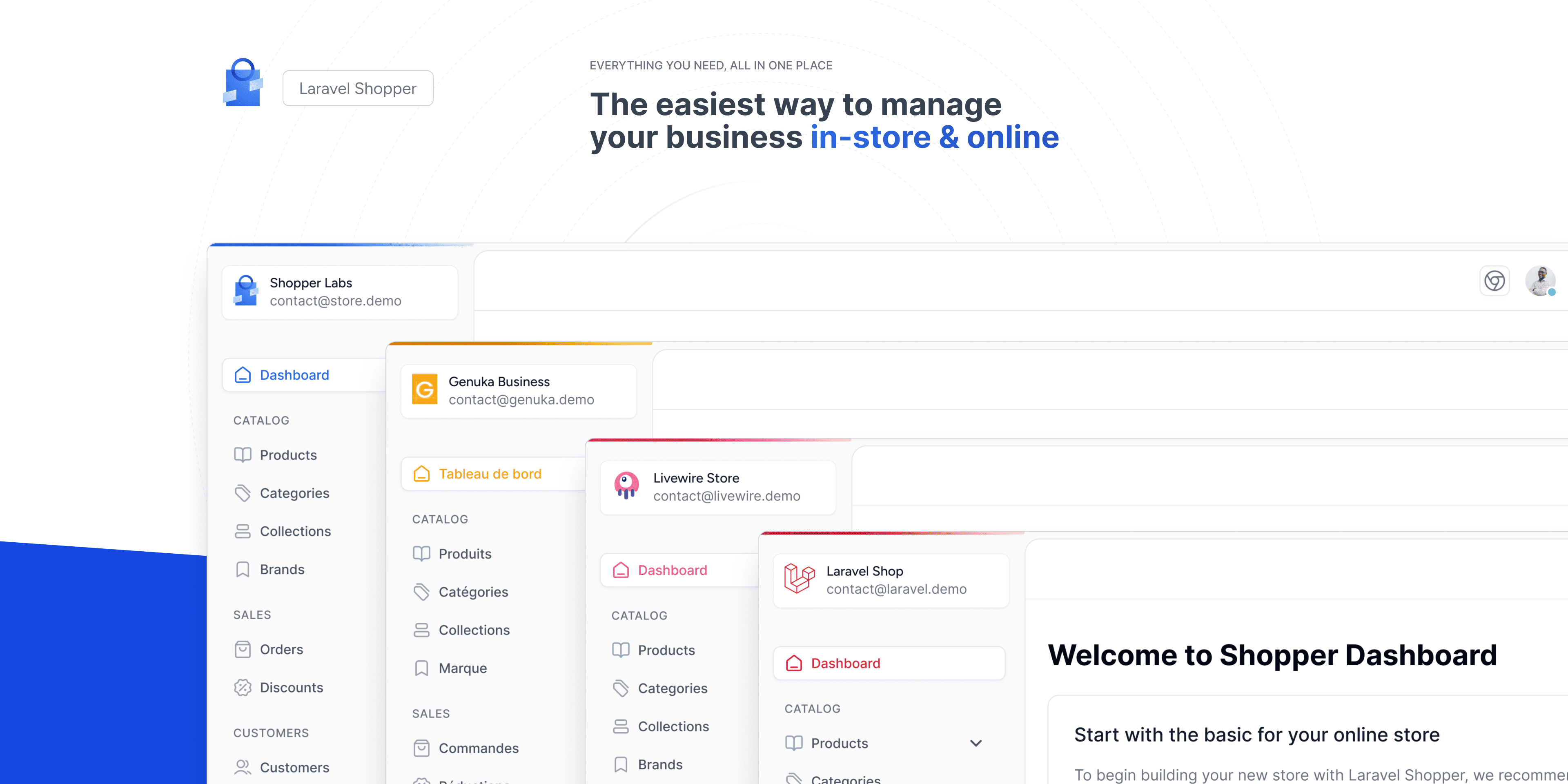
Laravel Shopper is an open-source e-commerce package designed for Laravel, offering a powerful admin panel and a headless API. This architecture provides composable building blocks, enabling developers to integrate e-commerce functionalities into existing applications or build entirely new storefronts using any frontend stack. Key features include comprehensive product management, efficient order processing, customer management, and inventory control. It empowers developers to create highly customized online stores, leveraging the flexibility of Laravel while maintaining full control over the user experience and design.

Data Wizards
Data Wizards is an AI consulting firm specializing in helping corporates and ambitious SMEs unlock their business potential through expert AI solutions. They provide comprehensive services including AI strategy development, AI solution and development, and AI education. Data Wizards builds high-performing AI solutions to overcome challenges, streamline operations, and identify new growth opportunities. Their expertise spans various industries such as Automotive, Retail, Pharmaceutical, Manufacturing, Insurance, Financial, Logistics, Energy, Healthcare, Telecommunications, Media, SMEs, Security, Commodity, and Food, offering tailored applications like predictive maintenance, sales forecasts, customer churn analysis, and fraud detection.
swin2sr
swin2sr is an open-source AI tool leveraging the SwinV2 Transformer for advanced image super-resolution and restoration. It excels at reducing JPEG compression artifacts and upscaling images, offering state-of-the-art performance in classical, lightweight, and real-world image super-resolution. The tool is particularly effective for compressed input scenarios, addressing common issues like training instability and resolution gaps in transformer vision models. It provides code, pre-trained models, and demos, making it suitable for both research and practical applications in image processing and low-level vision. Demos are available on platforms like Kaggle, Google Colab, and Huggingface Spaces.
Deep-RL-Notes
Deep-RL-Notes offers a comprehensive collection of notes on Deep Reinforcement Learning, specifically tailored for UC Berkeley's CS 285 (formerly CS 294-112) course, taught by Professor Sergey Levine. This resource serves as a textbook, covering foundational concepts like Markov decision processes and value functions, as well as advanced techniques such as Deep Q-Networks (DQN) and Proximal Policy Optimization (PPO). It integrates deep learning with reinforcement learning, discussing function approximation and representation learning. Users can compile the LaTeX source code into a PDF locally or edit it online via Overleaf, as the repository is regularly updated. The notes aim to balance theoretical clarity with practical relevance, providing examples, case studies, and programming exercises for hands-on experience.
sonata
Sonata is the official project repository for "Sonata: Self-Supervised Learning of Reliable Point Representations," a CVPR'25 Highlight paper. This open-source tool provides self-supervised pre-trained Point Transformer V3 models specifically designed for various 3D point cloud downstream tasks. Users can leverage Sonata for quick inference and visualization, with easy-to-use installation options for both standalone and package modes. The repository includes pre-trained models, inference code, and visualization demos, making it accessible for researchers and developers. It supports custom data integration and offers a flexible data transformation pipeline, along with options for loading models from Huggingface or local paths, even accommodating environments without FlashAttention.
screenclip.fast
screenclip.fast is a browser extension designed for retroactive screen capture, allowing users to instantly save the last 2 minutes of their screen activity. It runs silently in the background, continuously buffering your screen, so you never miss a moment worth sharing. The tool prioritizes privacy by keeping all recordings and processing local to your device, with no account required for core features. Clips are automatically saved as WebM files to your downloads folder, ready for immediate sharing. It offers features like speed control, frame-by-frame scrubbing, and is built to be lightweight, ensuring minimal impact on browser performance. The extension is currently available for Chrome, with Edge support in progress.
MCP Registry
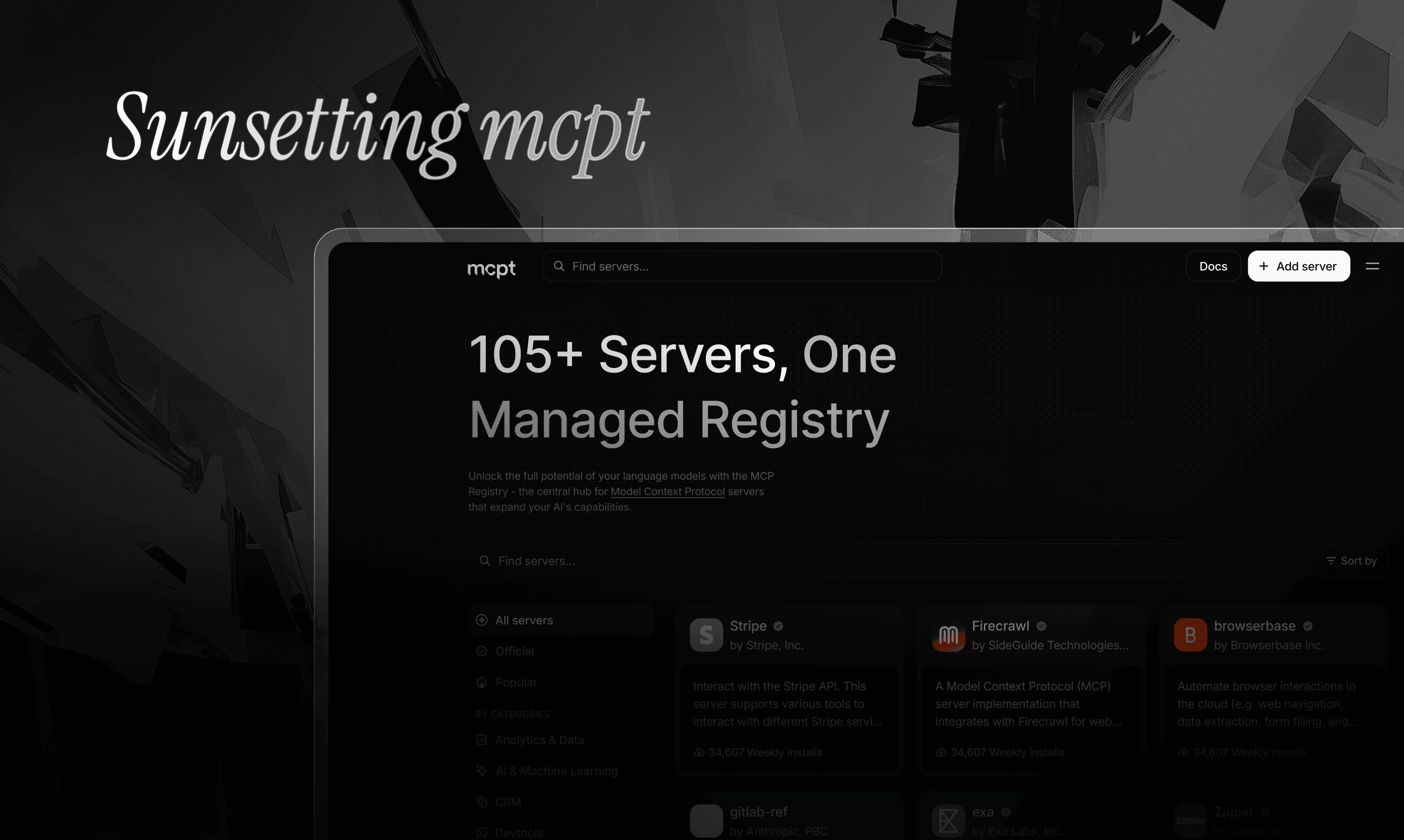
MCP Registry was a server registry developed by Mintlify, intended to provide a central platform for discovering and showcasing MCP (Model Context Protocol) servers. Launched after the success of Mintlify's MCP server generator, the registry aimed to solve the discoverability problem within the MCP ecosystem. Despite attracting over 3,000 unique visitors within 24 hours of its launch and receiving significant interest from developers, the project was sunsetted just five days later. The decision was made because building and supporting a marketplace would have diverted critical operational resources from Mintlify's core developer tools product, and marketplace building was not considered their core strength. This case highlights the importance of strategic focus for companies, especially during periods of rapid growth.
timm Attention Visualization
timm Attention Visualization is an AI tool designed to help users understand how deep learning models, specifically those from the timm (PyTorch Image Models) library, process visual information. By uploading an image and selecting a timm model, users can generate detailed attention maps and rollout visualizations. These visualizations highlight the specific parts of an image that the model focuses on when making predictions, offering insights into its decision-making process. This tool is invaluable for researchers, developers, and data scientists working with computer vision models, aiding in debugging, improving model interpretability, and enhancing overall model performance. It is hosted on Hugging Face Spaces, making it easily accessible for experimentation.
W2NER
W2NER offers the source code for a novel approach to Unified Named Entity Recognition (NER), as presented in an AAAI 2022 paper. Unlike traditional methods that study flat, overlapped, and discontinuous NER individually, W2NER unifies these tasks by modeling them as word-word relation classification. The architecture effectively captures neighboring relations between entity words using Next-Neighboring-Word (NNW) and Tail-Head-Word-* (THW-*) relations. It employs a neural framework that treats unified NER as a 2D grid of word pairs, enhanced by multi-granularity 2D convolutions for refining grid representations. A co-predictor then reasons about word-word relations. The model has demonstrated state-of-the-art performance across 14 benchmark datasets, including both English and Chinese, for all three types of NER.
xplique
Xplique is a comprehensive Python toolkit designed to bring clarity to complex neural network models through state-of-the-art Explainable AI (XAI) techniques. Originally developed for TensorFlow models, it also offers partial compatibility with PyTorch. The library features modules for Attribution Methods, allowing users to compute explanations like Grad-CAM and Integrated Gradients across various tasks such as classification, regression, object detection, and semantic segmentation. It also includes Feature Visualization to understand how networks build their understanding, Concept Extraction to identify human concepts, and Metrics to evaluate the faithfulness and robustness of explanations. Xplique supports diverse data types including images, time series, and tabular data, making it a versatile tool for AI model analysis and debugging.
wer_are_we
wer_are_we is an open-source project dedicated to tracking the state-of-the-art and recent research results in speech recognition. It functions as a dynamic bibliography, compiling and presenting performance metrics (such as Word Error Rate or WER) for various models across different datasets like LibriSpeech, WSJ, Hub5'00, TED-LIUM, and CHiME. The project details the architectures, training methodologies, and published papers associated with each result, offering a valuable resource for researchers and practitioners to compare and understand advancements in the field. Users are encouraged to contribute corrections and updates, fostering a collaborative environment for maintaining an accurate and up-to-date overview of speech recognition progress.
ydata-synthetic
ydata-synthetic is an open-source Python package designed for generating synthetic tabular and time-series data. It incorporates state-of-the-art generative models, including various GAN architectures like CTGAN, WGAN, and TimeGAN, as well as Gaussian Mixture models. The tool provides a low-code experience for quick data generation and features a Streamlit-based UI for an intuitive workflow, from training models to generating and profiling synthetic data samples. It supports diverse applications such as privacy compliance, bias removal, dataset balancing, and augmentation, making it a versatile solution for data scientists and developers working with sensitive or limited datasets.
Based
Based is a platform centered around digital collectibles and generative art. It features 'based/punks' as collectible characters and 'based/toadz' as amphibious creatures. Additionally, 'based/glyphs' are described as generative, tokenized artifacts, suggesting a focus on unique, programmatically generated digital assets. The platform also provides functionality to 'bridge your ETH to Base', indicating integration with the Base blockchain. Users can stay updated via '@based' and engage with the community through 'based/chat' for vibes and alpha.
Coder
Coder is an AI software developer tool designed to streamline and enhance the process of AI software development and code generation. This tool is particularly useful for individuals looking to learn coding or automate various software-related tasks. It operates by loading a given website within a border-less, full-screen iframe, providing a seamless and immersive development environment. The tool is hosted on Hugging Face Spaces, indicating its accessibility and potential for community-driven enhancements. Coder aims to simplify complex development workflows, making it an asset for both novice and experienced developers in the AI domain.

OSR Enterprises AG
OSR Enterprises AG positions itself as a new-age Tier1 supplier to the automotive industry, offering a speedboat for development teams at car manufacturers. The core of their offering is the EVOLVER platform, described as a multi-domain AI brain specifically designed for cars. This platform aims to provide the foundational technology for smart, autonomous, and securely connected vehicles, processing data collected from these vehicles. While the website emphasizes their role in automotive innovation and cybersecurity, specific features of the EVOLVER platform beyond its general description as an "AI brain" are not detailed on the publicly accessible pages.
ZenCtrl
ZenCtrl is a powerful framework designed for generating multi-view images without the need for specialized training or LoRA models. Users can upload an initial image and provide a text prompt to produce diverse perspectives and scenes of the subject. The tool offers customizable parameters such as generation steps, strength, and output size, giving users control over the final image quality and style. Developed by Fotographer.ai, ZenCtrl aims to simplify the process of creating complex visual assets, making it accessible for various creative applications. Although currently paused on Hugging Face Spaces, its core capability lies in transforming a single input into a rich set of multi-angle visuals.